


 Home
Home
Tencent, Tsinghua Launch SongGeneration 2 With 8.55% Error Rate, Intensifying Pressure on Suno
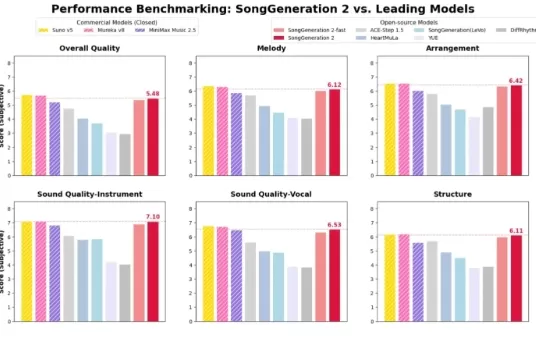
The AI music landscape experienced another significant shift in early 2026. On March 9, the music foundation model SongGeneration2, developed jointly by Tencent and Tsinghua University's Human-Computer Speech Interaction Lab , was officially released. This model not only marked a qualitative leap in technical architecture but also outperformed current mainstream open-source models across multiple core dimensions, even rivaling top commercial models in overall quality.
Three Breakthroughs: No More 'Plastic' AI Music
SongGeneration2 ’s core advantages come from a comprehensive upgrade of its underlying architecture, addressing three key pain points that plagued earlier AI music:
High musicality: Unlike basic melody stacking, this model handles complex multi-track arrangements with impressive spatial depth.
High lyric accuracy: Unclear pronunciation and hallucinated pitch shifts are now history. Its phoneme error rate (PER) is as low as 8.55%, notably outperforming the leading commercial model Suno v5 (12.4%), and trailing only MiniMax2.5 .
Strong controllability: Whether through text descriptions or audio prompts, it precisely follows instructions, enabling deep customization of style and emotion.
'Dual-Core' Drive: A Dream Collaboration Between LLM and Diffusion Models
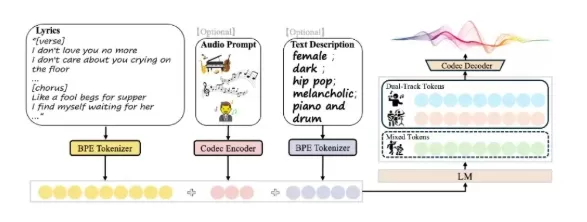
Architecturally, SongGeneration2 employs an innovative hybrid LLM-diffusion architecture:
Composing Brain (LeLM): Handles global structure planning and vocal details, solving the challenge of "how to sing".
High-Fidelity Renderer (Diffusion): Synthesizes extremely complex acoustic details under the guidance of the language model.
Hierarchical Representation: The first to adopt parallel modeling of mixed and multi-track representations, balancing melodic stability with sound quality refinement.
True Open Source, Low Barrier: Ordinary Computers Can Also 'Write Songs'
What excited developers most was Tencent's remarkable openness. The SongGeneration-v2-large model with 4 billion parameters is now fully open-source, supporting multilingual generation including Chinese and English. Remarkably, it runs smoothly on consumer-grade hardware with just 22GB VRAM, enabling local and private music creation.
To let users try it right away, the team also released the SongGeneration-v2-Fast version on HuggingFace, trading a minimal drop in audio quality for ultra-fast generation—producing a complete song in under a minute.
Based on the performance of SongGeneration2 , AI music has officially evolved from a 'geek toy' into the realm of 'commercial-grade applications.' With the upcoming open-sourcing of a Medium model supporting 12GB VRAM and an automated evaluation framework, the era of everyone becoming a 'composer' may finally be upon us.
Related article
 DeepMind CEO Hassabis: I sleep six hours a day, usually feel energetic around 1 a.m.
Fortune recently featured an interview with Demis Hassabis, CEO of Google DeepMind, revealing his unconventional approach to rest and productivity. Hassabis disclosed that he sleeps very little, structuring his waking hours into two distinct work blo
OpenAI, Anthropic Vie for Market Share Despite Revenue Shortfalls
Despite recent reports suggesting OpenAI missed revenue targets, creating pressure on tech stocks this Tuesday, private AI lab investors remain resilient. Seasoned backers have confirmed they will not reduce investment despite negative media coverage
California AV Compliance: A New Era of Tickets, Geofences, and 1M Miles
Guident operates an AuveTech shuttle in South Florida, managing a four-mile route in West Palm Beach and a one-mile route in Boca Raton using its remote monitoring technology. | Credit: GuidentCalifornia is redefining the regulatory landscape for dri
Related Special Topic Recommendations
chatbot
DeepMind CEO Hassabis: I sleep six hours a day, usually feel energetic around 1 a.m.
Fortune recently featured an interview with Demis Hassabis, CEO of Google DeepMind, revealing his unconventional approach to rest and productivity. Hassabis disclosed that he sleeps very little, structuring his waking hours into two distinct work blo
OpenAI, Anthropic Vie for Market Share Despite Revenue Shortfalls
Despite recent reports suggesting OpenAI missed revenue targets, creating pressure on tech stocks this Tuesday, private AI lab investors remain resilient. Seasoned backers have confirmed they will not reduce investment despite negative media coverage
California AV Compliance: A New Era of Tickets, Geofences, and 1M Miles
Guident operates an AuveTech shuttle in South Florida, managing a four-mile route in West Palm Beach and a one-mile route in Boca Raton using its remote monitoring technology. | Credit: GuidentCalifornia is redefining the regulatory landscape for dri
Related Special Topic Recommendations
chatbot
 Best AI Roleplay Chat Apps for Language Practice, Interview Prep, and Daily Fluency
2026 Latest Best Top-rated AI Roleplay Chat Apps for Language Practice, Interview Prep, and Daily Fluency! XIX.AI curates a powerful game-changing collection that offers free vs paid comparison, real-world tests, and updated rankings weekly. These must-try tools help you boost writing skills, overcome fluency challenges, and improve communication efficiency across all daily scenarios. Explore now to discover your perfect tool for language growth!
 10 tools
 xix.ai
Music composition
AI Stem Separation Tools for Remix Production, Sampling Prep, and Karaoke Masters
xix.ai
Music composition
AI Stem Separation Tools for Remix Production, Sampling Prep, and Karaoke Masters
2026 Latest Best Top-rated AI Stem Separation Tools Curated for Remix Production, Sampling Prep, and Karaoke Masters. These powerful game-changing tools offer real-world tests to deliver precise audio isolation, boosting productivity significantly. XIX.AI provides a weekly updated free vs paid comparison guide to help you find the must-try solution that suits your needs. Explore now to unlock your AI edge.
8 tools
xix.ai
Data Analysis
AI SQL Copilots for Revenue Dashboards, Funnel Analysis, and Product Metrics
2026 Latest Best AI SQL Copilots Ranked Top-Rated! XIX.AI curates a powerful game-changing collection for weekly updated real-world tests. These must-try tools help you generate accurate revenue dashboards, analyze sales funnels, and track product metrics swiftly, boosting productivity massively. Explore now to Discover your perfect tool for data-driven decision making! 238 characters
9 tools
xix.ai
Music composition
Best AI Melody Writing Tools for Song Drafts
2026 Latest Best Top-Rated AI Melody Writing Tools for Song Drafts! XIX.AI has curated a highly powerful game-changing collection that goes through rigorous real-world tests to deliver the best writing experience. You can find detailed free vs paid comparisons, accurate rankings, and must-try options designed to help you create stunning song drafts effortlessly and boost your creative productivity significantly. Explore now to discover your perfect tool!
8 tools
xix.ai
chatbot
Best AI Conversation Trainer Tools for Interview Practice
2026 Latest Best Top-rated AI Conversation Trainer Tools for Interview Practice are here on XIX.AI! This curated collection features powerful, game-changing tools that go through rigorous real-world tests to deliver accurate feedback. You’ll find a free vs paid comparison and detailed rankings to help you choose the must-try option that boosts your confidence and skills. Explore now to Discover your perfect tool for interview success!
12 tools
xix.ai
Design & Art
Best AI Style Transfer Tools for Creative Experiments
2026 Latest Best Top-rated AI Style Transfer Tools for Creative Experiments! XIX.AI has curated a powerful, game-changing collection of must-try tools that deliver exceptional results through real-world tests and rigorous rankings. These top solutions help creatives boost productivity significantly by accelerating content creation and unlocking endless creative possibilities. Explore now to discover your perfect tool and start creating today!
9 tools
xix.ai

 Comments (0)
0/500
Comments (0)
0/500
The AI music landscape experienced another significant shift in early 2026. On March 9, the music foundation model SongGeneration2, developed jointly by
Three Breakthroughs: No More 'Plastic' AI Music
High musicality: Unlike basic melody stacking, this model handles complex multi-track arrangements with impressive spatial depth.
High lyric accuracy: Unclear pronunciation and hallucinated pitch shifts are now history. Its phoneme error rate (PER) is as low as 8.55%, notably outperforming the leading commercial model
Strong controllability: Whether through text descriptions or audio prompts, it precisely follows instructions, enabling deep customization of style and emotion.
'Dual-Core' Drive: A Dream Collaboration Between LLM and Diffusion Models
Architecturally,
Composing Brain (LeLM): Handles global structure planning and vocal details, solving the challenge of "how to sing".
High-Fidelity Renderer (Diffusion): Synthesizes extremely complex acoustic details under the guidance of the language model.
Hierarchical Representation: The first to adopt parallel modeling of mixed and multi-track representations, balancing melodic stability with sound quality refinement.
True Open Source, Low Barrier: Ordinary Computers Can Also 'Write Songs'
What excited developers most was Tencent's remarkable openness. The SongGeneration-v2-large model with 4 billion parameters is now fully open-source, supporting multilingual generation including Chinese and English. Remarkably, it runs smoothly on consumer-grade hardware with just 22GB VRAM, enabling local and private music creation.
To let users try it right away, the team also released the SongGeneration-v2-Fast version on HuggingFace, trading a minimal drop in audio quality for ultra-fast generation—producing a complete song in under a minute.
Based on the performance of








 DeepMind CEO Hassabis: I sleep six hours a day, usually feel energetic around 1 a.m.
Fortune recently featured an interview with Demis Hassabis, CEO of Google DeepMind, revealing his unconventional approach to rest and productivity. Hassabis disclosed that he sleeps very little, structuring his waking hours into two distinct work blo
DeepMind CEO Hassabis: I sleep six hours a day, usually feel energetic around 1 a.m.
Fortune recently featured an interview with Demis Hassabis, CEO of Google DeepMind, revealing his unconventional approach to rest and productivity. Hassabis disclosed that he sleeps very little, structuring his waking hours into two distinct work blo
 OpenAI, Anthropic Vie for Market Share Despite Revenue Shortfalls
Despite recent reports suggesting OpenAI missed revenue targets, creating pressure on tech stocks this Tuesday, private AI lab investors remain resilient. Seasoned backers have confirmed they will not reduce investment despite negative media coverage
California AV Compliance: A New Era of Tickets, Geofences, and 1M Miles
Guident operates an AuveTech shuttle in South Florida, managing a four-mile route in West Palm Beach and a one-mile route in Boca Raton using its remote monitoring technology. | Credit: GuidentCalifornia is redefining the regulatory landscape for dri
OpenAI, Anthropic Vie for Market Share Despite Revenue Shortfalls
Despite recent reports suggesting OpenAI missed revenue targets, creating pressure on tech stocks this Tuesday, private AI lab investors remain resilient. Seasoned backers have confirmed they will not reduce investment despite negative media coverage
California AV Compliance: A New Era of Tickets, Geofences, and 1M Miles
Guident operates an AuveTech shuttle in South Florida, managing a four-mile route in West Palm Beach and a one-mile route in Boca Raton using its remote monitoring technology. | Credit: GuidentCalifornia is redefining the regulatory landscape for dri

2026 Latest Best Top-rated AI Roleplay Chat Apps for Language Practice, Interview Prep, and Daily Fluency! XIX.AI curates a powerful game-changing collection that offers free vs paid comparison, real-world tests, and updated rankings weekly. These must-try tools help you boost writing skills, overcome fluency challenges, and improve communication efficiency across all daily scenarios. Explore now to discover your perfect tool for language growth!
10 tools
xix.ai
2026 Latest Best Top-rated AI Stem Separation Tools Curated for Remix Production, Sampling Prep, and Karaoke Masters. These powerful game-changing tools offer real-world tests to deliver precise audio isolation, boosting productivity significantly. XIX.AI provides a weekly updated free vs paid comparison guide to help you find the must-try solution that suits your needs. Explore now to unlock your AI edge.
8 tools
xix.ai
2026 Latest Best AI SQL Copilots Ranked Top-Rated! XIX.AI curates a powerful game-changing collection for weekly updated real-world tests. These must-try tools help you generate accurate revenue dashboards, analyze sales funnels, and track product metrics swiftly, boosting productivity massively. Explore now to Discover your perfect tool for data-driven decision making! 238 characters
9 tools
xix.ai
2026 Latest Best Top-Rated AI Melody Writing Tools for Song Drafts! XIX.AI has curated a highly powerful game-changing collection that goes through rigorous real-world tests to deliver the best writing experience. You can find detailed free vs paid comparisons, accurate rankings, and must-try options designed to help you create stunning song drafts effortlessly and boost your creative productivity significantly. Explore now to discover your perfect tool!
8 tools
xix.ai
2026 Latest Best Top-rated AI Conversation Trainer Tools for Interview Practice are here on XIX.AI! This curated collection features powerful, game-changing tools that go through rigorous real-world tests to deliver accurate feedback. You’ll find a free vs paid comparison and detailed rankings to help you choose the must-try option that boosts your confidence and skills. Explore now to Discover your perfect tool for interview success!
12 tools
xix.ai

2026 Latest Best Top-rated AI Style Transfer Tools for Creative Experiments! XIX.AI has curated a powerful, game-changing collection of must-try tools that deliver exceptional results through real-world tests and rigorous rankings. These top solutions help creatives boost productivity significantly by accelerating content creation and unlocking endless creative possibilities. Explore now to discover your perfect tool and start creating today!
9 tools
xix.ai












