


 Home
HomeTalat’s AI meeting notes live on your device, not the cloud
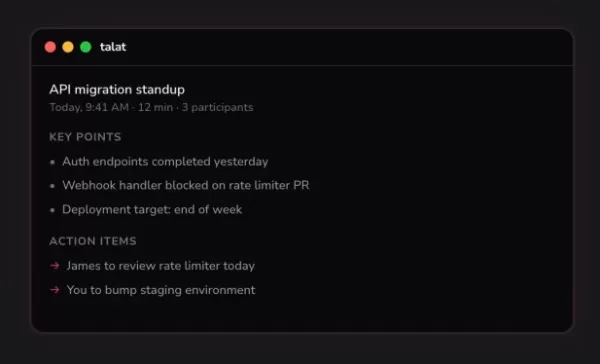
Granola, the AI-powered notetaking app valued at $250 million, has gained traction among tech founders and venture capitalists. But one developer sees demand for a more private, fully local alternative available for a one-time fee with no subscription. That vision led to a new Mac app called Talat.
Nick Payne, a self-described computer nerd based in Yorkshire, England, says the idea for a local AI notetaker emerged largely from a series of fortunate accidents.
“I think Granola is amazing; it’s a shining example of what you can achieve with an Electron app when you give it enough love and care,” he told TechCrunch. “When I first tried it, I was fascinated by how it managed to record system audio on my Mac without also recording video, which was the standard workaround at the time. That set off a lot of research, leading me to discover a relatively new and poorly documented Apple API.”
To make working with that API (Core Audio Taps, which lets developers tap into a Mac’s audio streams) easier, Payne decided to create an open source audio library called AudioTee.
“During that time, I was slowly putting together a toolkit, but I never found anything that felt like it could stand on its own as a product rather than just a cool tech demo,” Payne said. “The state-of-the-art hosted transcription models — the same providers apps like Granola use — are incredible, and it’s viscerally cool to see your speech unfurled onscreen in near real time. But it always nagged me that the trade-off meant providing not just my data, but my audio data; my actual voice,” he added.
He then stumbled upon a software toolkit called FluidAudio, a Swift framework that enables fully local, low-latency audio AI on Apple devices. It lets small, fast transcription models run directly on the Mac’s Neural Engine — Apple’s dedicated hardware for AI processing.
That was the piece that made Payne realize he could turn his research into an actual product — one where your audio never leaves your Mac and your transcripts aren’t stored on another company’s servers.
Talat, built alongside Payne’s longtime friend and former colleague Mike Franklin, is the result of Payne’s interest in the audio space. The result is a 20MB download with a one-time purchase price, no account required, and no analytics data shared back with developers. There are no ongoing fees either.
While some AI notetakers may offer more bells and whistles, Talat provides a streamlined set of features. It captures audio from your computer’s microphone during meetings in apps like Zoom, Teams, Meet, and others, transcribing it in real time. The app attempts to assign speakers in real time, but you can reassign them as needed. You can also take notes, and edit, delete, or split transcript segments. When the meeting ends, a local LLM generates a summary with key points, decisions, and action items.
The notes, transcripts, and summaries are all searchable within Talat.
In addition to the privacy angle, Payne said the goal is to give users more flexibility.
“We’re leaning into configurability and letting users control where their data goes: pick your own LLM, auto-export to [notetaking app] Obsidian, webhooks that push data out when a meeting finishes, an MCP server,” which is a standardized way for AI tools to connect to outside data sources, “to pull it on demand,” he explained.
Under the hood, the AI is a mixture — “mostly stitched together and abstracted behind FluidAudio,” Payne noted, crediting FluidAudio with doing a lot of the heavy lifting. For the summarization piece, the app defaults to an AI model called Qwen3-4B-4bit, which can run on fairly modest hardware.
However, users can opt to switch that out to any cloud LLM provider of their choice, or choose between two Parakeet variants — speech-recognition models developed by Nvidia — or point it at Ollama (a tool for running AI models locally), giving them more control over the experience. In time, Talat will add support for more built-in choices and integrate with other apps, like Google Calendar and Notion.
At launch, users with M-series Mac computers (those running Apple’s own processors, starting with the M1) can download the app and try it out for free with 10 hours of recordings before deciding to purchase.
Talat is available for $49 while in this pre-release version, which is still under active development.
When the app hits a 1.0 release, the price will increase to $99.
Payne and Franklin are bootstrapping Talat and plan to keep the core product a one-time purchase going forward.
Related article
 Gemini faces branding challenges, as does the wider AI industry
Google’s Wednesday announcement regarding new Gemini Live voice features makes a valid point: “You shouldn’t have to guess whether a task requires Spark, a Daily Brief, or a quick inbox search.” While Google presents this as a commitment to handling
New Report: AI-Powered Apps Struggle With Long-Term User Retention
As app stores become saturated with AI offerings, many developers assume integrating artificial intelligence is the surest path to profitability. Yet, a recent study examining the subscription ecosystem across iOS, Android, and web challenges this as
Sesame, AI Startup by Oculus Founders, Debuts on iOS
On Thursday, Sesame, an AI startup founded by the creators of Oculus and other former Meta VR team members, unveiled a public preview of its conversational AI agents, which have been in development for over a year. Through its new iOS application, Se
Related Special Topic Recommendations
Design & Art
Gemini faces branding challenges, as does the wider AI industry
Google’s Wednesday announcement regarding new Gemini Live voice features makes a valid point: “You shouldn’t have to guess whether a task requires Spark, a Daily Brief, or a quick inbox search.” While Google presents this as a commitment to handling
New Report: AI-Powered Apps Struggle With Long-Term User Retention
As app stores become saturated with AI offerings, many developers assume integrating artificial intelligence is the surest path to profitability. Yet, a recent study examining the subscription ecosystem across iOS, Android, and web challenges this as
Sesame, AI Startup by Oculus Founders, Debuts on iOS
On Thursday, Sesame, an AI startup founded by the creators of Oculus and other former Meta VR team members, unveiled a public preview of its conversational AI agents, which have been in development for over a year. Through its new iOS application, Se
Related Special Topic Recommendations
Design & Art
 Top AI Illustration Tools: Create Editorial Scenes and Cover Art Faster
2026 Latest Top-rated AI Illustration Tools: Our curated list features the best powerfully designed tools for creating stunning editorial scenes and eye-catching cover art quickly. Each option has gone through rigorous real-world tests, offering a free vs paid comparison to help you find the perfect match for your workflow. Try these must-try solutions today to unlock your AI edge and boost your creative productivity. Explore now at XIX.AI.
 10 tools
 xix.ai
Education and Learning
Top AI Tutors for Exam Prep: Practice Math, Science, and English
xix.ai
Education and Learning
Top AI Tutors for Exam Prep: Practice Math, Science, and English
2026 Latest Top-Rated Best AI Tutors for Exam Prep are here on XIX.AI! Our curated list features powerful game-changing tools that offer free vs paid comparison, real-world tests, and weekly updated rankings. They help boost your writing efficiency, simplify complex topic learning, and unlock your academic potential. Explore now to Discover your perfect exam prep tool and Start creating today to Unlock your AI edge!
10 tools
xix.ai
Finance
AI Budget Planning Tools for Personal Money Management
2026 Latest Best Top-Rated AI Budget Planning Tools for Personal Money Management are here on XIX.AI! This curated collection features powerful, game-changing solutions that help you conduct real-world tests, understand spending habits, and create personalized plans to boost productivity. Enjoy a free vs paid comparison along with detailed rankings. Must-try tools designed to simplify money management and unlock your AI edge. Explore now!
11 tools
xix.ai
Health & Wellness
AI Sleep Tracking Assistants: Improve Recovery with Better Bedtime Habits
2026 Latest Best Top-Rated AI Sleep Tracking Assistants curated for ultimate recovery. This fully updated weekly guide features powerful tools that deliver real-world tests, free vs paid comparison, and detailed rankings to help you find the must-try solution that boosts sleep quality and supports better bedtime habits. Explore now at XIX.AI to Unlock your AI edge.
10 tools
xix.ai
Data Analysis
AI SQL Copilots for Product and Revenue Analytics
2026 Latest Best Top-Rated AI SQL Copilots for Product and Revenue Analytics! XIX.AI has curated a powerful, game-changing collection of must-try tools that undergo real-world tests through weekly updated rankings. These tools help users boost productivity significantly by accelerating data analysis, streamlining complex queries, and generating accurate insights to drive smarter business decisions. Explore now to Discover your perfect tool for unlocking your AI edge!
14 tools
xix.ai
Education and Learning
Best AI Homework Helpers That Teach: Learn Concepts, Not Just Answers
2026 Latest Best Top-Rated AI Homework Helpers That Teach Core Concepts Not Just Answers Powerful Tools for Students Must-Try Curated List Weekly Updated Free vs Paid Comparison Real-World Tests Accurate Rankings to Help You Unlock Your Full Learning Potential Explore now to Discover your perfect tool for smarter studying.
10 tools
xix.ai

 Comments (0)
0/500
Comments (0)
0/500
Granola, the AI-powered notetaking app valued at $250 million, has gained traction among tech founders and venture capitalists. But one developer sees demand for a more private, fully local alternative available for a one-time fee with no subscription. That vision led to a new Mac app called Talat.
Nick Payne, a self-described computer nerd based in Yorkshire, England, says the idea for a local AI notetaker emerged largely from a series of fortunate accidents.
“I think Granola is amazing; it’s a shining example of what you can achieve with an Electron app when you give it enough love and care,” he told TechCrunch. “When I first tried it, I was fascinated by how it managed to record system audio on my Mac without also recording video, which was the standard workaround at the time. That set off a lot of research, leading me to discover a relatively new and poorly documented Apple API.”
To make working with that API (Core Audio Taps, which lets developers tap into a Mac’s audio streams) easier, Payne decided to create an open source audio library called AudioTee.
“During that time, I was slowly putting together a toolkit, but I never found anything that felt like it could stand on its own as a product rather than just a cool tech demo,” Payne said. “The state-of-the-art hosted transcription models — the same providers apps like Granola use — are incredible, and it’s viscerally cool to see your speech unfurled onscreen in near real time. But it always nagged me that the trade-off meant providing not just my data, but my audio data; my actual voice,” he added.
He then stumbled upon a software toolkit called FluidAudio, a Swift framework that enables fully local, low-latency audio AI on Apple devices. It lets small, fast transcription models run directly on the Mac’s Neural Engine — Apple’s dedicated hardware for AI processing.
That was the piece that made Payne realize he could turn his research into an actual product — one where your audio never leaves your Mac and your transcripts aren’t stored on another company’s servers.
Talat, built alongside Payne’s longtime friend and former colleague Mike Franklin, is the result of Payne’s interest in the audio space. The result is a 20MB download with a one-time purchase price, no account required, and no analytics data shared back with developers. There are no ongoing fees either.
While some AI notetakers may offer more bells and whistles, Talat provides a streamlined set of features. It captures audio from your computer’s microphone during meetings in apps like Zoom, Teams, Meet, and others, transcribing it in real time. The app attempts to assign speakers in real time, but you can reassign them as needed. You can also take notes, and edit, delete, or split transcript segments. When the meeting ends, a local LLM generates a summary with key points, decisions, and action items.
The notes, transcripts, and summaries are all searchable within Talat.
In addition to the privacy angle, Payne said the goal is to give users more flexibility.
“We’re leaning into configurability and letting users control where their data goes: pick your own LLM, auto-export to [notetaking app] Obsidian, webhooks that push data out when a meeting finishes, an MCP server,” which is a standardized way for AI tools to connect to outside data sources, “to pull it on demand,” he explained.
Under the hood, the AI is a mixture — “mostly stitched together and abstracted behind FluidAudio,” Payne noted, crediting FluidAudio with doing a lot of the heavy lifting. For the summarization piece, the app defaults to an AI model called Qwen3-4B-4bit, which can run on fairly modest hardware.
However, users can opt to switch that out to any cloud LLM provider of their choice, or choose between two Parakeet variants — speech-recognition models developed by Nvidia — or point it at Ollama (a tool for running AI models locally), giving them more control over the experience. In time, Talat will add support for more built-in choices and integrate with other apps, like Google Calendar and Notion.
At launch, users with M-series Mac computers (those running Apple’s own processors, starting with the M1) can download the app and try it out for free with 10 hours of recordings before deciding to purchase.
Talat is available for $49 while in this pre-release version, which is still under active development.
When the app hits a 1.0 release, the price will increase to $99.
Payne and Franklin are bootstrapping Talat and plan to keep the core product a one-time purchase going forward.








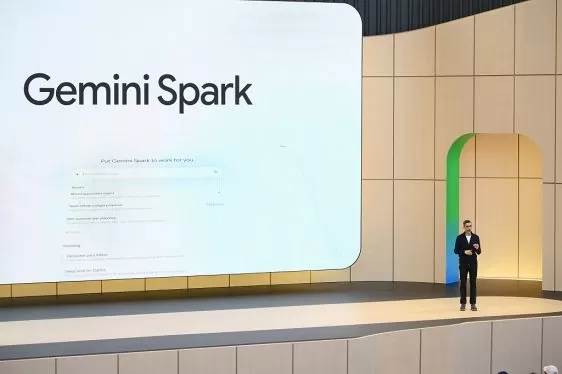 Gemini faces branding challenges, as does the wider AI industry
Google’s Wednesday announcement regarding new Gemini Live voice features makes a valid point: “You shouldn’t have to guess whether a task requires Spark, a Daily Brief, or a quick inbox search.” While Google presents this as a commitment to handling
Gemini faces branding challenges, as does the wider AI industry
Google’s Wednesday announcement regarding new Gemini Live voice features makes a valid point: “You shouldn’t have to guess whether a task requires Spark, a Daily Brief, or a quick inbox search.” While Google presents this as a commitment to handling
 New Report: AI-Powered Apps Struggle With Long-Term User Retention
As app stores become saturated with AI offerings, many developers assume integrating artificial intelligence is the surest path to profitability. Yet, a recent study examining the subscription ecosystem across iOS, Android, and web challenges this as
New Report: AI-Powered Apps Struggle With Long-Term User Retention
As app stores become saturated with AI offerings, many developers assume integrating artificial intelligence is the surest path to profitability. Yet, a recent study examining the subscription ecosystem across iOS, Android, and web challenges this as
 Sesame, AI Startup by Oculus Founders, Debuts on iOS
On Thursday, Sesame, an AI startup founded by the creators of Oculus and other former Meta VR team members, unveiled a public preview of its conversational AI agents, which have been in development for over a year. Through its new iOS application, Se
Sesame, AI Startup by Oculus Founders, Debuts on iOS
On Thursday, Sesame, an AI startup founded by the creators of Oculus and other former Meta VR team members, unveiled a public preview of its conversational AI agents, which have been in development for over a year. Through its new iOS application, Se
2026 Latest Top-rated AI Illustration Tools: Our curated list features the best powerfully designed tools for creating stunning editorial scenes and eye-catching cover art quickly. Each option has gone through rigorous real-world tests, offering a free vs paid comparison to help you find the perfect match for your workflow. Try these must-try solutions today to unlock your AI edge and boost your creative productivity. Explore now at XIX.AI.
10 tools
xix.ai

2026 Latest Top-Rated Best AI Tutors for Exam Prep are here on XIX.AI! Our curated list features powerful game-changing tools that offer free vs paid comparison, real-world tests, and weekly updated rankings. They help boost your writing efficiency, simplify complex topic learning, and unlock your academic potential. Explore now to Discover your perfect exam prep tool and Start creating today to Unlock your AI edge!
10 tools
xix.ai

2026 Latest Best Top-Rated AI Budget Planning Tools for Personal Money Management are here on XIX.AI! This curated collection features powerful, game-changing solutions that help you conduct real-world tests, understand spending habits, and create personalized plans to boost productivity. Enjoy a free vs paid comparison along with detailed rankings. Must-try tools designed to simplify money management and unlock your AI edge. Explore now!
11 tools
xix.ai
2026 Latest Best Top-Rated AI Sleep Tracking Assistants curated for ultimate recovery. This fully updated weekly guide features powerful tools that deliver real-world tests, free vs paid comparison, and detailed rankings to help you find the must-try solution that boosts sleep quality and supports better bedtime habits. Explore now at XIX.AI to Unlock your AI edge.
10 tools
xix.ai
2026 Latest Best Top-Rated AI SQL Copilots for Product and Revenue Analytics! XIX.AI has curated a powerful, game-changing collection of must-try tools that undergo real-world tests through weekly updated rankings. These tools help users boost productivity significantly by accelerating data analysis, streamlining complex queries, and generating accurate insights to drive smarter business decisions. Explore now to Discover your perfect tool for unlocking your AI edge!
14 tools
xix.ai

2026 Latest Best Top-Rated AI Homework Helpers That Teach Core Concepts Not Just Answers Powerful Tools for Students Must-Try Curated List Weekly Updated Free vs Paid Comparison Real-World Tests Accurate Rankings to Help You Unlock Your Full Learning Potential Explore now to Discover your perfect tool for smarter studying.
10 tools
xix.ai












