


 Home
HomeAI Apps Generate Revenue but Face User Retention Challenges, Data Reveals
With app stores overflowing with AI-powered applications, many developers believe that integrating artificial intelligence is the key to profitability. However, a new study examining the subscription app landscape across iOS, Android, and the web challenges this prevailing assumption.
RevenueCat, a subscription management platform serving over 75,000 app developers, reveals in its 2026 State of Subscription Apps Report that AI integration does not ensure long-term user loyalty. In fact, the data indicates that AI-powered apps face greater challenges in retaining subscribers. The median annual churn rate for these apps is 30% higher than for their non-AI counterparts.
The report's insights are drawn from an analysis of apps using RevenueCat's tools to manage over 1 billion in-app transactions, generating more than $11 billion in annual revenue for developers. As a leading platform in this sector, its data provides a robust and representative sample for trend analysis.
One notable finding is that the majority of apps on the platform are not yet AI-driven. AI-powered apps constitute 27.1% of the total across all categories, compared to 72.9% for non-AI apps. Nevertheless, this represents a significant and growing segment, with roughly one in four apps now leveraging AI technology.
(For clarity, the "AI-powered apps" category encompasses not only popular chatbots like ChatGPT and Gemini but any application that markets itself as utilizing artificial intelligence.)
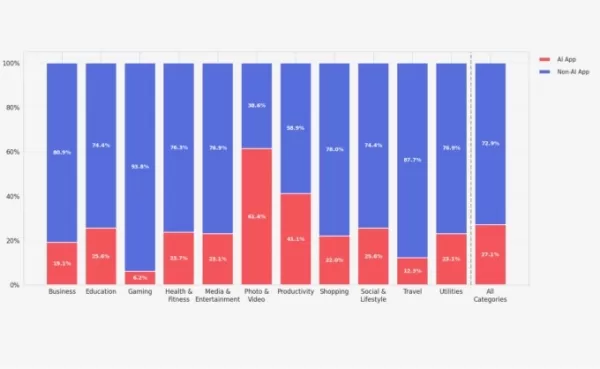
RevenueCat: AI vs. Non-AI Apps by CategoryImage Credits:RevenueCat
Photo & Video apps lead in AI adoption with a 61.4% share, while Gaming has the smallest at 6.2%. Travel (12.3%) and Business (19.1%) also represent segments with lower AI integration.
More surprising are the figures related to customer retention. RevenueCat's data shows that AI apps underperform in retaining paying users on both monthly and annual timelines.
The annual retention rate, measuring subscribers who remain after 12 months, was 21.1% for AI apps, significantly lower than the 30.7% rate for non-AI apps. Monthly retention showed a similar gap, with AI apps at 6.1% versus 9.5% for non-AI apps—a difference of 3.4 percentage points.
AI apps only outperformed in weekly retention, with a rate of 2.5% compared to 1.7% for non-AI apps. It is important to note that weekly subscriptions are not a common choice for AI-powered applications.
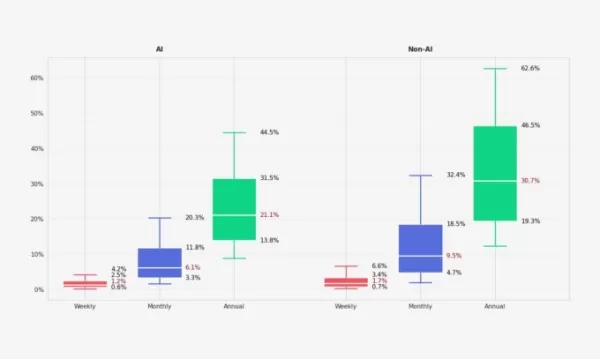
Image Credits:RevenueCat
These trends may be influenced by the fast-paced evolution of AI technology. Users may frequently switch between different AI apps in search of the most advanced and current features available.
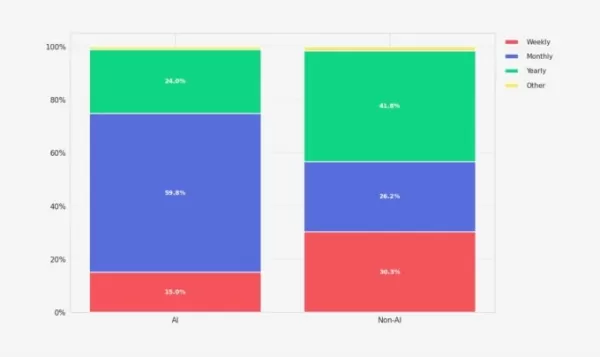
AI vs. Non-AI Apps by Subscription Plan TypeImage Credits:RevenueCat
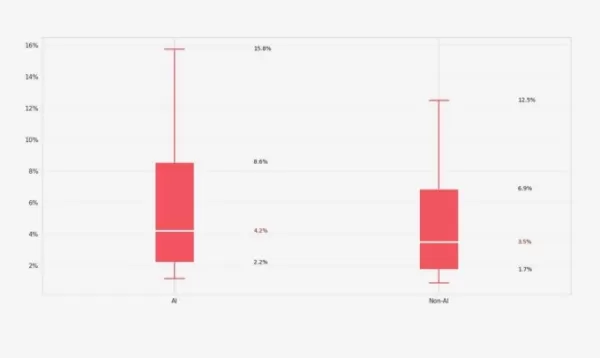
As users experiment with a growing array of AI apps, they are more likely to discover that some fail to meet their expectations. The report notes that AI apps have a 20% higher median refund rate (4.2% vs. 3.5%) than non-AI apps.
The upper bound for refund rates is also higher for AI apps (15.6% vs. 12.5%), suggesting "greater volatility in realized revenue and deeper issues in user value, experience, and long-term quality," according to the report.
ScreenshotImage Credits:RevenueCat
The data does highlight several advantages for AI-powered apps.
RevenueCat found that AI apps convert users from free trials to paid customers 52% more effectively than non-AI apps (8.5% vs. 5.6% median rate). They also monetize their downloads approximately 20% better (2.4% vs. 2.0% median).
Furthermore, AI apps generate at least 39% higher monthly Realized Lifetime Value (RLTV), a metric tracking the net value of an average paying user over time. The median monthly RLTV for AI apps is $18.92, compared to $13.59 for non-AI apps. Annually, AI apps sustain at least a 41% higher RLTV, with a median of $30.16 versus $21.37.
The core conclusion from the report is clear: while AI can drive powerful initial monetization, these applications often struggle to maintain their perceived value and retain customers in the long run.
Related article
 Meta's Muse outpaces ChatGPT in early mobile launch
New data suggests Meta’s latest AI app, Muse, could become the social giant’s next major success. According to recent estimates from Appfigures, Muse has been downloaded on mobile devices more times in its first twelve days than ChatGPT did in the tw
Gemini faces branding challenges, as does the wider AI industry
Google’s Wednesday announcement regarding new Gemini Live voice features makes a valid point: “You shouldn’t have to guess whether a task requires Spark, a Daily Brief, or a quick inbox search.” While Google presents this as a commitment to handling
Rival AI agents Instinct and Meta’s Muse now support calling features
The market for text-based AI assistants is fiercely competitive, with Instinct, Wajo, Town, Ollie, and Meta’s newly launched Muse agent all vying for user attention and task management. Based in San Francisco, Instinct has emerged as a leading conten
Related Special Topic Recommendations
Design & Art
Meta's Muse outpaces ChatGPT in early mobile launch
New data suggests Meta’s latest AI app, Muse, could become the social giant’s next major success. According to recent estimates from Appfigures, Muse has been downloaded on mobile devices more times in its first twelve days than ChatGPT did in the tw
Gemini faces branding challenges, as does the wider AI industry
Google’s Wednesday announcement regarding new Gemini Live voice features makes a valid point: “You shouldn’t have to guess whether a task requires Spark, a Daily Brief, or a quick inbox search.” While Google presents this as a commitment to handling
Rival AI agents Instinct and Meta’s Muse now support calling features
The market for text-based AI assistants is fiercely competitive, with Instinct, Wajo, Town, Ollie, and Meta’s newly launched Muse agent all vying for user attention and task management. Based in San Francisco, Instinct has emerged as a leading conten
Related Special Topic Recommendations
Design & Art
 Top AI Illustration Tools: Create Editorial Scenes and Cover Art Faster
2026 Latest Top-rated AI Illustration Tools: Our curated list features the best powerfully designed tools for creating stunning editorial scenes and eye-catching cover art quickly. Each option has gone through rigorous real-world tests, offering a free vs paid comparison to help you find the perfect match for your workflow. Try these must-try solutions today to unlock your AI edge and boost your creative productivity. Explore now at XIX.AI.
 10 tools
 xix.ai
Education and Learning
Top AI Tutors for Exam Prep: Practice Math, Science, and English
xix.ai
Education and Learning
Top AI Tutors for Exam Prep: Practice Math, Science, and English
2026 Latest Top-Rated Best AI Tutors for Exam Prep are here on XIX.AI! Our curated list features powerful game-changing tools that offer free vs paid comparison, real-world tests, and weekly updated rankings. They help boost your writing efficiency, simplify complex topic learning, and unlock your academic potential. Explore now to Discover your perfect exam prep tool and Start creating today to Unlock your AI edge!
10 tools
xix.ai
Finance
AI Budget Planning Tools for Personal Money Management
2026 Latest Best Top-Rated AI Budget Planning Tools for Personal Money Management are here on XIX.AI! This curated collection features powerful, game-changing solutions that help you conduct real-world tests, understand spending habits, and create personalized plans to boost productivity. Enjoy a free vs paid comparison along with detailed rankings. Must-try tools designed to simplify money management and unlock your AI edge. Explore now!
11 tools
xix.ai
Health & Wellness
AI Sleep Tracking Assistants: Improve Recovery with Better Bedtime Habits
2026 Latest Best Top-Rated AI Sleep Tracking Assistants curated for ultimate recovery. This fully updated weekly guide features powerful tools that deliver real-world tests, free vs paid comparison, and detailed rankings to help you find the must-try solution that boosts sleep quality and supports better bedtime habits. Explore now at XIX.AI to Unlock your AI edge.
10 tools
xix.ai
Data Analysis
AI SQL Copilots for Product and Revenue Analytics
2026 Latest Best Top-Rated AI SQL Copilots for Product and Revenue Analytics! XIX.AI has curated a powerful, game-changing collection of must-try tools that undergo real-world tests through weekly updated rankings. These tools help users boost productivity significantly by accelerating data analysis, streamlining complex queries, and generating accurate insights to drive smarter business decisions. Explore now to Discover your perfect tool for unlocking your AI edge!
14 tools
xix.ai
Education and Learning
Best AI Homework Helpers That Teach: Learn Concepts, Not Just Answers
2026 Latest Best Top-Rated AI Homework Helpers That Teach Core Concepts Not Just Answers Powerful Tools for Students Must-Try Curated List Weekly Updated Free vs Paid Comparison Real-World Tests Accurate Rankings to Help You Unlock Your Full Learning Potential Explore now to Discover your perfect tool for smarter studying.
10 tools
xix.ai

 Comments (1)
0/500
Comments (1)
0/500
![KeithYoung]()
Everyone's slapping 'AI' on their apps now to boost revenue, but the retention numbers are telling a different story. It seems like novelty wears off fast when the core utility doesn't improve. Developers need to focus on real value, not just the buzzword.
With app stores overflowing with AI-powered applications, many developers believe that integrating artificial intelligence is the key to profitability. However, a new study examining the subscription app landscape across iOS, Android, and the web challenges this prevailing assumption.
RevenueCat, a subscription management platform serving over 75,000 app developers, reveals in its 2026 State of Subscription Apps Report that AI integration does not ensure long-term user loyalty. In fact, the data indicates that AI-powered apps face greater challenges in retaining subscribers. The median annual churn rate for these apps is 30% higher than for their non-AI counterparts.
The report's insights are drawn from an analysis of apps using RevenueCat's tools to manage over 1 billion in-app transactions, generating more than $11 billion in annual revenue for developers. As a leading platform in this sector, its data provides a robust and representative sample for trend analysis.
One notable finding is that the majority of apps on the platform are not yet AI-driven. AI-powered apps constitute 27.1% of the total across all categories, compared to 72.9% for non-AI apps. Nevertheless, this represents a significant and growing segment, with roughly one in four apps now leveraging AI technology.
(For clarity, the "AI-powered apps" category encompasses not only popular chatbots like ChatGPT and Gemini but any application that markets itself as utilizing artificial intelligence.)
RevenueCat: AI vs. Non-AI Apps by CategoryImage Credits:RevenueCat
Photo & Video apps lead in AI adoption with a 61.4% share, while Gaming has the smallest at 6.2%. Travel (12.3%) and Business (19.1%) also represent segments with lower AI integration.
More surprising are the figures related to customer retention. RevenueCat's data shows that AI apps underperform in retaining paying users on both monthly and annual timelines.
The annual retention rate, measuring subscribers who remain after 12 months, was 21.1% for AI apps, significantly lower than the 30.7% rate for non-AI apps. Monthly retention showed a similar gap, with AI apps at 6.1% versus 9.5% for non-AI apps—a difference of 3.4 percentage points.
AI apps only outperformed in weekly retention, with a rate of 2.5% compared to 1.7% for non-AI apps. It is important to note that weekly subscriptions are not a common choice for AI-powered applications.
Image Credits:RevenueCat
These trends may be influenced by the fast-paced evolution of AI technology. Users may frequently switch between different AI apps in search of the most advanced and current features available.
AI vs. Non-AI Apps by Subscription Plan TypeImage Credits:RevenueCat
As users experiment with a growing array of AI apps, they are more likely to discover that some fail to meet their expectations. The report notes that AI apps have a 20% higher median refund rate (4.2% vs. 3.5%) than non-AI apps.
The upper bound for refund rates is also higher for AI apps (15.6% vs. 12.5%), suggesting "greater volatility in realized revenue and deeper issues in user value, experience, and long-term quality," according to the report.
ScreenshotImage Credits:RevenueCat
The data does highlight several advantages for AI-powered apps.
RevenueCat found that AI apps convert users from free trials to paid customers 52% more effectively than non-AI apps (8.5% vs. 5.6% median rate). They also monetize their downloads approximately 20% better (2.4% vs. 2.0% median).
Furthermore, AI apps generate at least 39% higher monthly Realized Lifetime Value (RLTV), a metric tracking the net value of an average paying user over time. The median monthly RLTV for AI apps is $18.92, compared to $13.59 for non-AI apps. Annually, AI apps sustain at least a 41% higher RLTV, with a median of $30.16 versus $21.37.
The core conclusion from the report is clear: while AI can drive powerful initial monetization, these applications often struggle to maintain their perceived value and retain customers in the long run.








 Meta's Muse outpaces ChatGPT in early mobile launch
New data suggests Meta’s latest AI app, Muse, could become the social giant’s next major success. According to recent estimates from Appfigures, Muse has been downloaded on mobile devices more times in its first twelve days than ChatGPT did in the tw
Meta's Muse outpaces ChatGPT in early mobile launch
New data suggests Meta’s latest AI app, Muse, could become the social giant’s next major success. According to recent estimates from Appfigures, Muse has been downloaded on mobile devices more times in its first twelve days than ChatGPT did in the tw
 Gemini faces branding challenges, as does the wider AI industry
Google’s Wednesday announcement regarding new Gemini Live voice features makes a valid point: “You shouldn’t have to guess whether a task requires Spark, a Daily Brief, or a quick inbox search.” While Google presents this as a commitment to handling
Gemini faces branding challenges, as does the wider AI industry
Google’s Wednesday announcement regarding new Gemini Live voice features makes a valid point: “You shouldn’t have to guess whether a task requires Spark, a Daily Brief, or a quick inbox search.” While Google presents this as a commitment to handling
 Rival AI agents Instinct and Meta’s Muse now support calling features
The market for text-based AI assistants is fiercely competitive, with Instinct, Wajo, Town, Ollie, and Meta’s newly launched Muse agent all vying for user attention and task management. Based in San Francisco, Instinct has emerged as a leading conten
Rival AI agents Instinct and Meta’s Muse now support calling features
The market for text-based AI assistants is fiercely competitive, with Instinct, Wajo, Town, Ollie, and Meta’s newly launched Muse agent all vying for user attention and task management. Based in San Francisco, Instinct has emerged as a leading conten

2026 Latest Top-rated AI Illustration Tools: Our curated list features the best powerfully designed tools for creating stunning editorial scenes and eye-catching cover art quickly. Each option has gone through rigorous real-world tests, offering a free vs paid comparison to help you find the perfect match for your workflow. Try these must-try solutions today to unlock your AI edge and boost your creative productivity. Explore now at XIX.AI.
10 tools
xix.ai

2026 Latest Top-Rated Best AI Tutors for Exam Prep are here on XIX.AI! Our curated list features powerful game-changing tools that offer free vs paid comparison, real-world tests, and weekly updated rankings. They help boost your writing efficiency, simplify complex topic learning, and unlock your academic potential. Explore now to Discover your perfect exam prep tool and Start creating today to Unlock your AI edge!
10 tools
xix.ai

2026 Latest Best Top-Rated AI Budget Planning Tools for Personal Money Management are here on XIX.AI! This curated collection features powerful, game-changing solutions that help you conduct real-world tests, understand spending habits, and create personalized plans to boost productivity. Enjoy a free vs paid comparison along with detailed rankings. Must-try tools designed to simplify money management and unlock your AI edge. Explore now!
11 tools
xix.ai

2026 Latest Best Top-Rated AI Sleep Tracking Assistants curated for ultimate recovery. This fully updated weekly guide features powerful tools that deliver real-world tests, free vs paid comparison, and detailed rankings to help you find the must-try solution that boosts sleep quality and supports better bedtime habits. Explore now at XIX.AI to Unlock your AI edge.
10 tools
xix.ai
2026 Latest Best Top-Rated AI SQL Copilots for Product and Revenue Analytics! XIX.AI has curated a powerful, game-changing collection of must-try tools that undergo real-world tests through weekly updated rankings. These tools help users boost productivity significantly by accelerating data analysis, streamlining complex queries, and generating accurate insights to drive smarter business decisions. Explore now to Discover your perfect tool for unlocking your AI edge!
14 tools
xix.ai

2026 Latest Best Top-Rated AI Homework Helpers That Teach Core Concepts Not Just Answers Powerful Tools for Students Must-Try Curated List Weekly Updated Free vs Paid Comparison Real-World Tests Accurate Rankings to Help You Unlock Your Full Learning Potential Explore now to Discover your perfect tool for smarter studying.
10 tools
xix.ai

Everyone's slapping 'AI' on their apps now to boost revenue, but the retention numbers are telling a different story. It seems like novelty wears off fast when the core utility doesn't improve. Developers need to focus on real value, not just the buzzword.












