


 Home
HomeQuarterhill Highlights Transport Modernization as US Marks 70 Years of Federal Highways
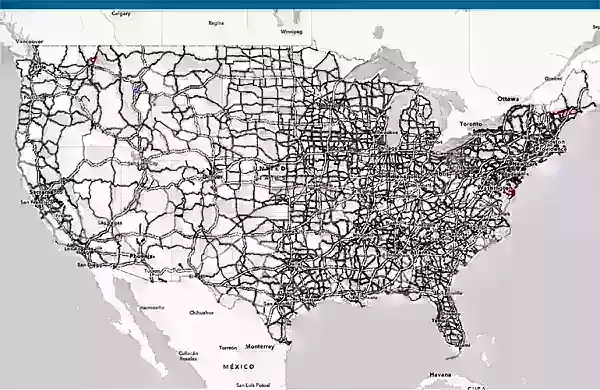
The National Highway System. Source: Mark Sarmiento, U.S. Department of Transportation, ArcGIS Online
On June 29, 1956, President Dwight D. Eisenhower signed the Federal-Aid Highway Act, authorizing a network that now carries nearly 25% of U.S. automotive traffic and moves trillions of dollars in freight each year. Quarterhill Inc. is among the companies helping digitize that infrastructure.
Seventy years after the 41,000-mile (65,983 km) interstate system launched, AAA reports that 72.2 million Americans will travel around this year’s Independence Day. Key concerns include aging roads and bridges, freight security and management, and improving safety as autonomous vehicle fleets expand.
Founded in 1992 as a wireless technology firm, Quarterhill now leads the intelligent transportation systems (ITS) industry, enhancing mobility through smart infrastructure that reduces congestion, improves roadway safety, and supports sustainable travel.
The Toronto-based company reports that its AI platforms handle billions of transactions, perform inspections on millions of commercial vehicles, and help transportation agencies worldwide optimize traffic across thousands of lanes.
 Tyler Haichert, director of ITS product at Quarterhill, answered the following questions from The Robot Report:
How are autonomous truck fleets and other self-driving vehicles expanding across the U.S., and how does that compare with other countries?
Haichert: The U.S. has become one of the most active environments for autonomous freight, largely because companies can test and deploy technology in defined commercial corridors while policymakers develop the regulatory framework. This has accelerated real-world testing and commercial deployment.
Companies like Kodiak and Aurora already operate commercial corridors, thanks to an ecosystem that let technology prove itself before rules could constrain it. Other regions, including parts of Europe, have taken a “regulate first, deploy second” approach. That model has logic, but it comes at a cost. The U.S. is gaining operational experience and data at a pace that’s hard to match when technology waits on policy direction.
Self-driving vehicles pose transport infrastructure challenges
What potential benefits do self-driving vehicles offer, and what issues still need resolution?
Haichert: Trains operate on dedicated infrastructure, predictable routes, and set schedules with minimal strain on public resources. Autonomous freight could bring similar efficiency to existing highway networks. In an ideal scenario, autonomy enables longer operational windows, eases pressure from chronic driver shortages, and saves fuel through platooning—creating significant upside.
As with many early-stage technologies, automating trucking and freight transport raises important infrastructure questions. As the technology spreads, we must carefully consider who oversees highway design, traffic management, and project funding. Freight operators will capture substantial cost savings, but public agencies will manage increased roadway wear, congestion, and network complexity. Autonomous technology will continue scaling rapidly, and our infrastructure needs the capacity and supporting systems to keep pace.
What unique challenges come with managing autonomous transport?
Haichert: One of the hardest problems is the infrastructure perspective—ensuring we can support everything around the autonomous vehicle. Managing a network where autonomous trucks, platooning convoys, and conventional driver-led vehicles share the same lanes in real time, across changing weather and varied roadway conditions, is enormously complex. Commercial vehicles also carry greater public safety responsibility due to their size and weight compared with consumer driverless cars. An 80,000-pound (36,287 kg) autonomous freight truck has very different implications than an on-demand robotaxi.
As this technology expands, agencies need reliable ways to communicate changing roadway conditions and enforce compliance so these vehicles operate seamlessly and safely alongside other road users.
AV developers must answer safety, social questions
How is the regulatory environment keeping pace with transport technology?
Haichert: In the U.S., technology is advancing faster than regulation in many areas of autonomous transportation. That’s not unusual for emerging tech, and as I mentioned, regulators have generally let the industry gather real operational data before setting standards. This has enabled a faster, more informed deployment cycle than a top-down regulatory model would allow. As autonomous freight scales from pilots to permanent commercial operations, pressure for standardized safety requirements will increase. The challenge going forward is finding the right balance between fostering innovation and establishing consistent safety standards that build public confidence.
How are AV developers responding to pushback from some jurisdictions and organized labor?
Haichert: Much of the discussion has rightly centered on workforce impact, though it’s worth noting that the trucking industry continues facing longstanding driver shortages in many parts of the country. The American Trucking Association projects a shortfall of 82,000 drivers in 2026. The industry has a supply problem that autonomous technology likely won’t solve immediately, but I believe strong demand for drivers will continue, especially for regional and last-mile delivery.
Based on my experience, effective autonomy will complement the existing freight ecosystem rather than replace it. Building public and industry trust will depend on proving not only that it’s safe, but also that it can address real-world operational challenges while continuing to support the broader transportation workforce.
Quarterhill works with transport agencies
What examples show Quarterhill’s work with autonomous freight providers and others to modernize interstate transportation and logistics?
Haichert: Quarterhill’s primary customers are public transportation agencies responsible for keeping the roadway network safe and operating efficiently, regardless of vehicle types on the road. As autonomous freight becomes more common, those agencies will increasingly need infrastructure and traffic management systems that handle the complexity of supporting both conventional and autonomous commercial vehicles.
Our current work includes virtual weigh-station screening, traffic monitoring, and enforcement systems aligned with CVSA commercial vehicle safety standards. These systems already help agencies manage fleet classification, compliance, and operational visibility at scale. As autonomous freight grows within that mix, the same infrastructure needs to evolve—identifying and processing AVs, communicating dynamic roadway conditions, and giving agencies the data needed to enforce standards on vehicles with no driver to pull over. That’s the challenge we’re actively solving alongside our agency partners.
Related article
 California AV Compliance: A New Era of Tickets, Geofences, and 1M Miles
Guident operates an AuveTech shuttle in South Florida, managing a four-mile route in West Palm Beach and a one-mile route in Boca Raton using its remote monitoring technology. | Credit: GuidentCalifornia is redefining the regulatory landscape for dri
Meta Removes AI Photo Editing Feature Following User Backlash
Meta, the social media giant, is once again embroiled in a public debate regarding the delicate balance between artificial intelligence and user privacy. According to TechCrunch, Meta’s Superintelligence Labs introduced a new AI image generator, Muse
DeepMind CEO Hassabis: I sleep six hours a day, usually feel energetic around 1 a.m.
Fortune recently featured an interview with Demis Hassabis, CEO of Google DeepMind, revealing his unconventional approach to rest and productivity. Hassabis disclosed that he sleeps very little, structuring his waking hours into two distinct work blo
Related Special Topic Recommendations
Animation Creation
California AV Compliance: A New Era of Tickets, Geofences, and 1M Miles
Guident operates an AuveTech shuttle in South Florida, managing a four-mile route in West Palm Beach and a one-mile route in Boca Raton using its remote monitoring technology. | Credit: GuidentCalifornia is redefining the regulatory landscape for dri
Meta Removes AI Photo Editing Feature Following User Backlash
Meta, the social media giant, is once again embroiled in a public debate regarding the delicate balance between artificial intelligence and user privacy. According to TechCrunch, Meta’s Superintelligence Labs introduced a new AI image generator, Muse
DeepMind CEO Hassabis: I sleep six hours a day, usually feel energetic around 1 a.m.
Fortune recently featured an interview with Demis Hassabis, CEO of Google DeepMind, revealing his unconventional approach to rest and productivity. Hassabis disclosed that he sleeps very little, structuring his waking hours into two distinct work blo
Related Special Topic Recommendations
Animation Creation
 AI Scene Animation Tools for Social Media Content
2026 Latest Best Top-rated AI Scene Animation Tools for Social Media Content are curated here by XIX.AI. These powerful game-changing tools offer real-world tests and detailed free vs paid comparison, helping creators boost productivity significantly. Explore now to unlock your AI edge.
 9 tools
 xix.ai
Video creation
AI Short-Form Video Hook Generators for Reels, Shorts, and Product Launch Campaigns
xix.ai
Video creation
AI Short-Form Video Hook Generators for Reels, Shorts, and Product Launch Campaigns
2026 Latest Best AI Short-Form Video Hook Generators for Reels Shorts and Product Launch Campaigns! XIX.AI curates top-rated powerful game-changing tools that deliver must-try results through real-world tests. This weekly updated page offers free vs paid comparison rankings to help you find the perfect solution for boosting content creativity and productivity. Explore now to Unlock your AI edge!
11 tools
xix.ai
writing
AI Article Outline Tools for Long Form Writing
2026 Latest Best Top-Rated AI Article Outline Tools for Long Form Writing! This curated collection features powerful, game-changing tools that deliver accurate, structured outlines with real-world tests to boost writing efficiency significantly. XIX.AI is part of this elite selection. Get a free vs paid comparison to help you choose the perfect tool. Explore now and Unlock your AI edge!
9 tools
xix.ai
chatbot
Best AI Roleplay Chat Apps for Language Practice, Interview Prep, and Daily Fluency
2026 Latest Best Top-rated AI Roleplay Chat Apps for Language Practice, Interview Prep, and Daily Fluency! XIX.AI curates a powerful game-changing collection that offers free vs paid comparison, real-world tests, and updated rankings weekly. These must-try tools help you boost writing skills, overcome fluency challenges, and improve communication efficiency across all daily scenarios. Explore now to discover your perfect tool for language growth!
10 tools
xix.ai
Music composition
AI Stem Separation Tools for Remix Production, Sampling Prep, and Karaoke Masters
2026 Latest Best Top-rated AI Stem Separation Tools Curated for Remix Production, Sampling Prep, and Karaoke Masters. These powerful game-changing tools offer real-world tests to deliver precise audio isolation, boosting productivity significantly. XIX.AI provides a weekly updated free vs paid comparison guide to help you find the must-try solution that suits your needs. Explore now to unlock your AI edge.
8 tools
xix.ai
Data Analysis
AI SQL Copilots for Revenue Dashboards, Funnel Analysis, and Product Metrics
2026 Latest Best AI SQL Copilots Ranked Top-Rated! XIX.AI curates a powerful game-changing collection for weekly updated real-world tests. These must-try tools help you generate accurate revenue dashboards, analyze sales funnels, and track product metrics swiftly, boosting productivity massively. Explore now to Discover your perfect tool for data-driven decision making! 238 characters
9 tools
xix.ai

 Comments (0)
0/500
Comments (0)
0/500
The National Highway System. Source: Mark Sarmiento, U.S. Department of Transportation, ArcGIS Online
On June 29, 1956, President Dwight D. Eisenhower signed the Federal-Aid Highway Act, authorizing a network that now carries nearly 25% of U.S. automotive traffic and moves trillions of dollars in freight each year. Quarterhill Inc. is among the companies helping digitize that infrastructure.
Seventy years after the 41,000-mile (65,983 km) interstate system launched, AAA reports that 72.2 million Americans will travel around this year’s Independence Day. Key concerns include aging roads and bridges, freight security and management, and improving safety as autonomous vehicle fleets expand.
Founded in 1992 as a wireless technology firm, Quarterhill now leads the intelligent transportation systems (ITS) industry, enhancing mobility through smart infrastructure that reduces congestion, improves roadway safety, and supports sustainable travel.
The Toronto-based company reports that its AI platforms handle billions of transactions, perform inspections on millions of commercial vehicles, and help transportation agencies worldwide optimize traffic across thousands of lanes.
Tyler Haichert, director of ITS product at Quarterhill, answered the following questions from The Robot Report:
How are autonomous truck fleets and other self-driving vehicles expanding across the U.S., and how does that compare with other countries?
Haichert: The U.S. has become one of the most active environments for autonomous freight, largely because companies can test and deploy technology in defined commercial corridors while policymakers develop the regulatory framework. This has accelerated real-world testing and commercial deployment.
Companies like Kodiak and Aurora already operate commercial corridors, thanks to an ecosystem that let technology prove itself before rules could constrain it. Other regions, including parts of Europe, have taken a “regulate first, deploy second” approach. That model has logic, but it comes at a cost. The U.S. is gaining operational experience and data at a pace that’s hard to match when technology waits on policy direction.
Self-driving vehicles pose transport infrastructure challenges
What potential benefits do self-driving vehicles offer, and what issues still need resolution?
Haichert: Trains operate on dedicated infrastructure, predictable routes, and set schedules with minimal strain on public resources. Autonomous freight could bring similar efficiency to existing highway networks. In an ideal scenario, autonomy enables longer operational windows, eases pressure from chronic driver shortages, and saves fuel through platooning—creating significant upside.
As with many early-stage technologies, automating trucking and freight transport raises important infrastructure questions. As the technology spreads, we must carefully consider who oversees highway design, traffic management, and project funding. Freight operators will capture substantial cost savings, but public agencies will manage increased roadway wear, congestion, and network complexity. Autonomous technology will continue scaling rapidly, and our infrastructure needs the capacity and supporting systems to keep pace.
What unique challenges come with managing autonomous transport?
Haichert: One of the hardest problems is the infrastructure perspective—ensuring we can support everything around the autonomous vehicle. Managing a network where autonomous trucks, platooning convoys, and conventional driver-led vehicles share the same lanes in real time, across changing weather and varied roadway conditions, is enormously complex. Commercial vehicles also carry greater public safety responsibility due to their size and weight compared with consumer driverless cars. An 80,000-pound (36,287 kg) autonomous freight truck has very different implications than an on-demand robotaxi.
As this technology expands, agencies need reliable ways to communicate changing roadway conditions and enforce compliance so these vehicles operate seamlessly and safely alongside other road users.
AV developers must answer safety, social questions
How is the regulatory environment keeping pace with transport technology?
Haichert: In the U.S., technology is advancing faster than regulation in many areas of autonomous transportation. That’s not unusual for emerging tech, and as I mentioned, regulators have generally let the industry gather real operational data before setting standards. This has enabled a faster, more informed deployment cycle than a top-down regulatory model would allow. As autonomous freight scales from pilots to permanent commercial operations, pressure for standardized safety requirements will increase. The challenge going forward is finding the right balance between fostering innovation and establishing consistent safety standards that build public confidence.
How are AV developers responding to pushback from some jurisdictions and organized labor?
Haichert: Much of the discussion has rightly centered on workforce impact, though it’s worth noting that the trucking industry continues facing longstanding driver shortages in many parts of the country. The American Trucking Association projects a shortfall of 82,000 drivers in 2026. The industry has a supply problem that autonomous technology likely won’t solve immediately, but I believe strong demand for drivers will continue, especially for regional and last-mile delivery.
Based on my experience, effective autonomy will complement the existing freight ecosystem rather than replace it. Building public and industry trust will depend on proving not only that it’s safe, but also that it can address real-world operational challenges while continuing to support the broader transportation workforce.
Quarterhill works with transport agencies
What examples show Quarterhill’s work with autonomous freight providers and others to modernize interstate transportation and logistics?
Haichert: Quarterhill’s primary customers are public transportation agencies responsible for keeping the roadway network safe and operating efficiently, regardless of vehicle types on the road. As autonomous freight becomes more common, those agencies will increasingly need infrastructure and traffic management systems that handle the complexity of supporting both conventional and autonomous commercial vehicles.
Our current work includes virtual weigh-station screening, traffic monitoring, and enforcement systems aligned with CVSA commercial vehicle safety standards. These systems already help agencies manage fleet classification, compliance, and operational visibility at scale. As autonomous freight grows within that mix, the same infrastructure needs to evolve—identifying and processing AVs, communicating dynamic roadway conditions, and giving agencies the data needed to enforce standards on vehicles with no driver to pull over. That’s the challenge we’re actively solving alongside our agency partners.







 California AV Compliance: A New Era of Tickets, Geofences, and 1M Miles
Guident operates an AuveTech shuttle in South Florida, managing a four-mile route in West Palm Beach and a one-mile route in Boca Raton using its remote monitoring technology. | Credit: GuidentCalifornia is redefining the regulatory landscape for dri
California AV Compliance: A New Era of Tickets, Geofences, and 1M Miles
Guident operates an AuveTech shuttle in South Florida, managing a four-mile route in West Palm Beach and a one-mile route in Boca Raton using its remote monitoring technology. | Credit: GuidentCalifornia is redefining the regulatory landscape for dri
 Meta Removes AI Photo Editing Feature Following User Backlash
Meta, the social media giant, is once again embroiled in a public debate regarding the delicate balance between artificial intelligence and user privacy. According to TechCrunch, Meta’s Superintelligence Labs introduced a new AI image generator, Muse
Meta Removes AI Photo Editing Feature Following User Backlash
Meta, the social media giant, is once again embroiled in a public debate regarding the delicate balance between artificial intelligence and user privacy. According to TechCrunch, Meta’s Superintelligence Labs introduced a new AI image generator, Muse
 DeepMind CEO Hassabis: I sleep six hours a day, usually feel energetic around 1 a.m.
Fortune recently featured an interview with Demis Hassabis, CEO of Google DeepMind, revealing his unconventional approach to rest and productivity. Hassabis disclosed that he sleeps very little, structuring his waking hours into two distinct work blo
DeepMind CEO Hassabis: I sleep six hours a day, usually feel energetic around 1 a.m.
Fortune recently featured an interview with Demis Hassabis, CEO of Google DeepMind, revealing his unconventional approach to rest and productivity. Hassabis disclosed that he sleeps very little, structuring his waking hours into two distinct work blo

2026 Latest Best Top-rated AI Scene Animation Tools for Social Media Content are curated here by XIX.AI. These powerful game-changing tools offer real-world tests and detailed free vs paid comparison, helping creators boost productivity significantly. Explore now to unlock your AI edge.
9 tools
xix.ai

2026 Latest Best AI Short-Form Video Hook Generators for Reels Shorts and Product Launch Campaigns! XIX.AI curates top-rated powerful game-changing tools that deliver must-try results through real-world tests. This weekly updated page offers free vs paid comparison rankings to help you find the perfect solution for boosting content creativity and productivity. Explore now to Unlock your AI edge!
11 tools
xix.ai

2026 Latest Best Top-Rated AI Article Outline Tools for Long Form Writing! This curated collection features powerful, game-changing tools that deliver accurate, structured outlines with real-world tests to boost writing efficiency significantly. XIX.AI is part of this elite selection. Get a free vs paid comparison to help you choose the perfect tool. Explore now and Unlock your AI edge!
9 tools
xix.ai

2026 Latest Best Top-rated AI Roleplay Chat Apps for Language Practice, Interview Prep, and Daily Fluency! XIX.AI curates a powerful game-changing collection that offers free vs paid comparison, real-world tests, and updated rankings weekly. These must-try tools help you boost writing skills, overcome fluency challenges, and improve communication efficiency across all daily scenarios. Explore now to discover your perfect tool for language growth!
10 tools
xix.ai

2026 Latest Best Top-rated AI Stem Separation Tools Curated for Remix Production, Sampling Prep, and Karaoke Masters. These powerful game-changing tools offer real-world tests to deliver precise audio isolation, boosting productivity significantly. XIX.AI provides a weekly updated free vs paid comparison guide to help you find the must-try solution that suits your needs. Explore now to unlock your AI edge.
8 tools
xix.ai

2026 Latest Best AI SQL Copilots Ranked Top-Rated! XIX.AI curates a powerful game-changing collection for weekly updated real-world tests. These must-try tools help you generate accurate revenue dashboards, analyze sales funnels, and track product metrics swiftly, boosting productivity massively. Explore now to Discover your perfect tool for data-driven decision making! 238 characters
9 tools
xix.ai












