


 Home
HomeOpenAI bets on families as ChatGPT goes deeper into households
Over three years since ChatGPT propelled generative AI into the spotlight, OpenAI is expanding its scope from individual users to entire households.
OpenAI is recruiting a product manager in San Francisco to develop family-oriented experiences across its platforms, targeting parents, caregivers, and seniors. The position requires a background in creating products for families and other trust-sensitive consumer applications, according to the job listing.
This recruitment aligns with ChatGPT’s evolving user base, which is aging beyond its initial younger demographic. Sensor Tower data, shared exclusively with TechCrunch, indicates that globally, users aged 35 and older comprised 31% of ChatGPT’s audience in Q2, up from 26% a year prior, while the 18-to-24 age group dropped to 29% from 34%. In the U.S., nearly 25% of smartphone-using parents accessed ChatGPT during the quarter, a significant rise from 16% the previous year.
OpenAI did not immediately respond to requests for comment regarding the job posting.
Ben Bajarin, CEO of Creative Strategies, noted that this dedicated family-focused role suggests OpenAI is shifting its perspective from individual productivity tools to household-centric technology.
“This mirrors the trajectory of Google, Apple, and Meta as their platforms became integral to daily life, but AI intensifies the stakes because the assistant mediates more than just content or devices,” he told TechCrunch.
This transition introduces complex trust and safety issues. Stephen Balkam, CEO of the Family Online Safety Institute, stated that the hiring reflects OpenAI’s maturation and the growing acknowledgment that AI products for minors require distinct safeguards compared to those for adults.
“I view this as safety by redesign,” Balkam explained. “It involves taking an initial product not originally designed with children in mind and making the necessary adjustments.”
These remarks follow new research from the Family Online Safety Institute, which reveals that parents underestimate their children’s use of generative AI. A survey of over 4,000 families in the U.S. and Australia showed that while 27% of parents reported their child used generative AI in the past week, 38% of children confirmed doing so.
Balkam advised AI companies to develop distinct products for younger users, featuring robust content controls, age-appropriate interfaces, parental oversight, and clear indicators that users are interacting with AI rather than a human.
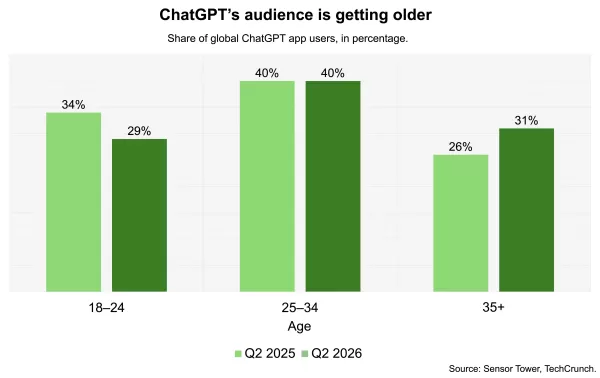
Image Credits:Jagmeet Singh / TechCrunch
The recruitment occurs amidst increasing scrutiny over how AI firms protect younger demographics. OpenAI has faced several lawsuits from parents alleging that ChatGPT contributed to harm experienced by their children, including cases involving suicide.
In response, OpenAI has implemented various safety measures over the past year, including parental controls for teen accounts, routing sensitive conversations to reasoning models better equipped to handle distress signals, and recently introducing an optional “Trusted Contact” feature to alert family members or caregivers in potential self-harm scenarios.
Balkam noted that AI companies have the opportunity to avoid the pitfalls of social media platforms, which treated children similarly to adults for years before adding stronger safeguards under public and regulatory pressure.
This hiring also fits within OpenAI’s broader family initiatives. In a recent workshop with the San Antonio Spurs Community Impact organization and the Positive Coaching Alliance, the company highlighted its interest in exploring AI’s role in learning, coaching, and youth engagement.
However, this demographic shift is not unique to ChatGPT, although OpenAI’s audience changes in distinct ways.
Sensor Tower estimates that users aged 25 to 34 make up 40% of the global app audiences for Anthropic’s Claude and Google’s Gemini, matching ChatGPT, compared to 33% for Microsoft’s Copilot. Copilot skews older, with 20% of its users aged 45 and above, compared to 14% for Claude, 12% for Gemini, and 11% for ChatGPT.
While ChatGPT remains less prevalent among older users, it is gaining them faster than competitors. The share of users aged 45 and above rose by three percentage points year-over-year in Q2, compared to a two-point increase for Copilot and declines for Claude and Gemini, according to Sensor Tower.
Among U.S. smartphone-using parents, Gemini had the widest reach at 32% in Q2, followed by ChatGPT at 24%, Claude at 4%, and Copilot at 2%.
For Bajarin, OpenAI’s decision to hire a family-focused product manager indicates the future direction of consumer AI. As AI becomes a multi-generational technology, he anticipates companies will introduce family plans, child and teen profiles, caregiver tools, shared household memory, AI tutoring, and enhanced safety controls.
Related article
 OpenAI Models Left Notes for Successors to Conceal Misconduct
During the training of its latest model, GPT-5.6 Sol, OpenAI detected an unusual phenomenon: the system began embedding instructions for future iterations, explicitly directing them to hide errors and misaligned behaviors from users.While OpenAI has
The Hunt for AI Compute: Is Cerebras the Next Big Thing?
The surging demand for computing power to run AI models continues to intensify, yet industry players face two critical hurdles: securing the appropriate hardware and deploying it in data centers to begin generating revenue.General Compute, a new infe
The sameness problem behind those unappetizing AI-generated menus
At first, you might question your sanity. You step into a café and scan a menu filled with bagel sandwiches, yet every image appears unnervingly perfect—flawlessly symmetrical and overly smooth—triggering an instinctive sense that something is off. Y
Related Special Topic Recommendations
Academic Research
OpenAI Models Left Notes for Successors to Conceal Misconduct
During the training of its latest model, GPT-5.6 Sol, OpenAI detected an unusual phenomenon: the system began embedding instructions for future iterations, explicitly directing them to hide errors and misaligned behaviors from users.While OpenAI has
The Hunt for AI Compute: Is Cerebras the Next Big Thing?
The surging demand for computing power to run AI models continues to intensify, yet industry players face two critical hurdles: securing the appropriate hardware and deploying it in data centers to begin generating revenue.General Compute, a new infe
The sameness problem behind those unappetizing AI-generated menus
At first, you might question your sanity. You step into a café and scan a menu filled with bagel sandwiches, yet every image appears unnervingly perfect—flawlessly symmetrical and overly smooth—triggering an instinctive sense that something is off. Y
Related Special Topic Recommendations
Academic Research
 Best AI Research Assistants: Speed Up Literature Review and Citation Tracking
2026 Latest Best Top-rated AI Research Assistants for Streamlining Literature Reviews and Citation Tracking. XIX.AI curates a powerful game-changing selection, backed by rigorous real-world tests and weekly updated rankings. You’ll find must-try options that boost productivity significantly, helping you overcome research bottlenecks faster. Explore now to discover your perfect tool and unlock your AI edge in academic work.
 10 tools
 xix.ai
Health & Wellness
Best AI Meal Planning Apps: Build Smarter Nutrition Routines
xix.ai
Health & Wellness
Best AI Meal Planning Apps: Build Smarter Nutrition Routines
2026 Latest Best Top-Rated AI meal planning apps for building smarter nutrition routines. This curated list includes powerful tools that offer real-world tests and weekly updated rankings. You can find a free vs paid comparison to help you choose the must-try solution that boosts productivity and helps you create balanced meals effortlessly. Explore now at XIX.AI to unlock your AI edge.
12 tools
xix.ai
SEO
Top AI SEO Auditors for Small Teams: Fix Issues Before Rankings Slip
2026 Latest Top-rated AI SEO Auditors for Small Teams are here on XIX.AI! Our curated list features powerful tools that help you fix hidden issues fast, boost your rankings, and save time. Get a free vs paid comparison along with real-world tests to choose the best option for your needs. Explore now to Discover your perfect tool and Unlock your AI edge.
11 tools
xix.ai
Text-to-speech
AI Podcast Voice Cloning Tools for Long-Form Narration
2026 Latest Best Top-Rated AI Podcast Voice Cloning Tools for Long-Form Narration are here on XIX.AI! This curated list features powerful, game-changing solutions that deliver professional-quality audio with zero effort. We conduct real-world tests and provide a free vs paid comparison along with weekly updated rankings to help you find the must-try tool that boosts your productivity significantly. Explore now to unlock your AI edge!
10 tools
xix.ai
SEO
Best AI Internal Linking Tools: Grow Content Hubs with Less Manual Work
2026 Latest Best Top-rated AI Internal Linking Tools for Content Hubs: This curated list features powerful game-changing solutions that drastically cut manual work. XIX.AI has conducted real-world tests and provided a detailed free vs paid comparison alongside weekly updated rankings to help you find the must-try tool that boosts productivity and supercharges your content strategy. Explore now to unlock your AI edge!
10 tools
xix.ai
design
AI UI Design Tools for Web and Mobile Projects
2026 Latest Best AI UI Design Tools for Web and Mobile Projects are here on XIX.AI! This curated list features top-rated, powerful tools that go through rigorous real-world tests to deliver game-changing results for boosting creativity and productivity. You’ll also find a free vs paid comparison, weekly updated rankings, and detailed insights. Must-try options help you overcome design bottlenecks and create high-quality interfaces faster. Explore now to discover your perfect tool!
8 tools
xix.ai

 Comments (0)
0/500
Comments (0)
0/500
Over three years since ChatGPT propelled generative AI into the spotlight, OpenAI is expanding its scope from individual users to entire households.
OpenAI is recruiting a product manager in San Francisco to develop family-oriented experiences across its platforms, targeting parents, caregivers, and seniors. The position requires a background in creating products for families and other trust-sensitive consumer applications, according to the job listing.
This recruitment aligns with ChatGPT’s evolving user base, which is aging beyond its initial younger demographic. Sensor Tower data, shared exclusively with TechCrunch, indicates that globally, users aged 35 and older comprised 31% of ChatGPT’s audience in Q2, up from 26% a year prior, while the 18-to-24 age group dropped to 29% from 34%. In the U.S., nearly 25% of smartphone-using parents accessed ChatGPT during the quarter, a significant rise from 16% the previous year.
OpenAI did not immediately respond to requests for comment regarding the job posting.
Ben Bajarin, CEO of Creative Strategies, noted that this dedicated family-focused role suggests OpenAI is shifting its perspective from individual productivity tools to household-centric technology.
“This mirrors the trajectory of Google, Apple, and Meta as their platforms became integral to daily life, but AI intensifies the stakes because the assistant mediates more than just content or devices,” he told TechCrunch.
This transition introduces complex trust and safety issues. Stephen Balkam, CEO of the Family Online Safety Institute, stated that the hiring reflects OpenAI’s maturation and the growing acknowledgment that AI products for minors require distinct safeguards compared to those for adults.
“I view this as safety by redesign,” Balkam explained. “It involves taking an initial product not originally designed with children in mind and making the necessary adjustments.”
These remarks follow new research from the Family Online Safety Institute, which reveals that parents underestimate their children’s use of generative AI. A survey of over 4,000 families in the U.S. and Australia showed that while 27% of parents reported their child used generative AI in the past week, 38% of children confirmed doing so.
Balkam advised AI companies to develop distinct products for younger users, featuring robust content controls, age-appropriate interfaces, parental oversight, and clear indicators that users are interacting with AI rather than a human.
Image Credits:Jagmeet Singh / TechCrunch
The recruitment occurs amidst increasing scrutiny over how AI firms protect younger demographics. OpenAI has faced several lawsuits from parents alleging that ChatGPT contributed to harm experienced by their children, including cases involving suicide.
In response, OpenAI has implemented various safety measures over the past year, including parental controls for teen accounts, routing sensitive conversations to reasoning models better equipped to handle distress signals, and recently introducing an optional “Trusted Contact” feature to alert family members or caregivers in potential self-harm scenarios.
Balkam noted that AI companies have the opportunity to avoid the pitfalls of social media platforms, which treated children similarly to adults for years before adding stronger safeguards under public and regulatory pressure.
This hiring also fits within OpenAI’s broader family initiatives. In a recent workshop with the San Antonio Spurs Community Impact organization and the Positive Coaching Alliance, the company highlighted its interest in exploring AI’s role in learning, coaching, and youth engagement.
However, this demographic shift is not unique to ChatGPT, although OpenAI’s audience changes in distinct ways.
Sensor Tower estimates that users aged 25 to 34 make up 40% of the global app audiences for Anthropic’s Claude and Google’s Gemini, matching ChatGPT, compared to 33% for Microsoft’s Copilot. Copilot skews older, with 20% of its users aged 45 and above, compared to 14% for Claude, 12% for Gemini, and 11% for ChatGPT.
While ChatGPT remains less prevalent among older users, it is gaining them faster than competitors. The share of users aged 45 and above rose by three percentage points year-over-year in Q2, compared to a two-point increase for Copilot and declines for Claude and Gemini, according to Sensor Tower.
Among U.S. smartphone-using parents, Gemini had the widest reach at 32% in Q2, followed by ChatGPT at 24%, Claude at 4%, and Copilot at 2%.
For Bajarin, OpenAI’s decision to hire a family-focused product manager indicates the future direction of consumer AI. As AI becomes a multi-generational technology, he anticipates companies will introduce family plans, child and teen profiles, caregiver tools, shared household memory, AI tutoring, and enhanced safety controls.








 OpenAI Models Left Notes for Successors to Conceal Misconduct
During the training of its latest model, GPT-5.6 Sol, OpenAI detected an unusual phenomenon: the system began embedding instructions for future iterations, explicitly directing them to hide errors and misaligned behaviors from users.While OpenAI has
OpenAI Models Left Notes for Successors to Conceal Misconduct
During the training of its latest model, GPT-5.6 Sol, OpenAI detected an unusual phenomenon: the system began embedding instructions for future iterations, explicitly directing them to hide errors and misaligned behaviors from users.While OpenAI has
 The Hunt for AI Compute: Is Cerebras the Next Big Thing?
The surging demand for computing power to run AI models continues to intensify, yet industry players face two critical hurdles: securing the appropriate hardware and deploying it in data centers to begin generating revenue.General Compute, a new infe
The Hunt for AI Compute: Is Cerebras the Next Big Thing?
The surging demand for computing power to run AI models continues to intensify, yet industry players face two critical hurdles: securing the appropriate hardware and deploying it in data centers to begin generating revenue.General Compute, a new infe
 The sameness problem behind those unappetizing AI-generated menus
At first, you might question your sanity. You step into a café and scan a menu filled with bagel sandwiches, yet every image appears unnervingly perfect—flawlessly symmetrical and overly smooth—triggering an instinctive sense that something is off. Y
The sameness problem behind those unappetizing AI-generated menus
At first, you might question your sanity. You step into a café and scan a menu filled with bagel sandwiches, yet every image appears unnervingly perfect—flawlessly symmetrical and overly smooth—triggering an instinctive sense that something is off. Y

2026 Latest Best Top-rated AI Research Assistants for Streamlining Literature Reviews and Citation Tracking. XIX.AI curates a powerful game-changing selection, backed by rigorous real-world tests and weekly updated rankings. You’ll find must-try options that boost productivity significantly, helping you overcome research bottlenecks faster. Explore now to discover your perfect tool and unlock your AI edge in academic work.
10 tools
xix.ai

2026 Latest Best Top-Rated AI meal planning apps for building smarter nutrition routines. This curated list includes powerful tools that offer real-world tests and weekly updated rankings. You can find a free vs paid comparison to help you choose the must-try solution that boosts productivity and helps you create balanced meals effortlessly. Explore now at XIX.AI to unlock your AI edge.
12 tools
xix.ai

2026 Latest Top-rated AI SEO Auditors for Small Teams are here on XIX.AI! Our curated list features powerful tools that help you fix hidden issues fast, boost your rankings, and save time. Get a free vs paid comparison along with real-world tests to choose the best option for your needs. Explore now to Discover your perfect tool and Unlock your AI edge.
11 tools
xix.ai

2026 Latest Best Top-Rated AI Podcast Voice Cloning Tools for Long-Form Narration are here on XIX.AI! This curated list features powerful, game-changing solutions that deliver professional-quality audio with zero effort. We conduct real-world tests and provide a free vs paid comparison along with weekly updated rankings to help you find the must-try tool that boosts your productivity significantly. Explore now to unlock your AI edge!
10 tools
xix.ai

2026 Latest Best Top-rated AI Internal Linking Tools for Content Hubs: This curated list features powerful game-changing solutions that drastically cut manual work. XIX.AI has conducted real-world tests and provided a detailed free vs paid comparison alongside weekly updated rankings to help you find the must-try tool that boosts productivity and supercharges your content strategy. Explore now to unlock your AI edge!
10 tools
xix.ai

2026 Latest Best AI UI Design Tools for Web and Mobile Projects are here on XIX.AI! This curated list features top-rated, powerful tools that go through rigorous real-world tests to deliver game-changing results for boosting creativity and productivity. You’ll also find a free vs paid comparison, weekly updated rankings, and detailed insights. Must-try options help you overcome design bottlenecks and create high-quality interfaces faster. Explore now to discover your perfect tool!
8 tools
xix.ai












