


 Home
Home
Mistral AI’s Open-Source Math Proof Tool Uses 119B Parameters, Activating Just 6B, Cuts Costs to 1% of Rivals
Mistral AI, a European artificial intelligence firm, has officially released Leanstral 1.5, a specialized model for formal mathematical proof. Built specifically for the Lean4 programming language, this 119B-parameter model activates only 6B parameters during reasoning, delivering exceptional proof capabilities at minimal computational cost. The model is fully open-sourced under the Apache-2.0 license.
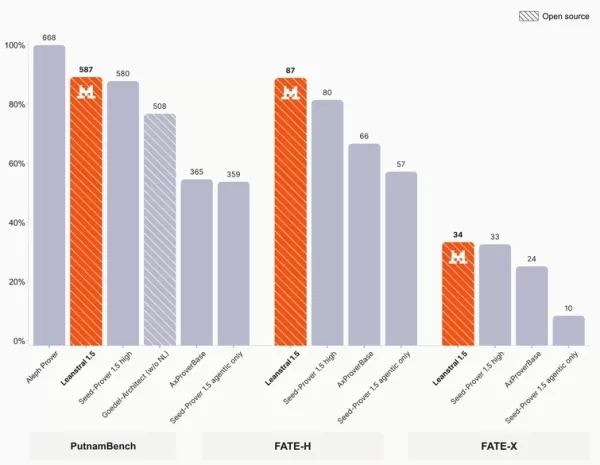
On core benchmark tests, Leanstral 1.5 demonstrated near-perfect performance. It achieved a 100% completion rate on both the validation and test sets of the miniF2F formal mathematics benchmark, and successfully solved 587 out of 672 Lean4 problems in the PutnamBench math competition. In abstract algebra benchmarks from the FATE series, it reached 87% on the master's level (FATE-H) and 34% on the doctoral level (FATE-X), setting new state-of-the-art records.
The cost of solving problems is just one percent of the competitors'
Leanstral 1.5 also offers a significant cost advantage. On the PutnamBench dataset, the model averages just $4 per problem, compared to over $300 for ByteDance's Seed-Prover 1.5 and between $54 and $68 for Aleph Prover. This means Leanstral 1.5's reasoning costs are roughly one percent of its strongest competitors, effectively removing economic barriers to the large-scale application of formal mathematical proofs.
In practical engineering scenarios, Leanstral 1.5 has proven its real-world value. The model identified 47 violating attributes across 57 tested code repositories, including 11 real code defects, five of which were entirely new issues never previously reported on GitHub. From pure mathematical competitions to real software engineering verification, this model demonstrates that parameter size is not the sole determinant of capability; efficient activation is the key to making AI reasoning practical.
Related article
 Meta launches AI optimism ad set to song about human extinction
Meta’s latest ad opens with a stark black-and-white close-up of an eye, capturing the anxiety of scrolling through alarming headlines about AI stealing jobs, isolating society, and triggering a global crisis.“Some people will have you believe AI is g
OpenAI Models Left Notes for Successors to Conceal Misconduct
During the training of its latest model, GPT-5.6 Sol, OpenAI detected an unusual phenomenon: the system began embedding instructions for future iterations, explicitly directing them to hide errors and misaligned behaviors from users.While OpenAI has
QQ Announces Native Integration with OpenClaw: Built-in QQ Bot Plugin and Simplified Deployment Process
Tencent QQ has officially integrated with the open-source AI framework OpenClaw (Xiaolongxia), signaling a major leap in combining instant messaging with generative AI. The release of OpenClaw v2026.3.31 introduces a built-in QQ Bot plugin, developed
Related Special Topic Recommendations
Meeting Assistant
Meta launches AI optimism ad set to song about human extinction
Meta’s latest ad opens with a stark black-and-white close-up of an eye, capturing the anxiety of scrolling through alarming headlines about AI stealing jobs, isolating society, and triggering a global crisis.“Some people will have you believe AI is g
OpenAI Models Left Notes for Successors to Conceal Misconduct
During the training of its latest model, GPT-5.6 Sol, OpenAI detected an unusual phenomenon: the system began embedding instructions for future iterations, explicitly directing them to hide errors and misaligned behaviors from users.While OpenAI has
QQ Announces Native Integration with OpenClaw: Built-in QQ Bot Plugin and Simplified Deployment Process
Tencent QQ has officially integrated with the open-source AI framework OpenClaw (Xiaolongxia), signaling a major leap in combining instant messaging with generative AI. The release of OpenClaw v2026.3.31 introduces a built-in QQ Bot plugin, developed
Related Special Topic Recommendations
Meeting Assistant
 Best AI Transcript Tools for Client Call Notes
2026 Latest Best Top-Rated AI Transcript Tools for Client Call Notes! XIX.AI has curated a powerful, game-changing collection of must-try tools that go through real-world tests to deliver accurate, detailed notes. You can compare free and paid options side by side and see how they boost your productivity. Explore now to discover your perfect tool and unlock your AI edge in client communication!
 10 tools
 xix.ai
Text-to-speech
Best AI Dubbing Platforms for Multilingual Shorts, Tutorials, and Product Walkthroughs
xix.ai
Text-to-speech
Best AI Dubbing Platforms for Multilingual Shorts, Tutorials, and Product Walkthroughs
2026 Latest Best Top-rated AI Dubbing Platforms for Multilingual Shorts, Tutorials, and Product Walkthroughs! XIX.AI curates a powerful game-changing collection after rigorous real-world tests and weekly updated rankings. You’ll find must-try options that boost productivity significantly, helping you create high-quality content faster without wasting time. Explore now to discover your perfect tool and unlock your AI edge.
9 tools
xix.ai
Productivity
ChatGPT Meeting Follow-Up Tools for Action Items, Owners, and Deadline Tracking
2026 Latest Best ChatGPT Meeting Follow-Up Tools Ranked! XIX.AI has curated a top-rated collection of powerful tools that help you quickly turn meeting notes into actionable items, track owners and deadlines effortlessly, and stay organized throughout your projects. Every tool goes through rigorous real-world tests to ensure reliability. Check out the free vs paid comparison and rankings to discover your perfect solution for boosting productivity. Explore now!
9 tools
xix.ai
Meeting Assistant
Best AI Agenda Builders: Plan Better Weekly Syncs in Minutes
2026 Latest Best AI Agenda Builders page features a curated list of top-rated tools that make planning weekly team syncs effortless. These powerful solutions help you create organized, efficient agendas in just minutes, saving valuable time and boosting productivity. XIX.AI ensures all entries go through rigorous real-world tests before inclusion. Get a free vs paid comparison and discover the must-try options that deliver game-changing results. Explore now to find your perfect tool for smoother workflows!
15 tools
xix.ai
Business
Best AI Business Plan Tools for Startups
2026 Latest Best Top-Rated AI Business Plan Tools for Startups! XIX.AI curates a powerful, game-changing collection of must-try tools that go through real-world tests and rigorous weekly updated rankings. These top solutions help startups draft flawless plans, boost productivity, and unlock their full AI edge. Explore now to discover your perfect tool!
9 tools
xix.ai
Marketing
Best AI Persona Builder Tools for Audience Research
2026 Latest Best Top-rated AI Persona Builder Tools for Audience Research are here on XIX.AI! This curated list features powerful, game-changing tools that help you conduct real-world tests and create accurate audience profiles through detailed free vs paid comparison. You’ll discover the must-try options that boost writing efficiency and unlock your AI edge in marketing strategies. Explore now to find your perfect tool!
9 tools
xix.ai

 Comments (0)
0/500
Comments (0)
0/500
Mistral AI, a European artificial intelligence firm, has officially released Leanstral 1.5, a specialized model for formal mathematical proof. Built specifically for the Lean4 programming language, this 119B-parameter model activates only 6B parameters during reasoning, delivering exceptional proof capabilities at minimal computational cost. The model is fully open-sourced under the Apache-2.0 license.
On core benchmark tests, Leanstral 1.5 demonstrated near-perfect performance. It achieved a 100% completion rate on both the validation and test sets of the miniF2F formal mathematics benchmark, and successfully solved 587 out of 672 Lean4 problems in the PutnamBench math competition. In abstract algebra benchmarks from the FATE series, it reached 87% on the master's level (FATE-H) and 34% on the doctoral level (FATE-X), setting new state-of-the-art records.
The cost of solving problems is just one percent of the competitors'
Leanstral 1.5 also offers a significant cost advantage. On the PutnamBench dataset, the model averages just $4 per problem, compared to over $300 for ByteDance's Seed-Prover 1.5 and between $54 and $68 for Aleph Prover. This means Leanstral 1.5's reasoning costs are roughly one percent of its strongest competitors, effectively removing economic barriers to the large-scale application of formal mathematical proofs.
In practical engineering scenarios, Leanstral 1.5 has proven its real-world value. The model identified 47 violating attributes across 57 tested code repositories, including 11 real code defects, five of which were entirely new issues never previously reported on GitHub. From pure mathematical competitions to real software engineering verification, this model demonstrates that parameter size is not the sole determinant of capability; efficient activation is the key to making AI reasoning practical.








 Meta launches AI optimism ad set to song about human extinction
Meta’s latest ad opens with a stark black-and-white close-up of an eye, capturing the anxiety of scrolling through alarming headlines about AI stealing jobs, isolating society, and triggering a global crisis.“Some people will have you believe AI is g
Meta launches AI optimism ad set to song about human extinction
Meta’s latest ad opens with a stark black-and-white close-up of an eye, capturing the anxiety of scrolling through alarming headlines about AI stealing jobs, isolating society, and triggering a global crisis.“Some people will have you believe AI is g
 OpenAI Models Left Notes for Successors to Conceal Misconduct
During the training of its latest model, GPT-5.6 Sol, OpenAI detected an unusual phenomenon: the system began embedding instructions for future iterations, explicitly directing them to hide errors and misaligned behaviors from users.While OpenAI has
OpenAI Models Left Notes for Successors to Conceal Misconduct
During the training of its latest model, GPT-5.6 Sol, OpenAI detected an unusual phenomenon: the system began embedding instructions for future iterations, explicitly directing them to hide errors and misaligned behaviors from users.While OpenAI has
 QQ Announces Native Integration with OpenClaw: Built-in QQ Bot Plugin and Simplified Deployment Process
Tencent QQ has officially integrated with the open-source AI framework OpenClaw (Xiaolongxia), signaling a major leap in combining instant messaging with generative AI. The release of OpenClaw v2026.3.31 introduces a built-in QQ Bot plugin, developed
QQ Announces Native Integration with OpenClaw: Built-in QQ Bot Plugin and Simplified Deployment Process
Tencent QQ has officially integrated with the open-source AI framework OpenClaw (Xiaolongxia), signaling a major leap in combining instant messaging with generative AI. The release of OpenClaw v2026.3.31 introduces a built-in QQ Bot plugin, developed

2026 Latest Best Top-Rated AI Transcript Tools for Client Call Notes! XIX.AI has curated a powerful, game-changing collection of must-try tools that go through real-world tests to deliver accurate, detailed notes. You can compare free and paid options side by side and see how they boost your productivity. Explore now to discover your perfect tool and unlock your AI edge in client communication!
10 tools
xix.ai

2026 Latest Best Top-rated AI Dubbing Platforms for Multilingual Shorts, Tutorials, and Product Walkthroughs! XIX.AI curates a powerful game-changing collection after rigorous real-world tests and weekly updated rankings. You’ll find must-try options that boost productivity significantly, helping you create high-quality content faster without wasting time. Explore now to discover your perfect tool and unlock your AI edge.
9 tools
xix.ai

2026 Latest Best ChatGPT Meeting Follow-Up Tools Ranked! XIX.AI has curated a top-rated collection of powerful tools that help you quickly turn meeting notes into actionable items, track owners and deadlines effortlessly, and stay organized throughout your projects. Every tool goes through rigorous real-world tests to ensure reliability. Check out the free vs paid comparison and rankings to discover your perfect solution for boosting productivity. Explore now!
9 tools
xix.ai

2026 Latest Best AI Agenda Builders page features a curated list of top-rated tools that make planning weekly team syncs effortless. These powerful solutions help you create organized, efficient agendas in just minutes, saving valuable time and boosting productivity. XIX.AI ensures all entries go through rigorous real-world tests before inclusion. Get a free vs paid comparison and discover the must-try options that deliver game-changing results. Explore now to find your perfect tool for smoother workflows!
15 tools
xix.ai

2026 Latest Best Top-Rated AI Business Plan Tools for Startups! XIX.AI curates a powerful, game-changing collection of must-try tools that go through real-world tests and rigorous weekly updated rankings. These top solutions help startups draft flawless plans, boost productivity, and unlock their full AI edge. Explore now to discover your perfect tool!
9 tools
xix.ai

2026 Latest Best Top-rated AI Persona Builder Tools for Audience Research are here on XIX.AI! This curated list features powerful, game-changing tools that help you conduct real-world tests and create accurate audience profiles through detailed free vs paid comparison. You’ll discover the must-try options that boost writing efficiency and unlock your AI edge in marketing strategies. Explore now to find your perfect tool!
9 tools
xix.ai












