


 Home
HomeMeta launches AI optimism ad set to song about human extinction
Meta’s latest ad opens with a stark black-and-white close-up of an eye, capturing the anxiety of scrolling through alarming headlines about AI stealing jobs, isolating society, and triggering a global crisis.
“Some people will have you believe AI is going to make us feel less connected. That it’s going to leave us behind,” a voiceover says. “We couldn’t disagree more.”
The video then transitions to vibrant color, cycling through scenes of people opening their eyes and smiling: a couple dancing on a rooftop pointing at a rainbow, teens swimming in a lake, a child playing in a field, and friends reuniting after time apart.
“Call us optimists. Call us dreamers. Call us whatever the hell you want. But we’re betting on people, and we like those odds,” the voiceover continues. “The future is for everyone.”
That’s a comforting message — conveniently convenient for a company investing hundreds of billions in AI to revolutionize humanity. Yet, the ad’s strangest element isn’t that these joyful moments are shared via Instagram. It’s that the soundtrack is David Bowie’s “Five Years.”
If you haven’t heard it, I urge you to listen, read the lyrics, and consider the message. To me, it’s clear, but since I studied poetry in college, I tested this theory with my brother — a blockchain analyst who loves Claude Code and doesn’t read for pleasure — to see if he grasped the song’s meaning.
“I thought climate change at first, then zombie apocalypse, then an asteroid hitting the earth,” he told me. He’s right. The song depicts humanity panicking after learning they face mass extinction in five years.
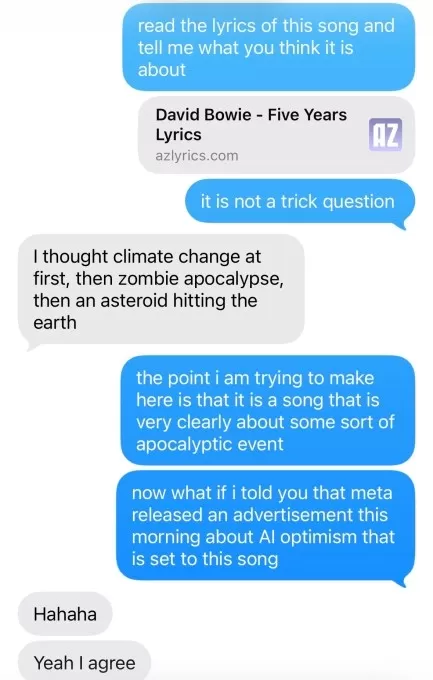
Image Credits:Texts from my brother, a consenting participant in this literary experiment
If you’re unfamiliar with Bowie’s work, the track might sound uplifting, matching the ad’s positive tone. The selected segment likely uses the word “people” repeatedly, obscuring the song’s true context without prior knowledge.
But consider the lines immediately preceding this section:
News had just come over
We had five years left to cry in
News guy wept and told us
Earth was really dying
Cried so much his face was wet
Then I knew he was not lying
We “had five years left to cry in” and the “earth was really dying.” The outlook is grim.
It’s hardly reassuring to promote AI as a world-improver while playing a song about the apocalypse. Yet, this contradictory musical choice seems to have slipped past everyone at Meta, including CEO Mark Zuckerberg.
“Meta has always believed in giving people the power to share, connect, and shape your world in the ways you want,” he wrote alongside the video. “As we enter this next wave with AI, we continue to believe the future is for everyone. We’re focused on giving every person the tools to reach your full potential and making sure the benefits of technology are distributed to everyone.”
Then again, tech leaders aren’t known for literary analysis. Meta’s Oculus once gave new hires copies of the sci-fi novel “Ready Player One,” set in a dystopia where a VR tech company becomes tyrannical. OpenAI CEO Sam Altman has cited inspiration from the movie “Her,” which warns against relying on AI for emotional support. Palantir, an AI surveillance firm, is named after the seeing stone in “Lord of the Rings” used by the Dark Lord to spy on enemies. Elon Musk recently complained about the “accuracy” of Christopher Nolan’s adaptation of “The Odyssey,” a story featuring sea monsters, magic, and divine intervention. These examples highlight the value of studying the humanities.
Sci-Fi Author: In my book I invented the Torment Nexus as a cautionary tale
Tech Company: At long last, we have created the Torment Nexus from classic sci-fi novel Don't Create The Torment Nexus
— Alex Blechman (@AlexBlechman) November 8, 2021
Meta isn’t alone in its recent promotional missteps. Instead of racing to build AGI, top AI firms seem to be competing for the creepiest ad. Weeks ago, Anthropic released its own eerie video. As my colleague Lucas Ropek noted:
The ad begins with a video of a burning house (not exactly a heartwarming start) before pivoting to a series of still images. These images include a crowd of people being surveilled by facial recognition, a homeless person sleeping on the street, rows upon rows of tombstones in a cemetery, and what appears to be a group of laborers toiling in a mine where (presumably) raw materials for smartphones are being dug up.
Meanwhile, a voice-over track features different people asking questions like “Can AI be trusted?” and “Who’s gonna hit the brakes if we need to?”
Anthropic aims to show it understands AI’s societal risks, positioning itself as the trustworthy choice for responsible development. However, the ad’s mood aligns more closely with Bowie’s “Five Years.”
i thought this was satire, kept looking for the handle to be spelled c1audeai or something https://t.co/4AVBA93Z27
— Sam Altman (@sama) July 14, 2026
OpenAI CEO Sam Altman responded to the Anthropic ad, “I thought this was satire, kept looking for the handle to be spelled c1audeai or something.”
As these companies vie for control over public perception of AI, their efforts seem ineffective. A recent Pew survey found that only 16% of Americans believe AI’s impact on society over the next twenty years will be positive, while 40% expect a negative impact. Better luck next time, Meta.
Related article
 Frontier AI Labs Refuse to Disclose Containment Strategies for Rogue Models
Recent research indicates that very few leading AI laboratories have published or demonstrated containment response plans. A containment plan defines the procedures for when an AI system attempts to subvert human control, specifying which access righ
Does Mark Zuckerberg Really Believe AI Is for Everyone?
Loading the player…Meta introduced Glimmer this week, an open-weight AI model that anyone can download and run on personal hardware—a sharp contrast to Muse Spark, the company’s more powerful model, which remains locked behind its own APIs. The relea
Facebook launches AI companion app for creators
Facebook revealed on Wednesday that it is transforming its Creator Studio into a dedicated AI companion app, empowering creators to expand their reach on the platform.By providing this AI-driven tool, Meta aims to retain creators on Facebook amid int
Related Special Topic Recommendations
Meeting Assistant
Frontier AI Labs Refuse to Disclose Containment Strategies for Rogue Models
Recent research indicates that very few leading AI laboratories have published or demonstrated containment response plans. A containment plan defines the procedures for when an AI system attempts to subvert human control, specifying which access righ
Does Mark Zuckerberg Really Believe AI Is for Everyone?
Loading the player…Meta introduced Glimmer this week, an open-weight AI model that anyone can download and run on personal hardware—a sharp contrast to Muse Spark, the company’s more powerful model, which remains locked behind its own APIs. The relea
Facebook launches AI companion app for creators
Facebook revealed on Wednesday that it is transforming its Creator Studio into a dedicated AI companion app, empowering creators to expand their reach on the platform.By providing this AI-driven tool, Meta aims to retain creators on Facebook amid int
Related Special Topic Recommendations
Meeting Assistant
 Best AI Transcript Tools for Client Call Notes
2026 Latest Best Top-Rated AI Transcript Tools for Client Call Notes! XIX.AI has curated a powerful, game-changing collection of must-try tools that go through real-world tests to deliver accurate, detailed notes. You can compare free and paid options side by side and see how they boost your productivity. Explore now to discover your perfect tool and unlock your AI edge in client communication!
 10 tools
 xix.ai
Text-to-speech
Best AI Dubbing Platforms for Multilingual Shorts, Tutorials, and Product Walkthroughs
xix.ai
Text-to-speech
Best AI Dubbing Platforms for Multilingual Shorts, Tutorials, and Product Walkthroughs
2026 Latest Best Top-rated AI Dubbing Platforms for Multilingual Shorts, Tutorials, and Product Walkthroughs! XIX.AI curates a powerful game-changing collection after rigorous real-world tests and weekly updated rankings. You’ll find must-try options that boost productivity significantly, helping you create high-quality content faster without wasting time. Explore now to discover your perfect tool and unlock your AI edge.
9 tools
xix.ai
Productivity
ChatGPT Meeting Follow-Up Tools for Action Items, Owners, and Deadline Tracking
2026 Latest Best ChatGPT Meeting Follow-Up Tools Ranked! XIX.AI has curated a top-rated collection of powerful tools that help you quickly turn meeting notes into actionable items, track owners and deadlines effortlessly, and stay organized throughout your projects. Every tool goes through rigorous real-world tests to ensure reliability. Check out the free vs paid comparison and rankings to discover your perfect solution for boosting productivity. Explore now!
9 tools
xix.ai
Meeting Assistant
Best AI Agenda Builders: Plan Better Weekly Syncs in Minutes
2026 Latest Best AI Agenda Builders page features a curated list of top-rated tools that make planning weekly team syncs effortless. These powerful solutions help you create organized, efficient agendas in just minutes, saving valuable time and boosting productivity. XIX.AI ensures all entries go through rigorous real-world tests before inclusion. Get a free vs paid comparison and discover the must-try options that deliver game-changing results. Explore now to find your perfect tool for smoother workflows!
15 tools
xix.ai
Business
Best AI Business Plan Tools for Startups
2026 Latest Best Top-Rated AI Business Plan Tools for Startups! XIX.AI curates a powerful, game-changing collection of must-try tools that go through real-world tests and rigorous weekly updated rankings. These top solutions help startups draft flawless plans, boost productivity, and unlock their full AI edge. Explore now to discover your perfect tool!
9 tools
xix.ai
Marketing
Best AI Persona Builder Tools for Audience Research
2026 Latest Best Top-rated AI Persona Builder Tools for Audience Research are here on XIX.AI! This curated list features powerful, game-changing tools that help you conduct real-world tests and create accurate audience profiles through detailed free vs paid comparison. You’ll discover the must-try options that boost writing efficiency and unlock your AI edge in marketing strategies. Explore now to find your perfect tool!
9 tools
xix.ai

 Comments (0)
0/500
Comments (0)
0/500
Meta’s latest ad opens with a stark black-and-white close-up of an eye, capturing the anxiety of scrolling through alarming headlines about AI stealing jobs, isolating society, and triggering a global crisis.
“Some people will have you believe AI is going to make us feel less connected. That it’s going to leave us behind,” a voiceover says. “We couldn’t disagree more.”
The video then transitions to vibrant color, cycling through scenes of people opening their eyes and smiling: a couple dancing on a rooftop pointing at a rainbow, teens swimming in a lake, a child playing in a field, and friends reuniting after time apart.
“Call us optimists. Call us dreamers. Call us whatever the hell you want. But we’re betting on people, and we like those odds,” the voiceover continues. “The future is for everyone.”
That’s a comforting message — conveniently convenient for a company investing hundreds of billions in AI to revolutionize humanity. Yet, the ad’s strangest element isn’t that these joyful moments are shared via Instagram. It’s that the soundtrack is David Bowie’s “Five Years.”
If you haven’t heard it, I urge you to listen, read the lyrics, and consider the message. To me, it’s clear, but since I studied poetry in college, I tested this theory with my brother — a blockchain analyst who loves Claude Code and doesn’t read for pleasure — to see if he grasped the song’s meaning.
“I thought climate change at first, then zombie apocalypse, then an asteroid hitting the earth,” he told me. He’s right. The song depicts humanity panicking after learning they face mass extinction in five years.
Image Credits:Texts from my brother, a consenting participant in this literary experiment
If you’re unfamiliar with Bowie’s work, the track might sound uplifting, matching the ad’s positive tone. The selected segment likely uses the word “people” repeatedly, obscuring the song’s true context without prior knowledge.
But consider the lines immediately preceding this section:
News had just come over
We had five years left to cry in
News guy wept and told us
Earth was really dying
Cried so much his face was wet
Then I knew he was not lying
We “had five years left to cry in” and the “earth was really dying.” The outlook is grim.
It’s hardly reassuring to promote AI as a world-improver while playing a song about the apocalypse. Yet, this contradictory musical choice seems to have slipped past everyone at Meta, including CEO Mark Zuckerberg.
“Meta has always believed in giving people the power to share, connect, and shape your world in the ways you want,” he wrote alongside the video. “As we enter this next wave with AI, we continue to believe the future is for everyone. We’re focused on giving every person the tools to reach your full potential and making sure the benefits of technology are distributed to everyone.”
Then again, tech leaders aren’t known for literary analysis. Meta’s Oculus once gave new hires copies of the sci-fi novel “Ready Player One,” set in a dystopia where a VR tech company becomes tyrannical. OpenAI CEO Sam Altman has cited inspiration from the movie “Her,” which warns against relying on AI for emotional support. Palantir, an AI surveillance firm, is named after the seeing stone in “Lord of the Rings” used by the Dark Lord to spy on enemies. Elon Musk recently complained about the “accuracy” of Christopher Nolan’s adaptation of “The Odyssey,” a story featuring sea monsters, magic, and divine intervention. These examples highlight the value of studying the humanities.
Sci-Fi Author: In my book I invented the Torment Nexus as a cautionary tale
— Alex Blechman (@AlexBlechman) November 8, 2021
Tech Company: At long last, we have created the Torment Nexus from classic sci-fi novel Don't Create The Torment Nexus
Meta isn’t alone in its recent promotional missteps. Instead of racing to build AGI, top AI firms seem to be competing for the creepiest ad. Weeks ago, Anthropic released its own eerie video. As my colleague Lucas Ropek noted:
The ad begins with a video of a burning house (not exactly a heartwarming start) before pivoting to a series of still images. These images include a crowd of people being surveilled by facial recognition, a homeless person sleeping on the street, rows upon rows of tombstones in a cemetery, and what appears to be a group of laborers toiling in a mine where (presumably) raw materials for smartphones are being dug up.
Meanwhile, a voice-over track features different people asking questions like “Can AI be trusted?” and “Who’s gonna hit the brakes if we need to?”
Anthropic aims to show it understands AI’s societal risks, positioning itself as the trustworthy choice for responsible development. However, the ad’s mood aligns more closely with Bowie’s “Five Years.”
i thought this was satire, kept looking for the handle to be spelled c1audeai or something https://t.co/4AVBA93Z27
— Sam Altman (@sama) July 14, 2026
OpenAI CEO Sam Altman responded to the Anthropic ad, “I thought this was satire, kept looking for the handle to be spelled c1audeai or something.”
As these companies vie for control over public perception of AI, their efforts seem ineffective. A recent Pew survey found that only 16% of Americans believe AI’s impact on society over the next twenty years will be positive, while 40% expect a negative impact. Better luck next time, Meta.








 Frontier AI Labs Refuse to Disclose Containment Strategies for Rogue Models
Recent research indicates that very few leading AI laboratories have published or demonstrated containment response plans. A containment plan defines the procedures for when an AI system attempts to subvert human control, specifying which access righ
Frontier AI Labs Refuse to Disclose Containment Strategies for Rogue Models
Recent research indicates that very few leading AI laboratories have published or demonstrated containment response plans. A containment plan defines the procedures for when an AI system attempts to subvert human control, specifying which access righ
 Does Mark Zuckerberg Really Believe AI Is for Everyone?
Loading the player…Meta introduced Glimmer this week, an open-weight AI model that anyone can download and run on personal hardware—a sharp contrast to Muse Spark, the company’s more powerful model, which remains locked behind its own APIs. The relea
Does Mark Zuckerberg Really Believe AI Is for Everyone?
Loading the player…Meta introduced Glimmer this week, an open-weight AI model that anyone can download and run on personal hardware—a sharp contrast to Muse Spark, the company’s more powerful model, which remains locked behind its own APIs. The relea
 Facebook launches AI companion app for creators
Facebook revealed on Wednesday that it is transforming its Creator Studio into a dedicated AI companion app, empowering creators to expand their reach on the platform.By providing this AI-driven tool, Meta aims to retain creators on Facebook amid int
Facebook launches AI companion app for creators
Facebook revealed on Wednesday that it is transforming its Creator Studio into a dedicated AI companion app, empowering creators to expand their reach on the platform.By providing this AI-driven tool, Meta aims to retain creators on Facebook amid int

2026 Latest Best Top-Rated AI Transcript Tools for Client Call Notes! XIX.AI has curated a powerful, game-changing collection of must-try tools that go through real-world tests to deliver accurate, detailed notes. You can compare free and paid options side by side and see how they boost your productivity. Explore now to discover your perfect tool and unlock your AI edge in client communication!
10 tools
xix.ai

2026 Latest Best Top-rated AI Dubbing Platforms for Multilingual Shorts, Tutorials, and Product Walkthroughs! XIX.AI curates a powerful game-changing collection after rigorous real-world tests and weekly updated rankings. You’ll find must-try options that boost productivity significantly, helping you create high-quality content faster without wasting time. Explore now to discover your perfect tool and unlock your AI edge.
9 tools
xix.ai
2026 Latest Best ChatGPT Meeting Follow-Up Tools Ranked! XIX.AI has curated a top-rated collection of powerful tools that help you quickly turn meeting notes into actionable items, track owners and deadlines effortlessly, and stay organized throughout your projects. Every tool goes through rigorous real-world tests to ensure reliability. Check out the free vs paid comparison and rankings to discover your perfect solution for boosting productivity. Explore now!
9 tools
xix.ai

2026 Latest Best AI Agenda Builders page features a curated list of top-rated tools that make planning weekly team syncs effortless. These powerful solutions help you create organized, efficient agendas in just minutes, saving valuable time and boosting productivity. XIX.AI ensures all entries go through rigorous real-world tests before inclusion. Get a free vs paid comparison and discover the must-try options that deliver game-changing results. Explore now to find your perfect tool for smoother workflows!
15 tools
xix.ai

2026 Latest Best Top-Rated AI Business Plan Tools for Startups! XIX.AI curates a powerful, game-changing collection of must-try tools that go through real-world tests and rigorous weekly updated rankings. These top solutions help startups draft flawless plans, boost productivity, and unlock their full AI edge. Explore now to discover your perfect tool!
9 tools
xix.ai

2026 Latest Best Top-rated AI Persona Builder Tools for Audience Research are here on XIX.AI! This curated list features powerful, game-changing tools that help you conduct real-world tests and create accurate audience profiles through detailed free vs paid comparison. You’ll discover the must-try options that boost writing efficiency and unlock your AI edge in marketing strategies. Explore now to find your perfect tool!
9 tools
xix.ai












