


 Home
HomeGoogle DeepMind launches institute to widen the AGI debate

Google and Google DeepMind established the DeepMind Institute on Wednesday to foster dialogue on artificial general intelligence. The institute is led by DeepMind co-founder Shane Legg, Google executive James Manyika, and Google DeepMind chair Demis Hassabis, with Legg acting as managing editor.
This new initiative seeks to highlight diverse perspectives within Google, DeepMind, and the global research community regarding AGI. The announcement notes that participants “may not always agree” and are likely to revise their positions as new data emerges at this rapidly evolving frontier.
The first collection features four essays addressing key issues: economic strategies for managing potential AGI disruption, maintaining human-readable model reasoning, principles for human flourishing, and a framework for assessing frontier AI models.
DeepMind safety researchers Rohin Shah and Anca Dragan argue in one essay that the declining transparency of AI systems—the capacity to inspect step-by-step reasoning—is not unavoidable. As newer architectures complicate monitoring, they suggest developers and regulators must address safety trade-offs directly. This could involve restricting “opaque serial depth,” or requiring proof that less transparent systems remain equally monitorable.
In another essay, Demis Hassabis proposes a U.S.-led frontier AI standards body to evaluate advanced models. Under this proposal, developers would initially submit models voluntarily for review up to 30 days before launch. Once the evaluation system proves effective, passing these tests could become mandatory for deploying frontier models in the United States.
Initially, this body would design assessments with input from AI companies, but it would eventually create independent, undisclosed evaluations—termed “held-out” tests—to prevent labs from optimizing models for known benchmarks. Hassabis indicated the framework could be “escalated if the situation warrants,” potentially including a coordinated slowdown among frontier AI developers.
These essays emerge as industry safety discussions shift from general concerns to concrete proposals for disclosure, external scrutiny, and coordinated slowdowns if safeguards lag. This momentum grew this week as industry leaders supported Anthropic CEO Dario Amodei’s call to “pace” frontier AI development.
Related article
 Anthropic’s Sonnet 5.5 Leak: 2M Token Context Challenges DeepSeek to Reclaim Cost-Effectiveness
Anthropic has unveiled its latest Sonnet 5.5 model, internally known as "Fennec" (after the desert fox), with a release expected next month. Leaked details indicate the model supports a 2 million token context window, offering faster reasoning, lower
Chrome Launches Skill Library for Gemini: One-Click Reuse of Prompts, Say Goodbye to Repetitive Input
Google has rolled out an update to the desktop version of Chrome, introducing a new "Skills Library" for its integrated Gemini feature. This enhancement enables users to save complex AI prompts as reusable "skills" for seamless application across web
Anthropic CEO Pushes for Bank-Style AI Rules, Experts Warn Against Being Both Player and Referee
According to CNBC, Anthropic CEO Dario Amodei suggested embedding long-term independent third-party safety assessors within leading AI firms, granting them near-access to internal risk teams and the authority to independently publish their findings u
Related Special Topic Recommendations
Social Media
Anthropic’s Sonnet 5.5 Leak: 2M Token Context Challenges DeepSeek to Reclaim Cost-Effectiveness
Anthropic has unveiled its latest Sonnet 5.5 model, internally known as "Fennec" (after the desert fox), with a release expected next month. Leaked details indicate the model supports a 2 million token context window, offering faster reasoning, lower
Chrome Launches Skill Library for Gemini: One-Click Reuse of Prompts, Say Goodbye to Repetitive Input
Google has rolled out an update to the desktop version of Chrome, introducing a new "Skills Library" for its integrated Gemini feature. This enhancement enables users to save complex AI prompts as reusable "skills" for seamless application across web
Anthropic CEO Pushes for Bank-Style AI Rules, Experts Warn Against Being Both Player and Referee
According to CNBC, Anthropic CEO Dario Amodei suggested embedding long-term independent third-party safety assessors within leading AI firms, granting them near-access to internal risk teams and the authority to independently publish their findings u
Related Special Topic Recommendations
Social Media
 Best AI Caption Generators: Write Platform-Specific Social Posts Fast
2026 Latest Best AI Caption Generators page! XIX.AI curated a top-rated list of must-try powerful tools for writing platform-specific social posts quickly. These tools go through rigorous real-world tests, offering free vs paid comparison and clear rankings to help you find the best option that boosts your productivity and unlocks your AI edge. Explore now!
 11 tools
 xix.ai
Health & Wellness
Best AI Sleep Coaching Tools for Shift Workers, Jet Lag Recovery, and Better Routines
xix.ai
Health & Wellness
Best AI Sleep Coaching Tools for Shift Workers, Jet Lag Recovery, and Better Routines
2026 Latest Best AI Sleep Coaching Tools for Shift Workers, Jet Lag Recovery, and Better Routines! XIX.AI has curated a top-rated list of powerful game-changing tools that go through real-world tests to deliver accurate guidance. You can find detailed free vs paid comparison info and see how these must-try solutions help boost sleep quality, speed up jet lag recovery, and build healthier routines. Explore now to discover your perfect tool!
7 tools
xix.ai
code
ChatGPT Debugging Tools for Python Errors, API Logs, and Stack Trace Triage
2026 Latest Best ChatGPT debugging tools for Python errors, API logs, and stack trace triage are here on XIX.AI. This curated list of top-rated solutions offers a free vs paid comparison, real-world tests, and detailed rankings to help you find the most powerful tool that can significantly boost your productivity and help you solve complex technical issues faster. Explore now to discover your perfect solution!
9 tools
xix.ai
Text-to-speech
AI Voiceover Tools for Product Demo Videos
2026 Latest Best Top-Rated AI Voiceover Tools for Product Demo Videos are here on XIX.AI! This curated list features powerful, game-changing options that help you create professional-quality audio content fast, boosting your demo efficiency significantly. We conduct real-world tests and provide a free vs paid comparison along with weekly updated rankings to help you find the perfect fit. Explore now to Unlock your AI edge!
10 tools
xix.ai
Business
AI Business Plan Tools for Startup Validation
2026 Latest Best AI Business Plan Tools for Startup Validation! XIX.AI has curated a top-rated list of powerful game-changing tools that go through real-world tests to deliver accurate results. You’ll find a free vs paid comparison, detailed rankings, and easy-to-understand insights to help you choose the perfect solution and boost your startup’s success rate. Explore now to Unlock your AI edge!
9 tools
xix.ai
chatbot
AI Chat Apps for Roleplay and Conversation Practice
2026 Latest Best AI Chat Apps for Roleplay and Conversation Practice! XIX.AI curates a top-rated list of powerful must-try tools that go through rigorous real-world tests to deliver exceptional results. You’ll find detailed free vs paid comparison, comprehensive rankings, and insights into how these apps can boost your language skills and communication confidence effectively. Explore now to discover your perfect tool for practice!
10 tools
xix.ai

 Comments (0)
0/500
Comments (0)
0/500
Google and Google DeepMind established the DeepMind Institute on Wednesday to foster dialogue on artificial general intelligence. The institute is led by DeepMind co-founder Shane Legg, Google executive James Manyika, and Google DeepMind chair Demis Hassabis, with Legg acting as managing editor.
This new initiative seeks to highlight diverse perspectives within Google, DeepMind, and the global research community regarding AGI. The announcement notes that participants “may not always agree” and are likely to revise their positions as new data emerges at this rapidly evolving frontier.
The first collection features four essays addressing key issues: economic strategies for managing potential AGI disruption, maintaining human-readable model reasoning, principles for human flourishing, and a framework for assessing frontier AI models.
DeepMind safety researchers Rohin Shah and Anca Dragan argue in one essay that the declining transparency of AI systems—the capacity to inspect step-by-step reasoning—is not unavoidable. As newer architectures complicate monitoring, they suggest developers and regulators must address safety trade-offs directly. This could involve restricting “opaque serial depth,” or requiring proof that less transparent systems remain equally monitorable.
In another essay, Demis Hassabis proposes a U.S.-led frontier AI standards body to evaluate advanced models. Under this proposal, developers would initially submit models voluntarily for review up to 30 days before launch. Once the evaluation system proves effective, passing these tests could become mandatory for deploying frontier models in the United States.
Initially, this body would design assessments with input from AI companies, but it would eventually create independent, undisclosed evaluations—termed “held-out” tests—to prevent labs from optimizing models for known benchmarks. Hassabis indicated the framework could be “escalated if the situation warrants,” potentially including a coordinated slowdown among frontier AI developers.
These essays emerge as industry safety discussions shift from general concerns to concrete proposals for disclosure, external scrutiny, and coordinated slowdowns if safeguards lag. This momentum grew this week as industry leaders supported Anthropic CEO Dario Amodei’s call to “pace” frontier AI development.








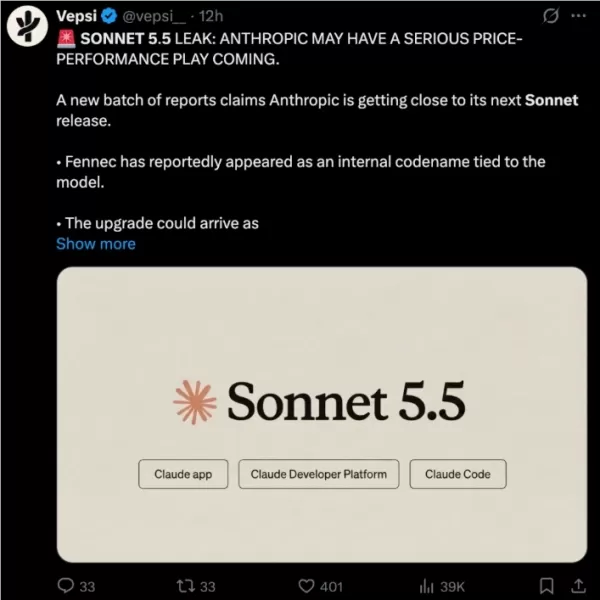 Anthropic’s Sonnet 5.5 Leak: 2M Token Context Challenges DeepSeek to Reclaim Cost-Effectiveness
Anthropic has unveiled its latest Sonnet 5.5 model, internally known as "Fennec" (after the desert fox), with a release expected next month. Leaked details indicate the model supports a 2 million token context window, offering faster reasoning, lower
Anthropic’s Sonnet 5.5 Leak: 2M Token Context Challenges DeepSeek to Reclaim Cost-Effectiveness
Anthropic has unveiled its latest Sonnet 5.5 model, internally known as "Fennec" (after the desert fox), with a release expected next month. Leaked details indicate the model supports a 2 million token context window, offering faster reasoning, lower
 Chrome Launches Skill Library for Gemini: One-Click Reuse of Prompts, Say Goodbye to Repetitive Input
Google has rolled out an update to the desktop version of Chrome, introducing a new "Skills Library" for its integrated Gemini feature. This enhancement enables users to save complex AI prompts as reusable "skills" for seamless application across web
Chrome Launches Skill Library for Gemini: One-Click Reuse of Prompts, Say Goodbye to Repetitive Input
Google has rolled out an update to the desktop version of Chrome, introducing a new "Skills Library" for its integrated Gemini feature. This enhancement enables users to save complex AI prompts as reusable "skills" for seamless application across web
 Anthropic CEO Pushes for Bank-Style AI Rules, Experts Warn Against Being Both Player and Referee
According to CNBC, Anthropic CEO Dario Amodei suggested embedding long-term independent third-party safety assessors within leading AI firms, granting them near-access to internal risk teams and the authority to independently publish their findings u
Anthropic CEO Pushes for Bank-Style AI Rules, Experts Warn Against Being Both Player and Referee
According to CNBC, Anthropic CEO Dario Amodei suggested embedding long-term independent third-party safety assessors within leading AI firms, granting them near-access to internal risk teams and the authority to independently publish their findings u

2026 Latest Best AI Caption Generators page! XIX.AI curated a top-rated list of must-try powerful tools for writing platform-specific social posts quickly. These tools go through rigorous real-world tests, offering free vs paid comparison and clear rankings to help you find the best option that boosts your productivity and unlocks your AI edge. Explore now!
11 tools
xix.ai

2026 Latest Best AI Sleep Coaching Tools for Shift Workers, Jet Lag Recovery, and Better Routines! XIX.AI has curated a top-rated list of powerful game-changing tools that go through real-world tests to deliver accurate guidance. You can find detailed free vs paid comparison info and see how these must-try solutions help boost sleep quality, speed up jet lag recovery, and build healthier routines. Explore now to discover your perfect tool!
7 tools
xix.ai

2026 Latest Best ChatGPT debugging tools for Python errors, API logs, and stack trace triage are here on XIX.AI. This curated list of top-rated solutions offers a free vs paid comparison, real-world tests, and detailed rankings to help you find the most powerful tool that can significantly boost your productivity and help you solve complex technical issues faster. Explore now to discover your perfect solution!
9 tools
xix.ai

2026 Latest Best Top-Rated AI Voiceover Tools for Product Demo Videos are here on XIX.AI! This curated list features powerful, game-changing options that help you create professional-quality audio content fast, boosting your demo efficiency significantly. We conduct real-world tests and provide a free vs paid comparison along with weekly updated rankings to help you find the perfect fit. Explore now to Unlock your AI edge!
10 tools
xix.ai

2026 Latest Best AI Business Plan Tools for Startup Validation! XIX.AI has curated a top-rated list of powerful game-changing tools that go through real-world tests to deliver accurate results. You’ll find a free vs paid comparison, detailed rankings, and easy-to-understand insights to help you choose the perfect solution and boost your startup’s success rate. Explore now to Unlock your AI edge!
9 tools
xix.ai

2026 Latest Best AI Chat Apps for Roleplay and Conversation Practice! XIX.AI curates a top-rated list of powerful must-try tools that go through rigorous real-world tests to deliver exceptional results. You’ll find detailed free vs paid comparison, comprehensive rankings, and insights into how these apps can boost your language skills and communication confidence effectively. Explore now to discover your perfect tool for practice!
10 tools
xix.ai












