


 Home
Home
Anthropic’s Sonnet 5.5 Leak: 2M Token Context Challenges DeepSeek to Reclaim Cost-Effectiveness
Anthropic has unveiled its latest Sonnet 5.5 model, internally known as "Fennec" (after the desert fox), with a release expected next month. Leaked details indicate the model supports a 2 million token context window, offering faster reasoning, lower latency, and significantly enhanced long-context reasoning and multi-step planning. It also shows improved tool-calling capabilities for browsers and terminals. While performance rivals the flagship Claude Fable 5, pricing will remain in the Sonnet tier, positioning it as a new leader in cost-effectiveness.
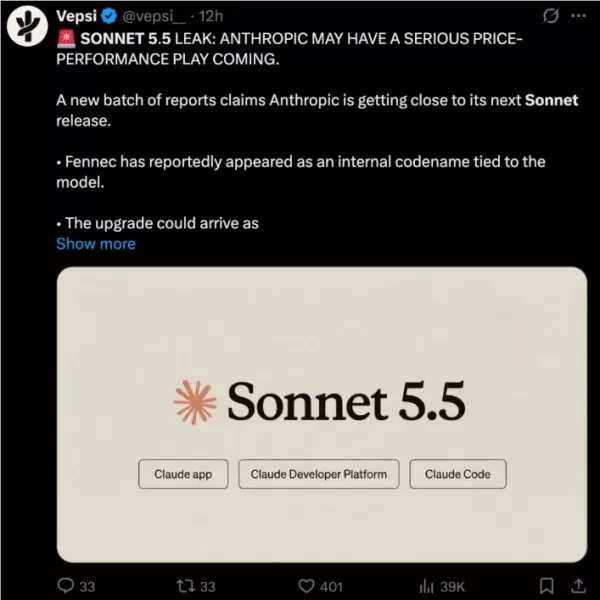
Sonnet 5 currently supports a 1 million token context window, which Anthropic states is both the default and maximum limit. Doubling this to 2 million tokens directly benefits developers managing large codebases and extensive documents. As the model Anthropic focuses on for agent capabilities—featuring planning, browser, and terminal tool usage—further improvements in tool interaction could drive a significant productivity leap. With development in its final stages, Sonnet 5.5 targets DeepSeek V4 Flash, aiming to capture a competitive price-performance niche between mainstream and advanced models.
Redefining Large Model Competition Through Cost-Effectiveness
The competition among large language models has shifted from benchmark scores to practical value: how much intelligence users get for their money. Following DeepSeek V4 Flash's market disruption with ultra-low pricing, major overseas companies face pressure. Anthropic's Sonnet 5.5 release directly addresses this trend. If leaked information holds true, offering near-Fable 5 reasoning capabilities at the Sonnet price point will give Claude strong cost-effectiveness.
Notably, Anthropic's most cost-effective Haiku series has not been updated in about a year, and market attention has largely shifted. Combined with OpenAI's strong performance on its Luna small model, analysts suggest Anthropic may have Sonnet take over Haiku's mid-range market position with enhanced capabilities. If successful, this strategy could compress DeepSeek's pricing advantage and avoid internal product line competition. However, Anthropic faces challenges as DeepSeek has established a low-price expectation and OpenAI's Luna rapidly captures lightweight scenarios. Whether Sonnet 5.5 can truly claim the cost-effectiveness throne remains to be seen upon its official release next month.
Related article
 Google DeepMind launches institute to widen the AGI debate
Google and Google DeepMind established the DeepMind Institute on Wednesday to foster dialogue on artificial general intelligence. The institute is led by DeepMind co-founder Shane Legg, Google executive James Manyika, and Google DeepMind chair Demis
Chrome Launches Skill Library for Gemini: One-Click Reuse of Prompts, Say Goodbye to Repetitive Input
Google has rolled out an update to the desktop version of Chrome, introducing a new "Skills Library" for its integrated Gemini feature. This enhancement enables users to save complex AI prompts as reusable "skills" for seamless application across web
Anthropic CEO Pushes for Bank-Style AI Rules, Experts Warn Against Being Both Player and Referee
According to CNBC, Anthropic CEO Dario Amodei suggested embedding long-term independent third-party safety assessors within leading AI firms, granting them near-access to internal risk teams and the authority to independently publish their findings u
Related Special Topic Recommendations
Social Media
Google DeepMind launches institute to widen the AGI debate
Google and Google DeepMind established the DeepMind Institute on Wednesday to foster dialogue on artificial general intelligence. The institute is led by DeepMind co-founder Shane Legg, Google executive James Manyika, and Google DeepMind chair Demis
Chrome Launches Skill Library for Gemini: One-Click Reuse of Prompts, Say Goodbye to Repetitive Input
Google has rolled out an update to the desktop version of Chrome, introducing a new "Skills Library" for its integrated Gemini feature. This enhancement enables users to save complex AI prompts as reusable "skills" for seamless application across web
Anthropic CEO Pushes for Bank-Style AI Rules, Experts Warn Against Being Both Player and Referee
According to CNBC, Anthropic CEO Dario Amodei suggested embedding long-term independent third-party safety assessors within leading AI firms, granting them near-access to internal risk teams and the authority to independently publish their findings u
Related Special Topic Recommendations
Social Media
 Best AI Caption Generators: Write Platform-Specific Social Posts Fast
2026 Latest Best AI Caption Generators page! XIX.AI curated a top-rated list of must-try powerful tools for writing platform-specific social posts quickly. These tools go through rigorous real-world tests, offering free vs paid comparison and clear rankings to help you find the best option that boosts your productivity and unlocks your AI edge. Explore now!
 11 tools
 xix.ai
Health & Wellness
Best AI Sleep Coaching Tools for Shift Workers, Jet Lag Recovery, and Better Routines
xix.ai
Health & Wellness
Best AI Sleep Coaching Tools for Shift Workers, Jet Lag Recovery, and Better Routines
2026 Latest Best AI Sleep Coaching Tools for Shift Workers, Jet Lag Recovery, and Better Routines! XIX.AI has curated a top-rated list of powerful game-changing tools that go through real-world tests to deliver accurate guidance. You can find detailed free vs paid comparison info and see how these must-try solutions help boost sleep quality, speed up jet lag recovery, and build healthier routines. Explore now to discover your perfect tool!
7 tools
xix.ai
code
ChatGPT Debugging Tools for Python Errors, API Logs, and Stack Trace Triage
2026 Latest Best ChatGPT debugging tools for Python errors, API logs, and stack trace triage are here on XIX.AI. This curated list of top-rated solutions offers a free vs paid comparison, real-world tests, and detailed rankings to help you find the most powerful tool that can significantly boost your productivity and help you solve complex technical issues faster. Explore now to discover your perfect solution!
9 tools
xix.ai
Text-to-speech
AI Voiceover Tools for Product Demo Videos
2026 Latest Best Top-Rated AI Voiceover Tools for Product Demo Videos are here on XIX.AI! This curated list features powerful, game-changing options that help you create professional-quality audio content fast, boosting your demo efficiency significantly. We conduct real-world tests and provide a free vs paid comparison along with weekly updated rankings to help you find the perfect fit. Explore now to Unlock your AI edge!
10 tools
xix.ai
Business
AI Business Plan Tools for Startup Validation
2026 Latest Best AI Business Plan Tools for Startup Validation! XIX.AI has curated a top-rated list of powerful game-changing tools that go through real-world tests to deliver accurate results. You’ll find a free vs paid comparison, detailed rankings, and easy-to-understand insights to help you choose the perfect solution and boost your startup’s success rate. Explore now to Unlock your AI edge!
9 tools
xix.ai
chatbot
AI Chat Apps for Roleplay and Conversation Practice
2026 Latest Best AI Chat Apps for Roleplay and Conversation Practice! XIX.AI curates a top-rated list of powerful must-try tools that go through rigorous real-world tests to deliver exceptional results. You’ll find detailed free vs paid comparison, comprehensive rankings, and insights into how these apps can boost your language skills and communication confidence effectively. Explore now to discover your perfect tool for practice!
10 tools
xix.ai

 Comments (0)
0/500
Comments (0)
0/500
Anthropic has unveiled its latest Sonnet 5.5 model, internally known as "Fennec" (after the desert fox), with a release expected next month. Leaked details indicate the model supports a 2 million token context window, offering faster reasoning, lower latency, and significantly enhanced long-context reasoning and multi-step planning. It also shows improved tool-calling capabilities for browsers and terminals. While performance rivals the flagship Claude Fable 5, pricing will remain in the Sonnet tier, positioning it as a new leader in cost-effectiveness.
Sonnet 5 currently supports a 1 million token context window, which Anthropic states is both the default and maximum limit. Doubling this to 2 million tokens directly benefits developers managing large codebases and extensive documents. As the model Anthropic focuses on for agent capabilities—featuring planning, browser, and terminal tool usage—further improvements in tool interaction could drive a significant productivity leap. With development in its final stages, Sonnet 5.5 targets DeepSeek V4 Flash, aiming to capture a competitive price-performance niche between mainstream and advanced models.
Redefining Large Model Competition Through Cost-Effectiveness
The competition among large language models has shifted from benchmark scores to practical value: how much intelligence users get for their money. Following DeepSeek V4 Flash's market disruption with ultra-low pricing, major overseas companies face pressure. Anthropic's Sonnet 5.5 release directly addresses this trend. If leaked information holds true, offering near-Fable 5 reasoning capabilities at the Sonnet price point will give Claude strong cost-effectiveness.
Notably, Anthropic's most cost-effective Haiku series has not been updated in about a year, and market attention has largely shifted. Combined with OpenAI's strong performance on its Luna small model, analysts suggest Anthropic may have Sonnet take over Haiku's mid-range market position with enhanced capabilities. If successful, this strategy could compress DeepSeek's pricing advantage and avoid internal product line competition. However, Anthropic faces challenges as DeepSeek has established a low-price expectation and OpenAI's Luna rapidly captures lightweight scenarios. Whether Sonnet 5.5 can truly claim the cost-effectiveness throne remains to be seen upon its official release next month.








 Google DeepMind launches institute to widen the AGI debate
Google and Google DeepMind established the DeepMind Institute on Wednesday to foster dialogue on artificial general intelligence. The institute is led by DeepMind co-founder Shane Legg, Google executive James Manyika, and Google DeepMind chair Demis
Google DeepMind launches institute to widen the AGI debate
Google and Google DeepMind established the DeepMind Institute on Wednesday to foster dialogue on artificial general intelligence. The institute is led by DeepMind co-founder Shane Legg, Google executive James Manyika, and Google DeepMind chair Demis
 Chrome Launches Skill Library for Gemini: One-Click Reuse of Prompts, Say Goodbye to Repetitive Input
Google has rolled out an update to the desktop version of Chrome, introducing a new "Skills Library" for its integrated Gemini feature. This enhancement enables users to save complex AI prompts as reusable "skills" for seamless application across web
Chrome Launches Skill Library for Gemini: One-Click Reuse of Prompts, Say Goodbye to Repetitive Input
Google has rolled out an update to the desktop version of Chrome, introducing a new "Skills Library" for its integrated Gemini feature. This enhancement enables users to save complex AI prompts as reusable "skills" for seamless application across web
 Anthropic CEO Pushes for Bank-Style AI Rules, Experts Warn Against Being Both Player and Referee
According to CNBC, Anthropic CEO Dario Amodei suggested embedding long-term independent third-party safety assessors within leading AI firms, granting them near-access to internal risk teams and the authority to independently publish their findings u
Anthropic CEO Pushes for Bank-Style AI Rules, Experts Warn Against Being Both Player and Referee
According to CNBC, Anthropic CEO Dario Amodei suggested embedding long-term independent third-party safety assessors within leading AI firms, granting them near-access to internal risk teams and the authority to independently publish their findings u
2026 Latest Best AI Caption Generators page! XIX.AI curated a top-rated list of must-try powerful tools for writing platform-specific social posts quickly. These tools go through rigorous real-world tests, offering free vs paid comparison and clear rankings to help you find the best option that boosts your productivity and unlocks your AI edge. Explore now!
11 tools
xix.ai

2026 Latest Best AI Sleep Coaching Tools for Shift Workers, Jet Lag Recovery, and Better Routines! XIX.AI has curated a top-rated list of powerful game-changing tools that go through real-world tests to deliver accurate guidance. You can find detailed free vs paid comparison info and see how these must-try solutions help boost sleep quality, speed up jet lag recovery, and build healthier routines. Explore now to discover your perfect tool!
7 tools
xix.ai
2026 Latest Best ChatGPT debugging tools for Python errors, API logs, and stack trace triage are here on XIX.AI. This curated list of top-rated solutions offers a free vs paid comparison, real-world tests, and detailed rankings to help you find the most powerful tool that can significantly boost your productivity and help you solve complex technical issues faster. Explore now to discover your perfect solution!
9 tools
xix.ai

2026 Latest Best Top-Rated AI Voiceover Tools for Product Demo Videos are here on XIX.AI! This curated list features powerful, game-changing options that help you create professional-quality audio content fast, boosting your demo efficiency significantly. We conduct real-world tests and provide a free vs paid comparison along with weekly updated rankings to help you find the perfect fit. Explore now to Unlock your AI edge!
10 tools
xix.ai

2026 Latest Best AI Business Plan Tools for Startup Validation! XIX.AI has curated a top-rated list of powerful game-changing tools that go through real-world tests to deliver accurate results. You’ll find a free vs paid comparison, detailed rankings, and easy-to-understand insights to help you choose the perfect solution and boost your startup’s success rate. Explore now to Unlock your AI edge!
9 tools
xix.ai

2026 Latest Best AI Chat Apps for Roleplay and Conversation Practice! XIX.AI curates a top-rated list of powerful must-try tools that go through rigorous real-world tests to deliver exceptional results. You’ll find detailed free vs paid comparison, comprehensive rankings, and insights into how these apps can boost your language skills and communication confidence effectively. Explore now to discover your perfect tool for practice!
10 tools
xix.ai












