


 Home
HomeGoogle AI Search Cuts Small Website Traffic by 60%, Axios Reports
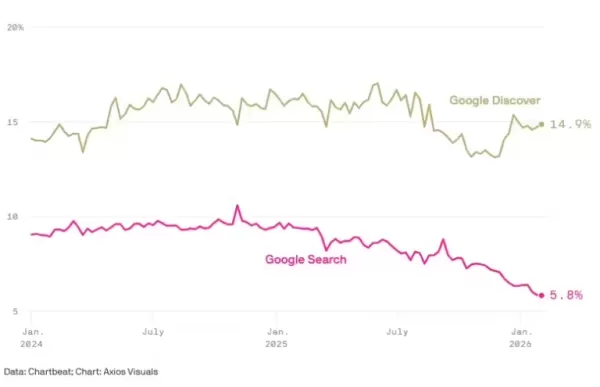
Technology outlet Axios recently published a data report from Chartbeat, detailing the severe impact of Google's "AI Overviews" feature on content publishers. The report highlights that as AI provides direct answers at the top of search results, user motivation to click through to original source websites has plummeted.
Traffic Erosion: Smaller Sites Hit Hardest
The data reveals that websites of all sizes have seen declines in referral traffic, with smaller publishers—those least equipped to handle the risk—bearing the brunt of the impact:
Small Publishers (1k-10k daily pageviews): Have lost up to 60% of their Google referral traffic over the past two years.Midsize Publishers (10k-100k daily pageviews): Experienced a 47% drop in traditional search traffic.Large Publishers (100k+ daily pageviews): Saw traffic decrease by 22%.
A Failing Lifeline: AI Traffic Remains Below 1%
Even for publishers attempting to optimize for AI chatbots, the results have been disappointing:
Minimal Overall Impact: While traffic from AI chatbots grew over 200% year-over-year, it still represents less than 1% of total site traffic.
Ineffective Redirects: Research indicates most users redirected to source pages via AI are not there to read the content, but merely to verify the accuracy of the AI's summary.
Shrinking Alternative Channels: Traffic from the once-promising "Google Discover" feed also declined by 15% in the past year.
Confronted with this hemorrhage of search engine traffic, the content industry is being pushed toward a transformation:
Moving Off-Platform: Major publishers are increasingly turning to email newsletters and cultivating direct traffic, striving to build an audience independent of algorithmic control.
Higher Barriers to Survival: The significant time and resources required to build a standalone brand mean smaller, independent creators face the risk of being pushed out of the industry entirely.
The report concludes that Google search referral views fell by a total of 34% through 2025, indicating that this AI-driven shift in search is fundamentally rewriting the rules of online traffic distribution.
Related article
 Former OpenAI Researcher Barrett Zoph Returns to Google to Support Gemini Development
Barret Zoph, who previously abruptly left and joined OpenAI due to a disagreement with Thinking Machines Lab CEO Miriam Mularati, has once again changed employers. Alphabet's Google announced that Zoph will return as Vice President of Research, bring
How Recursive Intelligence Raised $335M at $4B Valuation in 4 Months
The co-founders of startup Ricursive Intelligence seemed destined to be co-founders.Anna Goldie, CEO, and Azalia Mirhoseini, CTO, are so well-known in the AI community that they were among those AI engineers who “got those weird emails from Zuckerber
AI race won’t wait, nor will this TechCrunch Disrupt 25% discount
Every founder building in AI right now is asking the same question: Are we moving fast enough, and effectively enough? TechCrunch Disrupt 2026 puts you in the same room as the people wrestling with that existential question at the highest levels. Fro
Related Special Topic Recommendations
Design & Art
Former OpenAI Researcher Barrett Zoph Returns to Google to Support Gemini Development
Barret Zoph, who previously abruptly left and joined OpenAI due to a disagreement with Thinking Machines Lab CEO Miriam Mularati, has once again changed employers. Alphabet's Google announced that Zoph will return as Vice President of Research, bring
How Recursive Intelligence Raised $335M at $4B Valuation in 4 Months
The co-founders of startup Ricursive Intelligence seemed destined to be co-founders.Anna Goldie, CEO, and Azalia Mirhoseini, CTO, are so well-known in the AI community that they were among those AI engineers who “got those weird emails from Zuckerber
AI race won’t wait, nor will this TechCrunch Disrupt 25% discount
Every founder building in AI right now is asking the same question: Are we moving fast enough, and effectively enough? TechCrunch Disrupt 2026 puts you in the same room as the people wrestling with that existential question at the highest levels. Fro
Related Special Topic Recommendations
Design & Art
 Top AI Illustration Tools: Create Editorial Scenes and Cover Art Faster
2026 Latest Top-rated AI Illustration Tools: Our curated list features the best powerfully designed tools for creating stunning editorial scenes and eye-catching cover art quickly. Each option has gone through rigorous real-world tests, offering a free vs paid comparison to help you find the perfect match for your workflow. Try these must-try solutions today to unlock your AI edge and boost your creative productivity. Explore now at XIX.AI.
 10 tools
 xix.ai
Education and Learning
Top AI Tutors for Exam Prep: Practice Math, Science, and English
xix.ai
Education and Learning
Top AI Tutors for Exam Prep: Practice Math, Science, and English
2026 Latest Top-Rated Best AI Tutors for Exam Prep are here on XIX.AI! Our curated list features powerful game-changing tools that offer free vs paid comparison, real-world tests, and weekly updated rankings. They help boost your writing efficiency, simplify complex topic learning, and unlock your academic potential. Explore now to Discover your perfect exam prep tool and Start creating today to Unlock your AI edge!
10 tools
xix.ai
Finance
AI Budget Planning Tools for Personal Money Management
2026 Latest Best Top-Rated AI Budget Planning Tools for Personal Money Management are here on XIX.AI! This curated collection features powerful, game-changing solutions that help you conduct real-world tests, understand spending habits, and create personalized plans to boost productivity. Enjoy a free vs paid comparison along with detailed rankings. Must-try tools designed to simplify money management and unlock your AI edge. Explore now!
11 tools
xix.ai
Health & Wellness
AI Sleep Tracking Assistants: Improve Recovery with Better Bedtime Habits
2026 Latest Best Top-Rated AI Sleep Tracking Assistants curated for ultimate recovery. This fully updated weekly guide features powerful tools that deliver real-world tests, free vs paid comparison, and detailed rankings to help you find the must-try solution that boosts sleep quality and supports better bedtime habits. Explore now at XIX.AI to Unlock your AI edge.
10 tools
xix.ai
Data Analysis
AI SQL Copilots for Product and Revenue Analytics
2026 Latest Best Top-Rated AI SQL Copilots for Product and Revenue Analytics! XIX.AI has curated a powerful, game-changing collection of must-try tools that undergo real-world tests through weekly updated rankings. These tools help users boost productivity significantly by accelerating data analysis, streamlining complex queries, and generating accurate insights to drive smarter business decisions. Explore now to Discover your perfect tool for unlocking your AI edge!
14 tools
xix.ai
Education and Learning
Best AI Homework Helpers That Teach: Learn Concepts, Not Just Answers
2026 Latest Best Top-Rated AI Homework Helpers That Teach Core Concepts Not Just Answers Powerful Tools for Students Must-Try Curated List Weekly Updated Free vs Paid Comparison Real-World Tests Accurate Rankings to Help You Unlock Your Full Learning Potential Explore now to Discover your perfect tool for smarter studying.
10 tools
xix.ai

 Comments (1)
0/500
Comments (1)
0/500
![TimothyHernández]()
Damn, 60% drop is brutal for small publishers. Google's AI summaries are convenient but they're killing the web's diversity. 😤
Technology outlet Axios recently published a data report from Chartbeat, detailing the severe impact of Google's "AI Overviews" feature on content publishers. The report highlights that as AI provides direct answers at the top of search results, user motivation to click through to original source websites has plummeted.
Traffic Erosion: Smaller Sites Hit Hardest
The data reveals that websites of all sizes have seen declines in referral traffic, with smaller publishers—those least equipped to handle the risk—bearing the brunt of the impact:
Small Publishers (1k-10k daily pageviews): Have lost up to 60% of their Google referral traffic over the past two years.Midsize Publishers (10k-100k daily pageviews): Experienced a 47% drop in traditional search traffic.Large Publishers (100k+ daily pageviews): Saw traffic decrease by 22%.
A Failing Lifeline: AI Traffic Remains Below 1%
Even for publishers attempting to optimize for AI chatbots, the results have been disappointing:
Minimal Overall Impact: While traffic from AI chatbots grew over 200% year-over-year, it still represents less than 1% of total site traffic.
Ineffective Redirects: Research indicates most users redirected to source pages via AI are not there to read the content, but merely to verify the accuracy of the AI's summary.
Shrinking Alternative Channels: Traffic from the once-promising "Google Discover" feed also declined by 15% in the past year.
Confronted with this hemorrhage of search engine traffic, the content industry is being pushed toward a transformation:
Moving Off-Platform: Major publishers are increasingly turning to email newsletters and cultivating direct traffic, striving to build an audience independent of algorithmic control.
Higher Barriers to Survival: The significant time and resources required to build a standalone brand mean smaller, independent creators face the risk of being pushed out of the industry entirely.
The report concludes that Google search referral views fell by a total of 34% through 2025, indicating that this AI-driven shift in search is fundamentally rewriting the rules of online traffic distribution.








 Former OpenAI Researcher Barrett Zoph Returns to Google to Support Gemini Development
Barret Zoph, who previously abruptly left and joined OpenAI due to a disagreement with Thinking Machines Lab CEO Miriam Mularati, has once again changed employers. Alphabet's Google announced that Zoph will return as Vice President of Research, bring
Former OpenAI Researcher Barrett Zoph Returns to Google to Support Gemini Development
Barret Zoph, who previously abruptly left and joined OpenAI due to a disagreement with Thinking Machines Lab CEO Miriam Mularati, has once again changed employers. Alphabet's Google announced that Zoph will return as Vice President of Research, bring
 How Recursive Intelligence Raised $335M at $4B Valuation in 4 Months
The co-founders of startup Ricursive Intelligence seemed destined to be co-founders.Anna Goldie, CEO, and Azalia Mirhoseini, CTO, are so well-known in the AI community that they were among those AI engineers who “got those weird emails from Zuckerber
How Recursive Intelligence Raised $335M at $4B Valuation in 4 Months
The co-founders of startup Ricursive Intelligence seemed destined to be co-founders.Anna Goldie, CEO, and Azalia Mirhoseini, CTO, are so well-known in the AI community that they were among those AI engineers who “got those weird emails from Zuckerber
 AI race won’t wait, nor will this TechCrunch Disrupt 25% discount
Every founder building in AI right now is asking the same question: Are we moving fast enough, and effectively enough? TechCrunch Disrupt 2026 puts you in the same room as the people wrestling with that existential question at the highest levels. Fro
AI race won’t wait, nor will this TechCrunch Disrupt 25% discount
Every founder building in AI right now is asking the same question: Are we moving fast enough, and effectively enough? TechCrunch Disrupt 2026 puts you in the same room as the people wrestling with that existential question at the highest levels. Fro

2026 Latest Top-rated AI Illustration Tools: Our curated list features the best powerfully designed tools for creating stunning editorial scenes and eye-catching cover art quickly. Each option has gone through rigorous real-world tests, offering a free vs paid comparison to help you find the perfect match for your workflow. Try these must-try solutions today to unlock your AI edge and boost your creative productivity. Explore now at XIX.AI.
10 tools
xix.ai

2026 Latest Top-Rated Best AI Tutors for Exam Prep are here on XIX.AI! Our curated list features powerful game-changing tools that offer free vs paid comparison, real-world tests, and weekly updated rankings. They help boost your writing efficiency, simplify complex topic learning, and unlock your academic potential. Explore now to Discover your perfect exam prep tool and Start creating today to Unlock your AI edge!
10 tools
xix.ai

2026 Latest Best Top-Rated AI Budget Planning Tools for Personal Money Management are here on XIX.AI! This curated collection features powerful, game-changing solutions that help you conduct real-world tests, understand spending habits, and create personalized plans to boost productivity. Enjoy a free vs paid comparison along with detailed rankings. Must-try tools designed to simplify money management and unlock your AI edge. Explore now!
11 tools
xix.ai

2026 Latest Best Top-Rated AI Sleep Tracking Assistants curated for ultimate recovery. This fully updated weekly guide features powerful tools that deliver real-world tests, free vs paid comparison, and detailed rankings to help you find the must-try solution that boosts sleep quality and supports better bedtime habits. Explore now at XIX.AI to Unlock your AI edge.
10 tools
xix.ai

2026 Latest Best Top-Rated AI SQL Copilots for Product and Revenue Analytics! XIX.AI has curated a powerful, game-changing collection of must-try tools that undergo real-world tests through weekly updated rankings. These tools help users boost productivity significantly by accelerating data analysis, streamlining complex queries, and generating accurate insights to drive smarter business decisions. Explore now to Discover your perfect tool for unlocking your AI edge!
14 tools
xix.ai

2026 Latest Best Top-Rated AI Homework Helpers That Teach Core Concepts Not Just Answers Powerful Tools for Students Must-Try Curated List Weekly Updated Free vs Paid Comparison Real-World Tests Accurate Rankings to Help You Unlock Your Full Learning Potential Explore now to Discover your perfect tool for smarter studying.
10 tools
xix.ai

Damn, 60% drop is brutal for small publishers. Google's AI summaries are convenient but they're killing the web's diversity. 😤












