


 Home
HomeDavid Sacks Leaves AI Czar Role, Unveils Next Move
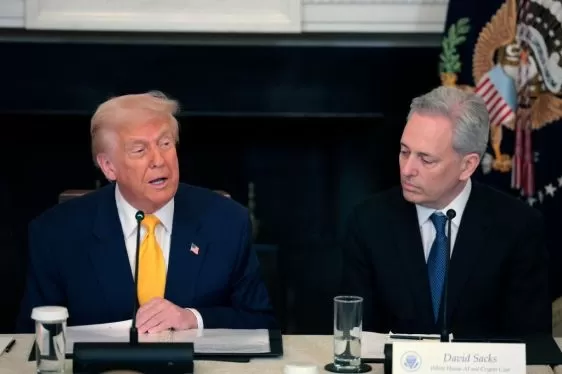
David Sacks’ tenure as Donald Trump’s AI and crypto czar has come to an end.
In an interview with Bloomberg on Thursday, the longtime entrepreneur, investor and podcaster confirmed that his 130‑day, non‑consecutive role as a special government employee is over. He is now moving to co‑chair the President’s Council of Advisors on Science and Technology (PCAST) alongside senior White House technology adviser Michael Kratsios.
“Going forward as co‑chair of PCAST, I can offer recommendations not just on AI but on a wider range of technology topics,” he told Bloomberg in a video interview. “So yes, this is how I’ll be contributing from now on.”
In practice, this means Sacks will be much farther from Washington’s power center than at any point since the start of the second Trump administration. As AI czar, he had a direct line to Trump and helped shape policy. PCAST is a federal advisory body—it examines issues, produces reports and sends recommendations up the chain, but it does not set policy.
The council has existed in some form since FDR, but Sacks noted to Bloomberg that this particular iteration has “the most star power of any group like this” ever assembled, and it’s hard to argue with him. The initial 15 members include Nvidia’s Jensen Huang, Meta’s Mark Zuckerberg, Oracle’s Larry Ellison, Google co‑founder Sergey Brin, Marc Andreessen, AMD’s Lisa Su and Michael Dell, among others. (That’s a lot of billionaires.)
Sacks told Bloomberg the council will take on AI, advanced semiconductors, quantum computing and nuclear power, with near‑term focus on advancing Trump’s national AI framework, released just last week. The framework is designed to replace what Sacks described as a messy tangle of conflicting state‑level rules. “You’ve got 50 different states regulating this in 50 different ways,” he said, “and it’s creating a patchwork of regulation that’s difficult for our innovators to comply with.”
What Sacks did not directly address was why the transition is happening now and whether his recent comments played a role. Earlier this month, on the popular “All In” podcast he co‑hosts, Sacks publicly urged the administration to find an exit from the U.S.‑backed war with Iran, walking through a series of worsening scenarios—attacks on oil infrastructure in neighboring countries, destruction of desalination plants and the possibility of nuclear use by Israel—and calling for a diplomatic way out. Trump responded by telling reporters that Sacks hadn’t spoken to him about the war. (The U.S.‑Israel war on Iran has now been going on for approximately 27 days.)
Asked about the podcast episode by Bloomberg on Thursday, Sacks essentially threw up his hands: “I’m not on the foreign policy team or the national security team,” he said, adding that his podcast comments represented his personal view, not an official one.
For all the marquee names Sacks is bringing to PCAST, it’s worth remembering what the council has historically been: an advisory body that wielded influence in some administrations and almost none in others.
President Obama’s version was arguably the most productive on record, producing 36 reports over eight years—two of which led to concrete policy changes, including an FDA rule that opened the market for over‑the‑counter hearing aids.
President Trump’s first‑term council, by contrast, took nearly three years just to name its first members, issued only a handful of reports and made little impact. President Biden’s council leaned heavily academic—with Nobel laureates, MacArthur fellows and National Academy members—and released a modest number of reports before the administration ended.
The current PCAST is a completely different animal, built almost entirely from the executive suites of the companies shaping the technology it will advise on.
Now, Sacks is once again one of those unencumbered executives, free to return to his life as an investor and entrepreneur. A spokesperson for Craft Ventures, the firm Sacks co‑founded and where he remains a partner, has not yet responded to related questions about next steps. TechCrunch reported last year on the ethics waivers Sacks obtained to maintain financial stakes in AI and crypto companies while shaping federal policy in both areas—an arrangement that drew sharp criticism from ethics experts and lawmakers.
Related article
 Kimi: Threat or menace?
Chinese company Moonshot AI launched an updated version of its Kimi model this week, sparking fresh discussions about China's role in open-source AI.Moonshot stated that while Kimi K3 “still trails the most powerful proprietary models, Claude Fable 5
DeepMind CEO Hassabis: I sleep six hours a day, usually feel energetic around 1 a.m.
Fortune recently featured an interview with Demis Hassabis, CEO of Google DeepMind, revealing his unconventional approach to rest and productivity. Hassabis disclosed that he sleeps very little, structuring his waking hours into two distinct work blo
OpenAI, Anthropic Vie for Market Share Despite Revenue Shortfalls
Despite recent reports suggesting OpenAI missed revenue targets, creating pressure on tech stocks this Tuesday, private AI lab investors remain resilient. Seasoned backers have confirmed they will not reduce investment despite negative media coverage
Related Special Topic Recommendations
Video creation
Kimi: Threat or menace?
Chinese company Moonshot AI launched an updated version of its Kimi model this week, sparking fresh discussions about China's role in open-source AI.Moonshot stated that while Kimi K3 “still trails the most powerful proprietary models, Claude Fable 5
DeepMind CEO Hassabis: I sleep six hours a day, usually feel energetic around 1 a.m.
Fortune recently featured an interview with Demis Hassabis, CEO of Google DeepMind, revealing his unconventional approach to rest and productivity. Hassabis disclosed that he sleeps very little, structuring his waking hours into two distinct work blo
OpenAI, Anthropic Vie for Market Share Despite Revenue Shortfalls
Despite recent reports suggesting OpenAI missed revenue targets, creating pressure on tech stocks this Tuesday, private AI lab investors remain resilient. Seasoned backers have confirmed they will not reduce investment despite negative media coverage
Related Special Topic Recommendations
Video creation
 AI Short-Form Video Hook Generators for Reels, Shorts, and Product Launch Campaigns
2026 Latest Best AI Short-Form Video Hook Generators for Reels Shorts and Product Launch Campaigns! XIX.AI curates top-rated powerful game-changing tools that deliver must-try results through real-world tests. This weekly updated page offers free vs paid comparison rankings to help you find the perfect solution for boosting content creativity and productivity. Explore now to Unlock your AI edge!
 11 tools
 xix.ai
writing
AI Article Outline Tools for Long Form Writing
xix.ai
writing
AI Article Outline Tools for Long Form Writing
2026 Latest Best Top-Rated AI Article Outline Tools for Long Form Writing! This curated collection features powerful, game-changing tools that deliver accurate, structured outlines with real-world tests to boost writing efficiency significantly. XIX.AI is part of this elite selection. Get a free vs paid comparison to help you choose the perfect tool. Explore now and Unlock your AI edge!
9 tools
xix.ai
chatbot
Best AI Roleplay Chat Apps for Language Practice, Interview Prep, and Daily Fluency
2026 Latest Best Top-rated AI Roleplay Chat Apps for Language Practice, Interview Prep, and Daily Fluency! XIX.AI curates a powerful game-changing collection that offers free vs paid comparison, real-world tests, and updated rankings weekly. These must-try tools help you boost writing skills, overcome fluency challenges, and improve communication efficiency across all daily scenarios. Explore now to discover your perfect tool for language growth!
10 tools
xix.ai
Music composition
AI Stem Separation Tools for Remix Production, Sampling Prep, and Karaoke Masters
2026 Latest Best Top-rated AI Stem Separation Tools Curated for Remix Production, Sampling Prep, and Karaoke Masters. These powerful game-changing tools offer real-world tests to deliver precise audio isolation, boosting productivity significantly. XIX.AI provides a weekly updated free vs paid comparison guide to help you find the must-try solution that suits your needs. Explore now to unlock your AI edge.
8 tools
xix.ai
Data Analysis
AI SQL Copilots for Revenue Dashboards, Funnel Analysis, and Product Metrics
2026 Latest Best AI SQL Copilots Ranked Top-Rated! XIX.AI curates a powerful game-changing collection for weekly updated real-world tests. These must-try tools help you generate accurate revenue dashboards, analyze sales funnels, and track product metrics swiftly, boosting productivity massively. Explore now to Discover your perfect tool for data-driven decision making! 238 characters
9 tools
xix.ai
Music composition
Best AI Melody Writing Tools for Song Drafts
2026 Latest Best Top-Rated AI Melody Writing Tools for Song Drafts! XIX.AI has curated a highly powerful game-changing collection that goes through rigorous real-world tests to deliver the best writing experience. You can find detailed free vs paid comparisons, accurate rankings, and must-try options designed to help you create stunning song drafts effortlessly and boost your creative productivity significantly. Explore now to discover your perfect tool!
8 tools
xix.ai

 Comments (0)
0/500
Comments (0)
0/500
David Sacks’ tenure as Donald Trump’s AI and crypto czar has come to an end.
In an interview with Bloomberg on Thursday, the longtime entrepreneur, investor and podcaster confirmed that his 130‑day, non‑consecutive role as a special government employee is over. He is now moving to co‑chair the President’s Council of Advisors on Science and Technology (PCAST) alongside senior White House technology adviser Michael Kratsios.
“Going forward as co‑chair of PCAST, I can offer recommendations not just on AI but on a wider range of technology topics,” he told Bloomberg in a video interview. “So yes, this is how I’ll be contributing from now on.”
In practice, this means Sacks will be much farther from Washington’s power center than at any point since the start of the second Trump administration. As AI czar, he had a direct line to Trump and helped shape policy. PCAST is a federal advisory body—it examines issues, produces reports and sends recommendations up the chain, but it does not set policy.
The council has existed in some form since FDR, but Sacks noted to Bloomberg that this particular iteration has “the most star power of any group like this” ever assembled, and it’s hard to argue with him. The initial 15 members include Nvidia’s Jensen Huang, Meta’s Mark Zuckerberg, Oracle’s Larry Ellison, Google co‑founder Sergey Brin, Marc Andreessen, AMD’s Lisa Su and Michael Dell, among others. (That’s a lot of billionaires.)
Sacks told Bloomberg the council will take on AI, advanced semiconductors, quantum computing and nuclear power, with near‑term focus on advancing Trump’s national AI framework, released just last week. The framework is designed to replace what Sacks described as a messy tangle of conflicting state‑level rules. “You’ve got 50 different states regulating this in 50 different ways,” he said, “and it’s creating a patchwork of regulation that’s difficult for our innovators to comply with.”
What Sacks did not directly address was why the transition is happening now and whether his recent comments played a role. Earlier this month, on the popular “All In” podcast he co‑hosts, Sacks publicly urged the administration to find an exit from the U.S.‑backed war with Iran, walking through a series of worsening scenarios—attacks on oil infrastructure in neighboring countries, destruction of desalination plants and the possibility of nuclear use by Israel—and calling for a diplomatic way out. Trump responded by telling reporters that Sacks hadn’t spoken to him about the war. (The U.S.‑Israel war on Iran has now been going on for approximately 27 days.)
Asked about the podcast episode by Bloomberg on Thursday, Sacks essentially threw up his hands: “I’m not on the foreign policy team or the national security team,” he said, adding that his podcast comments represented his personal view, not an official one.
For all the marquee names Sacks is bringing to PCAST, it’s worth remembering what the council has historically been: an advisory body that wielded influence in some administrations and almost none in others.
President Obama’s version was arguably the most productive on record, producing 36 reports over eight years—two of which led to concrete policy changes, including an FDA rule that opened the market for over‑the‑counter hearing aids.
President Trump’s first‑term council, by contrast, took nearly three years just to name its first members, issued only a handful of reports and made little impact. President Biden’s council leaned heavily academic—with Nobel laureates, MacArthur fellows and National Academy members—and released a modest number of reports before the administration ended.
The current PCAST is a completely different animal, built almost entirely from the executive suites of the companies shaping the technology it will advise on.
Now, Sacks is once again one of those unencumbered executives, free to return to his life as an investor and entrepreneur. A spokesperson for Craft Ventures, the firm Sacks co‑founded and where he remains a partner, has not yet responded to related questions about next steps. TechCrunch reported last year on the ethics waivers Sacks obtained to maintain financial stakes in AI and crypto companies while shaping federal policy in both areas—an arrangement that drew sharp criticism from ethics experts and lawmakers.








 Kimi: Threat or menace?
Chinese company Moonshot AI launched an updated version of its Kimi model this week, sparking fresh discussions about China's role in open-source AI.Moonshot stated that while Kimi K3 “still trails the most powerful proprietary models, Claude Fable 5
Kimi: Threat or menace?
Chinese company Moonshot AI launched an updated version of its Kimi model this week, sparking fresh discussions about China's role in open-source AI.Moonshot stated that while Kimi K3 “still trails the most powerful proprietary models, Claude Fable 5
 DeepMind CEO Hassabis: I sleep six hours a day, usually feel energetic around 1 a.m.
Fortune recently featured an interview with Demis Hassabis, CEO of Google DeepMind, revealing his unconventional approach to rest and productivity. Hassabis disclosed that he sleeps very little, structuring his waking hours into two distinct work blo
DeepMind CEO Hassabis: I sleep six hours a day, usually feel energetic around 1 a.m.
Fortune recently featured an interview with Demis Hassabis, CEO of Google DeepMind, revealing his unconventional approach to rest and productivity. Hassabis disclosed that he sleeps very little, structuring his waking hours into two distinct work blo
 OpenAI, Anthropic Vie for Market Share Despite Revenue Shortfalls
Despite recent reports suggesting OpenAI missed revenue targets, creating pressure on tech stocks this Tuesday, private AI lab investors remain resilient. Seasoned backers have confirmed they will not reduce investment despite negative media coverage
OpenAI, Anthropic Vie for Market Share Despite Revenue Shortfalls
Despite recent reports suggesting OpenAI missed revenue targets, creating pressure on tech stocks this Tuesday, private AI lab investors remain resilient. Seasoned backers have confirmed they will not reduce investment despite negative media coverage

2026 Latest Best AI Short-Form Video Hook Generators for Reels Shorts and Product Launch Campaigns! XIX.AI curates top-rated powerful game-changing tools that deliver must-try results through real-world tests. This weekly updated page offers free vs paid comparison rankings to help you find the perfect solution for boosting content creativity and productivity. Explore now to Unlock your AI edge!
11 tools
xix.ai

2026 Latest Best Top-Rated AI Article Outline Tools for Long Form Writing! This curated collection features powerful, game-changing tools that deliver accurate, structured outlines with real-world tests to boost writing efficiency significantly. XIX.AI is part of this elite selection. Get a free vs paid comparison to help you choose the perfect tool. Explore now and Unlock your AI edge!
9 tools
xix.ai

2026 Latest Best Top-rated AI Roleplay Chat Apps for Language Practice, Interview Prep, and Daily Fluency! XIX.AI curates a powerful game-changing collection that offers free vs paid comparison, real-world tests, and updated rankings weekly. These must-try tools help you boost writing skills, overcome fluency challenges, and improve communication efficiency across all daily scenarios. Explore now to discover your perfect tool for language growth!
10 tools
xix.ai

2026 Latest Best Top-rated AI Stem Separation Tools Curated for Remix Production, Sampling Prep, and Karaoke Masters. These powerful game-changing tools offer real-world tests to deliver precise audio isolation, boosting productivity significantly. XIX.AI provides a weekly updated free vs paid comparison guide to help you find the must-try solution that suits your needs. Explore now to unlock your AI edge.
8 tools
xix.ai

2026 Latest Best AI SQL Copilots Ranked Top-Rated! XIX.AI curates a powerful game-changing collection for weekly updated real-world tests. These must-try tools help you generate accurate revenue dashboards, analyze sales funnels, and track product metrics swiftly, boosting productivity massively. Explore now to Discover your perfect tool for data-driven decision making! 238 characters
9 tools
xix.ai

2026 Latest Best Top-Rated AI Melody Writing Tools for Song Drafts! XIX.AI has curated a highly powerful game-changing collection that goes through rigorous real-world tests to deliver the best writing experience. You can find detailed free vs paid comparisons, accurate rankings, and must-try options designed to help you create stunning song drafts effortlessly and boost your creative productivity significantly. Explore now to discover your perfect tool!
8 tools
xix.ai












