


 Home
HomeChatGPT's Energy Use Lower Than Expected
ChatGPT, the chatbot from OpenAI, might not be the energy guzzler we thought it was. But, its energy use can vary a lot depending on how it's used and which AI models are answering the questions, according to a new study.
Epoch AI, a nonprofit research group, took a crack at figuring out how much juice a typical ChatGPT query uses. You might have heard that ChatGPT needs about 3 watt-hours to answer a single question, which is 10 times more than a Google search. But Epoch thinks that's a bit of an overstatement.
Using OpenAI's latest default model, GPT-4o, as a benchmark, Epoch found that the average ChatGPT query actually uses around 0.3 watt-hours. That's less than what many household appliances need.
"The energy use is really not a big deal compared to using normal appliances or heating or cooling your home, or driving a car," Joshua You, the data analyst at Epoch who did the analysis, told TechCrunch.
The energy use of AI, and its impact on the environment, is a hot topic as AI companies are looking to expand their data centers like crazy. Just last week, over 100 organizations signed an open letter urging the AI industry and regulators to make sure new AI data centers don't drain natural resources and force utilities to rely on nonrenewable energy sources.
You told TechCrunch that his analysis was sparked by what he saw as outdated research. He pointed out that the report that came up with the 3 watt-hours estimate assumed OpenAI was using older, less-efficient chips to run its models.
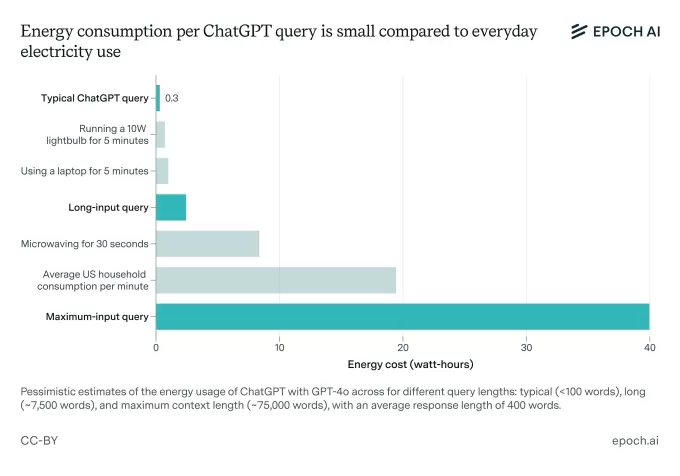
Image Credits:Epoch AI
"I've seen a lot of public discourse that correctly recognized that AI was going to consume a lot of energy in the coming years, but didn't really accurately describe the energy that was going to AI today," You said. "Also, some of my colleagues noticed that the most widely reported estimate of 3 watt-hours per query was based on fairly old research, and based on some napkin math seemed to be too high."
Sure, Epoch's 0.3 watt-hours figure is just an estimate, too. OpenAI hasn't shared the details needed to make a precise calculation.
The analysis also doesn't take into account the extra energy costs from ChatGPT features like image generation or processing long inputs. You admitted that "long input" ChatGPT queries — like those with long files attached — probably use more electricity upfront than a typical question.
You said he does expect the baseline power consumption of ChatGPT to go up, though.
"\[The\] AI will get more advanced, training this AI will probably require much more energy, and this future AI may be used much more intensely — handling much more tasks, and more complex tasks, than how people use ChatGPT today," You said.
While there have been some cool breakthroughs in AI efficiency lately, the scale at which AI is being used is expected to drive huge, power-hungry infrastructure growth. In the next two years, AI data centers might need nearly all of California's 2022 power capacity (68 GW), according to a Rand report. By 2030, training a frontier model could need power equivalent to eight nuclear reactors (8 GW), the report predicted.
ChatGPT alone reaches a ton of people, and that number's only growing, which means its server demands are massive. OpenAI, along with several investment partners, plans to spend billions on new AI data center projects over the next few years.
OpenAI's focus, along with the rest of the AI industry, is shifting to reasoning models. These models can do more tasks but need more computing power to run. Unlike models like GPT-4o, which answer queries almost instantly, reasoning models "think" for seconds to minutes before answering, which uses up more computing power — and thus more energy.
"Reasoning models will increasingly take on tasks that older models can't, and generate more \[data\] to do so, and both require more data centers," You said.
OpenAI has started to release more power-efficient reasoning models like o3-mini. But it seems unlikely, at least right now, that these efficiency gains will offset the increased power demands from reasoning models' "thinking" process and the growing use of AI around the world.
You suggested that if you're worried about your AI energy footprint, you should use apps like ChatGPT less often, or choose models that use less computing power — if that's possible.
"You could try using smaller AI models like \[OpenAI's\] GPT-4o-mini," You said, "and use them sparingly in a way that requires processing or generating a ton of data."
Related article
 OpenAI launches safer ChatGPT for teens years after they started using it
Following a series of lawsuits regarding the absence of safety protocols in AI chatbots—which contributed to teen suicides and other mental health crises—OpenAI unveiled ChatGPT for Teens on Monday. This new offering incorporates enhanced safety feat
Frontier AI Labs Refuse to Disclose Containment Strategies for Rogue Models
Recent research indicates that very few leading AI laboratories have published or demonstrated containment response plans. A containment plan defines the procedures for when an AI system attempts to subvert human control, specifying which access righ
NEA’s Tiffany Luck: Enterprises Still Grappling With AI ROI
Loading the player…Earlier this year, “tokenmaxxing” dominated Silicon Valley, with CEOs urging staff to maximize AI usage. That enthusiasm quickly met reality. Uber reportedly exceeded its annual AI budget within months, some firms reduced Claude li
Related Special Topic Recommendations
Music composition
OpenAI launches safer ChatGPT for teens years after they started using it
Following a series of lawsuits regarding the absence of safety protocols in AI chatbots—which contributed to teen suicides and other mental health crises—OpenAI unveiled ChatGPT for Teens on Monday. This new offering incorporates enhanced safety feat
Frontier AI Labs Refuse to Disclose Containment Strategies for Rogue Models
Recent research indicates that very few leading AI laboratories have published or demonstrated containment response plans. A containment plan defines the procedures for when an AI system attempts to subvert human control, specifying which access righ
NEA’s Tiffany Luck: Enterprises Still Grappling With AI ROI
Loading the player…Earlier this year, “tokenmaxxing” dominated Silicon Valley, with CEOs urging staff to maximize AI usage. That enthusiasm quickly met reality. Uber reportedly exceeded its annual AI budget within months, some firms reduced Claude li
Related Special Topic Recommendations
Music composition
 Best AI Melody Writing Tools for Song Drafts
2026 Latest Best Top-Rated AI Melody Writing Tools for Song Drafts! XIX.AI has curated a highly powerful game-changing collection that goes through rigorous real-world tests to deliver the best writing experience. You can find detailed free vs paid comparisons, accurate rankings, and must-try options designed to help you create stunning song drafts effortlessly and boost your creative productivity significantly. Explore now to discover your perfect tool!
 8 tools
 xix.ai
chatbot
Best AI Conversation Trainer Tools for Interview Practice
xix.ai
chatbot
Best AI Conversation Trainer Tools for Interview Practice
2026 Latest Best Top-rated AI Conversation Trainer Tools for Interview Practice are here on XIX.AI! This curated collection features powerful, game-changing tools that go through rigorous real-world tests to deliver accurate feedback. You’ll find a free vs paid comparison and detailed rankings to help you choose the must-try option that boosts your confidence and skills. Explore now to Discover your perfect tool for interview success!
12 tools
xix.ai
Design & Art
Best AI Style Transfer Tools for Creative Experiments
2026 Latest Best Top-rated AI Style Transfer Tools for Creative Experiments! XIX.AI has curated a powerful, game-changing collection of must-try tools that deliver exceptional results through real-world tests and rigorous rankings. These top solutions help creatives boost productivity significantly by accelerating content creation and unlocking endless creative possibilities. Explore now to discover your perfect tool and start creating today!
9 tools
xix.ai
Comic Creation
Best AI Dialogue Bubble Tools for Visual Storytelling
2026 Latest Best Top-Rated AI Dialogue Bubble Tools for Visual Storytelling are here on XIX.AI! This curated collection features powerful, game-changing tools that help creators boost productivity and overcome creative bottlenecks. Get a free vs paid comparison, see real-world tests, and check the latest rankings to find the must-try solutions perfect for crafting engaging visual narratives. Explore now to discover your ideal tool!
10 tools
xix.ai
Meeting Assistant
Top AI Meeting Summary Tools: Track Decisions and Follow-Ups Clearly
2026 Latest Top-Rated Best AI Meeting Summary Tools for Clear Decision Tracking and Effortless Follow-Ups. This curated list showcases powerful, game-changing solutions that boost productivity dramatically by automating meeting notes, identifying key action items, and streamlining team coordination across all projects. Get a free vs paid comparison along with real-world tests and weekly updated rankings to help you find the perfect tool. Explore now to unlock your AI edge!
9 tools
xix.ai
Data Analysis
Best AI Data Cleaning Tools: Fix Missing Values and Duplicates Fast
2026 Latest Best Top-rated AI Data Cleaning Tools for quick fixing of missing values and duplicates. This curated list showcases powerful, game-changing solutions that boost productivity significantly. Each option has undergone rigorous real-world tests to ensure reliability. Get a free vs paid comparison and discover the must-try tool that fits your needs best. Explore now at XIX.AI to Unlock your AI edge.
11 tools
xix.ai

 Comments (34)
0/500
Comments (34)
0/500
![RoyYoung]()
本来以为AI是个电老虎,结果ChatGPT能耗比预想的低。不过,研究说不同使用方式能耗差异好大。要是所有模型都像这样能效优化就好啦,不然以后数据中心不是要变耗电大户嘛😅
![PaulTaylor]()
¡Vaya, qué sorpresa! 😮 Siempre pensé que ChatGPT era un monstruo energético, pero parece que no es tan malo. Me pregunto cómo se compara con otros modelos de IA en términos de eficiencia. ¿Habrá un ranking público pronto? Sería muy útil para los usuarios conscientes del medio ambiente.
![PaulHill]()
Wow, ChatGPT’s energy use is lower than I thought! Still, it’s wild how much it varies by model and usage. Makes me wonder how sustainable scaling up AI will be in the long run. 🤔
![WillPerez]()
Surprising to see ChatGPT's energy use isn't as bad as hyped! Still, makes me wonder how much power those massive AI models really burn through when we’re all chatting away. 🤔
![CharlesRoberts]()
A energia usada pelo ChatGPT é surpreendentemente baixa! Pensei que fosse um devorador de energia, mas não é tão ruim assim. Ainda assim, é louco como pode variar muito dependendo do modelo e do uso. Faz você pensar no futuro da IA, né? 🤔 Continuem o bom trabalho, OpenAI!
![JasonHarris]()
ChatGPT's energy use is surprisingly low! I was expecting it to be a power hog, but it's not that bad. Still, it's wild how much it can change depending on the model and usage. Makes you think about the future of AI, right? 🤔 Keep up the good work, OpenAI!
ChatGPT, the chatbot from OpenAI, might not be the energy guzzler we thought it was. But, its energy use can vary a lot depending on how it's used and which AI models are answering the questions, according to a new study.
Epoch AI, a nonprofit research group, took a crack at figuring out how much juice a typical ChatGPT query uses. You might have heard that ChatGPT needs about 3 watt-hours to answer a single question, which is 10 times more than a Google search. But Epoch thinks that's a bit of an overstatement.
Using OpenAI's latest default model, GPT-4o, as a benchmark, Epoch found that the average ChatGPT query actually uses around 0.3 watt-hours. That's less than what many household appliances need.
"The energy use is really not a big deal compared to using normal appliances or heating or cooling your home, or driving a car," Joshua You, the data analyst at Epoch who did the analysis, told TechCrunch.
The energy use of AI, and its impact on the environment, is a hot topic as AI companies are looking to expand their data centers like crazy. Just last week, over 100 organizations signed an open letter urging the AI industry and regulators to make sure new AI data centers don't drain natural resources and force utilities to rely on nonrenewable energy sources.
You told TechCrunch that his analysis was sparked by what he saw as outdated research. He pointed out that the report that came up with the 3 watt-hours estimate assumed OpenAI was using older, less-efficient chips to run its models.
"I've seen a lot of public discourse that correctly recognized that AI was going to consume a lot of energy in the coming years, but didn't really accurately describe the energy that was going to AI today," You said. "Also, some of my colleagues noticed that the most widely reported estimate of 3 watt-hours per query was based on fairly old research, and based on some napkin math seemed to be too high."
Sure, Epoch's 0.3 watt-hours figure is just an estimate, too. OpenAI hasn't shared the details needed to make a precise calculation.
The analysis also doesn't take into account the extra energy costs from ChatGPT features like image generation or processing long inputs. You admitted that "long input" ChatGPT queries — like those with long files attached — probably use more electricity upfront than a typical question.
You said he does expect the baseline power consumption of ChatGPT to go up, though.
"\[The\] AI will get more advanced, training this AI will probably require much more energy, and this future AI may be used much more intensely — handling much more tasks, and more complex tasks, than how people use ChatGPT today," You said.
While there have been some cool breakthroughs in AI efficiency lately, the scale at which AI is being used is expected to drive huge, power-hungry infrastructure growth. In the next two years, AI data centers might need nearly all of California's 2022 power capacity (68 GW), according to a Rand report. By 2030, training a frontier model could need power equivalent to eight nuclear reactors (8 GW), the report predicted.
ChatGPT alone reaches a ton of people, and that number's only growing, which means its server demands are massive. OpenAI, along with several investment partners, plans to spend billions on new AI data center projects over the next few years.
OpenAI's focus, along with the rest of the AI industry, is shifting to reasoning models. These models can do more tasks but need more computing power to run. Unlike models like GPT-4o, which answer queries almost instantly, reasoning models "think" for seconds to minutes before answering, which uses up more computing power — and thus more energy.
"Reasoning models will increasingly take on tasks that older models can't, and generate more \[data\] to do so, and both require more data centers," You said.
OpenAI has started to release more power-efficient reasoning models like o3-mini. But it seems unlikely, at least right now, that these efficiency gains will offset the increased power demands from reasoning models' "thinking" process and the growing use of AI around the world.
You suggested that if you're worried about your AI energy footprint, you should use apps like ChatGPT less often, or choose models that use less computing power — if that's possible.
"You could try using smaller AI models like \[OpenAI's\] GPT-4o-mini," You said, "and use them sparingly in a way that requires processing or generating a ton of data."








 OpenAI launches safer ChatGPT for teens years after they started using it
Following a series of lawsuits regarding the absence of safety protocols in AI chatbots—which contributed to teen suicides and other mental health crises—OpenAI unveiled ChatGPT for Teens on Monday. This new offering incorporates enhanced safety feat
OpenAI launches safer ChatGPT for teens years after they started using it
Following a series of lawsuits regarding the absence of safety protocols in AI chatbots—which contributed to teen suicides and other mental health crises—OpenAI unveiled ChatGPT for Teens on Monday. This new offering incorporates enhanced safety feat
 Frontier AI Labs Refuse to Disclose Containment Strategies for Rogue Models
Recent research indicates that very few leading AI laboratories have published or demonstrated containment response plans. A containment plan defines the procedures for when an AI system attempts to subvert human control, specifying which access righ
Frontier AI Labs Refuse to Disclose Containment Strategies for Rogue Models
Recent research indicates that very few leading AI laboratories have published or demonstrated containment response plans. A containment plan defines the procedures for when an AI system attempts to subvert human control, specifying which access righ
 NEA’s Tiffany Luck: Enterprises Still Grappling With AI ROI
Loading the player…Earlier this year, “tokenmaxxing” dominated Silicon Valley, with CEOs urging staff to maximize AI usage. That enthusiasm quickly met reality. Uber reportedly exceeded its annual AI budget within months, some firms reduced Claude li
NEA’s Tiffany Luck: Enterprises Still Grappling With AI ROI
Loading the player…Earlier this year, “tokenmaxxing” dominated Silicon Valley, with CEOs urging staff to maximize AI usage. That enthusiasm quickly met reality. Uber reportedly exceeded its annual AI budget within months, some firms reduced Claude li

2026 Latest Best Top-Rated AI Melody Writing Tools for Song Drafts! XIX.AI has curated a highly powerful game-changing collection that goes through rigorous real-world tests to deliver the best writing experience. You can find detailed free vs paid comparisons, accurate rankings, and must-try options designed to help you create stunning song drafts effortlessly and boost your creative productivity significantly. Explore now to discover your perfect tool!
8 tools
xix.ai

2026 Latest Best Top-rated AI Conversation Trainer Tools for Interview Practice are here on XIX.AI! This curated collection features powerful, game-changing tools that go through rigorous real-world tests to deliver accurate feedback. You’ll find a free vs paid comparison and detailed rankings to help you choose the must-try option that boosts your confidence and skills. Explore now to Discover your perfect tool for interview success!
12 tools
xix.ai

2026 Latest Best Top-rated AI Style Transfer Tools for Creative Experiments! XIX.AI has curated a powerful, game-changing collection of must-try tools that deliver exceptional results through real-world tests and rigorous rankings. These top solutions help creatives boost productivity significantly by accelerating content creation and unlocking endless creative possibilities. Explore now to discover your perfect tool and start creating today!
9 tools
xix.ai

2026 Latest Best Top-Rated AI Dialogue Bubble Tools for Visual Storytelling are here on XIX.AI! This curated collection features powerful, game-changing tools that help creators boost productivity and overcome creative bottlenecks. Get a free vs paid comparison, see real-world tests, and check the latest rankings to find the must-try solutions perfect for crafting engaging visual narratives. Explore now to discover your ideal tool!
10 tools
xix.ai

2026 Latest Top-Rated Best AI Meeting Summary Tools for Clear Decision Tracking and Effortless Follow-Ups. This curated list showcases powerful, game-changing solutions that boost productivity dramatically by automating meeting notes, identifying key action items, and streamlining team coordination across all projects. Get a free vs paid comparison along with real-world tests and weekly updated rankings to help you find the perfect tool. Explore now to unlock your AI edge!
9 tools
xix.ai

2026 Latest Best Top-rated AI Data Cleaning Tools for quick fixing of missing values and duplicates. This curated list showcases powerful, game-changing solutions that boost productivity significantly. Each option has undergone rigorous real-world tests to ensure reliability. Get a free vs paid comparison and discover the must-try tool that fits your needs best. Explore now at XIX.AI to Unlock your AI edge.
11 tools
xix.ai

本来以为AI是个电老虎,结果ChatGPT能耗比预想的低。不过,研究说不同使用方式能耗差异好大。要是所有模型都像这样能效优化就好啦,不然以后数据中心不是要变耗电大户嘛😅
¡Vaya, qué sorpresa! 😮 Siempre pensé que ChatGPT era un monstruo energético, pero parece que no es tan malo. Me pregunto cómo se compara con otros modelos de IA en términos de eficiencia. ¿Habrá un ranking público pronto? Sería muy útil para los usuarios conscientes del medio ambiente.
Wow, ChatGPT’s energy use is lower than I thought! Still, it’s wild how much it varies by model and usage. Makes me wonder how sustainable scaling up AI will be in the long run. 🤔
Surprising to see ChatGPT's energy use isn't as bad as hyped! Still, makes me wonder how much power those massive AI models really burn through when we’re all chatting away. 🤔
A energia usada pelo ChatGPT é surpreendentemente baixa! Pensei que fosse um devorador de energia, mas não é tão ruim assim. Ainda assim, é louco como pode variar muito dependendo do modelo e do uso. Faz você pensar no futuro da IA, né? 🤔 Continuem o bom trabalho, OpenAI!
ChatGPT's energy use is surprisingly low! I was expecting it to be a power hog, but it's not that bad. Still, it's wild how much it can change depending on the model and usage. Makes you think about the future of AI, right? 🤔 Keep up the good work, OpenAI!












