


 Home
HomeASML CEO Confident in Market Position Amid Competition
Every time you interact with artificial intelligence, you are, in a small but significant way, relying on a 42-year-old Dutch company with 44,000 employees that invests €4.5 billion annually to push its technology forward.
ASML, based in the Netherlands, manufactures the machines that produce the chips which enable AI. More precisely, it builds the only machines globally capable of printing the microscopic patterns onto silicon wafers that form the most advanced semiconductors—a process known as extreme ultraviolet lithography (EUV). These machines are about the size of a school bus, require months to assemble, involve hundreds of suppliers, and cost between $200 million and over $400 million each, depending on the model—a price tag that gives even ASML's largest customers reason to hesitate at times.
This monopoly has positioned ASML as Europe's most valuable company, with a market capitalization exceeding $530 billion. With the four largest U.S. tech firms—Microsoft, Meta, Amazon, and Google—committing over $600 billion to AI infrastructure spending this year alone, demand for ASML's machines has skyrocketed. The company has publicly stated that the global chip supply will fall short of demand for years to come.
This intense demand has also made ASML a target. Substrate, a San Francisco startup founded by a protégé of Peter Thiel, has raised more than $100 million and achieved a valuation over $1 billion based on its claim that it can build a competing lithography machine. Separately, reports suggest former ASML engineers in China have partially reverse-engineered the technology, a development with profound geopolitical implications.
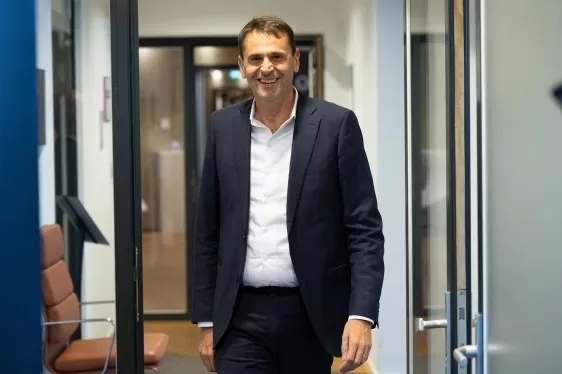
Christophe Fouquet, who became ASML's CEO in 2024 after more than a decade with the company, met with this editor on the rooftop deck of his Beverly Hills hotel on Tuesday morning before his appearance at the Milken Institute Global Conference. Dressed in a blue suit and white shirt, he appeared relaxed—even when the discussion turned to potential rivals.
This interview has been lightly edited for length and clarity.
TC: Did you anticipate the AI boom?
CF: No, not at all. We worked diligently, but not with the foresight that this specific wave was coming. The shift went from a theoretical concept—something people expected to materialize eventually—to ChatGPT, which served as the first compelling demonstration of AI's potential. Today, we view AI as the next major revolution, impacting both industry and society. Did I see it coming? No. Even immersed in it daily, we sometimes wake up and have to verify that what's unfolding is indeed real.
The major question on everyone's mind is whether the supply chain can match the demand. Is it possible?
The demand is so substantial that the overall market will be constrained by supply for some time. Currently, the most significant bottleneck appears to be in chip manufacturing. As an equipment supplier, we align with our customers' plans, and we've managed to keep pace reasonably well so far. However, we recognize the need to accelerate and expand our entire supply chain and production capacity. If you speak with the hyperscale cloud providers, I believe they would confirm that for the next two, three, or even five years, they will not have access to sufficient chips.
TSMC recently made headlines by stating your latest machines are too costly. How do you address that?
An EUV system will have a higher price tag than a low-NA system, but the cost per wafer produced using this tool for certain advanced layers will be lower. We can achieve a 20% to 30% reduction in cost.
[Editor's note: Both machines Fouquet mentions here are EUV machines, sharing the same core technology. NA stands for numerical aperture, which measures how finely a machine can focus light onto a chip. Low-NA EUV represents the current generation, while high-NA EUV is ASML's newest generation, capable of printing even finer patterns but with a price of $350 million or more per unit. Fouquet's argument is that despite the higher initial cost, the new machine manufactures chips more affordably.]
I frequently get asked if the transition will happen this month, next month, or the month after. My typical response is that the exact timing is less critical because we designed high-NA technology for the next 10 to 20 years. If you review press reports from 2016 or 2017, you'll find similar comments—low-NA EUV was considered very expensive at the time. We know what followed. The same pattern will unfold with high-NA.
A startup named Substrate, backed by Peter Thiel, claims it can build a competing lithography machine. What are your thoughts?
There is a vast difference between aspiring to build it and actually achieving it. Lithography presents numerous challenges. Creating an image is just the beginning; you must then produce that image in high volume, at low cost, with high speed, and nanometer-level precision. I often say ASML could only develop an EUV machine because 80% of the necessary technology already existed, built upon prior knowledge and products developed over decades. We had to solve one primary problem—generating EUV light—and that alone took 20 years. Starting from zero represents an enormous challenge. I've seen many claims and a few images. However, we captured our first EUV image 30 years ago and still required another 20 years of intensive work to transform it into a viable manufacturing system.
What about xLight, a laser startup partially funded by the U.S. government that seeks to collaborate with you?
xLight is concentrating on a single component of our EUV machine: the light source. Our existing source can be extended and scaled for many years to come. What xLight is developing is a new source that still requires construction and validation. The key question is whether it offers a performance or cost benefit compared to our current technology. I believe that verdict is still pending. We are collaborating with them to help demonstrate their technology—we view that as part of our responsibility. Nevertheless, it remains a very long journey.
There are also reports that former ASML engineers in China have reverse-engineered your machines.
To reverse-engineer anything, you first need physical access to the machine. There are no EUV machines in China—we have never shipped any tools there. We know the location of every tool we have shipped; they are either in active use with customers, which we track, or they have been dismantled and returned to us. The notion that one of our systems is in China is incorrect. Furthermore, since our EUV technology has never been exported there, we also have no personnel in China trained on EUV systems.
Very early on, when export restrictions were implemented, we established a complete internal separation within the company between personnel authorized to access EUV technology, documents, and training and those who are not. Our team in China falls on the latter side of that line. The evidence suggests there has been minimal, if any, progress. This is difficult for some to accept because access to this technology is considered so crucial.
Regarding export controls more broadly—Jensen Huang was here last night arguing that companies should sell globally, that increased corporate revenue translates to more tax revenue for a company's home country. He also stated the key is to keep the best and latest technology closer to home. Do you agree?
I think he is absolutely correct. What he adds—and I believe this is what Nvidia has successfully implemented—is that you can maintain a technological lead by preserving a generational gap in what you sell. Nvidia sells products that are a few generations behind its latest, allowing it to balance continued commerce with not handing a strong competitive advantage to countries where the latest technology is not sold. We believe the same principle should apply to our products. Today, we ship tools to China—as permitted by export controls—but it is a tool we first introduced in 2015. Applying Jensen's philosophy to our context, Nvidia operates with roughly an eight-generation gap. We are looking at a gap of two or three generations. There is room for rationalization—finding the appropriate balance between ceasing business entirely, forfeiting a significant opportunity, and strongly incentivizing others to compete with you.
How do you evaluate the current state of discussions with the present administration on these matters?
There is a constructive dialogue, which is vital. I believe there is a genuine understanding of business requirements, but the challenge remains in striking the right balance among the various voices and interests involved. The dialogue is ongoing, and we value that. I have visited Washington many times. At the very least, the conversation is taking place. However, it is an exceptionally complex issue.
You don't appear overly concerned about anyone finding a shortcut to replicate your technology.
People desire cutting-edge technology but often overlook what it took to create it. It has required many years of work—not only at ASML but also with our suppliers. It involved diverse groups of people solving extremely difficult problems, followed by one company integrating it all, leveraging decades of lithography expertise to create a manufacturing system. This is by no means simple. And I believe that history and complexity are also our strongest safeguards. It simply reflects the immense effort required to assemble this capability.
Related article
 OneRail Leverages Nvidia AI to Optimize Real-Time Last-Mile Delivery
OneRail has introduced an AI-driven delivery platform leveraging Nvidia technology to assist retailers, wholesalers, and distributors in determining the most efficient delivery methods for individual orders.Named OmniSTAR, the system assesses various
Apple's New Hardware Chief John Ternus Steers Vision for Future Products
Loading the player…The Ternus era at Apple has officially begun.Tim Cook stepped down as CEO this week, handing leadership to former hardware chief John Ternus. Ternus’s first memo promised a “huge launch next week,” meaning the next iPhone event lan
Groq raises $350M to fuel its pivot from AI chips to neocloud
AI infrastructure firm Groq has secured $350 million in fresh funding, marking its ongoing transition from a specialized chip developer to a neocloud provider offering robust GPU and AI infrastructure services.Backed by Disruptive Technologies, with
Related Special Topic Recommendations
Design & Art
OneRail Leverages Nvidia AI to Optimize Real-Time Last-Mile Delivery
OneRail has introduced an AI-driven delivery platform leveraging Nvidia technology to assist retailers, wholesalers, and distributors in determining the most efficient delivery methods for individual orders.Named OmniSTAR, the system assesses various
Apple's New Hardware Chief John Ternus Steers Vision for Future Products
Loading the player…The Ternus era at Apple has officially begun.Tim Cook stepped down as CEO this week, handing leadership to former hardware chief John Ternus. Ternus’s first memo promised a “huge launch next week,” meaning the next iPhone event lan
Groq raises $350M to fuel its pivot from AI chips to neocloud
AI infrastructure firm Groq has secured $350 million in fresh funding, marking its ongoing transition from a specialized chip developer to a neocloud provider offering robust GPU and AI infrastructure services.Backed by Disruptive Technologies, with
Related Special Topic Recommendations
Design & Art
 Best AI Style Transfer Tools for Creative Experiments
2026 Latest Best Top-rated AI Style Transfer Tools for Creative Experiments! XIX.AI has curated a powerful, game-changing collection of must-try tools that deliver exceptional results through real-world tests and rigorous rankings. These top solutions help creatives boost productivity significantly by accelerating content creation and unlocking endless creative possibilities. Explore now to discover your perfect tool and start creating today!
 9 tools
 xix.ai
Comic Creation
Best AI Dialogue Bubble Tools for Visual Storytelling
xix.ai
Comic Creation
Best AI Dialogue Bubble Tools for Visual Storytelling
2026 Latest Best Top-Rated AI Dialogue Bubble Tools for Visual Storytelling are here on XIX.AI! This curated collection features powerful, game-changing tools that help creators boost productivity and overcome creative bottlenecks. Get a free vs paid comparison, see real-world tests, and check the latest rankings to find the must-try solutions perfect for crafting engaging visual narratives. Explore now to discover your ideal tool!
10 tools
xix.ai
Meeting Assistant
Top AI Meeting Summary Tools: Track Decisions and Follow-Ups Clearly
2026 Latest Top-Rated Best AI Meeting Summary Tools for Clear Decision Tracking and Effortless Follow-Ups. This curated list showcases powerful, game-changing solutions that boost productivity dramatically by automating meeting notes, identifying key action items, and streamlining team coordination across all projects. Get a free vs paid comparison along with real-world tests and weekly updated rankings to help you find the perfect tool. Explore now to unlock your AI edge!
9 tools
xix.ai
Data Analysis
Best AI Data Cleaning Tools: Fix Missing Values and Duplicates Fast
2026 Latest Best Top-rated AI Data Cleaning Tools for quick fixing of missing values and duplicates. This curated list showcases powerful, game-changing solutions that boost productivity significantly. Each option has undergone rigorous real-world tests to ensure reliability. Get a free vs paid comparison and discover the must-try tool that fits your needs best. Explore now at XIX.AI to Unlock your AI edge.
11 tools
xix.ai
Design & Art
Best AI Creative Ideation Tools for Artists: Break Through Visual Blocks
2026 Latest Best Top-Rated AI Creative Ideation Tools for Artists are curated by XIX.AI to help creators break through visual blocks and boost creativity instantly. These powerful game-changing tools offer real-world tests, detailed free vs paid comparison, and weekly updated rankings. Discover your perfect tool to accelerate content creation and unlock your AI edge today. Explore now!
14 tools
xix.ai
Music composition
AI Beat Makers for TikTok Background Tracks, Reels Audio, and Creator Promo Music
2026 Latest Best AI Beat Makers for TikTok Background Tracks, Reels Audio, and Creator Promo Music! XIX.AI has curated a top-rated list of powerful game-changing tools that go through real-world tests to deliver flawless music for every content need. You’ll find detailed free vs paid comparison data, weekly updated rankings, and must-try options to help you boost creativity and productivity. Explore now to discover your perfect tool!
11 tools
xix.ai

 Comments (0)
0/500
Comments (0)
0/500
Every time you interact with artificial intelligence, you are, in a small but significant way, relying on a 42-year-old Dutch company with 44,000 employees that invests €4.5 billion annually to push its technology forward.
ASML, based in the Netherlands, manufactures the machines that produce the chips which enable AI. More precisely, it builds the only machines globally capable of printing the microscopic patterns onto silicon wafers that form the most advanced semiconductors—a process known as extreme ultraviolet lithography (EUV). These machines are about the size of a school bus, require months to assemble, involve hundreds of suppliers, and cost between $200 million and over $400 million each, depending on the model—a price tag that gives even ASML's largest customers reason to hesitate at times.
This monopoly has positioned ASML as Europe's most valuable company, with a market capitalization exceeding $530 billion. With the four largest U.S. tech firms—Microsoft, Meta, Amazon, and Google—committing over $600 billion to AI infrastructure spending this year alone, demand for ASML's machines has skyrocketed. The company has publicly stated that the global chip supply will fall short of demand for years to come.
This intense demand has also made ASML a target. Substrate, a San Francisco startup founded by a protégé of Peter Thiel, has raised more than $100 million and achieved a valuation over $1 billion based on its claim that it can build a competing lithography machine. Separately, reports suggest former ASML engineers in China have partially reverse-engineered the technology, a development with profound geopolitical implications.
Christophe Fouquet, who became ASML's CEO in 2024 after more than a decade with the company, met with this editor on the rooftop deck of his Beverly Hills hotel on Tuesday morning before his appearance at the Milken Institute Global Conference. Dressed in a blue suit and white shirt, he appeared relaxed—even when the discussion turned to potential rivals.
This interview has been lightly edited for length and clarity.
TC: Did you anticipate the AI boom?
CF: No, not at all. We worked diligently, but not with the foresight that this specific wave was coming. The shift went from a theoretical concept—something people expected to materialize eventually—to ChatGPT, which served as the first compelling demonstration of AI's potential. Today, we view AI as the next major revolution, impacting both industry and society. Did I see it coming? No. Even immersed in it daily, we sometimes wake up and have to verify that what's unfolding is indeed real.
The major question on everyone's mind is whether the supply chain can match the demand. Is it possible?
The demand is so substantial that the overall market will be constrained by supply for some time. Currently, the most significant bottleneck appears to be in chip manufacturing. As an equipment supplier, we align with our customers' plans, and we've managed to keep pace reasonably well so far. However, we recognize the need to accelerate and expand our entire supply chain and production capacity. If you speak with the hyperscale cloud providers, I believe they would confirm that for the next two, three, or even five years, they will not have access to sufficient chips.
TSMC recently made headlines by stating your latest machines are too costly. How do you address that?
An EUV system will have a higher price tag than a low-NA system, but the cost per wafer produced using this tool for certain advanced layers will be lower. We can achieve a 20% to 30% reduction in cost.
[Editor's note: Both machines Fouquet mentions here are EUV machines, sharing the same core technology. NA stands for numerical aperture, which measures how finely a machine can focus light onto a chip. Low-NA EUV represents the current generation, while high-NA EUV is ASML's newest generation, capable of printing even finer patterns but with a price of $350 million or more per unit. Fouquet's argument is that despite the higher initial cost, the new machine manufactures chips more affordably.]
I frequently get asked if the transition will happen this month, next month, or the month after. My typical response is that the exact timing is less critical because we designed high-NA technology for the next 10 to 20 years. If you review press reports from 2016 or 2017, you'll find similar comments—low-NA EUV was considered very expensive at the time. We know what followed. The same pattern will unfold with high-NA.
A startup named Substrate, backed by Peter Thiel, claims it can build a competing lithography machine. What are your thoughts?
There is a vast difference between aspiring to build it and actually achieving it. Lithography presents numerous challenges. Creating an image is just the beginning; you must then produce that image in high volume, at low cost, with high speed, and nanometer-level precision. I often say ASML could only develop an EUV machine because 80% of the necessary technology already existed, built upon prior knowledge and products developed over decades. We had to solve one primary problem—generating EUV light—and that alone took 20 years. Starting from zero represents an enormous challenge. I've seen many claims and a few images. However, we captured our first EUV image 30 years ago and still required another 20 years of intensive work to transform it into a viable manufacturing system.
What about xLight, a laser startup partially funded by the U.S. government that seeks to collaborate with you?
xLight is concentrating on a single component of our EUV machine: the light source. Our existing source can be extended and scaled for many years to come. What xLight is developing is a new source that still requires construction and validation. The key question is whether it offers a performance or cost benefit compared to our current technology. I believe that verdict is still pending. We are collaborating with them to help demonstrate their technology—we view that as part of our responsibility. Nevertheless, it remains a very long journey.
There are also reports that former ASML engineers in China have reverse-engineered your machines.
To reverse-engineer anything, you first need physical access to the machine. There are no EUV machines in China—we have never shipped any tools there. We know the location of every tool we have shipped; they are either in active use with customers, which we track, or they have been dismantled and returned to us. The notion that one of our systems is in China is incorrect. Furthermore, since our EUV technology has never been exported there, we also have no personnel in China trained on EUV systems.
Very early on, when export restrictions were implemented, we established a complete internal separation within the company between personnel authorized to access EUV technology, documents, and training and those who are not. Our team in China falls on the latter side of that line. The evidence suggests there has been minimal, if any, progress. This is difficult for some to accept because access to this technology is considered so crucial.
Regarding export controls more broadly—Jensen Huang was here last night arguing that companies should sell globally, that increased corporate revenue translates to more tax revenue for a company's home country. He also stated the key is to keep the best and latest technology closer to home. Do you agree?
I think he is absolutely correct. What he adds—and I believe this is what Nvidia has successfully implemented—is that you can maintain a technological lead by preserving a generational gap in what you sell. Nvidia sells products that are a few generations behind its latest, allowing it to balance continued commerce with not handing a strong competitive advantage to countries where the latest technology is not sold. We believe the same principle should apply to our products. Today, we ship tools to China—as permitted by export controls—but it is a tool we first introduced in 2015. Applying Jensen's philosophy to our context, Nvidia operates with roughly an eight-generation gap. We are looking at a gap of two or three generations. There is room for rationalization—finding the appropriate balance between ceasing business entirely, forfeiting a significant opportunity, and strongly incentivizing others to compete with you.
How do you evaluate the current state of discussions with the present administration on these matters?
There is a constructive dialogue, which is vital. I believe there is a genuine understanding of business requirements, but the challenge remains in striking the right balance among the various voices and interests involved. The dialogue is ongoing, and we value that. I have visited Washington many times. At the very least, the conversation is taking place. However, it is an exceptionally complex issue.
You don't appear overly concerned about anyone finding a shortcut to replicate your technology.
People desire cutting-edge technology but often overlook what it took to create it. It has required many years of work—not only at ASML but also with our suppliers. It involved diverse groups of people solving extremely difficult problems, followed by one company integrating it all, leveraging decades of lithography expertise to create a manufacturing system. This is by no means simple. And I believe that history and complexity are also our strongest safeguards. It simply reflects the immense effort required to assemble this capability.








 OneRail Leverages Nvidia AI to Optimize Real-Time Last-Mile Delivery
OneRail has introduced an AI-driven delivery platform leveraging Nvidia technology to assist retailers, wholesalers, and distributors in determining the most efficient delivery methods for individual orders.Named OmniSTAR, the system assesses various
OneRail Leverages Nvidia AI to Optimize Real-Time Last-Mile Delivery
OneRail has introduced an AI-driven delivery platform leveraging Nvidia technology to assist retailers, wholesalers, and distributors in determining the most efficient delivery methods for individual orders.Named OmniSTAR, the system assesses various
 Apple's New Hardware Chief John Ternus Steers Vision for Future Products
Loading the player…The Ternus era at Apple has officially begun.Tim Cook stepped down as CEO this week, handing leadership to former hardware chief John Ternus. Ternus’s first memo promised a “huge launch next week,” meaning the next iPhone event lan
Apple's New Hardware Chief John Ternus Steers Vision for Future Products
Loading the player…The Ternus era at Apple has officially begun.Tim Cook stepped down as CEO this week, handing leadership to former hardware chief John Ternus. Ternus’s first memo promised a “huge launch next week,” meaning the next iPhone event lan
 Groq raises $350M to fuel its pivot from AI chips to neocloud
AI infrastructure firm Groq has secured $350 million in fresh funding, marking its ongoing transition from a specialized chip developer to a neocloud provider offering robust GPU and AI infrastructure services.Backed by Disruptive Technologies, with
Groq raises $350M to fuel its pivot from AI chips to neocloud
AI infrastructure firm Groq has secured $350 million in fresh funding, marking its ongoing transition from a specialized chip developer to a neocloud provider offering robust GPU and AI infrastructure services.Backed by Disruptive Technologies, with

2026 Latest Best Top-rated AI Style Transfer Tools for Creative Experiments! XIX.AI has curated a powerful, game-changing collection of must-try tools that deliver exceptional results through real-world tests and rigorous rankings. These top solutions help creatives boost productivity significantly by accelerating content creation and unlocking endless creative possibilities. Explore now to discover your perfect tool and start creating today!
9 tools
xix.ai

2026 Latest Best Top-Rated AI Dialogue Bubble Tools for Visual Storytelling are here on XIX.AI! This curated collection features powerful, game-changing tools that help creators boost productivity and overcome creative bottlenecks. Get a free vs paid comparison, see real-world tests, and check the latest rankings to find the must-try solutions perfect for crafting engaging visual narratives. Explore now to discover your ideal tool!
10 tools
xix.ai

2026 Latest Top-Rated Best AI Meeting Summary Tools for Clear Decision Tracking and Effortless Follow-Ups. This curated list showcases powerful, game-changing solutions that boost productivity dramatically by automating meeting notes, identifying key action items, and streamlining team coordination across all projects. Get a free vs paid comparison along with real-world tests and weekly updated rankings to help you find the perfect tool. Explore now to unlock your AI edge!
9 tools
xix.ai

2026 Latest Best Top-rated AI Data Cleaning Tools for quick fixing of missing values and duplicates. This curated list showcases powerful, game-changing solutions that boost productivity significantly. Each option has undergone rigorous real-world tests to ensure reliability. Get a free vs paid comparison and discover the must-try tool that fits your needs best. Explore now at XIX.AI to Unlock your AI edge.
11 tools
xix.ai

2026 Latest Best Top-Rated AI Creative Ideation Tools for Artists are curated by XIX.AI to help creators break through visual blocks and boost creativity instantly. These powerful game-changing tools offer real-world tests, detailed free vs paid comparison, and weekly updated rankings. Discover your perfect tool to accelerate content creation and unlock your AI edge today. Explore now!
14 tools
xix.ai

2026 Latest Best AI Beat Makers for TikTok Background Tracks, Reels Audio, and Creator Promo Music! XIX.AI has curated a top-rated list of powerful game-changing tools that go through real-world tests to deliver flawless music for every content need. You’ll find detailed free vs paid comparison data, weekly updated rankings, and must-try options to help you boost creativity and productivity. Explore now to discover your perfect tool!
11 tools
xix.ai












