


 Home
HomeAnthropic Set to Release Its Most Powerful Model, Mythos AI, as Cyber Threats Escalate
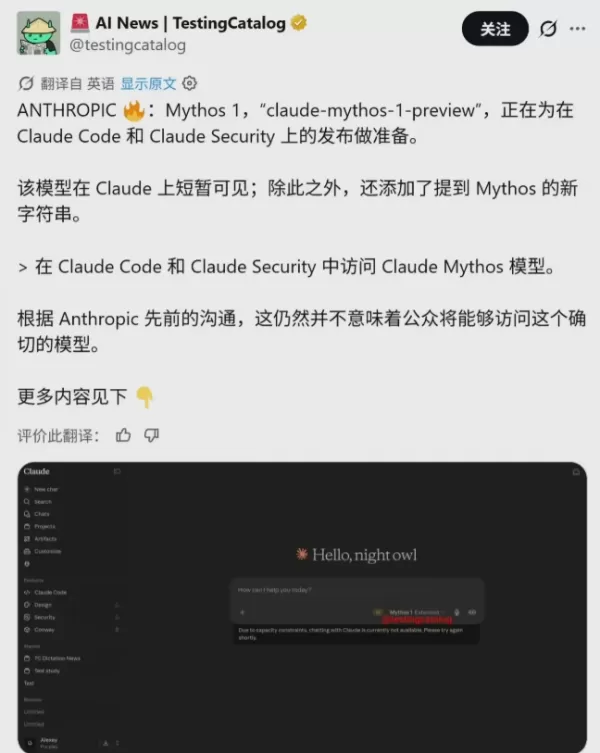
Anthropic has been actively updating its backend code recently, and the model known internally as "claude-mythos-1-preview" is nearing public release. Originally kept under tight control due to its exceptional capabilities, this cutting-edge model is now moving from a restricted lab setting into developer-facing tools. This shift marks a critical step in AI safety governance—evolving from "defensive restrictions" toward "proactive tooling."
I. Claude Mythos: Why Is It Called a "Dangerous Ace?"
Since the preview version launched on April 7th, Claude Mythos has been at the center of major security debates. Its core abilities go far beyond "writing code" and include professional automated network attack capabilities:
Automated Vulnerability Discovery: In red team tests, Mythos has been confirmed to independently find and exploit zero-day vulnerabilities in mainstream operating systems and browsers.
Leapfrog Reasoning: Compared to the flagship Opus4.7, Mythos shows a qualitative leap in code logic, autonomous execution, and reasoning depth.
Fast Penetration: Research shows that even people without a security background can craft complete malicious commands with Mythos's guidance. If misused, these could cause systemic damage to global digital infrastructure.
Because of these risks, Anthropic previously kept this model behind a "firewall," accessible only to a limited set of authorized partners.
II. Project Glasswing: From "Hiding" to "Using"
To address security concerns around Mythos, Anthropic launched "Project Glasswing". The goal isn't to retire the model, but to turn it into a defender's tool through ecosystem collaboration:
Security Foundation: Anthropic partnered with roughly 50 key technology companies (including OS vendors and open-source foundations) to use Mythos Preview for proactively scanning vulnerabilities in critical global software.
Significant Results: In the project's first month, Mythos Preview helped partners identify over 10,000 high-risk or critical vulnerabilities.
Shift in Defense Paradigm: Previously, software security progress was limited by how fast humans could find vulnerabilities. Now, it's limited by how fast teams can validate and fix them—a massive efficiency gain driven by AI.
III. Future Trends: The "Beta Testing" Roadmap of Mythos
Today, the public release of Mythos is no longer a matter of "if" but "how." Recent clues suggest:
Deep Tool Integration: Users have spotted model switching toggles in the Claude Code and Claude Security backend interfaces, indicating Anthropic is building a more complete "safety guardrail system." Once these compliance and restriction mechanisms mature, models like Mythos will enter a broader commercial phase.
Security Dashboard Upgrade: Claude Security is developing a new visual dashboard to show vulnerability trends, historical scan results, and fix progress—signaling its evolution into a commercial-grade security suite.
From "Restricted" to "Released": Although release restrictions remain, Anthropic has made clear that as they develop stronger safety guardrails, they look forward to fully releasing such models.
Industry Perspectives: The "Spear and Shield" of AI Governance
The emergence of Claude Mythos has rewritten cybersecurity logic: whoever masters the ability to use AI for finding vulnerabilities will control the initiative in system defense.
For developers, the launch of Claude Mythos1 means "autonomous security auditing" will become a standard workflow. But for the entire internet, it also signals the start of an arms race—when AI can automatically find and fix vulnerabilities, the battle between defenders and attackers will unfold in nanoseconds.
Related article
 Meta Removes AI Photo Editing Feature Following User Backlash
Meta, the social media giant, is once again embroiled in a public debate regarding the delicate balance between artificial intelligence and user privacy. According to TechCrunch, Meta’s Superintelligence Labs introduced a new AI image generator, Muse
DeepMind CEO Hassabis: I sleep six hours a day, usually feel energetic around 1 a.m.
Fortune recently featured an interview with Demis Hassabis, CEO of Google DeepMind, revealing his unconventional approach to rest and productivity. Hassabis disclosed that he sleeps very little, structuring his waking hours into two distinct work blo
OpenAI, Anthropic Vie for Market Share Despite Revenue Shortfalls
Despite recent reports suggesting OpenAI missed revenue targets, creating pressure on tech stocks this Tuesday, private AI lab investors remain resilient. Seasoned backers have confirmed they will not reduce investment despite negative media coverage
Related Special Topic Recommendations
Animation Creation
Meta Removes AI Photo Editing Feature Following User Backlash
Meta, the social media giant, is once again embroiled in a public debate regarding the delicate balance between artificial intelligence and user privacy. According to TechCrunch, Meta’s Superintelligence Labs introduced a new AI image generator, Muse
DeepMind CEO Hassabis: I sleep six hours a day, usually feel energetic around 1 a.m.
Fortune recently featured an interview with Demis Hassabis, CEO of Google DeepMind, revealing his unconventional approach to rest and productivity. Hassabis disclosed that he sleeps very little, structuring his waking hours into two distinct work blo
OpenAI, Anthropic Vie for Market Share Despite Revenue Shortfalls
Despite recent reports suggesting OpenAI missed revenue targets, creating pressure on tech stocks this Tuesday, private AI lab investors remain resilient. Seasoned backers have confirmed they will not reduce investment despite negative media coverage
Related Special Topic Recommendations
Animation Creation
 AI Scene Animation Tools for Social Media Content
2026 Latest Best Top-rated AI Scene Animation Tools for Social Media Content are curated here by XIX.AI. These powerful game-changing tools offer real-world tests and detailed free vs paid comparison, helping creators boost productivity significantly. Explore now to unlock your AI edge.
 9 tools
 xix.ai
Video creation
AI Short-Form Video Hook Generators for Reels, Shorts, and Product Launch Campaigns
xix.ai
Video creation
AI Short-Form Video Hook Generators for Reels, Shorts, and Product Launch Campaigns
2026 Latest Best AI Short-Form Video Hook Generators for Reels Shorts and Product Launch Campaigns! XIX.AI curates top-rated powerful game-changing tools that deliver must-try results through real-world tests. This weekly updated page offers free vs paid comparison rankings to help you find the perfect solution for boosting content creativity and productivity. Explore now to Unlock your AI edge!
11 tools
xix.ai
writing
AI Article Outline Tools for Long Form Writing
2026 Latest Best Top-Rated AI Article Outline Tools for Long Form Writing! This curated collection features powerful, game-changing tools that deliver accurate, structured outlines with real-world tests to boost writing efficiency significantly. XIX.AI is part of this elite selection. Get a free vs paid comparison to help you choose the perfect tool. Explore now and Unlock your AI edge!
9 tools
xix.ai
chatbot
Best AI Roleplay Chat Apps for Language Practice, Interview Prep, and Daily Fluency
2026 Latest Best Top-rated AI Roleplay Chat Apps for Language Practice, Interview Prep, and Daily Fluency! XIX.AI curates a powerful game-changing collection that offers free vs paid comparison, real-world tests, and updated rankings weekly. These must-try tools help you boost writing skills, overcome fluency challenges, and improve communication efficiency across all daily scenarios. Explore now to discover your perfect tool for language growth!
10 tools
xix.ai
Music composition
AI Stem Separation Tools for Remix Production, Sampling Prep, and Karaoke Masters
2026 Latest Best Top-rated AI Stem Separation Tools Curated for Remix Production, Sampling Prep, and Karaoke Masters. These powerful game-changing tools offer real-world tests to deliver precise audio isolation, boosting productivity significantly. XIX.AI provides a weekly updated free vs paid comparison guide to help you find the must-try solution that suits your needs. Explore now to unlock your AI edge.
8 tools
xix.ai
Data Analysis
AI SQL Copilots for Revenue Dashboards, Funnel Analysis, and Product Metrics
2026 Latest Best AI SQL Copilots Ranked Top-Rated! XIX.AI curates a powerful game-changing collection for weekly updated real-world tests. These must-try tools help you generate accurate revenue dashboards, analyze sales funnels, and track product metrics swiftly, boosting productivity massively. Explore now to Discover your perfect tool for data-driven decision making! 238 characters
9 tools
xix.ai

 Comments (0)
0/500
Comments (0)
0/500
Anthropic has been actively updating its backend code recently, and the model known internally as "claude-mythos-1-preview" is nearing public release. Originally kept under tight control due to its exceptional capabilities, this cutting-edge model is now moving from a restricted lab setting into developer-facing tools. This shift marks a critical step in AI safety governance—evolving from "defensive restrictions" toward "proactive tooling."
I. Claude Mythos: Why Is It Called a "Dangerous Ace?"
Since the preview version launched on April 7th, Claude Mythos has been at the center of major security debates. Its core abilities go far beyond "writing code" and include professional automated network attack capabilities:
Automated Vulnerability Discovery: In red team tests, Mythos has been confirmed to independently find and exploit zero-day vulnerabilities in mainstream operating systems and browsers.
Leapfrog Reasoning: Compared to the flagship Opus4.7, Mythos shows a qualitative leap in code logic, autonomous execution, and reasoning depth.
Fast Penetration: Research shows that even people without a security background can craft complete malicious commands with Mythos's guidance. If misused, these could cause systemic damage to global digital infrastructure.
Because of these risks, Anthropic previously kept this model behind a "firewall," accessible only to a limited set of authorized partners.
II. Project Glasswing: From "Hiding" to "Using"
To address security concerns around Mythos, Anthropic launched "Project Glasswing". The goal isn't to retire the model, but to turn it into a defender's tool through ecosystem collaboration:
Security Foundation: Anthropic partnered with roughly 50 key technology companies (including OS vendors and open-source foundations) to use Mythos Preview for proactively scanning vulnerabilities in critical global software.
Significant Results: In the project's first month, Mythos Preview helped partners identify over 10,000 high-risk or critical vulnerabilities.
Shift in Defense Paradigm: Previously, software security progress was limited by how fast humans could find vulnerabilities. Now, it's limited by how fast teams can validate and fix them—a massive efficiency gain driven by AI.
III. Future Trends: The "Beta Testing" Roadmap of Mythos
Today, the public release of Mythos is no longer a matter of "if" but "how." Recent clues suggest:
Deep Tool Integration: Users have spotted model switching toggles in the Claude Code and Claude Security backend interfaces, indicating Anthropic is building a more complete "safety guardrail system." Once these compliance and restriction mechanisms mature, models like Mythos will enter a broader commercial phase.
Security Dashboard Upgrade: Claude Security is developing a new visual dashboard to show vulnerability trends, historical scan results, and fix progress—signaling its evolution into a commercial-grade security suite.
From "Restricted" to "Released": Although release restrictions remain, Anthropic has made clear that as they develop stronger safety guardrails, they look forward to fully releasing such models.
Industry Perspectives: The "Spear and Shield" of AI Governance
The emergence of Claude Mythos has rewritten cybersecurity logic: whoever masters the ability to use AI for finding vulnerabilities will control the initiative in system defense.
For developers, the launch of Claude Mythos1 means "autonomous security auditing" will become a standard workflow. But for the entire internet, it also signals the start of an arms race—when AI can automatically find and fix vulnerabilities, the battle between defenders and attackers will unfold in nanoseconds.








 Meta Removes AI Photo Editing Feature Following User Backlash
Meta, the social media giant, is once again embroiled in a public debate regarding the delicate balance between artificial intelligence and user privacy. According to TechCrunch, Meta’s Superintelligence Labs introduced a new AI image generator, Muse
Meta Removes AI Photo Editing Feature Following User Backlash
Meta, the social media giant, is once again embroiled in a public debate regarding the delicate balance between artificial intelligence and user privacy. According to TechCrunch, Meta’s Superintelligence Labs introduced a new AI image generator, Muse
 DeepMind CEO Hassabis: I sleep six hours a day, usually feel energetic around 1 a.m.
Fortune recently featured an interview with Demis Hassabis, CEO of Google DeepMind, revealing his unconventional approach to rest and productivity. Hassabis disclosed that he sleeps very little, structuring his waking hours into two distinct work blo
DeepMind CEO Hassabis: I sleep six hours a day, usually feel energetic around 1 a.m.
Fortune recently featured an interview with Demis Hassabis, CEO of Google DeepMind, revealing his unconventional approach to rest and productivity. Hassabis disclosed that he sleeps very little, structuring his waking hours into two distinct work blo
 OpenAI, Anthropic Vie for Market Share Despite Revenue Shortfalls
Despite recent reports suggesting OpenAI missed revenue targets, creating pressure on tech stocks this Tuesday, private AI lab investors remain resilient. Seasoned backers have confirmed they will not reduce investment despite negative media coverage
OpenAI, Anthropic Vie for Market Share Despite Revenue Shortfalls
Despite recent reports suggesting OpenAI missed revenue targets, creating pressure on tech stocks this Tuesday, private AI lab investors remain resilient. Seasoned backers have confirmed they will not reduce investment despite negative media coverage
2026 Latest Best Top-rated AI Scene Animation Tools for Social Media Content are curated here by XIX.AI. These powerful game-changing tools offer real-world tests and detailed free vs paid comparison, helping creators boost productivity significantly. Explore now to unlock your AI edge.
9 tools
xix.ai

2026 Latest Best AI Short-Form Video Hook Generators for Reels Shorts and Product Launch Campaigns! XIX.AI curates top-rated powerful game-changing tools that deliver must-try results through real-world tests. This weekly updated page offers free vs paid comparison rankings to help you find the perfect solution for boosting content creativity and productivity. Explore now to Unlock your AI edge!
11 tools
xix.ai

2026 Latest Best Top-Rated AI Article Outline Tools for Long Form Writing! This curated collection features powerful, game-changing tools that deliver accurate, structured outlines with real-world tests to boost writing efficiency significantly. XIX.AI is part of this elite selection. Get a free vs paid comparison to help you choose the perfect tool. Explore now and Unlock your AI edge!
9 tools
xix.ai

2026 Latest Best Top-rated AI Roleplay Chat Apps for Language Practice, Interview Prep, and Daily Fluency! XIX.AI curates a powerful game-changing collection that offers free vs paid comparison, real-world tests, and updated rankings weekly. These must-try tools help you boost writing skills, overcome fluency challenges, and improve communication efficiency across all daily scenarios. Explore now to discover your perfect tool for language growth!
10 tools
xix.ai

2026 Latest Best Top-rated AI Stem Separation Tools Curated for Remix Production, Sampling Prep, and Karaoke Masters. These powerful game-changing tools offer real-world tests to deliver precise audio isolation, boosting productivity significantly. XIX.AI provides a weekly updated free vs paid comparison guide to help you find the must-try solution that suits your needs. Explore now to unlock your AI edge.
8 tools
xix.ai

2026 Latest Best AI SQL Copilots Ranked Top-Rated! XIX.AI curates a powerful game-changing collection for weekly updated real-world tests. These must-try tools help you generate accurate revenue dashboards, analyze sales funnels, and track product metrics swiftly, boosting productivity massively. Explore now to Discover your perfect tool for data-driven decision making! 238 characters
9 tools
xix.ai












