AI adoption in financial services has passed a critical tipping point. Only 2% of institutions worldwide report no use of AI at all—a clear sign the technology has moved firmly from strategic discussion to everyday operation.
New research from Finastra, surveying 1,509 senior leaders across 11 markets, finds Singapore's financial institutions are at the forefront. Nearly two-thirds are already using AI in live environments, moving beyond limited pilot programs.
The Financial Services State of the Nation 2026 report indicates 73% of Singaporean institutions have deployed or enhanced AI in their payments technology over the past year—almost double the 38% global average.
"Singapore is demonstrating what true, scaled AI implementation entails. This isn't about scattered experiments. It's about integrating AI into core business functions, backed by modern infrastructure, solid data governance, and robust frameworks," said Chris Walters, CEO of Finastra.
From experimentation to enterprise AI deployment
Globally, 31% of institutions report scaled AI deployment across multiple business areas, while 30% have limited production use. Another 27% are running pilots or tests in specific functions, with a mere 8% still in the initial exploration stage.
This marks a fundamental change in the financial sector's approach to AI. The technology has graduated from innovation labs and proof-of-concepts to become a core component of banking operations.
In Singapore, an additional 35% of institutions are piloting or researching AI applications beyond their current deployments, signaling a strong pipeline of innovation that cements the city-state's role as a regional AI hub.
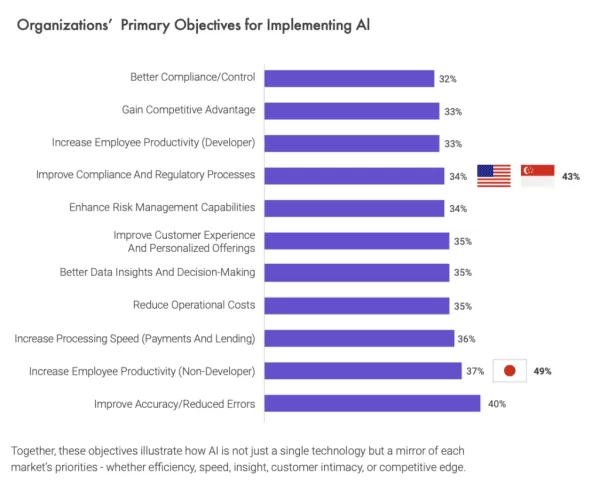
The key goals for AI deployment differ by market. In Singapore and the US, 43% of institutions are leveraging AI to enhance compliance and regulatory processes—highlighting the technology's value in managing complex oversight while maintaining operational stability.
Worldwide, the main objectives for AI implementation are improving accuracy and reducing errors (40%), boosting employee productivity (37%), and strengthening risk management (34%). Vietnam focuses on speed, with 49% using AI to accelerate payments and lending services. Mexico prioritises customer experience and personalisation at 43%.
Cloud infrastructure enables AI at scale
Singapore's AI success is built on widespread cloud adoption. The research shows 55% of its institutions host all or most infrastructure in the cloud, with another 30% using hybrid environments. This combined 85% far surpasses the adoption rates of many global counterparts.
This cloud-first strategy provides the scalable, resilient foundation needed for enterprise AI. Without modern data architecture and elastic computing power, AI initiatives remain small-scale experiments unable to deliver organisation-wide impact.
The connection between technological modernisation and AI deployment is evident. Nearly 90% of institutions (87%) globally plan to increase modernisation spending in the next 12 months, with Singapore leading in planned budget increases exceeding 50%.
Institutions also express strong confidence in their technological foundations. 71% of Singapore respondents rate their core infrastructure, security, and reliability as superior to their peers—the highest confidence level globally and well above the 72% average.
Security spending surges as AI creates new threat vectors
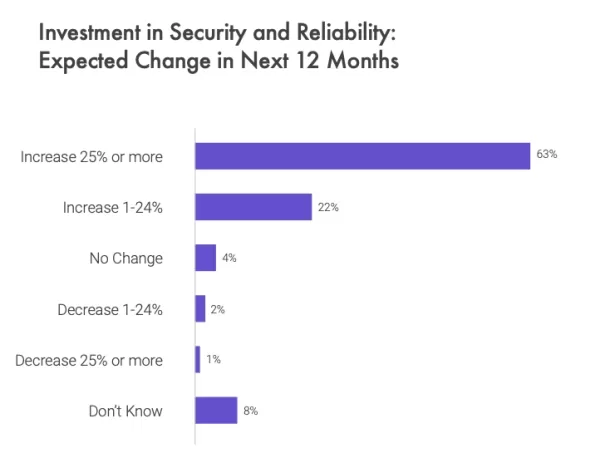
As AI deployment grows, so do AI-powered security threats. The research forecasts a 40% average rise in global security spending for 2026, as institutions respond to what 43% describe as continuously evolving risks.
Singapore leads in deploying advanced fraud detection and transaction monitoring, with 62% having implemented or upgraded these systems in the past year. This compares to a 48% global average, highlighting the local recognition that AI-driven fraud demands AI-powered defences.
Similarly, 60% of Singapore institutions have modernised their Security Information and Event Management (SIEM) and Security Orchestration, Automation and Response (SOAR) capabilities—again the highest rate globally—enabling real-time threat monitoring and automated responses at scale.
Multi-factor authentication and biometrics deployment reached 54% in Singapore, as institutions bolster identity verification against increasingly sophisticated attacks that use generative AI and deepfake technology.
Looking forward, API security and gateway hardening are becoming key priorities, identified by 34% of institutions globally as a focus for the coming year. This reflects a growing understanding that as digital ecosystems expand and AI systems interact across boundaries, securing access points is crucial.
Talent shortages emerge as the primary barrier
Despite significant progress, challenges to AI deployment remain. Talent shortages are the top global barrier at 43%, but in Singapore this figure climbs to 54%—the highest of any market surveyed and matched only by the UAE.
This fierce competition for specialised AI, cloud, and security expertise highlights the gap between institutional goals and available skilled professionals. Demand for experts who can design AI systems, ensure model governance, and integrate AI into workflows vastly exceeds supply.
Budget constraints are another major hurdle, cited by 52% of Singapore institutions—again, the highest rate globally. Even well-resourced organisations face tough prioritisation decisions as they balance AI investment, security upgrades, system modernisation, and customer experience projects.
In response, 54% of institutions worldwide are turning to fintech partnerships as their primary method for accessing AI capabilities without the full burden of hiring talent or developing systems in-house. These collaborations allow organisations to accelerate AI deployment while maintaining control over critical data and compliance.
The research depicts a sector that has unequivocally embraced AI but now confronts the more intricate challenge of scaling it responsibly. As Walters observed, success will be measured not by the number of AI experiments, but by the ability to embed intelligence into operations in a way that builds, rather than erodes, trust.
The study surveyed managers and executives from institutions in France, Germany, Hong Kong, Japan, Mexico, Saudi Arabia, Singapore, the UAE, the UK, the US, and Vietnam. These organisations collectively manage over $100 trillion in assets.
See also: AI Expo 2026 Day 2: Moving experimental pilots to AI production
Want to learn more about AI and big data from industry leaders? Check out the AI & Big Data Expo happening in Amsterdam, California, and London. This comprehensive event is part of TechEx and is co-located with other leading technology events. Click here for more information.
AI News is powered by TechForge Media. Explore other upcoming enterprise technology events and webinars here.
Stripe to Acquire OpenRouter as AI Model Routing Gains MomentumStripe has agreed to acquire OpenRouter, an AI model-routing platform that gives developers access to hundreds of models through a single interface. The deal adds model selection and routing to Stripe’s existing work around AI usage and token-based b
Google AI Overviews Gain Ground in Search ResultsAccording to Similarweb’s 2026 Generative AI Landscape report, Google’s AI-generated summaries appeared in 43% of US searches, a significant rise from 15% recorded a year prior.While AI Overviews present generated summaries within standard search res
Sequoia-backed Empirik raises $21M to forecast outages before they strikeBefore joining Sequoia Capital in 2020 as chief digital and information officer, Avon Puri spent over a decade running infrastructure at Rubrik and VMware. Three years ago, as large language models began showing their true potential, Puri, alongside
2026 Latest Top-rated AI Illustration Tools: Our curated list features the best powerfully designed tools for creating stunning editorial scenes and eye-catching cover art quickly. Each option has gone through rigorous real-world tests, offering a free vs paid comparison to help you find the perfect match for your workflow. Try these must-try solutions today to unlock your AI edge and boost your creative productivity. Explore now at XIX.AI.
2026 Latest Top-Rated Best AI Tutors for Exam Prep are here on XIX.AI! Our curated list features powerful game-changing tools that offer free vs paid comparison, real-world tests, and weekly updated rankings. They help boost your writing efficiency, simplify complex topic learning, and unlock your academic potential. Explore now to Discover your perfect exam prep tool and Start creating today to Unlock your AI edge!
2026 Latest Best Top-Rated AI Budget Planning Tools for Personal Money Management are here on XIX.AI! This curated collection features powerful, game-changing solutions that help you conduct real-world tests, understand spending habits, and create personalized plans to boost productivity. Enjoy a free vs paid comparison along with detailed rankings. Must-try tools designed to simplify money management and unlock your AI edge. Explore now!
2026 Latest Best Top-Rated AI Sleep Tracking Assistants curated for ultimate recovery. This fully updated weekly guide features powerful tools that deliver real-world tests, free vs paid comparison, and detailed rankings to help you find the must-try solution that boosts sleep quality and supports better bedtime habits. Explore now at XIX.AI to Unlock your AI edge.
2026 Latest Best Top-Rated AI SQL Copilots for Product and Revenue Analytics! XIX.AI has curated a powerful, game-changing collection of must-try tools that undergo real-world tests through weekly updated rankings. These tools help users boost productivity significantly by accelerating data analysis, streamlining complex queries, and generating accurate insights to drive smarter business decisions. Explore now to Discover your perfect tool for unlocking your AI edge!
2026 Latest Best Top-Rated AI Homework Helpers That Teach Core Concepts Not Just Answers Powerful Tools for Students Must-Try Curated List Weekly Updated Free vs Paid Comparison Real-World Tests Accurate Rankings to Help You Unlock Your Full Learning Potential Explore now to Discover your perfect tool for smarter studying.
By clicking "Accept All Cookies", you agree to the storing of cookies on your device to enhance site navigation, analyze site usage, and assist in our marketing efforts.Privacy Policy Notice
When you visit any website, it may store or retrieve information on your browser, mostly in the form of cookies. This information might be about you, your preferences or your device and is mostly used to make the site work as you expect it to. The information does not usually directly identify you, but it can give you a more personalized web experience. Because we respect your right to privacy, you can choose not to allow some types of cookies. Click on the different category headings to find out more and change our default settings.However, blocking some types of cookies may impact your experience of the site and the services we are able to offer. Privacy PolicyStatement
Manage Preferences
Strictly Necessary Cookie
Always Active
These cookies are necessary for the website to function and cannot be switched off in our systems. They are usually only set in response to actions made by you which amount to a request for services, such as setting your privacy preferences, logging in or filling in forms. You can set your browser to block or alert you about these cookies, but some parts of the site will not then work. These cookies do not store any personally identifiable information.



 Home
Home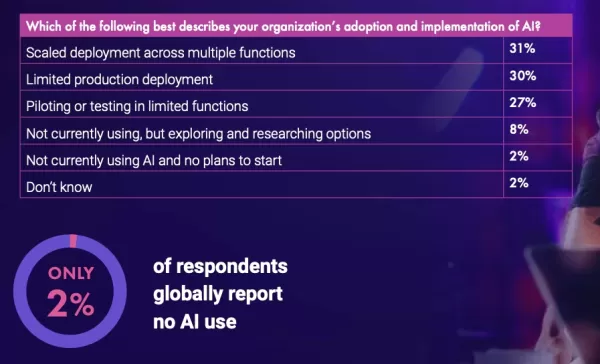
 Stripe to Acquire OpenRouter as AI Model Routing Gains Momentum
Stripe has agreed to acquire OpenRouter, an AI model-routing platform that gives developers access to hundreds of models through a single interface. The deal adds model selection and routing to Stripe’s existing work around AI usage and token-based b
Stripe to Acquire OpenRouter as AI Model Routing Gains Momentum
Stripe has agreed to acquire OpenRouter, an AI model-routing platform that gives developers access to hundreds of models through a single interface. The deal adds model selection and routing to Stripe’s existing work around AI usage and token-based b
 Top AI Illustration Tools: Create Editorial Scenes and Cover Art Faster
 10 tools
 xix.ai
Education and Learning
xix.ai
Education and Learning

 Comments (0)
0/500
Comments (0)
0/500








 Stripe to Acquire OpenRouter as AI Model Routing Gains Momentum
Stripe has agreed to acquire OpenRouter, an AI model-routing platform that gives developers access to hundreds of models through a single interface. The deal adds model selection and routing to Stripe’s existing work around AI usage and token-based b
Stripe to Acquire OpenRouter as AI Model Routing Gains Momentum
Stripe has agreed to acquire OpenRouter, an AI model-routing platform that gives developers access to hundreds of models through a single interface. The deal adds model selection and routing to Stripe’s existing work around AI usage and token-based b
 Google AI Overviews Gain Ground in Search Results
According to Similarweb’s 2026 Generative AI Landscape report, Google’s AI-generated summaries appeared in 43% of US searches, a significant rise from 15% recorded a year prior.While AI Overviews present generated summaries within standard search res
Google AI Overviews Gain Ground in Search Results
According to Similarweb’s 2026 Generative AI Landscape report, Google’s AI-generated summaries appeared in 43% of US searches, a significant rise from 15% recorded a year prior.While AI Overviews present generated summaries within standard search res
 Sequoia-backed Empirik raises $21M to forecast outages before they strike
Before joining Sequoia Capital in 2020 as chief digital and information officer, Avon Puri spent over a decade running infrastructure at Rubrik and VMware. Three years ago, as large language models began showing their true potential, Puri, alongside
Sequoia-backed Empirik raises $21M to forecast outages before they strike
Before joining Sequoia Capital in 2020 as chief digital and information officer, Avon Puri spent over a decade running infrastructure at Rubrik and VMware. Three years ago, as large language models began showing their true potential, Puri, alongside