


 Home
HomeOpenAI to Retain ChatGPT Data Per Court Order, CEO Altman Proposes 'AI Privilege'
Many regular ChatGPT users, including the author of this article, may have interacted with the "temporary chat" feature. This option, offered by OpenAI's popular chatbot, is designed to automatically clear all information exchanged during a session as soon as it is closed.
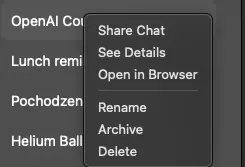
Furthermore, users have the ability to manually delete past ChatGPT conversations from the sidebar in the web, desktop, and mobile applications. This is done by left-clicking, control-clicking, or performing a long press on the desired chat.
This week, however, OpenAI faced user criticism after it was revealed the company had not been deleting these chat logs as users were led to believe.
"You’re telling me my deleted ChatGPT chats are actually not deleted and [are] being saved to be investigated by a judge?" posted X user @ns123abc, a comment that garnered over a million views.
Another user, @kepano, added, "you can ‘delete’ a ChatGPT chat, however all chats must be retained due to legal obligations ?".
As AI expert and software engineer Simon Willison noted on his blog: "Paying customers of [OpenAI’s] APIs may well make the decision to switch to other providers who can offer retention policies that aren’t subverted by this court order!"
OpenAI confirmed that, since mid-May 2025, it has been preserving deleted and temporary user chats in compliance with a federal court order. The company did not inform users of this retention until June 5th.
The order, issued on May 13, 2025, by U.S. Magistrate Judge Ona T. Wang, directs OpenAI to "preserve and segregate all output log data that would otherwise be deleted on a going forward basis." This includes chats users have requested to delete or those cleared automatically for privacy.
gov.uscourts.nysd.612697.551.0_1DownloadThis directive originates from The New York Times (NYT) v. OpenAI and Microsoft, a copyright lawsuit ongoing for over a year and a half. Lawyers for the NYT allege OpenAI's language models can reproduce copyrighted news content verbatim. They argue that logs, including those users deleted, could contain relevant evidence of infringing outputs.
While OpenAI complied with the order immediately, it waited more than three weeks to notify affected users publicly. The company later published a blog post and FAQ detailing the legal mandate and which users were impacted.
OpenAI places the responsibility for this action on the NYT and the judge's order, stating it believes the preservation demand is "baseless."
OpenAI clarifies the court order to preserve ChatGPT user logs and details which chats are affected
In a recent blog post, OpenAI COO Brad Lightcap defended the company's stance, stating it is advocating for user privacy against what it views as an overly broad judicial order. He wrote:
“The New York Times and other plaintiffs have made a sweeping and unnecessary demand in their baseless lawsuit against us: retain consumer ChatGPT and API customer data indefinitely. This fundamentally conflicts with the privacy commitments we have made to our users.”
The post clarified that ChatGPT Free, Plus, Pro, and Team users, along with API customers without a zero data retention (ZDR) agreement, are subject to the preservation order. For these users, even deleted chats or those from temporary chat sessions will be stored for the foreseeable future.
However, subscribers to ChatGPT Enterprise and Edu plans, as well as API clients using ZDR endpoints, are not impacted. Their chats will continue to be deleted as directed.
The retained data is held under a legal hold, meaning it is stored in a secure, separate system accessible only to a limited number of legal and security personnel.
“This data is not automatically shared with The New York Times or anyone else,” Lightcap emphasized.
Sam Altman proposes 'AI privilege' for confidential user-model conversations
OpenAI CEO and co-founder Sam Altman also addressed the issue publicly in a post on X, writing:
“recently the NYT asked a court to force us to not delete any user chats. we think this was an inappropriate request that sets a bad precedent. we are appealing the decision. we will fight any demand that compromises our users’ privacy; this is a core principle.”
He suggested a broader legal and ethical framework for AI privacy may be necessary:
“we have been thinking recently about the need for something like ‘AI privilege’; this really accelerates the need to have the conversation.”
“imo talking to an AI should be like talking to a lawyer or a doctor.”
“i hope society will figure this out soon.“
The concept of "AI privilege" would parallel established confidentiality standards like attorney-client or doctor-patient privilege.
Whether such a framework gains traction in legal or policy arenas is uncertain, but Altman's comments indicate OpenAI may push for this type of change.
What's next for OpenAI and your temporary or deleted chats?
OpenAI has formally objected to the court's order, requesting it be vacated.
In court filings, the company argues the demand lacks a factual basis and that preserving billions of additional data points is unnecessary and disproportionate.
Judge Wang indicated during a May 27 hearing that the order is temporary. She instructed both parties to develop a sampling plan to test whether deleted user data materially differs from retained logs. OpenAI was ordered to submit that proposal by June 6, though the filing has not yet been made public.
Implications for enterprises and corporate AI decision-makers
Although the order exempts ChatGPT Enterprise and API customers using ZDR endpoints, its broader legal and reputational implications are significant for professionals managing AI deployments.
Those overseeing the lifecycle of large language models (LLMs) must reassess data governance assumptions. If user-facing LLM components can be subject to legal preservation orders, critical questions arise about data flow after it leaves a secure endpoint and how to isolate or anonymize high-risk interactions.
Any platform utilizing OpenAI APIs must verify which endpoints (ZDR vs. non-ZDR) are in use and ensure data handling policies are clearly reflected in user agreements, audit logs, and internal documentation.
Even with ZDR endpoints, organizations should review data lifecycle policies to confirm that downstream systems (analytics, logging, backup) do not inadvertently retain interactions presumed to be transient.
Security officers must now expand threat modeling to include legal discovery as a potential risk vector. Teams need to verify if OpenAI's backend retention practices align with internal controls, assess third-party risks, and determine if users are relying on features like "temporary chat" that may not function as expected under a legal hold.
A pivotal moment for user privacy and security in AI
This situation represents more than a legal dispute; it is a pivotal moment in the evolving debate over AI privacy and data rights. By introducing the concept of "AI privilege," OpenAI is proposing a new social contract for how intelligent systems handle confidential user input.
Whether courts or lawmakers accept this framing is still unknown. For now, OpenAI is navigating a complex balance between legal compliance, enterprise assurances, and user trust, all while facing growing scrutiny over who ultimately controls data when interacting with AI.
Related article
 Warner Music acquires AI attribution startup Sureel AI
Warner Music Group (WMG) confirmed on Wednesday that it is acquiring Sureel AI, an artificial intelligence attribution startup. Sureel’s proprietary technology generates “AI DNA” for musical tracks, deconstructing them into constituent elements to tr
Amazon introduces Alexa for Shopping while pushing Rufus to the background
Amazon has launched Alexa for Shopping, merging its Rufus shopping chatbot with Alexa+ across the app, website, and Echo Show devices.The assistant answers product queries, compares items, tracks prices, and supports shopping reminders. It also handl
Microsoft, Azure and AI Tech Combat California Wildfire Risks
Microsoft invests in AI-driven wildfire detection, with Juan Lavista Ferres, CVP and Chief Data Scientist, discussing strategies to mitigate environmental damage.According to NASA, climate change impacts everyone on Earth, manifesting as rising tempe
Related Special Topic Recommendations
chatbot
Warner Music acquires AI attribution startup Sureel AI
Warner Music Group (WMG) confirmed on Wednesday that it is acquiring Sureel AI, an artificial intelligence attribution startup. Sureel’s proprietary technology generates “AI DNA” for musical tracks, deconstructing them into constituent elements to tr
Amazon introduces Alexa for Shopping while pushing Rufus to the background
Amazon has launched Alexa for Shopping, merging its Rufus shopping chatbot with Alexa+ across the app, website, and Echo Show devices.The assistant answers product queries, compares items, tracks prices, and supports shopping reminders. It also handl
Microsoft, Azure and AI Tech Combat California Wildfire Risks
Microsoft invests in AI-driven wildfire detection, with Juan Lavista Ferres, CVP and Chief Data Scientist, discussing strategies to mitigate environmental damage.According to NASA, climate change impacts everyone on Earth, manifesting as rising tempe
Related Special Topic Recommendations
chatbot
 Best AI Conversation Trainer Tools for Interview Practice
2026 Latest Best Top-rated AI Conversation Trainer Tools for Interview Practice are here on XIX.AI! This curated collection features powerful, game-changing tools that go through rigorous real-world tests to deliver accurate feedback. You’ll find a free vs paid comparison and detailed rankings to help you choose the must-try option that boosts your confidence and skills. Explore now to Discover your perfect tool for interview success!
 12 tools
 xix.ai
Design & Art
Best AI Style Transfer Tools for Creative Experiments
xix.ai
Design & Art
Best AI Style Transfer Tools for Creative Experiments
2026 Latest Best Top-rated AI Style Transfer Tools for Creative Experiments! XIX.AI has curated a powerful, game-changing collection of must-try tools that deliver exceptional results through real-world tests and rigorous rankings. These top solutions help creatives boost productivity significantly by accelerating content creation and unlocking endless creative possibilities. Explore now to discover your perfect tool and start creating today!
9 tools
xix.ai
Comic Creation
Best AI Dialogue Bubble Tools for Visual Storytelling
2026 Latest Best Top-Rated AI Dialogue Bubble Tools for Visual Storytelling are here on XIX.AI! This curated collection features powerful, game-changing tools that help creators boost productivity and overcome creative bottlenecks. Get a free vs paid comparison, see real-world tests, and check the latest rankings to find the must-try solutions perfect for crafting engaging visual narratives. Explore now to discover your ideal tool!
10 tools
xix.ai
Meeting Assistant
Top AI Meeting Summary Tools: Track Decisions and Follow-Ups Clearly
2026 Latest Top-Rated Best AI Meeting Summary Tools for Clear Decision Tracking and Effortless Follow-Ups. This curated list showcases powerful, game-changing solutions that boost productivity dramatically by automating meeting notes, identifying key action items, and streamlining team coordination across all projects. Get a free vs paid comparison along with real-world tests and weekly updated rankings to help you find the perfect tool. Explore now to unlock your AI edge!
9 tools
xix.ai
Data Analysis
Best AI Data Cleaning Tools: Fix Missing Values and Duplicates Fast
2026 Latest Best Top-rated AI Data Cleaning Tools for quick fixing of missing values and duplicates. This curated list showcases powerful, game-changing solutions that boost productivity significantly. Each option has undergone rigorous real-world tests to ensure reliability. Get a free vs paid comparison and discover the must-try tool that fits your needs best. Explore now at XIX.AI to Unlock your AI edge.
11 tools
xix.ai
Design & Art
Best AI Creative Ideation Tools for Artists: Break Through Visual Blocks
2026 Latest Best Top-Rated AI Creative Ideation Tools for Artists are curated by XIX.AI to help creators break through visual blocks and boost creativity instantly. These powerful game-changing tools offer real-world tests, detailed free vs paid comparison, and weekly updated rankings. Discover your perfect tool to accelerate content creation and unlock your AI edge today. Explore now!
14 tools
xix.ai

 Comments (2)
0/500
Comments (2)
0/500
![RalphWalker]()
So the 'temporary chat' wasn't really temporary after all? Classic move – promise privacy, then keep the data anyway. 🙄 And 'AI privilege' sounds like a get-out-of-jail-free card for tech giants. I'd rather see actual encryption than fancy new terms.
![LucasNelson]()
Interesting... So 'temporary chats' weren't really that temporary after all? This proposed 'AI privilege' sounds like an attempt to build a legal shield. The privacy vs. intelligence gathering debate is just getting started. What data policy are you actually agreeing to when you click 'agree'? 🤔
Many regular ChatGPT users, including the author of this article, may have interacted with the "temporary chat" feature. This option, offered by OpenAI's popular chatbot, is designed to automatically clear all information exchanged during a session as soon as it is closed.
Furthermore, users have the ability to manually delete past ChatGPT conversations from the sidebar in the web, desktop, and mobile applications. This is done by left-clicking, control-clicking, or performing a long press on the desired chat.
This week, however, OpenAI faced user criticism after it was revealed the company had not been deleting these chat logs as users were led to believe.
"You’re telling me my deleted ChatGPT chats are actually not deleted and [are] being saved to be investigated by a judge?" posted X user @ns123abc, a comment that garnered over a million views.
Another user, @kepano, added, "you can ‘delete’ a ChatGPT chat, however all chats must be retained due to legal obligations ?".
As AI expert and software engineer Simon Willison noted on his blog: "Paying customers of [OpenAI’s] APIs may well make the decision to switch to other providers who can offer retention policies that aren’t subverted by this court order!"
OpenAI confirmed that, since mid-May 2025, it has been preserving deleted and temporary user chats in compliance with a federal court order. The company did not inform users of this retention until June 5th.
The order, issued on May 13, 2025, by U.S. Magistrate Judge Ona T. Wang, directs OpenAI to "preserve and segregate all output log data that would otherwise be deleted on a going forward basis." This includes chats users have requested to delete or those cleared automatically for privacy.
gov.uscourts.nysd.612697.551.0_1DownloadThis directive originates from The New York Times (NYT) v. OpenAI and Microsoft, a copyright lawsuit ongoing for over a year and a half. Lawyers for the NYT allege OpenAI's language models can reproduce copyrighted news content verbatim. They argue that logs, including those users deleted, could contain relevant evidence of infringing outputs.
While OpenAI complied with the order immediately, it waited more than three weeks to notify affected users publicly. The company later published a blog post and FAQ detailing the legal mandate and which users were impacted.
OpenAI places the responsibility for this action on the NYT and the judge's order, stating it believes the preservation demand is "baseless."
OpenAI clarifies the court order to preserve ChatGPT user logs and details which chats are affected
In a recent blog post, OpenAI COO Brad Lightcap defended the company's stance, stating it is advocating for user privacy against what it views as an overly broad judicial order. He wrote:
“The New York Times and other plaintiffs have made a sweeping and unnecessary demand in their baseless lawsuit against us: retain consumer ChatGPT and API customer data indefinitely. This fundamentally conflicts with the privacy commitments we have made to our users.”
The post clarified that ChatGPT Free, Plus, Pro, and Team users, along with API customers without a zero data retention (ZDR) agreement, are subject to the preservation order. For these users, even deleted chats or those from temporary chat sessions will be stored for the foreseeable future.
However, subscribers to ChatGPT Enterprise and Edu plans, as well as API clients using ZDR endpoints, are not impacted. Their chats will continue to be deleted as directed.
The retained data is held under a legal hold, meaning it is stored in a secure, separate system accessible only to a limited number of legal and security personnel.
“This data is not automatically shared with The New York Times or anyone else,” Lightcap emphasized.
Sam Altman proposes 'AI privilege' for confidential user-model conversations
OpenAI CEO and co-founder Sam Altman also addressed the issue publicly in a post on X, writing:
“recently the NYT asked a court to force us to not delete any user chats. we think this was an inappropriate request that sets a bad precedent. we are appealing the decision. we will fight any demand that compromises our users’ privacy; this is a core principle.”
He suggested a broader legal and ethical framework for AI privacy may be necessary:
“we have been thinking recently about the need for something like ‘AI privilege’; this really accelerates the need to have the conversation.”
“imo talking to an AI should be like talking to a lawyer or a doctor.”
“i hope society will figure this out soon.“
The concept of "AI privilege" would parallel established confidentiality standards like attorney-client or doctor-patient privilege.
Whether such a framework gains traction in legal or policy arenas is uncertain, but Altman's comments indicate OpenAI may push for this type of change.
What's next for OpenAI and your temporary or deleted chats?
OpenAI has formally objected to the court's order, requesting it be vacated.
In court filings, the company argues the demand lacks a factual basis and that preserving billions of additional data points is unnecessary and disproportionate.
Judge Wang indicated during a May 27 hearing that the order is temporary. She instructed both parties to develop a sampling plan to test whether deleted user data materially differs from retained logs. OpenAI was ordered to submit that proposal by June 6, though the filing has not yet been made public.
Implications for enterprises and corporate AI decision-makers
Although the order exempts ChatGPT Enterprise and API customers using ZDR endpoints, its broader legal and reputational implications are significant for professionals managing AI deployments.
Those overseeing the lifecycle of large language models (LLMs) must reassess data governance assumptions. If user-facing LLM components can be subject to legal preservation orders, critical questions arise about data flow after it leaves a secure endpoint and how to isolate or anonymize high-risk interactions.
Any platform utilizing OpenAI APIs must verify which endpoints (ZDR vs. non-ZDR) are in use and ensure data handling policies are clearly reflected in user agreements, audit logs, and internal documentation.
Even with ZDR endpoints, organizations should review data lifecycle policies to confirm that downstream systems (analytics, logging, backup) do not inadvertently retain interactions presumed to be transient.
Security officers must now expand threat modeling to include legal discovery as a potential risk vector. Teams need to verify if OpenAI's backend retention practices align with internal controls, assess third-party risks, and determine if users are relying on features like "temporary chat" that may not function as expected under a legal hold.
A pivotal moment for user privacy and security in AI
This situation represents more than a legal dispute; it is a pivotal moment in the evolving debate over AI privacy and data rights. By introducing the concept of "AI privilege," OpenAI is proposing a new social contract for how intelligent systems handle confidential user input.
Whether courts or lawmakers accept this framing is still unknown. For now, OpenAI is navigating a complex balance between legal compliance, enterprise assurances, and user trust, all while facing growing scrutiny over who ultimately controls data when interacting with AI.








 Warner Music acquires AI attribution startup Sureel AI
Warner Music Group (WMG) confirmed on Wednesday that it is acquiring Sureel AI, an artificial intelligence attribution startup. Sureel’s proprietary technology generates “AI DNA” for musical tracks, deconstructing them into constituent elements to tr
Amazon introduces Alexa for Shopping while pushing Rufus to the background
Amazon has launched Alexa for Shopping, merging its Rufus shopping chatbot with Alexa+ across the app, website, and Echo Show devices.The assistant answers product queries, compares items, tracks prices, and supports shopping reminders. It also handl
Warner Music acquires AI attribution startup Sureel AI
Warner Music Group (WMG) confirmed on Wednesday that it is acquiring Sureel AI, an artificial intelligence attribution startup. Sureel’s proprietary technology generates “AI DNA” for musical tracks, deconstructing them into constituent elements to tr
Amazon introduces Alexa for Shopping while pushing Rufus to the background
Amazon has launched Alexa for Shopping, merging its Rufus shopping chatbot with Alexa+ across the app, website, and Echo Show devices.The assistant answers product queries, compares items, tracks prices, and supports shopping reminders. It also handl
 Microsoft, Azure and AI Tech Combat California Wildfire Risks
Microsoft invests in AI-driven wildfire detection, with Juan Lavista Ferres, CVP and Chief Data Scientist, discussing strategies to mitigate environmental damage.According to NASA, climate change impacts everyone on Earth, manifesting as rising tempe
Microsoft, Azure and AI Tech Combat California Wildfire Risks
Microsoft invests in AI-driven wildfire detection, with Juan Lavista Ferres, CVP and Chief Data Scientist, discussing strategies to mitigate environmental damage.According to NASA, climate change impacts everyone on Earth, manifesting as rising tempe

2026 Latest Best Top-rated AI Conversation Trainer Tools for Interview Practice are here on XIX.AI! This curated collection features powerful, game-changing tools that go through rigorous real-world tests to deliver accurate feedback. You’ll find a free vs paid comparison and detailed rankings to help you choose the must-try option that boosts your confidence and skills. Explore now to Discover your perfect tool for interview success!
12 tools
xix.ai

2026 Latest Best Top-rated AI Style Transfer Tools for Creative Experiments! XIX.AI has curated a powerful, game-changing collection of must-try tools that deliver exceptional results through real-world tests and rigorous rankings. These top solutions help creatives boost productivity significantly by accelerating content creation and unlocking endless creative possibilities. Explore now to discover your perfect tool and start creating today!
9 tools
xix.ai

2026 Latest Best Top-Rated AI Dialogue Bubble Tools for Visual Storytelling are here on XIX.AI! This curated collection features powerful, game-changing tools that help creators boost productivity and overcome creative bottlenecks. Get a free vs paid comparison, see real-world tests, and check the latest rankings to find the must-try solutions perfect for crafting engaging visual narratives. Explore now to discover your ideal tool!
10 tools
xix.ai

2026 Latest Top-Rated Best AI Meeting Summary Tools for Clear Decision Tracking and Effortless Follow-Ups. This curated list showcases powerful, game-changing solutions that boost productivity dramatically by automating meeting notes, identifying key action items, and streamlining team coordination across all projects. Get a free vs paid comparison along with real-world tests and weekly updated rankings to help you find the perfect tool. Explore now to unlock your AI edge!
9 tools
xix.ai

2026 Latest Best Top-rated AI Data Cleaning Tools for quick fixing of missing values and duplicates. This curated list showcases powerful, game-changing solutions that boost productivity significantly. Each option has undergone rigorous real-world tests to ensure reliability. Get a free vs paid comparison and discover the must-try tool that fits your needs best. Explore now at XIX.AI to Unlock your AI edge.
11 tools
xix.ai

2026 Latest Best Top-Rated AI Creative Ideation Tools for Artists are curated by XIX.AI to help creators break through visual blocks and boost creativity instantly. These powerful game-changing tools offer real-world tests, detailed free vs paid comparison, and weekly updated rankings. Discover your perfect tool to accelerate content creation and unlock your AI edge today. Explore now!
14 tools
xix.ai

So the 'temporary chat' wasn't really temporary after all? Classic move – promise privacy, then keep the data anyway. 🙄 And 'AI privilege' sounds like a get-out-of-jail-free card for tech giants. I'd rather see actual encryption than fancy new terms.
Interesting... So 'temporary chats' weren't really that temporary after all? This proposed 'AI privilege' sounds like an attempt to build a legal shield. The privacy vs. intelligence gathering debate is just getting started. What data policy are you actually agreeing to when you click 'agree'? 🤔












