


 Home
HomeFace Recognition in 2025: Siamese Networks or Binary Classification?
Face recognition plays a vital role in applications ranging from security systems to social media. While triplet loss is a widely used method for training convolutional neural networks (CNNs) for this purpose, an alternative strategy frames the task as a binary classification problem. This approach leverages Siamese networks, providing a distinct way to learn the parameters required for effective face verification. Below, we explore how this is accomplished by employing a pair of neural networks to generate embeddings.
Key Points
Siamese networks are effective for face verification.
Face recognition can be modeled as a binary classification task.
Learning similarity functions incorporates logistic regression.
Pre-computing embeddings enhances deployment efficiency.
Processes include data collection, model training, evaluation, and deployment.
Both face verification and recognition can be trained using binary classification as an alternative to triplet loss.
Understanding Face Recognition and Verification
Face Recognition as Binary Classification
Face recognition involves more than just identifying an individual; it verifies a person's claimed identity. This is known as face verification. One practical approach treats verification as a binary classification problem. Instead of distinguishing among many faces, the system answers a straightforward question: "Do these two faces belong to the same person?" This binary framing simplifies the problem and improves computational efficiency. The technique relies on a Siamese network, composed of two identical neural networks with shared weights and architecture. Each network processes one input image, and their outputs are compared to yield a similarity score. If the score surpasses a defined threshold, the faces are considered a match; otherwise, they are classified as different. The network is trained to output 1 for matching identities and 0 for non-matching ones. This contrasts with more complex systems that must differentiate across a wide array of known individuals.
The Siamese Network Architecture
The method is centered on the Siamese network architecture.
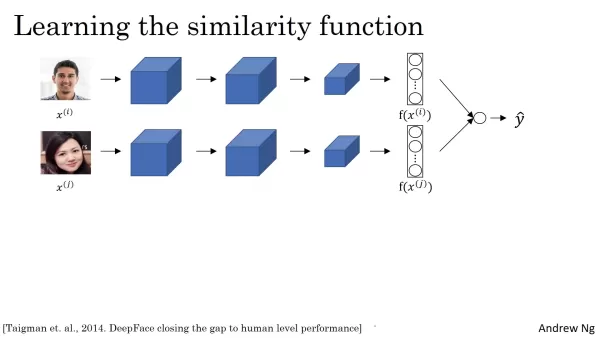
This architecture pairs two identical neural networks, each processing one of two input images. These networks compute embeddings, which are high-dimensional vectors that encode unique facial traits. By comparing these embeddings, the system assesses facial similarity. The embedding process generally includes convolutional, pooling, and fully connected layers, each extracting progressively intricate features from the image. The final output is a vector—often 128-dimensional—that captures essential facial characteristics. Larger dimensions may also be used to detect finer details. Crucially, both networks in the Siamese setup share identical parameters, ensuring the embeddings are generated through the same feature extraction process and are directly comparable.
Learning Similarity Functions with Logistic Regression
Using Logistic Regression
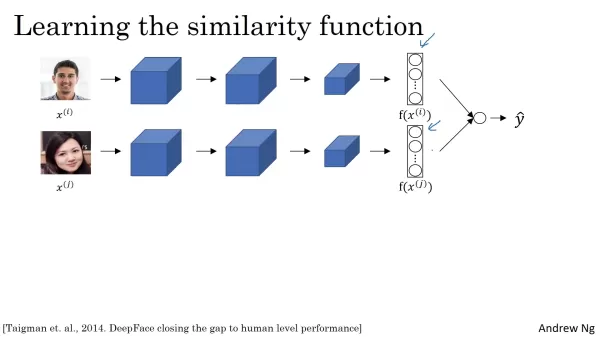
To determine whether two faces represent the same person, the embeddings from the Siamese network must be compared. A logistic regression unit applies a sigmoid function to these embeddings, producing a probability score that reflects the likelihood of a match. The input to this unit isn't the raw embeddings, but features derived from them. A common method is to compute the element-wise absolute difference between the two embeddings, emphasizing the features with the greatest disparities. Chi-square similarity is another technique used. The objective is to form highly discriminative features that enable the logistic regression unit to make precise predictions. The element-wise differences feed into the logistic regression model, which learns to assign appropriate weights. If differences are minimal, the unit assigns a high probability, indicating the same person; if differences are significant, it assigns a low probability, indicating different individuals.
Training the Siamese Network and Logistic Regression
Step-by-Step Training Process
- Gathering Training Data: Begin by compiling a dataset of face images, with labels indicating whether image pairs depict the same person or different people. This dataset trains the Siamese network and logistic regression unit.
- Setting Up the Siamese Network: Configure two identical CNNs with the same architecture and shared weights. These networks will learn to generate embeddings from input face images.
- Calculating Feature Differences: Determine the element-wise absolute differences between the embeddings generated by the two CNNs for each image pair. These differences become the input features for the logistic regression unit.
- Integrating Logistic Regression: Employ a logistic regression model to convert the feature differences into a probability score, indicating whether the faces match.
- Fine-Tuning: Refine the logistic regression layer by adjusting the weights assigned to the features (such as those in a 128-dimensional embedding).
- Backpropagation Training: Train the complete system—CNNs and logistic regression unit—using backpropagation. This minimizes a loss function that penalizes prediction errors, gradually improving accuracy by optimizing network weights and biases.
- Adjusting Weights: The final logistic regression model can include additional parameters like weight (W) and bias (B).
- Pre-computing Embeddings: For faster deployment, pre-compute the embeddings to enable quick comparisons.
Advantages and Disadvantages of Siamese Networks for Face Recognition
Pros
Computational Efficiency
Directly Addresses Face Verification
Effective Feature Extraction
Cons
Training Data Requirements
Potential for Overfitting
Limited Generalization
Frequently Asked Questions
What are Siamese networks, and how do they function in face recognition?
Siamese networks are neural networks comprising two or more identical subnetworks. Each subnetwork receives a distinct input but shares weights with the others. In face recognition, these networks process pairs of face images to produce embeddings, which are then evaluated for similarity.
Why is face recognition sometimes framed as a binary classification problem?
Viewing face recognition as a binary classification problem simplifies it to determining whether two faces match, increasing efficiency compared to distinguishing among many individuals. This method uses Siamese networks to compare pairs of face images.
What is the role of logistic regression in learning similarity functions for face recognition?
Logistic regression maps the differences between embeddings from Siamese networks to a probability score. This score estimates the likelihood that the two faces are the same person, supporting a binary decision.
Related Questions
How does this Siamese network approach compare to traditional methods like triplet loss?
Traditional methods like triplet loss aim to learn an embedding space where faces of the same person are closer and those of different people are farther apart. Siamese networks, structured for binary classification, concentrate on verifying if two faces are identical, offering computational advantages. The best choice depends on the specific application and dataset characteristics.
Are there other methods to evaluate the similarity of the embeddings?
Yes, alternatives include cosine similarity, Euclidean distance, and chi-square similarity. The chi-square similarity formula offers another way to approach face recognition. Each technique has its strengths and is suited to different data types and use cases. For instance, cosine similarity performs well with high-dimensional data, while Euclidean distance is effective in lower dimensions.
What is involved in actually deploying the trained system?
Deployment entails pre-computing embeddings to avoid storing raw images. The system, built on a Siamese network architecture, is designed to compare these embeddings efficiently.
Related article
 How Legora Is Building the Operating System for Legal AI
Legora has recruited attorney-editors with decades of experience in building publishers' navigation tools to develop its AI-native citator. Credit: LegoraLeveraging Azure OpenAI, Legora integrates a legal ontology with an AI-native citator to elimina
Xianyu AI Service Nears 10 Million Orders in Six Months, Driven by Female Sellers in Lower-Tier Cities
Xianyu’s first-half 2026 data reveals AI services as the platform’s top consumption category. The platform recorded 9.816 million AI service orders in H1, a 157% year-over-year surge. Nearly 5 million users purchased AI services on Xianyu, reflecting
Cao Cao Mobility Unveils AI Ride-Hailing Service Via Doubao in Beijing, Hangzhou and Suzhou
The AI-powered ride-hailing platform, a collaboration between Cao Cao Mobility and Doubao, has officially launched in Beijing, Hangzhou, and Suzhou. Users can now inquire about routes, destinations, dining options, and entertainment within Doubao, wi
Related Special Topic Recommendations
design
How Legora Is Building the Operating System for Legal AI
Legora has recruited attorney-editors with decades of experience in building publishers' navigation tools to develop its AI-native citator. Credit: LegoraLeveraging Azure OpenAI, Legora integrates a legal ontology with an AI-native citator to elimina
Xianyu AI Service Nears 10 Million Orders in Six Months, Driven by Female Sellers in Lower-Tier Cities
Xianyu’s first-half 2026 data reveals AI services as the platform’s top consumption category. The platform recorded 9.816 million AI service orders in H1, a 157% year-over-year surge. Nearly 5 million users purchased AI services on Xianyu, reflecting
Cao Cao Mobility Unveils AI Ride-Hailing Service Via Doubao in Beijing, Hangzhou and Suzhou
The AI-powered ride-hailing platform, a collaboration between Cao Cao Mobility and Doubao, has officially launched in Beijing, Hangzhou, and Suzhou. Users can now inquire about routes, destinations, dining options, and entertainment within Doubao, wi
Related Special Topic Recommendations
design
 Best AI Design System Assistants for UI Consistency across Web, Mobile, and Docs
2026 Latest Best Top-rated AI Design System Assistants for UI Consistency across Web, Mobile, and Docs. This curated list features powerful game-changing tools that help teams create uniform designs effortlessly, saving time and boosting productivity. Get a free vs paid comparison along with real-world tests and detailed rankings to find the must-try solution that fits your needs. Explore now at XIX.AI to Unlock your AI edge.
 10 tools
 xix.ai
Academic Research
Top AI Paper Reading Tools: Extract Methods, Results, and Limits Faster
xix.ai
Academic Research
Top AI Paper Reading Tools: Extract Methods, Results, and Limits Faster
2026 Latest Top-Rated Best AI Paper Reading Tools for Researchers! This curated list offers powerful game-changing solutions to quickly extract key methods, results, and limitations from complex academic papers. XIX.AI provides weekly updated free vs paid comparison data along with real-world tests across diverse research fields. Discover your perfect tool to boost productivity and unlock your AI edge today. Explore now!
8 tools
xix.ai
Music composition
Best AI Vocal Demo Tools for Track Prototypes
2026 Latest Best Top-rated AI Vocal Demo Tools for Track Prototypes are here on XIX.AI! This curated list features powerful, game-changing tools that go through real-world tests to ensure top performance. You’ll find a free vs paid comparison, detailed rankings, and must-try options perfect for boosting creative efficiency and helping you unlock your AI edge. Explore now to discover your perfect tool!
10 tools
xix.ai
Software Development
AI API Mocking Tools for Frontend-Backend Collaboration
2026 Latest Best Top-rated AI API Mocking Tools for Frontend-Backend Collaboration are here on XIX.AI! This curated list features powerful, game-changing solutions that help teams streamline workflows, boost productivity, and create high-quality apps faster through real-world tests and strict rankings. Get a free vs paid comparison to find the must-try option that suits your needs. Explore now to unlock your AI edge!
12 tools
xix.ai
Design & Art
Midjourney Style Reference Tools for Character Concepts, Posters, and Ad Visuals
2026 Latest Best Top-rated Midjourney Style Reference Tools for Character Concepts, Posters, and Ad Visuals! XIX.AI has curated a powerful game-changing collection that undergoes weekly updated real-world tests. You can find detailed free vs paid comparison insights and reliable rankings to help you pick the must-try option that boosts your creativity and speeds up workflow significantly. Explore now to Discover your perfect tool for all your visual design needs.
11 tools
xix.ai
Music composition
AI Vocal Generation Tools: Create Demo Vocals and Harmony Layers
2026 Latest Best Top-rated AI Vocal Generation Tools for Creating Demo Vocals and Harmony Layers are here on XIX.AI. This curated collection features powerful, game-changing solutions that have passed rigorous real-world tests. We provide a weekly updated free vs paid comparison along with detailed rankings to help you find the perfect tool for boosting your creativity and productivity. Explore now to Unlock your AI edge.
12 tools
xix.ai

 Comments (2)
0/500
Comments (2)
0/500
![PaulMartínez]()
Interessant, dass hier Siamese Networks und binäre Klassifikation verglichen werden. Ich frage mich, ob die Wahl je nach Anwendungsfall variieren sollte – vielleicht ist der eine Ansatz für Sicherheitssysteme besser, der andere für Social Media? 🤔 Die Diskussion um Triplet Loss vs. Alternativen zeigt, wie dynamisch das Feld noch ist. Hoffentlich bleibt die Ethik dabei nicht auf der Strecke, gerade bei Gesichtserkennung.
![JohnRoberts]()
¿Redes Siamesas vs. clasificación binaria en 2025? Me pregunto si esto afectará cómo funcionan los desbloqueos faciales en nuestros móviles 🤔 ¿Será más rápido o más seguro? Alguien que sepa del tema que comente!
Face recognition plays a vital role in applications ranging from security systems to social media. While triplet loss is a widely used method for training convolutional neural networks (CNNs) for this purpose, an alternative strategy frames the task as a binary classification problem. This approach leverages Siamese networks, providing a distinct way to learn the parameters required for effective face verification. Below, we explore how this is accomplished by employing a pair of neural networks to generate embeddings.
Key Points
Siamese networks are effective for face verification.
Face recognition can be modeled as a binary classification task.
Learning similarity functions incorporates logistic regression.
Pre-computing embeddings enhances deployment efficiency.
Processes include data collection, model training, evaluation, and deployment.
Both face verification and recognition can be trained using binary classification as an alternative to triplet loss.
Understanding Face Recognition and Verification
Face Recognition as Binary Classification
Face recognition involves more than just identifying an individual; it verifies a person's claimed identity. This is known as face verification. One practical approach treats verification as a binary classification problem. Instead of distinguishing among many faces, the system answers a straightforward question: "Do these two faces belong to the same person?" This binary framing simplifies the problem and improves computational efficiency. The technique relies on a Siamese network, composed of two identical neural networks with shared weights and architecture. Each network processes one input image, and their outputs are compared to yield a similarity score. If the score surpasses a defined threshold, the faces are considered a match; otherwise, they are classified as different. The network is trained to output 1 for matching identities and 0 for non-matching ones. This contrasts with more complex systems that must differentiate across a wide array of known individuals.
The Siamese Network Architecture
The method is centered on the Siamese network architecture.
This architecture pairs two identical neural networks, each processing one of two input images. These networks compute embeddings, which are high-dimensional vectors that encode unique facial traits. By comparing these embeddings, the system assesses facial similarity. The embedding process generally includes convolutional, pooling, and fully connected layers, each extracting progressively intricate features from the image. The final output is a vector—often 128-dimensional—that captures essential facial characteristics. Larger dimensions may also be used to detect finer details. Crucially, both networks in the Siamese setup share identical parameters, ensuring the embeddings are generated through the same feature extraction process and are directly comparable.
Learning Similarity Functions with Logistic Regression
Using Logistic Regression
To determine whether two faces represent the same person, the embeddings from the Siamese network must be compared. A logistic regression unit applies a sigmoid function to these embeddings, producing a probability score that reflects the likelihood of a match. The input to this unit isn't the raw embeddings, but features derived from them. A common method is to compute the element-wise absolute difference between the two embeddings, emphasizing the features with the greatest disparities. Chi-square similarity is another technique used. The objective is to form highly discriminative features that enable the logistic regression unit to make precise predictions. The element-wise differences feed into the logistic regression model, which learns to assign appropriate weights. If differences are minimal, the unit assigns a high probability, indicating the same person; if differences are significant, it assigns a low probability, indicating different individuals.
Training the Siamese Network and Logistic Regression
Step-by-Step Training Process
- Gathering Training Data: Begin by compiling a dataset of face images, with labels indicating whether image pairs depict the same person or different people. This dataset trains the Siamese network and logistic regression unit.
- Setting Up the Siamese Network: Configure two identical CNNs with the same architecture and shared weights. These networks will learn to generate embeddings from input face images.
- Calculating Feature Differences: Determine the element-wise absolute differences between the embeddings generated by the two CNNs for each image pair. These differences become the input features for the logistic regression unit.
- Integrating Logistic Regression: Employ a logistic regression model to convert the feature differences into a probability score, indicating whether the faces match.
- Fine-Tuning: Refine the logistic regression layer by adjusting the weights assigned to the features (such as those in a 128-dimensional embedding).
- Backpropagation Training: Train the complete system—CNNs and logistic regression unit—using backpropagation. This minimizes a loss function that penalizes prediction errors, gradually improving accuracy by optimizing network weights and biases.
- Adjusting Weights: The final logistic regression model can include additional parameters like weight (W) and bias (B).
- Pre-computing Embeddings: For faster deployment, pre-compute the embeddings to enable quick comparisons.
Advantages and Disadvantages of Siamese Networks for Face Recognition
Pros
Computational Efficiency
Directly Addresses Face Verification
Effective Feature Extraction
Cons
Training Data Requirements
Potential for Overfitting
Limited Generalization
Frequently Asked Questions
What are Siamese networks, and how do they function in face recognition?
Siamese networks are neural networks comprising two or more identical subnetworks. Each subnetwork receives a distinct input but shares weights with the others. In face recognition, these networks process pairs of face images to produce embeddings, which are then evaluated for similarity.
Why is face recognition sometimes framed as a binary classification problem?
Viewing face recognition as a binary classification problem simplifies it to determining whether two faces match, increasing efficiency compared to distinguishing among many individuals. This method uses Siamese networks to compare pairs of face images.
What is the role of logistic regression in learning similarity functions for face recognition?
Logistic regression maps the differences between embeddings from Siamese networks to a probability score. This score estimates the likelihood that the two faces are the same person, supporting a binary decision.
Related Questions
How does this Siamese network approach compare to traditional methods like triplet loss?
Traditional methods like triplet loss aim to learn an embedding space where faces of the same person are closer and those of different people are farther apart. Siamese networks, structured for binary classification, concentrate on verifying if two faces are identical, offering computational advantages. The best choice depends on the specific application and dataset characteristics.
Are there other methods to evaluate the similarity of the embeddings?
Yes, alternatives include cosine similarity, Euclidean distance, and chi-square similarity. The chi-square similarity formula offers another way to approach face recognition. Each technique has its strengths and is suited to different data types and use cases. For instance, cosine similarity performs well with high-dimensional data, while Euclidean distance is effective in lower dimensions.
What is involved in actually deploying the trained system?
Deployment entails pre-computing embeddings to avoid storing raw images. The system, built on a Siamese network architecture, is designed to compare these embeddings efficiently.








 How Legora Is Building the Operating System for Legal AI
Legora has recruited attorney-editors with decades of experience in building publishers' navigation tools to develop its AI-native citator. Credit: LegoraLeveraging Azure OpenAI, Legora integrates a legal ontology with an AI-native citator to elimina
How Legora Is Building the Operating System for Legal AI
Legora has recruited attorney-editors with decades of experience in building publishers' navigation tools to develop its AI-native citator. Credit: LegoraLeveraging Azure OpenAI, Legora integrates a legal ontology with an AI-native citator to elimina
 Xianyu AI Service Nears 10 Million Orders in Six Months, Driven by Female Sellers in Lower-Tier Cities
Xianyu’s first-half 2026 data reveals AI services as the platform’s top consumption category. The platform recorded 9.816 million AI service orders in H1, a 157% year-over-year surge. Nearly 5 million users purchased AI services on Xianyu, reflecting
Xianyu AI Service Nears 10 Million Orders in Six Months, Driven by Female Sellers in Lower-Tier Cities
Xianyu’s first-half 2026 data reveals AI services as the platform’s top consumption category. The platform recorded 9.816 million AI service orders in H1, a 157% year-over-year surge. Nearly 5 million users purchased AI services on Xianyu, reflecting
 Cao Cao Mobility Unveils AI Ride-Hailing Service Via Doubao in Beijing, Hangzhou and Suzhou
The AI-powered ride-hailing platform, a collaboration between Cao Cao Mobility and Doubao, has officially launched in Beijing, Hangzhou, and Suzhou. Users can now inquire about routes, destinations, dining options, and entertainment within Doubao, wi
Cao Cao Mobility Unveils AI Ride-Hailing Service Via Doubao in Beijing, Hangzhou and Suzhou
The AI-powered ride-hailing platform, a collaboration between Cao Cao Mobility and Doubao, has officially launched in Beijing, Hangzhou, and Suzhou. Users can now inquire about routes, destinations, dining options, and entertainment within Doubao, wi

2026 Latest Best Top-rated AI Design System Assistants for UI Consistency across Web, Mobile, and Docs. This curated list features powerful game-changing tools that help teams create uniform designs effortlessly, saving time and boosting productivity. Get a free vs paid comparison along with real-world tests and detailed rankings to find the must-try solution that fits your needs. Explore now at XIX.AI to Unlock your AI edge.
10 tools
xix.ai

2026 Latest Top-Rated Best AI Paper Reading Tools for Researchers! This curated list offers powerful game-changing solutions to quickly extract key methods, results, and limitations from complex academic papers. XIX.AI provides weekly updated free vs paid comparison data along with real-world tests across diverse research fields. Discover your perfect tool to boost productivity and unlock your AI edge today. Explore now!
8 tools
xix.ai

2026 Latest Best Top-rated AI Vocal Demo Tools for Track Prototypes are here on XIX.AI! This curated list features powerful, game-changing tools that go through real-world tests to ensure top performance. You’ll find a free vs paid comparison, detailed rankings, and must-try options perfect for boosting creative efficiency and helping you unlock your AI edge. Explore now to discover your perfect tool!
10 tools
xix.ai

2026 Latest Best Top-rated AI API Mocking Tools for Frontend-Backend Collaboration are here on XIX.AI! This curated list features powerful, game-changing solutions that help teams streamline workflows, boost productivity, and create high-quality apps faster through real-world tests and strict rankings. Get a free vs paid comparison to find the must-try option that suits your needs. Explore now to unlock your AI edge!
12 tools
xix.ai

2026 Latest Best Top-rated Midjourney Style Reference Tools for Character Concepts, Posters, and Ad Visuals! XIX.AI has curated a powerful game-changing collection that undergoes weekly updated real-world tests. You can find detailed free vs paid comparison insights and reliable rankings to help you pick the must-try option that boosts your creativity and speeds up workflow significantly. Explore now to Discover your perfect tool for all your visual design needs.
11 tools
xix.ai
2026 Latest Best Top-rated AI Vocal Generation Tools for Creating Demo Vocals and Harmony Layers are here on XIX.AI. This curated collection features powerful, game-changing solutions that have passed rigorous real-world tests. We provide a weekly updated free vs paid comparison along with detailed rankings to help you find the perfect tool for boosting your creativity and productivity. Explore now to Unlock your AI edge.
12 tools
xix.ai

Interessant, dass hier Siamese Networks und binäre Klassifikation verglichen werden. Ich frage mich, ob die Wahl je nach Anwendungsfall variieren sollte – vielleicht ist der eine Ansatz für Sicherheitssysteme besser, der andere für Social Media? 🤔 Die Diskussion um Triplet Loss vs. Alternativen zeigt, wie dynamisch das Feld noch ist. Hoffentlich bleibt die Ethik dabei nicht auf der Strecke, gerade bei Gesichtserkennung.
¿Redes Siamesas vs. clasificación binaria en 2025? Me pregunto si esto afectará cómo funcionan los desbloqueos faciales en nuestros móviles 🤔 ¿Será más rápido o más seguro? Alguien que sepa del tema que comente!












