


 Home
HomeOpenAI upgrades its transcription and voice-generating AI models
OpenAI is rolling out new AI models for transcription and voice generation via its API, promising significant improvements over their earlier versions. These updates are part of OpenAI's larger "agentic" vision, which focuses on creating autonomous systems capable of performing tasks independently for users. While the term "agent" can be debated, OpenAI's Head of Product, Olivier Godement, sees it as a chatbot that can interact with a business's customers.
"We're going to see more and more agents emerge in the coming months," Godement shared with TechCrunch during a briefing. "The overarching goal is to assist customers and developers in utilizing agents that are useful, accessible, and precise."
OpenAI's latest text-to-speech model, dubbed "gpt-4o-mini-tts," not only aims to produce more lifelike and nuanced speech but is also more adaptable than its predecessors. Developers can now guide the model using natural language commands, such as "speak like a mad scientist" or "use a serene voice, like a mindfulness teacher." This level of control allows for a more personalized voice experience.
Here’s a sample of a "true crime-style," weathered voice:
And here’s an example of a female "professional" voice:
Jeff Harris, a member of OpenAI's product team, emphasized to TechCrunch that the objective is to enable developers to customize both the voice "experience" and "context." "In various scenarios, you don't want a monotonous voice," Harris explained. "For instance, in a customer support setting where the voice needs to sound apologetic for a mistake, you can infuse that emotion into the voice. We strongly believe that developers and users want to control not just the content, but the manner of speech."
Moving to OpenAI's new speech-to-text offerings, "gpt-4o-transcribe" and "gpt-4o-mini-transcribe," these models are set to replace the outdated Whisper transcription model. Trained on a diverse array of high-quality audio data, they claim to better handle accented and varied speech, even in noisy settings. Additionally, these models are less prone to "hallucinations," a problem where Whisper would sometimes invent words or entire passages, adding inaccuracies like racial commentary or fictitious medical treatments to transcripts.
"These models show significant improvement over Whisper in this regard," Harris noted. "Ensuring model accuracy is crucial for a dependable voice experience, and by accuracy, we mean the models correctly capture the spoken words without adding unvoiced content."
However, performance may vary across languages. OpenAI's internal benchmarks indicate that gpt-4o-transcribe, the more precise of the two, has a "word error rate" nearing 30% for Indic and Dravidian languages like Tamil, Telugu, Malayalam, and Kannada. This suggests that about three out of every ten words might differ from a human transcription in these languages.
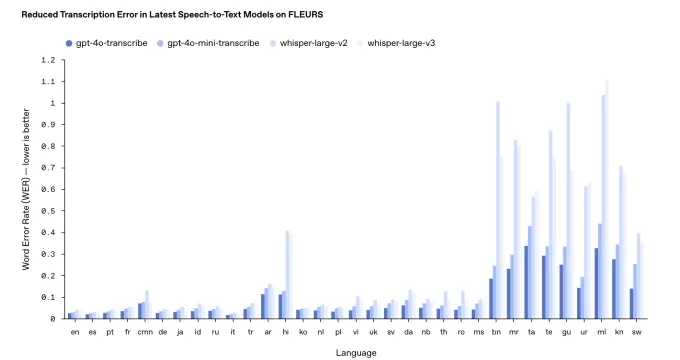
The results from OpenAI transcription benchmarking. Image Credits: OpenAI
In a departure from their usual practice, OpenAI won't be making these new transcription models freely available. Historically, they released new Whisper versions under an MIT license for commercial use. Harris pointed out that gpt-4o-transcribe and gpt-4o-mini-transcribe are significantly larger than Whisper, making them unsuitable for open release.
"These models are too big to run on a typical laptop like Whisper could," Harris added. "When we release models openly, we want to do it thoughtfully, ensuring they're tailored for specific needs. We see end-user devices as a prime area for open-source models."
Updated March 20, 2025, 11:54 a.m. PT to clarify the language around word error rate and update the benchmark results chart with a more recent version.
Related article
 Stripe to Acquire OpenRouter as AI Model Routing Gains Momentum
Stripe has agreed to acquire OpenRouter, an AI model-routing platform that gives developers access to hundreds of models through a single interface. The deal adds model selection and routing to Stripe’s existing work around AI usage and token-based b
PHP Armageddon: OpenAI, Google’s Wiz uncover ancient holes, sparking internet panic
The U.S. National Security Agency issued a critical alert on Wednesday regarding two severe vulnerabilities in PHP, for which patches have already been released by the PHP Foundation.As a server-side scripting language, PHP powers approximately 70% o
OpenAI launches GPT-5.5 Instant as ChatGPT’s new default model
OpenAI launched GPT-5.5 Instant on Monday, replacing GPT-5.3 Instant as the default ChatGPT model. The company states that this update minimizes hallucinations in high-stakes fields like law, medicine, and finance, while preserving the fast response
Related Special Topic Recommendations
Design & Art
Stripe to Acquire OpenRouter as AI Model Routing Gains Momentum
Stripe has agreed to acquire OpenRouter, an AI model-routing platform that gives developers access to hundreds of models through a single interface. The deal adds model selection and routing to Stripe’s existing work around AI usage and token-based b
PHP Armageddon: OpenAI, Google’s Wiz uncover ancient holes, sparking internet panic
The U.S. National Security Agency issued a critical alert on Wednesday regarding two severe vulnerabilities in PHP, for which patches have already been released by the PHP Foundation.As a server-side scripting language, PHP powers approximately 70% o
OpenAI launches GPT-5.5 Instant as ChatGPT’s new default model
OpenAI launched GPT-5.5 Instant on Monday, replacing GPT-5.3 Instant as the default ChatGPT model. The company states that this update minimizes hallucinations in high-stakes fields like law, medicine, and finance, while preserving the fast response
Related Special Topic Recommendations
Design & Art
 Top AI Illustration Tools: Create Editorial Scenes and Cover Art Faster
2026 Latest Top-rated AI Illustration Tools: Our curated list features the best powerfully designed tools for creating stunning editorial scenes and eye-catching cover art quickly. Each option has gone through rigorous real-world tests, offering a free vs paid comparison to help you find the perfect match for your workflow. Try these must-try solutions today to unlock your AI edge and boost your creative productivity. Explore now at XIX.AI.
 10 tools
 xix.ai
Education and Learning
Top AI Tutors for Exam Prep: Practice Math, Science, and English
xix.ai
Education and Learning
Top AI Tutors for Exam Prep: Practice Math, Science, and English
2026 Latest Top-Rated Best AI Tutors for Exam Prep are here on XIX.AI! Our curated list features powerful game-changing tools that offer free vs paid comparison, real-world tests, and weekly updated rankings. They help boost your writing efficiency, simplify complex topic learning, and unlock your academic potential. Explore now to Discover your perfect exam prep tool and Start creating today to Unlock your AI edge!
10 tools
xix.ai
Finance
AI Budget Planning Tools for Personal Money Management
2026 Latest Best Top-Rated AI Budget Planning Tools for Personal Money Management are here on XIX.AI! This curated collection features powerful, game-changing solutions that help you conduct real-world tests, understand spending habits, and create personalized plans to boost productivity. Enjoy a free vs paid comparison along with detailed rankings. Must-try tools designed to simplify money management and unlock your AI edge. Explore now!
11 tools
xix.ai
Health & Wellness
AI Sleep Tracking Assistants: Improve Recovery with Better Bedtime Habits
2026 Latest Best Top-Rated AI Sleep Tracking Assistants curated for ultimate recovery. This fully updated weekly guide features powerful tools that deliver real-world tests, free vs paid comparison, and detailed rankings to help you find the must-try solution that boosts sleep quality and supports better bedtime habits. Explore now at XIX.AI to Unlock your AI edge.
10 tools
xix.ai
Data Analysis
AI SQL Copilots for Product and Revenue Analytics
2026 Latest Best Top-Rated AI SQL Copilots for Product and Revenue Analytics! XIX.AI has curated a powerful, game-changing collection of must-try tools that undergo real-world tests through weekly updated rankings. These tools help users boost productivity significantly by accelerating data analysis, streamlining complex queries, and generating accurate insights to drive smarter business decisions. Explore now to Discover your perfect tool for unlocking your AI edge!
14 tools
xix.ai
Education and Learning
Best AI Homework Helpers That Teach: Learn Concepts, Not Just Answers
2026 Latest Best Top-Rated AI Homework Helpers That Teach Core Concepts Not Just Answers Powerful Tools for Students Must-Try Curated List Weekly Updated Free vs Paid Comparison Real-World Tests Accurate Rankings to Help You Unlock Your Full Learning Potential Explore now to Discover your perfect tool for smarter studying.
10 tools
xix.ai

 Comments (33)
0/500
Comments (33)
0/500
![LeviKing]()
음성 생성 모델 향상이라... 이게 결국 콜센터 직원 대체 같은 데 쓰이면 실업률 걱정이네요. 기술 좋지만 사회적 영향도 고민해야 할 문제 같아요.
![FrankMartínez]()
The new OpenAI models sound like a game-changer for voice tech! Can't wait to see how devs use this to make apps talk smoother than ever. 😎
![BenHernández]()
Wow, OpenAI's new transcription and voice models sound like a game-changer! I'm curious how these 'agentic' systems will stack up against real-world tasks. Could they finally nail natural-sounding convos? 🤔
![GeorgeTaylor]()
Os novos modelos de transcrição e geração de voz da OpenAI são um divisor de águas! Estou usando no meu podcast e as melhorias são impressionantes. O único ponto negativo? São um pouco caros, mas se você puder pagar, vale cada centavo! 🎙️💸
![GregoryAllen]()
OpenAI's new transcription and voice models are a game changer! I've been using them for my podcast and the improvements are night and day. The only downside? They're a bit pricey, but if you can swing it, they're worth every penny! 🎙️💸
![StevenAllen]()
OpenAI의 새로운 음성 인식 및 음성 생성 모델은 정말 혁신적이에요! 제 팟캐스트에서 사용 중인데, 개선이 눈에 띄어요. 단점은 조금 비싸다는 건데, 감당할 수 있다면 그만한 가치가 있어요! 🎙️💸
OpenAI is rolling out new AI models for transcription and voice generation via its API, promising significant improvements over their earlier versions. These updates are part of OpenAI's larger "agentic" vision, which focuses on creating autonomous systems capable of performing tasks independently for users. While the term "agent" can be debated, OpenAI's Head of Product, Olivier Godement, sees it as a chatbot that can interact with a business's customers.
"We're going to see more and more agents emerge in the coming months," Godement shared with TechCrunch during a briefing. "The overarching goal is to assist customers and developers in utilizing agents that are useful, accessible, and precise."
OpenAI's latest text-to-speech model, dubbed "gpt-4o-mini-tts," not only aims to produce more lifelike and nuanced speech but is also more adaptable than its predecessors. Developers can now guide the model using natural language commands, such as "speak like a mad scientist" or "use a serene voice, like a mindfulness teacher." This level of control allows for a more personalized voice experience.
Here’s a sample of a "true crime-style," weathered voice:
And here’s an example of a female "professional" voice:
Jeff Harris, a member of OpenAI's product team, emphasized to TechCrunch that the objective is to enable developers to customize both the voice "experience" and "context." "In various scenarios, you don't want a monotonous voice," Harris explained. "For instance, in a customer support setting where the voice needs to sound apologetic for a mistake, you can infuse that emotion into the voice. We strongly believe that developers and users want to control not just the content, but the manner of speech."
Moving to OpenAI's new speech-to-text offerings, "gpt-4o-transcribe" and "gpt-4o-mini-transcribe," these models are set to replace the outdated Whisper transcription model. Trained on a diverse array of high-quality audio data, they claim to better handle accented and varied speech, even in noisy settings. Additionally, these models are less prone to "hallucinations," a problem where Whisper would sometimes invent words or entire passages, adding inaccuracies like racial commentary or fictitious medical treatments to transcripts.
"These models show significant improvement over Whisper in this regard," Harris noted. "Ensuring model accuracy is crucial for a dependable voice experience, and by accuracy, we mean the models correctly capture the spoken words without adding unvoiced content."
However, performance may vary across languages. OpenAI's internal benchmarks indicate that gpt-4o-transcribe, the more precise of the two, has a "word error rate" nearing 30% for Indic and Dravidian languages like Tamil, Telugu, Malayalam, and Kannada. This suggests that about three out of every ten words might differ from a human transcription in these languages.
In a departure from their usual practice, OpenAI won't be making these new transcription models freely available. Historically, they released new Whisper versions under an MIT license for commercial use. Harris pointed out that gpt-4o-transcribe and gpt-4o-mini-transcribe are significantly larger than Whisper, making them unsuitable for open release.
"These models are too big to run on a typical laptop like Whisper could," Harris added. "When we release models openly, we want to do it thoughtfully, ensuring they're tailored for specific needs. We see end-user devices as a prime area for open-source models."
Updated March 20, 2025, 11:54 a.m. PT to clarify the language around word error rate and update the benchmark results chart with a more recent version.








 Stripe to Acquire OpenRouter as AI Model Routing Gains Momentum
Stripe has agreed to acquire OpenRouter, an AI model-routing platform that gives developers access to hundreds of models through a single interface. The deal adds model selection and routing to Stripe’s existing work around AI usage and token-based b
Stripe to Acquire OpenRouter as AI Model Routing Gains Momentum
Stripe has agreed to acquire OpenRouter, an AI model-routing platform that gives developers access to hundreds of models through a single interface. The deal adds model selection and routing to Stripe’s existing work around AI usage and token-based b
 PHP Armageddon: OpenAI, Google’s Wiz uncover ancient holes, sparking internet panic
The U.S. National Security Agency issued a critical alert on Wednesday regarding two severe vulnerabilities in PHP, for which patches have already been released by the PHP Foundation.As a server-side scripting language, PHP powers approximately 70% o
PHP Armageddon: OpenAI, Google’s Wiz uncover ancient holes, sparking internet panic
The U.S. National Security Agency issued a critical alert on Wednesday regarding two severe vulnerabilities in PHP, for which patches have already been released by the PHP Foundation.As a server-side scripting language, PHP powers approximately 70% o
 OpenAI launches GPT-5.5 Instant as ChatGPT’s new default model
OpenAI launched GPT-5.5 Instant on Monday, replacing GPT-5.3 Instant as the default ChatGPT model. The company states that this update minimizes hallucinations in high-stakes fields like law, medicine, and finance, while preserving the fast response
OpenAI launches GPT-5.5 Instant as ChatGPT’s new default model
OpenAI launched GPT-5.5 Instant on Monday, replacing GPT-5.3 Instant as the default ChatGPT model. The company states that this update minimizes hallucinations in high-stakes fields like law, medicine, and finance, while preserving the fast response

2026 Latest Top-rated AI Illustration Tools: Our curated list features the best powerfully designed tools for creating stunning editorial scenes and eye-catching cover art quickly. Each option has gone through rigorous real-world tests, offering a free vs paid comparison to help you find the perfect match for your workflow. Try these must-try solutions today to unlock your AI edge and boost your creative productivity. Explore now at XIX.AI.
10 tools
xix.ai
2026 Latest Top-Rated Best AI Tutors for Exam Prep are here on XIX.AI! Our curated list features powerful game-changing tools that offer free vs paid comparison, real-world tests, and weekly updated rankings. They help boost your writing efficiency, simplify complex topic learning, and unlock your academic potential. Explore now to Discover your perfect exam prep tool and Start creating today to Unlock your AI edge!
10 tools
xix.ai

2026 Latest Best Top-Rated AI Budget Planning Tools for Personal Money Management are here on XIX.AI! This curated collection features powerful, game-changing solutions that help you conduct real-world tests, understand spending habits, and create personalized plans to boost productivity. Enjoy a free vs paid comparison along with detailed rankings. Must-try tools designed to simplify money management and unlock your AI edge. Explore now!
11 tools
xix.ai

2026 Latest Best Top-Rated AI Sleep Tracking Assistants curated for ultimate recovery. This fully updated weekly guide features powerful tools that deliver real-world tests, free vs paid comparison, and detailed rankings to help you find the must-try solution that boosts sleep quality and supports better bedtime habits. Explore now at XIX.AI to Unlock your AI edge.
10 tools
xix.ai

2026 Latest Best Top-Rated AI SQL Copilots for Product and Revenue Analytics! XIX.AI has curated a powerful, game-changing collection of must-try tools that undergo real-world tests through weekly updated rankings. These tools help users boost productivity significantly by accelerating data analysis, streamlining complex queries, and generating accurate insights to drive smarter business decisions. Explore now to Discover your perfect tool for unlocking your AI edge!
14 tools
xix.ai
2026 Latest Best Top-Rated AI Homework Helpers That Teach Core Concepts Not Just Answers Powerful Tools for Students Must-Try Curated List Weekly Updated Free vs Paid Comparison Real-World Tests Accurate Rankings to Help You Unlock Your Full Learning Potential Explore now to Discover your perfect tool for smarter studying.
10 tools
xix.ai

음성 생성 모델 향상이라... 이게 결국 콜센터 직원 대체 같은 데 쓰이면 실업률 걱정이네요. 기술 좋지만 사회적 영향도 고민해야 할 문제 같아요.
The new OpenAI models sound like a game-changer for voice tech! Can't wait to see how devs use this to make apps talk smoother than ever. 😎
Wow, OpenAI's new transcription and voice models sound like a game-changer! I'm curious how these 'agentic' systems will stack up against real-world tasks. Could they finally nail natural-sounding convos? 🤔
Os novos modelos de transcrição e geração de voz da OpenAI são um divisor de águas! Estou usando no meu podcast e as melhorias são impressionantes. O único ponto negativo? São um pouco caros, mas se você puder pagar, vale cada centavo! 🎙️💸
OpenAI's new transcription and voice models are a game changer! I've been using them for my podcast and the improvements are night and day. The only downside? They're a bit pricey, but if you can swing it, they're worth every penny! 🎙️💸
OpenAI의 새로운 음성 인식 및 음성 생성 모델은 정말 혁신적이에요! 제 팟캐스트에서 사용 중인데, 개선이 눈에 띄어요. 단점은 조금 비싸다는 건데, 감당할 수 있다면 그만한 가치가 있어요! 🎙️💸












