


 Home
HomeLittlebird Secures $11M for AI-Powered Screen Reading Tool
There's been significant discussion about building context for AI systems. In the consumer software space, we've seen a wave of startups focused on search, documents, and meetings. Their goal is to capture context from your digital activities, connect with other tools, and let you query that aggregated data. Some have taken this further. For example, Rewind (which later became Limitless and was acquired by Meta) and Microsoft's Recall aim to capture everything on your screen to help you remember it all.
A new startup named Littlebird is tackling a similar challenge with a slightly different method. While apps like Rewind store screenshots or visual data, Littlebird "reads" your screen and stores the context as text.
The core premise of the product is that by continuously reading your screen, it eliminates the need for you to manually provide additional context for productivity tasks. The founders believe that while many AI tools demand your attention, Littlebird operates quietly in the background, only surfacing when you need it.
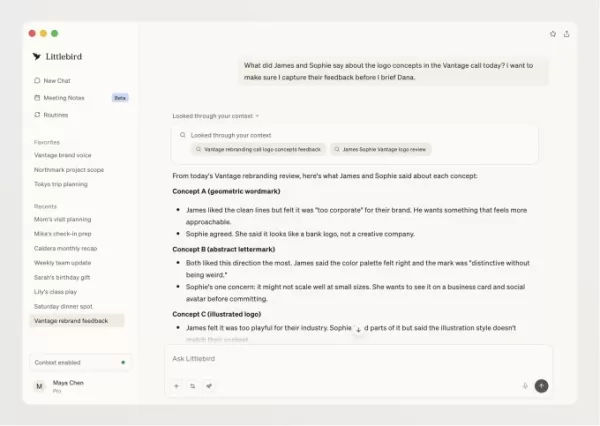
Image Credits: LittlebirdImage Credits:Littlebird
When you install Littlebird, you can customize which applications it should ignore, preventing it from capturing context from them. The company states it automatically excludes password managers and sensitive fields in web forms, such as those for passwords and credit card details. You can also choose to connect other apps like Gmail, Google Calendar, Apple Calendar, and Reminders.
The application allows you to ask questions about your data, providing pre-generated prompts to help you begin, like "What have I been working on today?" or "Which emails are most important to me?" After a few days of use, I observed these prompts becoming more tailored to my habits.
Littlebird also includes a built-in, Granola-like note-taker. It uses system audio to run in the background, transcribing meetings and generating notes and action items. When you view a meeting in detail, a "Prep for meeting" option leverages context from past meetings, emails, and company history to give you relevant background. This feature can even pull information from platforms like Reddit to show what users are saying about a specific product or company.
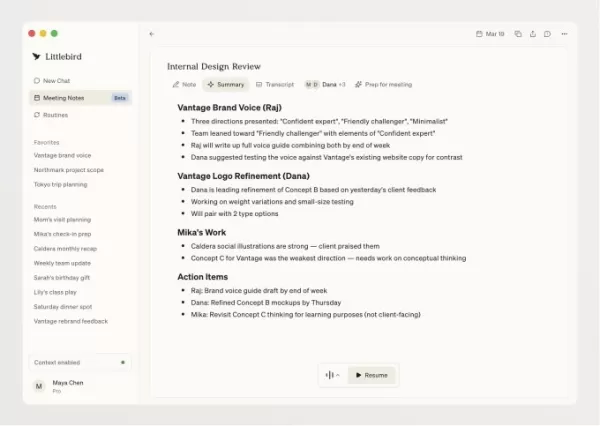
Image Credits: Littlebird
Another feature, called Routines, lets you set up detailed prompts for Littlebird to execute at regular intervals—daily, weekly, or monthly. The company offers pre-built routines such as a daily briefing, weekly activity summary, and yesterday's work recap. Users can also create their own custom routines with specific instructions.
Littlebird was founded in 2024 by Alap Shah, Naman Shah, and Alexander Green. Brothers Alap and Naman previously founded Sentieo, a platform for institutional investors that was sold to market intelligence firm AlphaSense. They also co-founded a health food company named Thistle. Alap co-authored the viral "Citrini" paper on how AI agents could impact the economy, which briefly affected several tech stocks. Green has experience founding companies across hardware, software, and AI.
"We began when Alap identified a key problem: AI's effectiveness hinges on user data. The models themselves know nothing about you, which limits their usefulness. We explored various user interface and operating system paradigms ripe for AI disruption, and that sparked the Littlebird project," Green explained to TechCrunch during a call.
Green noted that while Rewind's approach was similar, it relied on screenshots and offered a suboptimal search experience. He stated that Littlebird is just beginning and faces numerous challenges ahead, including teaching large language models (LLMs) to comprehend diverse types of user context.
Loading the player…
With Littlebird, users can delete their data at any time. All data is encrypted and stored in the cloud. Green explained that cloud storage enables the use of powerful models for various AI workflows, which isn't feasible on local devices.
"We don't store any visual information, only text, which makes the data much lighter. I believe that's another reason Recall and Rewind faced challenges—screenshots consume far more data. I also think visual capture feels more invasive," he said.

Image Credits: Alexander Green
Littlebird is free to download and use. However, for higher usage limits and access to features like image generation, users can subscribe to plans starting at $20 per month.
The startup has secured $11 million in funding led by Lotus Studio, with participation from investors including Lenny Rachitsky, Scott Belsky, Gokul Rajaram, Justin Rosenstein, Shawn Wang, and Russ Heddleston.
Several of these investors are active users of the product. Rajaram, who has worked on ad products at Google and Facebook, said the tool reduces the friction of remembering, retrieving, and re-explaining your own work. DocSend co-founder and CEO Heddleston mentioned he used Littlebird to rewrite his company's marketing site, drawing context from meetings, emails, Notion, and other sources.
Rachitsky, who runs a newsletter and podcast, commented that AI is only as good as its context and often misses nuances of your daily life. He uses the tool to refine his productivity workflows and improve his well-being. He believes that for long-term success, the product must identify a definitive killer use case.
"Everything hinges on finding that essential, must-have use case. That's the critical factor for this product's success right now. I know many users have already found their own killer use cases, and the team is actively focusing on these emerging experiences," he noted.
"I've interviewed many AI product builders on my podcast, and the most consistent lesson is that you never truly know how people will use your product until it's in their hands. The strategy is to release early, observe how people use it, and then double down on those successful use cases, rather than waiting for a perfectly conceived solution."
Related article
 Sesame, AI Startup by Oculus Founders, Debuts on iOS
On Thursday, Sesame, an AI startup founded by the creators of Oculus and other former Meta VR team members, unveiled a public preview of its conversational AI agents, which have been in development for over a year. Through its new iOS application, Se
Waze Unveils New AI Tools and Customization Options
Waze, the Google-owned navigation app, is getting new AI-powered features and customization updates, including the ability to report road updates conversationally and get personalized navigation. Some of the new features are powered by Google’s Gemin
Google Yields to User Backlash Over AI ‘Ask Photos’ Search Feature
Responding to user concerns about AI integration in everyday applications, Google has introduced a toggle in Google Photos that allows users to revert to the faster, traditional “classic” search experience instead of the newer AI-driven “Ask Photos”
Related Special Topic Recommendations
Music composition
Sesame, AI Startup by Oculus Founders, Debuts on iOS
On Thursday, Sesame, an AI startup founded by the creators of Oculus and other former Meta VR team members, unveiled a public preview of its conversational AI agents, which have been in development for over a year. Through its new iOS application, Se
Waze Unveils New AI Tools and Customization Options
Waze, the Google-owned navigation app, is getting new AI-powered features and customization updates, including the ability to report road updates conversationally and get personalized navigation. Some of the new features are powered by Google’s Gemin
Google Yields to User Backlash Over AI ‘Ask Photos’ Search Feature
Responding to user concerns about AI integration in everyday applications, Google has introduced a toggle in Google Photos that allows users to revert to the faster, traditional “classic” search experience instead of the newer AI-driven “Ask Photos”
Related Special Topic Recommendations
Music composition
 Best AI Melody Writing Tools for Song Drafts
2026 Latest Best Top-Rated AI Melody Writing Tools for Song Drafts! XIX.AI has curated a highly powerful game-changing collection that goes through rigorous real-world tests to deliver the best writing experience. You can find detailed free vs paid comparisons, accurate rankings, and must-try options designed to help you create stunning song drafts effortlessly and boost your creative productivity significantly. Explore now to discover your perfect tool!
 8 tools
 xix.ai
chatbot
Best AI Conversation Trainer Tools for Interview Practice
xix.ai
chatbot
Best AI Conversation Trainer Tools for Interview Practice
2026 Latest Best Top-rated AI Conversation Trainer Tools for Interview Practice are here on XIX.AI! This curated collection features powerful, game-changing tools that go through rigorous real-world tests to deliver accurate feedback. You’ll find a free vs paid comparison and detailed rankings to help you choose the must-try option that boosts your confidence and skills. Explore now to Discover your perfect tool for interview success!
12 tools
xix.ai
Design & Art
Best AI Style Transfer Tools for Creative Experiments
2026 Latest Best Top-rated AI Style Transfer Tools for Creative Experiments! XIX.AI has curated a powerful, game-changing collection of must-try tools that deliver exceptional results through real-world tests and rigorous rankings. These top solutions help creatives boost productivity significantly by accelerating content creation and unlocking endless creative possibilities. Explore now to discover your perfect tool and start creating today!
9 tools
xix.ai
Comic Creation
Best AI Dialogue Bubble Tools for Visual Storytelling
2026 Latest Best Top-Rated AI Dialogue Bubble Tools for Visual Storytelling are here on XIX.AI! This curated collection features powerful, game-changing tools that help creators boost productivity and overcome creative bottlenecks. Get a free vs paid comparison, see real-world tests, and check the latest rankings to find the must-try solutions perfect for crafting engaging visual narratives. Explore now to discover your ideal tool!
10 tools
xix.ai
Meeting Assistant
Top AI Meeting Summary Tools: Track Decisions and Follow-Ups Clearly
2026 Latest Top-Rated Best AI Meeting Summary Tools for Clear Decision Tracking and Effortless Follow-Ups. This curated list showcases powerful, game-changing solutions that boost productivity dramatically by automating meeting notes, identifying key action items, and streamlining team coordination across all projects. Get a free vs paid comparison along with real-world tests and weekly updated rankings to help you find the perfect tool. Explore now to unlock your AI edge!
9 tools
xix.ai
Data Analysis
Best AI Data Cleaning Tools: Fix Missing Values and Duplicates Fast
2026 Latest Best Top-rated AI Data Cleaning Tools for quick fixing of missing values and duplicates. This curated list showcases powerful, game-changing solutions that boost productivity significantly. Each option has undergone rigorous real-world tests to ensure reliability. Get a free vs paid comparison and discover the must-try tool that fits your needs best. Explore now at XIX.AI to Unlock your AI edge.
11 tools
xix.ai

 Comments (1)
0/500
Comments (1)
0/500
![HaroldJohnson]()
$11M for a screen reader? That's a lot of dough for something that basically reads your screen aloud. Hope they're using those funds to actually make it useful, not just another overhyped AI tool. 🙄
There's been significant discussion about building context for AI systems. In the consumer software space, we've seen a wave of startups focused on search, documents, and meetings. Their goal is to capture context from your digital activities, connect with other tools, and let you query that aggregated data. Some have taken this further. For example, Rewind (which later became Limitless and was acquired by Meta) and Microsoft's Recall aim to capture everything on your screen to help you remember it all.
A new startup named Littlebird is tackling a similar challenge with a slightly different method. While apps like Rewind store screenshots or visual data, Littlebird "reads" your screen and stores the context as text.
The core premise of the product is that by continuously reading your screen, it eliminates the need for you to manually provide additional context for productivity tasks. The founders believe that while many AI tools demand your attention, Littlebird operates quietly in the background, only surfacing when you need it.
Image Credits: LittlebirdImage Credits:Littlebird
When you install Littlebird, you can customize which applications it should ignore, preventing it from capturing context from them. The company states it automatically excludes password managers and sensitive fields in web forms, such as those for passwords and credit card details. You can also choose to connect other apps like Gmail, Google Calendar, Apple Calendar, and Reminders.
The application allows you to ask questions about your data, providing pre-generated prompts to help you begin, like "What have I been working on today?" or "Which emails are most important to me?" After a few days of use, I observed these prompts becoming more tailored to my habits.
Littlebird also includes a built-in, Granola-like note-taker. It uses system audio to run in the background, transcribing meetings and generating notes and action items. When you view a meeting in detail, a "Prep for meeting" option leverages context from past meetings, emails, and company history to give you relevant background. This feature can even pull information from platforms like Reddit to show what users are saying about a specific product or company.
Image Credits: Littlebird
Another feature, called Routines, lets you set up detailed prompts for Littlebird to execute at regular intervals—daily, weekly, or monthly. The company offers pre-built routines such as a daily briefing, weekly activity summary, and yesterday's work recap. Users can also create their own custom routines with specific instructions.
Littlebird was founded in 2024 by Alap Shah, Naman Shah, and Alexander Green. Brothers Alap and Naman previously founded Sentieo, a platform for institutional investors that was sold to market intelligence firm AlphaSense. They also co-founded a health food company named Thistle. Alap co-authored the viral "Citrini" paper on how AI agents could impact the economy, which briefly affected several tech stocks. Green has experience founding companies across hardware, software, and AI.
"We began when Alap identified a key problem: AI's effectiveness hinges on user data. The models themselves know nothing about you, which limits their usefulness. We explored various user interface and operating system paradigms ripe for AI disruption, and that sparked the Littlebird project," Green explained to TechCrunch during a call.
Green noted that while Rewind's approach was similar, it relied on screenshots and offered a suboptimal search experience. He stated that Littlebird is just beginning and faces numerous challenges ahead, including teaching large language models (LLMs) to comprehend diverse types of user context.
Loading the player…
With Littlebird, users can delete their data at any time. All data is encrypted and stored in the cloud. Green explained that cloud storage enables the use of powerful models for various AI workflows, which isn't feasible on local devices.
"We don't store any visual information, only text, which makes the data much lighter. I believe that's another reason Recall and Rewind faced challenges—screenshots consume far more data. I also think visual capture feels more invasive," he said.
Image Credits: Alexander Green
Littlebird is free to download and use. However, for higher usage limits and access to features like image generation, users can subscribe to plans starting at $20 per month.
The startup has secured $11 million in funding led by Lotus Studio, with participation from investors including Lenny Rachitsky, Scott Belsky, Gokul Rajaram, Justin Rosenstein, Shawn Wang, and Russ Heddleston.
Several of these investors are active users of the product. Rajaram, who has worked on ad products at Google and Facebook, said the tool reduces the friction of remembering, retrieving, and re-explaining your own work. DocSend co-founder and CEO Heddleston mentioned he used Littlebird to rewrite his company's marketing site, drawing context from meetings, emails, Notion, and other sources.
Rachitsky, who runs a newsletter and podcast, commented that AI is only as good as its context and often misses nuances of your daily life. He uses the tool to refine his productivity workflows and improve his well-being. He believes that for long-term success, the product must identify a definitive killer use case.
"Everything hinges on finding that essential, must-have use case. That's the critical factor for this product's success right now. I know many users have already found their own killer use cases, and the team is actively focusing on these emerging experiences," he noted.
"I've interviewed many AI product builders on my podcast, and the most consistent lesson is that you never truly know how people will use your product until it's in their hands. The strategy is to release early, observe how people use it, and then double down on those successful use cases, rather than waiting for a perfectly conceived solution."








 Sesame, AI Startup by Oculus Founders, Debuts on iOS
On Thursday, Sesame, an AI startup founded by the creators of Oculus and other former Meta VR team members, unveiled a public preview of its conversational AI agents, which have been in development for over a year. Through its new iOS application, Se
Sesame, AI Startup by Oculus Founders, Debuts on iOS
On Thursday, Sesame, an AI startup founded by the creators of Oculus and other former Meta VR team members, unveiled a public preview of its conversational AI agents, which have been in development for over a year. Through its new iOS application, Se
 Waze Unveils New AI Tools and Customization Options
Waze, the Google-owned navigation app, is getting new AI-powered features and customization updates, including the ability to report road updates conversationally and get personalized navigation. Some of the new features are powered by Google’s Gemin
Waze Unveils New AI Tools and Customization Options
Waze, the Google-owned navigation app, is getting new AI-powered features and customization updates, including the ability to report road updates conversationally and get personalized navigation. Some of the new features are powered by Google’s Gemin
 Google Yields to User Backlash Over AI ‘Ask Photos’ Search Feature
Responding to user concerns about AI integration in everyday applications, Google has introduced a toggle in Google Photos that allows users to revert to the faster, traditional “classic” search experience instead of the newer AI-driven “Ask Photos”
Google Yields to User Backlash Over AI ‘Ask Photos’ Search Feature
Responding to user concerns about AI integration in everyday applications, Google has introduced a toggle in Google Photos that allows users to revert to the faster, traditional “classic” search experience instead of the newer AI-driven “Ask Photos”

2026 Latest Best Top-Rated AI Melody Writing Tools for Song Drafts! XIX.AI has curated a highly powerful game-changing collection that goes through rigorous real-world tests to deliver the best writing experience. You can find detailed free vs paid comparisons, accurate rankings, and must-try options designed to help you create stunning song drafts effortlessly and boost your creative productivity significantly. Explore now to discover your perfect tool!
8 tools
xix.ai

2026 Latest Best Top-rated AI Conversation Trainer Tools for Interview Practice are here on XIX.AI! This curated collection features powerful, game-changing tools that go through rigorous real-world tests to deliver accurate feedback. You’ll find a free vs paid comparison and detailed rankings to help you choose the must-try option that boosts your confidence and skills. Explore now to Discover your perfect tool for interview success!
12 tools
xix.ai

2026 Latest Best Top-rated AI Style Transfer Tools for Creative Experiments! XIX.AI has curated a powerful, game-changing collection of must-try tools that deliver exceptional results through real-world tests and rigorous rankings. These top solutions help creatives boost productivity significantly by accelerating content creation and unlocking endless creative possibilities. Explore now to discover your perfect tool and start creating today!
9 tools
xix.ai

2026 Latest Best Top-Rated AI Dialogue Bubble Tools for Visual Storytelling are here on XIX.AI! This curated collection features powerful, game-changing tools that help creators boost productivity and overcome creative bottlenecks. Get a free vs paid comparison, see real-world tests, and check the latest rankings to find the must-try solutions perfect for crafting engaging visual narratives. Explore now to discover your ideal tool!
10 tools
xix.ai
2026 Latest Top-Rated Best AI Meeting Summary Tools for Clear Decision Tracking and Effortless Follow-Ups. This curated list showcases powerful, game-changing solutions that boost productivity dramatically by automating meeting notes, identifying key action items, and streamlining team coordination across all projects. Get a free vs paid comparison along with real-world tests and weekly updated rankings to help you find the perfect tool. Explore now to unlock your AI edge!
9 tools
xix.ai

2026 Latest Best Top-rated AI Data Cleaning Tools for quick fixing of missing values and duplicates. This curated list showcases powerful, game-changing solutions that boost productivity significantly. Each option has undergone rigorous real-world tests to ensure reliability. Get a free vs paid comparison and discover the must-try tool that fits your needs best. Explore now at XIX.AI to Unlock your AI edge.
11 tools
xix.ai

$11M for a screen reader? That's a lot of dough for something that basically reads your screen aloud. Hope they're using those funds to actually make it useful, not just another overhyped AI tool. 🙄












