


 Home
HomeIntangible, a no-code 3D creation tool for filmmakers and game designers, raises $4M
Intangible, a startup with a fresh infusion of $4 million in seed funding, is making waves with its AI-powered creative tool. This innovative platform empowers users to craft 3D world concepts using simple text prompts, catering to a wide range of professionals—from filmmakers and game designers to event planners and marketing agencies—as well as everyday users eager to bring their ideas to life. Whether it's designing a home or creating small art projects, Intangible makes the process accessible to all.
With this new funding, Intangible is gearing up for the much-anticipated launch of its no-code, web-based 3D studio in June. At the helm of this exciting venture is Charles Migos, who previously led the design for Apple's first-party iPad apps like iBooks, Notes, and News, and served as the vice president of product design at Unity. Joining him is co-founder Bharat Vasan, a seasoned entrepreneur known for co-founding Basis, a wearables company later acquired by Intel.
The idea for Intangible sparked while Migos was at Unity, a platform beloved by millions of game developers. He saw an opportunity to create a tool that would democratize 3D creation for all creatives, harnessing the power of generative AI. “Unity Editor is an incredible tool, but the people actually making the creative decisions aren’t using that tool,” Migos shared with TechCrunch. “With the advent of AI, I realized that it was going to be entirely possible to make 3D accessible to people who can’t now, and package that in a way where generative AI and 3D creation tools were designed for professional creatives,” he added.
Intangible’s product is all about simplifying 3D creation, eliminating the need for complex coding. Users can dive in by simply providing text prompts, allowing the AI to construct detailed 3D worlds, from cities to landscapes.
User-Friendly 3D Creation
Starting with a 3D canvas editor, users can effortlessly drag and drop elements from an extensive library of around 6,000 3D assets. This includes people in various poses, trees, roads, vehicles, and much more. Filmmakers will appreciate the storyboard capabilities, enabling them to manipulate camera angles and organize scenes seamlessly.
After crafting the initial design, users can switch to “Visualizer mode,” which enhances the scene using AI-generated images. Intangible leverages powerful technologies like DeepSeek, Llama, and Stable Diffusion to achieve vivid renderings.
Collaboration and Accessibility
Collaboration is a breeze with Intangible's web-based projects. Teams can share links, work together in real-time, and make on-the-fly adjustments based on feedback.
Currently in closed beta, Intangible has already piqued the interest of “hundreds” of creatives, including major film and gaming studios. While specific names are under wraps for now, the startup promises to reveal them soon.
The official launch in June will introduce both a free tier and paid subscription options, ranging from $15 to $50 per month. Users will also have the option to buy additional credits for enhanced image and video generation.
Investment and Future Plans
The recent funding round was led by a16z Speedrun, Crosslink Capital, and several angel investors. The capital will not only fuel product development but also support hiring efforts. With a current team of 10, including lead product designer Philip Metschan, who previously worked at Pixar and ILM, Intangible aims to double its team size this year.

Image Credits: Intangible
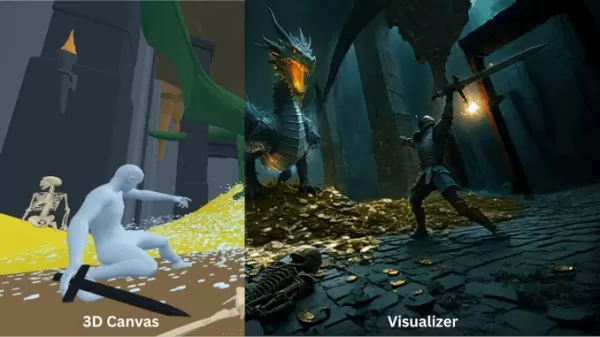
Image Credits: Intangible
Related article
 Neko Health raises $700 million to expand AI body scans in the US
Neko Health has secured $700 million in funding to roll out its AI-driven body scans across the United States, kicking off with a flagship clinic in New York. This preventive screening platform integrates medical imaging, blood analysis, proprietary
Video generation startup PixVerse raises $439M, valuation tops $2B
PixVerse, a Singapore-based video generation startup, announced today the close of its Series C extension, raising a total of $439 million in the round. According to the company, this new funding brings its valuation to over $2 billion. The capital w
ElevenLabs names BlackRock, Jamie Foxx, Eva Longoria as new investors
ElevenLabs, the voice AI company, has disclosed additional investors in its $500 million Series D round, originally announced in February. These include institutional investors like BlackRock, Wellington, D.E. Shaw, and Schroders; corporations such a
Related Special Topic Recommendations
Data Analysis
Neko Health raises $700 million to expand AI body scans in the US
Neko Health has secured $700 million in funding to roll out its AI-driven body scans across the United States, kicking off with a flagship clinic in New York. This preventive screening platform integrates medical imaging, blood analysis, proprietary
Video generation startup PixVerse raises $439M, valuation tops $2B
PixVerse, a Singapore-based video generation startup, announced today the close of its Series C extension, raising a total of $439 million in the round. According to the company, this new funding brings its valuation to over $2 billion. The capital w
ElevenLabs names BlackRock, Jamie Foxx, Eva Longoria as new investors
ElevenLabs, the voice AI company, has disclosed additional investors in its $500 million Series D round, originally announced in February. These include institutional investors like BlackRock, Wellington, D.E. Shaw, and Schroders; corporations such a
Related Special Topic Recommendations
Data Analysis
 AI SQL Copilots for Revenue Dashboards, Funnel Analysis, and Product Metrics
2026 Latest Best AI SQL Copilots Ranked Top-Rated! XIX.AI curates a powerful game-changing collection for weekly updated real-world tests. These must-try tools help you generate accurate revenue dashboards, analyze sales funnels, and track product metrics swiftly, boosting productivity massively. Explore now to Discover your perfect tool for data-driven decision making! 238 characters
 9 tools
 xix.ai
Music composition
Best AI Melody Writing Tools for Song Drafts
xix.ai
Music composition
Best AI Melody Writing Tools for Song Drafts
2026 Latest Best Top-Rated AI Melody Writing Tools for Song Drafts! XIX.AI has curated a highly powerful game-changing collection that goes through rigorous real-world tests to deliver the best writing experience. You can find detailed free vs paid comparisons, accurate rankings, and must-try options designed to help you create stunning song drafts effortlessly and boost your creative productivity significantly. Explore now to discover your perfect tool!
8 tools
xix.ai
chatbot
Best AI Conversation Trainer Tools for Interview Practice
2026 Latest Best Top-rated AI Conversation Trainer Tools for Interview Practice are here on XIX.AI! This curated collection features powerful, game-changing tools that go through rigorous real-world tests to deliver accurate feedback. You’ll find a free vs paid comparison and detailed rankings to help you choose the must-try option that boosts your confidence and skills. Explore now to Discover your perfect tool for interview success!
12 tools
xix.ai
Design & Art
Best AI Style Transfer Tools for Creative Experiments
2026 Latest Best Top-rated AI Style Transfer Tools for Creative Experiments! XIX.AI has curated a powerful, game-changing collection of must-try tools that deliver exceptional results through real-world tests and rigorous rankings. These top solutions help creatives boost productivity significantly by accelerating content creation and unlocking endless creative possibilities. Explore now to discover your perfect tool and start creating today!
9 tools
xix.ai
Comic Creation
Best AI Dialogue Bubble Tools for Visual Storytelling
2026 Latest Best Top-Rated AI Dialogue Bubble Tools for Visual Storytelling are here on XIX.AI! This curated collection features powerful, game-changing tools that help creators boost productivity and overcome creative bottlenecks. Get a free vs paid comparison, see real-world tests, and check the latest rankings to find the must-try solutions perfect for crafting engaging visual narratives. Explore now to discover your ideal tool!
10 tools
xix.ai
Meeting Assistant
Top AI Meeting Summary Tools: Track Decisions and Follow-Ups Clearly
2026 Latest Top-Rated Best AI Meeting Summary Tools for Clear Decision Tracking and Effortless Follow-Ups. This curated list showcases powerful, game-changing solutions that boost productivity dramatically by automating meeting notes, identifying key action items, and streamlining team coordination across all projects. Get a free vs paid comparison along with real-world tests and weekly updated rankings to help you find the perfect tool. Explore now to unlock your AI edge!
9 tools
xix.ai

 Comments (4)
0/500
Comments (4)
0/500
![RoyLopez]()
이런 AI 기반 3D 도구가 영화 제작자들에게 정말 혁신적이네요! 🎬 특히 게임 디자이너들이 빠르게 아이디어를 시각화할 수 있다는 점이 가장 매력적으로 느껴져요. 다만 이런 기술이 전문가들의 창의성을 대체할까 봐 조금 걱정되기도 하네요. 앞으로 어떻게 발전할지 지켜보고 싶어요!
![WillieRodriguez]()
Als Hobby-Filmer finde ich es krass, wie schnell sich KI-Tools entwickeln! 🚀 Aber mal ehrlich, werden solche Tools traditionelle 3D-Künstler verdrängen? Die Text-zu-3D-Funktion klingt praktisch, aber ich frage mich, ob die Ergebnisse wirklich professionell genug sind.
![JohnNelson]()
As a storyboard artist, tools that promise instant 3D worlds from text are a constant topic in our group chats. They're exciting, sure, but it feels like we're trading deep creative control for speed. Is the AI really going to understand the specific dramatic lighting I need for a tense scene? Still, $4M says someone believes in it. The no-code part is definitely the biggest draw for smaller studios.
![AnthonyScott]()
This $4M funding for Intangible sounds like a game-changer! Text-to-3D is wild—imagine crafting entire worlds just by typing. Excited to see how filmmakers use this! 😎
Intangible, a startup with a fresh infusion of $4 million in seed funding, is making waves with its AI-powered creative tool. This innovative platform empowers users to craft 3D world concepts using simple text prompts, catering to a wide range of professionals—from filmmakers and game designers to event planners and marketing agencies—as well as everyday users eager to bring their ideas to life. Whether it's designing a home or creating small art projects, Intangible makes the process accessible to all.
With this new funding, Intangible is gearing up for the much-anticipated launch of its no-code, web-based 3D studio in June. At the helm of this exciting venture is Charles Migos, who previously led the design for Apple's first-party iPad apps like iBooks, Notes, and News, and served as the vice president of product design at Unity. Joining him is co-founder Bharat Vasan, a seasoned entrepreneur known for co-founding Basis, a wearables company later acquired by Intel.
The idea for Intangible sparked while Migos was at Unity, a platform beloved by millions of game developers. He saw an opportunity to create a tool that would democratize 3D creation for all creatives, harnessing the power of generative AI. “Unity Editor is an incredible tool, but the people actually making the creative decisions aren’t using that tool,” Migos shared with TechCrunch. “With the advent of AI, I realized that it was going to be entirely possible to make 3D accessible to people who can’t now, and package that in a way where generative AI and 3D creation tools were designed for professional creatives,” he added.
Intangible’s product is all about simplifying 3D creation, eliminating the need for complex coding. Users can dive in by simply providing text prompts, allowing the AI to construct detailed 3D worlds, from cities to landscapes.
User-Friendly 3D Creation
Starting with a 3D canvas editor, users can effortlessly drag and drop elements from an extensive library of around 6,000 3D assets. This includes people in various poses, trees, roads, vehicles, and much more. Filmmakers will appreciate the storyboard capabilities, enabling them to manipulate camera angles and organize scenes seamlessly.
After crafting the initial design, users can switch to “Visualizer mode,” which enhances the scene using AI-generated images. Intangible leverages powerful technologies like DeepSeek, Llama, and Stable Diffusion to achieve vivid renderings.
Collaboration and Accessibility
Collaboration is a breeze with Intangible's web-based projects. Teams can share links, work together in real-time, and make on-the-fly adjustments based on feedback.
Currently in closed beta, Intangible has already piqued the interest of “hundreds” of creatives, including major film and gaming studios. While specific names are under wraps for now, the startup promises to reveal them soon.
The official launch in June will introduce both a free tier and paid subscription options, ranging from $15 to $50 per month. Users will also have the option to buy additional credits for enhanced image and video generation.
Investment and Future Plans
The recent funding round was led by a16z Speedrun, Crosslink Capital, and several angel investors. The capital will not only fuel product development but also support hiring efforts. With a current team of 10, including lead product designer Philip Metschan, who previously worked at Pixar and ILM, Intangible aims to double its team size this year.








 Neko Health raises $700 million to expand AI body scans in the US
Neko Health has secured $700 million in funding to roll out its AI-driven body scans across the United States, kicking off with a flagship clinic in New York. This preventive screening platform integrates medical imaging, blood analysis, proprietary
Neko Health raises $700 million to expand AI body scans in the US
Neko Health has secured $700 million in funding to roll out its AI-driven body scans across the United States, kicking off with a flagship clinic in New York. This preventive screening platform integrates medical imaging, blood analysis, proprietary
 Video generation startup PixVerse raises $439M, valuation tops $2B
PixVerse, a Singapore-based video generation startup, announced today the close of its Series C extension, raising a total of $439 million in the round. According to the company, this new funding brings its valuation to over $2 billion. The capital w
Video generation startup PixVerse raises $439M, valuation tops $2B
PixVerse, a Singapore-based video generation startup, announced today the close of its Series C extension, raising a total of $439 million in the round. According to the company, this new funding brings its valuation to over $2 billion. The capital w
 ElevenLabs names BlackRock, Jamie Foxx, Eva Longoria as new investors
ElevenLabs, the voice AI company, has disclosed additional investors in its $500 million Series D round, originally announced in February. These include institutional investors like BlackRock, Wellington, D.E. Shaw, and Schroders; corporations such a
ElevenLabs names BlackRock, Jamie Foxx, Eva Longoria as new investors
ElevenLabs, the voice AI company, has disclosed additional investors in its $500 million Series D round, originally announced in February. These include institutional investors like BlackRock, Wellington, D.E. Shaw, and Schroders; corporations such a

2026 Latest Best AI SQL Copilots Ranked Top-Rated! XIX.AI curates a powerful game-changing collection for weekly updated real-world tests. These must-try tools help you generate accurate revenue dashboards, analyze sales funnels, and track product metrics swiftly, boosting productivity massively. Explore now to Discover your perfect tool for data-driven decision making! 238 characters
9 tools
xix.ai

2026 Latest Best Top-Rated AI Melody Writing Tools for Song Drafts! XIX.AI has curated a highly powerful game-changing collection that goes through rigorous real-world tests to deliver the best writing experience. You can find detailed free vs paid comparisons, accurate rankings, and must-try options designed to help you create stunning song drafts effortlessly and boost your creative productivity significantly. Explore now to discover your perfect tool!
8 tools
xix.ai
2026 Latest Best Top-rated AI Conversation Trainer Tools for Interview Practice are here on XIX.AI! This curated collection features powerful, game-changing tools that go through rigorous real-world tests to deliver accurate feedback. You’ll find a free vs paid comparison and detailed rankings to help you choose the must-try option that boosts your confidence and skills. Explore now to Discover your perfect tool for interview success!
12 tools
xix.ai

2026 Latest Best Top-rated AI Style Transfer Tools for Creative Experiments! XIX.AI has curated a powerful, game-changing collection of must-try tools that deliver exceptional results through real-world tests and rigorous rankings. These top solutions help creatives boost productivity significantly by accelerating content creation and unlocking endless creative possibilities. Explore now to discover your perfect tool and start creating today!
9 tools
xix.ai
2026 Latest Best Top-Rated AI Dialogue Bubble Tools for Visual Storytelling are here on XIX.AI! This curated collection features powerful, game-changing tools that help creators boost productivity and overcome creative bottlenecks. Get a free vs paid comparison, see real-world tests, and check the latest rankings to find the must-try solutions perfect for crafting engaging visual narratives. Explore now to discover your ideal tool!
10 tools
xix.ai

2026 Latest Top-Rated Best AI Meeting Summary Tools for Clear Decision Tracking and Effortless Follow-Ups. This curated list showcases powerful, game-changing solutions that boost productivity dramatically by automating meeting notes, identifying key action items, and streamlining team coordination across all projects. Get a free vs paid comparison along with real-world tests and weekly updated rankings to help you find the perfect tool. Explore now to unlock your AI edge!
9 tools
xix.ai

이런 AI 기반 3D 도구가 영화 제작자들에게 정말 혁신적이네요! 🎬 특히 게임 디자이너들이 빠르게 아이디어를 시각화할 수 있다는 점이 가장 매력적으로 느껴져요. 다만 이런 기술이 전문가들의 창의성을 대체할까 봐 조금 걱정되기도 하네요. 앞으로 어떻게 발전할지 지켜보고 싶어요!
Als Hobby-Filmer finde ich es krass, wie schnell sich KI-Tools entwickeln! 🚀 Aber mal ehrlich, werden solche Tools traditionelle 3D-Künstler verdrängen? Die Text-zu-3D-Funktion klingt praktisch, aber ich frage mich, ob die Ergebnisse wirklich professionell genug sind.
As a storyboard artist, tools that promise instant 3D worlds from text are a constant topic in our group chats. They're exciting, sure, but it feels like we're trading deep creative control for speed. Is the AI really going to understand the specific dramatic lighting I need for a tense scene? Still, $4M says someone believes in it. The no-code part is definitely the biggest draw for smaller studios.
This $4M funding for Intangible sounds like a game-changer! Text-to-3D is wild—imagine crafting entire worlds just by typing. Excited to see how filmmakers use this! 😎












