


 Home
HomeGoogle's GEPA Enhances LLM Performance, Bypassing Expensive Reinforcement Learning Needs
Researchers from UC Berkeley, Stanford University, and Databricks have introduced a new AI optimization method called GEPA, which demonstrates remarkable improvements over traditional reinforcement learning techniques for adapting large language models to specialized tasks.
GEPA departs from the conventional approach of learning through thousands of trial-and-error attempts driven by simple numerical scores. Instead, it uses an LLM's internal language capabilities to analyze its performance, identify mistakes, and progressively refine its instructions. Beyond achieving higher accuracy than established methods, GEPA is far more efficient, delivering superior outcomes with up to 35 times fewer trial runs.
For companies developing complex AI agents and workflows, this breakthrough means faster development, significantly lower computing costs, and more powerful, dependable applications.
The High Cost of Optimizing Modern AI Systems
Modern enterprise AI applications seldom rely on a single call to an LLM. They are typically "compound AI systems"—sophisticated workflows that combine multiple LLM modules, external tools like databases or code interpreters, and custom logic to execute complex tasks, such as multi-step research and data analysis.
A common optimization strategy for these systems is reinforcement learning, exemplified by techniques like Group Relative Policy Optimization used in advanced reasoning models. These methods treat the AI system as a black box, assessing a task through a basic success metric. This limited feedback is then used to gradually adjust the model’s parameters toward better performance.
RL's primary limitation is its inefficiency. To learn effectively from minimal numerical scores, RL often requires tens or even hundreds of thousands of trial runs. For any real-world enterprise application involving costly tool calls or proprietary models, this process is prohibitively slow and expensive.
As explained by Lakshya A Agrawal, a co-author and doctoral student at UC Berkeley, this complexity presents a major obstacle for many organizations. "For numerous teams, RL is impractical due to its expense and complexity—their default approach has largely been manual prompt engineering," Agrawal noted. GEPA is designed for teams working with high-performance models that often cannot be fine-tuned, allowing them to enhance performance without managing specialized hardware.
The research team frames the challenge this way: "How can we extract the maximum learning signal from every costly trial to enable effective adaptation of complex, modular AI systems under tight data or budget constraints?"
An Optimizer That Learns Through Language

GEPA framework Source: arXiv GEPA addresses this challenge by replacing sparse reward signals with detailed, natural language feedback. It capitalizes on the fact that an AI system's entire execution—its reasoning steps, tool calls, and error messages—can be represented as text for an LLM to process. This methodology is founded on three core principles.
The first is "genetic prompt evolution," where GEPA treats a set of prompts as a gene pool, iteratively modifying them to generate new and potentially improved versions. This mutation process is guided by the second principle: "reflection with natural language feedback." After several trial runs, GEPA presents an LLM with the complete execution history and outcomes. The LLM then analyzes this information to diagnose issues and draft a more precise, enhanced prompt. For example, instead of just receiving a low score for code generation, it might examine a compiler error and determine that the prompt must specify a particular library version.
The third principle is "Pareto-based selection," which promotes intelligent exploration. Instead of solely focusing on the single highest-scoring prompt, which risks settling for a suboptimal solution, GEPA maintains a diverse collection of specialized prompts. It identifies which prompts excel on different test cases, compiling a roster of leading candidates. By sampling from this variety of successful strategies, GEPA explores a broader solution space and is more likely to discover a prompt that performs well across diverse inputs.

Focusing on a single top candidate can trap models in local minima, while Pareto selection explores more options to find optimal solutions Source: arXiv The success of this entire process depends on what the researchers term "feedback engineering." Agrawal emphasizes that the key is to capture the rich textual details systems already produce but often ignore. "Conventional pipelines typically condense this information into a single numerical reward, hiding the reasons behind specific outcomes," he explained. "GEPA’s core approach is to structure feedback that reveals not just final results but also intermediate steps and errors in plain text—the same evidence a human expert would use to analyze system behavior."
For instance, for a document retrieval system, this would involve listing which documents were correctly retrieved and which were missed, rather than only reporting a final accuracy score.
GEPA in Practice
The research team evaluated GEPA across four distinct tasks, from multi-hop question answering to privacy-preserving queries. They tested both open-source and proprietary models, comparing GEPA against RL-based GRPO and the advanced prompt optimizer MIPROv2.
Across all evaluations, GEPA significantly outperformed GRPO, achieving up to a 19% improvement in score while using up to 35 times fewer trial runs. Agrawal illustrated this efficiency with a specific example: "We optimized a question-answering system with GEPA in about 3 hours, compared to GRPO’s 24 hours—an eightfold reduction in development time, paired with a 20% performance gain," he stated. "RL-based optimization for the same test scenario cost around $300 in GPU compute, while GEPA achieved better results for under $20—a 15-fold cost reduction in our experiments."
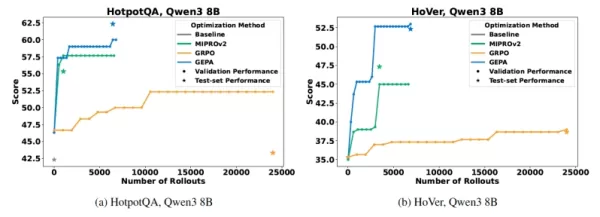
GEPA outperforms other benchmark methods on key performance measures Source: arXiv Beyond raw metrics, the researchers observed that GEPA-optimized systems are more reliable when handling new, unseen data, as indicated by a smaller "generalization gap." Agrawal suggests this improved robustness stems from GEPA learning from richer feedback. "GEPA’s smaller generalization gap likely comes from its use of detailed natural-language feedback on each outcome—clarifying what succeeded, what failed, and why—instead of relying on a single numerical score," he said. "This encourages the system to develop instructions and strategies based on a comprehensive understanding of success, rather than simply memorizing patterns from the training data." For businesses, this enhanced reliability translates to more robust and adaptable AI applications in customer-facing scenarios.
A key practical advantage is that GEPA's final instructions are up to 9.2 times shorter than prompts generated by optimizers like MIPROv2, which often include numerous examples. Shorter prompts reduce latency and lower costs for API-based models, making the final application both faster and more economical to run in production.
The paper also explores promising applications of GEPA as an "inference-time" search strategy, transforming an AI from a single-step answer generator into an iterative problem solver. Agrawal described a potential integration into a company’s development pipeline, where GEPA could automatically create and refine multiple optimized versions of a system, test their performance, and submit the best variant for engineering review. "This turns optimization into a continuous, automated process—quickly producing solutions that often meet or exceed the quality of expert manual tuning," Agrawal added. In tests on CUDA code generation, this method elevated performance to an expert level on 20% of tasks, compared to 0% for a single attempt with a model like GPT-4o.
The authors view GEPA as a foundational step toward a new paradigm in AI development. However, beyond fostering more human-like AI, its most immediate impact may be in democratizing the creation of high-performance systems.
"We anticipate GEPA will foster a positive shift in AI system construction—making optimization accessible to end-users who possess deep domain expertise for the task but may lack the time or desire to master complex RL techniques," Agrawal concluded. "It empowers the stakeholders who have the precise, task-specific knowledge."
Related article
 Stripe to Acquire OpenRouter as AI Model Routing Gains Momentum
Stripe has agreed to acquire OpenRouter, an AI model-routing platform that gives developers access to hundreds of models through a single interface. The deal adds model selection and routing to Stripe’s existing work around AI usage and token-based b
Former OpenAI Researcher Barrett Zoph Returns to Google to Support Gemini Development
Barret Zoph, who previously abruptly left and joined OpenAI due to a disagreement with Thinking Machines Lab CEO Miriam Mularati, has once again changed employers. Alphabet's Google announced that Zoph will return as Vice President of Research, bring
How Recursive Intelligence Raised $335M at $4B Valuation in 4 Months
The co-founders of startup Ricursive Intelligence seemed destined to be co-founders.Anna Goldie, CEO, and Azalia Mirhoseini, CTO, are so well-known in the AI community that they were among those AI engineers who “got those weird emails from Zuckerber
Related Special Topic Recommendations
Design & Art
Stripe to Acquire OpenRouter as AI Model Routing Gains Momentum
Stripe has agreed to acquire OpenRouter, an AI model-routing platform that gives developers access to hundreds of models through a single interface. The deal adds model selection and routing to Stripe’s existing work around AI usage and token-based b
Former OpenAI Researcher Barrett Zoph Returns to Google to Support Gemini Development
Barret Zoph, who previously abruptly left and joined OpenAI due to a disagreement with Thinking Machines Lab CEO Miriam Mularati, has once again changed employers. Alphabet's Google announced that Zoph will return as Vice President of Research, bring
How Recursive Intelligence Raised $335M at $4B Valuation in 4 Months
The co-founders of startup Ricursive Intelligence seemed destined to be co-founders.Anna Goldie, CEO, and Azalia Mirhoseini, CTO, are so well-known in the AI community that they were among those AI engineers who “got those weird emails from Zuckerber
Related Special Topic Recommendations
Design & Art
 Top AI Illustration Tools: Create Editorial Scenes and Cover Art Faster
2026 Latest Top-rated AI Illustration Tools: Our curated list features the best powerfully designed tools for creating stunning editorial scenes and eye-catching cover art quickly. Each option has gone through rigorous real-world tests, offering a free vs paid comparison to help you find the perfect match for your workflow. Try these must-try solutions today to unlock your AI edge and boost your creative productivity. Explore now at XIX.AI.
 10 tools
 xix.ai
Education and Learning
Top AI Tutors for Exam Prep: Practice Math, Science, and English
xix.ai
Education and Learning
Top AI Tutors for Exam Prep: Practice Math, Science, and English
2026 Latest Top-Rated Best AI Tutors for Exam Prep are here on XIX.AI! Our curated list features powerful game-changing tools that offer free vs paid comparison, real-world tests, and weekly updated rankings. They help boost your writing efficiency, simplify complex topic learning, and unlock your academic potential. Explore now to Discover your perfect exam prep tool and Start creating today to Unlock your AI edge!
10 tools
xix.ai
Finance
AI Budget Planning Tools for Personal Money Management
2026 Latest Best Top-Rated AI Budget Planning Tools for Personal Money Management are here on XIX.AI! This curated collection features powerful, game-changing solutions that help you conduct real-world tests, understand spending habits, and create personalized plans to boost productivity. Enjoy a free vs paid comparison along with detailed rankings. Must-try tools designed to simplify money management and unlock your AI edge. Explore now!
11 tools
xix.ai
Health & Wellness
AI Sleep Tracking Assistants: Improve Recovery with Better Bedtime Habits
2026 Latest Best Top-Rated AI Sleep Tracking Assistants curated for ultimate recovery. This fully updated weekly guide features powerful tools that deliver real-world tests, free vs paid comparison, and detailed rankings to help you find the must-try solution that boosts sleep quality and supports better bedtime habits. Explore now at XIX.AI to Unlock your AI edge.
10 tools
xix.ai
Data Analysis
AI SQL Copilots for Product and Revenue Analytics
2026 Latest Best Top-Rated AI SQL Copilots for Product and Revenue Analytics! XIX.AI has curated a powerful, game-changing collection of must-try tools that undergo real-world tests through weekly updated rankings. These tools help users boost productivity significantly by accelerating data analysis, streamlining complex queries, and generating accurate insights to drive smarter business decisions. Explore now to Discover your perfect tool for unlocking your AI edge!
14 tools
xix.ai
Education and Learning
Best AI Homework Helpers That Teach: Learn Concepts, Not Just Answers
2026 Latest Best Top-Rated AI Homework Helpers That Teach Core Concepts Not Just Answers Powerful Tools for Students Must-Try Curated List Weekly Updated Free vs Paid Comparison Real-World Tests Accurate Rankings to Help You Unlock Your Full Learning Potential Explore now to Discover your perfect tool for smarter studying.
10 tools
xix.ai

 Comments (0)
0/500
Comments (0)
0/500
Researchers from UC Berkeley, Stanford University, and Databricks have introduced a new AI optimization method called GEPA, which demonstrates remarkable improvements over traditional reinforcement learning techniques for adapting large language models to specialized tasks.
GEPA departs from the conventional approach of learning through thousands of trial-and-error attempts driven by simple numerical scores. Instead, it uses an LLM's internal language capabilities to analyze its performance, identify mistakes, and progressively refine its instructions. Beyond achieving higher accuracy than established methods, GEPA is far more efficient, delivering superior outcomes with up to 35 times fewer trial runs.
For companies developing complex AI agents and workflows, this breakthrough means faster development, significantly lower computing costs, and more powerful, dependable applications.
The High Cost of Optimizing Modern AI Systems
Modern enterprise AI applications seldom rely on a single call to an LLM. They are typically "compound AI systems"—sophisticated workflows that combine multiple LLM modules, external tools like databases or code interpreters, and custom logic to execute complex tasks, such as multi-step research and data analysis.
A common optimization strategy for these systems is reinforcement learning, exemplified by techniques like Group Relative Policy Optimization used in advanced reasoning models. These methods treat the AI system as a black box, assessing a task through a basic success metric. This limited feedback is then used to gradually adjust the model’s parameters toward better performance.
RL's primary limitation is its inefficiency. To learn effectively from minimal numerical scores, RL often requires tens or even hundreds of thousands of trial runs. For any real-world enterprise application involving costly tool calls or proprietary models, this process is prohibitively slow and expensive.
As explained by Lakshya A Agrawal, a co-author and doctoral student at UC Berkeley, this complexity presents a major obstacle for many organizations. "For numerous teams, RL is impractical due to its expense and complexity—their default approach has largely been manual prompt engineering," Agrawal noted. GEPA is designed for teams working with high-performance models that often cannot be fine-tuned, allowing them to enhance performance without managing specialized hardware.
The research team frames the challenge this way: "How can we extract the maximum learning signal from every costly trial to enable effective adaptation of complex, modular AI systems under tight data or budget constraints?"
An Optimizer That Learns Through Language
GEPA addresses this challenge by replacing sparse reward signals with detailed, natural language feedback. It capitalizes on the fact that an AI system's entire execution—its reasoning steps, tool calls, and error messages—can be represented as text for an LLM to process. This methodology is founded on three core principles.
The first is "genetic prompt evolution," where GEPA treats a set of prompts as a gene pool, iteratively modifying them to generate new and potentially improved versions. This mutation process is guided by the second principle: "reflection with natural language feedback." After several trial runs, GEPA presents an LLM with the complete execution history and outcomes. The LLM then analyzes this information to diagnose issues and draft a more precise, enhanced prompt. For example, instead of just receiving a low score for code generation, it might examine a compiler error and determine that the prompt must specify a particular library version.
The third principle is "Pareto-based selection," which promotes intelligent exploration. Instead of solely focusing on the single highest-scoring prompt, which risks settling for a suboptimal solution, GEPA maintains a diverse collection of specialized prompts. It identifies which prompts excel on different test cases, compiling a roster of leading candidates. By sampling from this variety of successful strategies, GEPA explores a broader solution space and is more likely to discover a prompt that performs well across diverse inputs.
The success of this entire process depends on what the researchers term "feedback engineering." Agrawal emphasizes that the key is to capture the rich textual details systems already produce but often ignore. "Conventional pipelines typically condense this information into a single numerical reward, hiding the reasons behind specific outcomes," he explained. "GEPA’s core approach is to structure feedback that reveals not just final results but also intermediate steps and errors in plain text—the same evidence a human expert would use to analyze system behavior."
For instance, for a document retrieval system, this would involve listing which documents were correctly retrieved and which were missed, rather than only reporting a final accuracy score.
GEPA in Practice
The research team evaluated GEPA across four distinct tasks, from multi-hop question answering to privacy-preserving queries. They tested both open-source and proprietary models, comparing GEPA against RL-based GRPO and the advanced prompt optimizer MIPROv2.
Across all evaluations, GEPA significantly outperformed GRPO, achieving up to a 19% improvement in score while using up to 35 times fewer trial runs. Agrawal illustrated this efficiency with a specific example: "We optimized a question-answering system with GEPA in about 3 hours, compared to GRPO’s 24 hours—an eightfold reduction in development time, paired with a 20% performance gain," he stated. "RL-based optimization for the same test scenario cost around $300 in GPU compute, while GEPA achieved better results for under $20—a 15-fold cost reduction in our experiments."
Beyond raw metrics, the researchers observed that GEPA-optimized systems are more reliable when handling new, unseen data, as indicated by a smaller "generalization gap." Agrawal suggests this improved robustness stems from GEPA learning from richer feedback. "GEPA’s smaller generalization gap likely comes from its use of detailed natural-language feedback on each outcome—clarifying what succeeded, what failed, and why—instead of relying on a single numerical score," he said. "This encourages the system to develop instructions and strategies based on a comprehensive understanding of success, rather than simply memorizing patterns from the training data." For businesses, this enhanced reliability translates to more robust and adaptable AI applications in customer-facing scenarios.
A key practical advantage is that GEPA's final instructions are up to 9.2 times shorter than prompts generated by optimizers like MIPROv2, which often include numerous examples. Shorter prompts reduce latency and lower costs for API-based models, making the final application both faster and more economical to run in production.
The paper also explores promising applications of GEPA as an "inference-time" search strategy, transforming an AI from a single-step answer generator into an iterative problem solver. Agrawal described a potential integration into a company’s development pipeline, where GEPA could automatically create and refine multiple optimized versions of a system, test their performance, and submit the best variant for engineering review. "This turns optimization into a continuous, automated process—quickly producing solutions that often meet or exceed the quality of expert manual tuning," Agrawal added. In tests on CUDA code generation, this method elevated performance to an expert level on 20% of tasks, compared to 0% for a single attempt with a model like GPT-4o.
The authors view GEPA as a foundational step toward a new paradigm in AI development. However, beyond fostering more human-like AI, its most immediate impact may be in democratizing the creation of high-performance systems.
"We anticipate GEPA will foster a positive shift in AI system construction—making optimization accessible to end-users who possess deep domain expertise for the task but may lack the time or desire to master complex RL techniques," Agrawal concluded. "It empowers the stakeholders who have the precise, task-specific knowledge."








 Stripe to Acquire OpenRouter as AI Model Routing Gains Momentum
Stripe has agreed to acquire OpenRouter, an AI model-routing platform that gives developers access to hundreds of models through a single interface. The deal adds model selection and routing to Stripe’s existing work around AI usage and token-based b
Stripe to Acquire OpenRouter as AI Model Routing Gains Momentum
Stripe has agreed to acquire OpenRouter, an AI model-routing platform that gives developers access to hundreds of models through a single interface. The deal adds model selection and routing to Stripe’s existing work around AI usage and token-based b
 Former OpenAI Researcher Barrett Zoph Returns to Google to Support Gemini Development
Barret Zoph, who previously abruptly left and joined OpenAI due to a disagreement with Thinking Machines Lab CEO Miriam Mularati, has once again changed employers. Alphabet's Google announced that Zoph will return as Vice President of Research, bring
Former OpenAI Researcher Barrett Zoph Returns to Google to Support Gemini Development
Barret Zoph, who previously abruptly left and joined OpenAI due to a disagreement with Thinking Machines Lab CEO Miriam Mularati, has once again changed employers. Alphabet's Google announced that Zoph will return as Vice President of Research, bring
 How Recursive Intelligence Raised $335M at $4B Valuation in 4 Months
The co-founders of startup Ricursive Intelligence seemed destined to be co-founders.Anna Goldie, CEO, and Azalia Mirhoseini, CTO, are so well-known in the AI community that they were among those AI engineers who “got those weird emails from Zuckerber
How Recursive Intelligence Raised $335M at $4B Valuation in 4 Months
The co-founders of startup Ricursive Intelligence seemed destined to be co-founders.Anna Goldie, CEO, and Azalia Mirhoseini, CTO, are so well-known in the AI community that they were among those AI engineers who “got those weird emails from Zuckerber

2026 Latest Top-rated AI Illustration Tools: Our curated list features the best powerfully designed tools for creating stunning editorial scenes and eye-catching cover art quickly. Each option has gone through rigorous real-world tests, offering a free vs paid comparison to help you find the perfect match for your workflow. Try these must-try solutions today to unlock your AI edge and boost your creative productivity. Explore now at XIX.AI.
10 tools
xix.ai

2026 Latest Top-Rated Best AI Tutors for Exam Prep are here on XIX.AI! Our curated list features powerful game-changing tools that offer free vs paid comparison, real-world tests, and weekly updated rankings. They help boost your writing efficiency, simplify complex topic learning, and unlock your academic potential. Explore now to Discover your perfect exam prep tool and Start creating today to Unlock your AI edge!
10 tools
xix.ai

2026 Latest Best Top-Rated AI Budget Planning Tools for Personal Money Management are here on XIX.AI! This curated collection features powerful, game-changing solutions that help you conduct real-world tests, understand spending habits, and create personalized plans to boost productivity. Enjoy a free vs paid comparison along with detailed rankings. Must-try tools designed to simplify money management and unlock your AI edge. Explore now!
11 tools
xix.ai

2026 Latest Best Top-Rated AI Sleep Tracking Assistants curated for ultimate recovery. This fully updated weekly guide features powerful tools that deliver real-world tests, free vs paid comparison, and detailed rankings to help you find the must-try solution that boosts sleep quality and supports better bedtime habits. Explore now at XIX.AI to Unlock your AI edge.
10 tools
xix.ai

2026 Latest Best Top-Rated AI SQL Copilots for Product and Revenue Analytics! XIX.AI has curated a powerful, game-changing collection of must-try tools that undergo real-world tests through weekly updated rankings. These tools help users boost productivity significantly by accelerating data analysis, streamlining complex queries, and generating accurate insights to drive smarter business decisions. Explore now to Discover your perfect tool for unlocking your AI edge!
14 tools
xix.ai

2026 Latest Best Top-Rated AI Homework Helpers That Teach Core Concepts Not Just Answers Powerful Tools for Students Must-Try Curated List Weekly Updated Free vs Paid Comparison Real-World Tests Accurate Rankings to Help You Unlock Your Full Learning Potential Explore now to Discover your perfect tool for smarter studying.
10 tools
xix.ai












