


 Home
HomeDapr Enhances Microservices with AI Agent Support
Back in 2019, Microsoft took a bold step by open-sourcing Dapr, a runtime designed to simplify the development of distributed microservice-based applications. At the time, AI agents weren't on the radar, but Dapr was already laying the groundwork for them. A key feature of Dapr is its use of virtual actors, which can independently handle and process messages, setting the stage for what would later become crucial for AI agents.
Fast forward to today, and the Dapr team is excited to introduce Dapr Agents, a new initiative aimed at helping developers build AI agents more easily. According to Yaron Schneider, a co-creator and maintainer of Dapr, "Agents are a very good use case for Dapr." He explains that Dapr's actors provide a lightweight, scalable, and resource-efficient way to run these agents, but there's still a lot of business logic that developers need to handle. While other frameworks exist, Dapr stands out with its robust orchestration and statefulness capabilities.
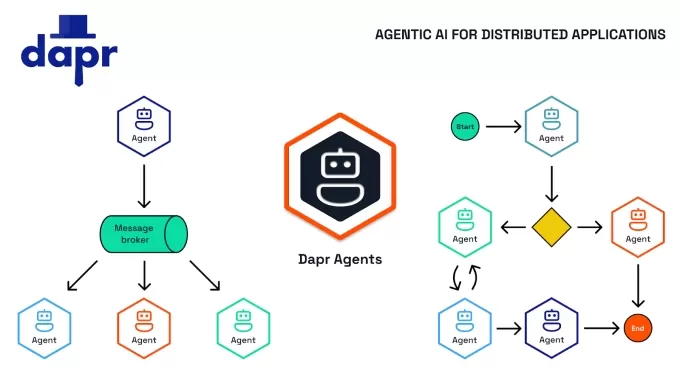
Image Credits:Dapr The concept of Dapr Agents was inspired by Floki, an open-source project that extended Dapr for AI agent applications. After discussions with Floki's maintainers, including Microsoft AI researcher Roberto Rodriguez, the decision was made to integrate Floki into the Dapr ecosystem, ensuring the continued development of this innovative agent framework.
Mark Fussell, another co-creator and maintainer of Dapr, sees agentic systems as a new term for distributed systems. He notes, "Rather than calling them microservices, you can call them agents now, mostly because you can put large language models amongst them all." The team emphasizes the need for an orchestration engine and statefulness to coordinate these agents effectively, which Dapr provides. Dapr's actors are designed to be highly efficient, capable of starting up in milliseconds to process a message and shutting down while preserving their state once their task is complete.
Currently, Dapr Agents can seamlessly integrate with popular model providers like AWS Bedrock, OpenAI, Anthropic, Mistral, and Hugging Face, with support for local LLMs on the horizon. Beyond model interaction, Dapr Agents leverage the existing Dapr framework, allowing developers to define tools that agents can use to accomplish tasks.
At the moment, Dapr Agents support Python, with .NET support coming soon, followed by Java, JavaScript, and Go. This expansion aims to make Dapr Agents a versatile tool for developers looking to harness the power of AI agents in their applications.
Related article
 OpenAI Leads 100-Signatory Push for Cyber Defence
OpenAI’s letter begins stating "we have a limited window to strengthen cyber defences". Credit: Getty ImagesMajor tech firms – including AWS, Google and Microsoft – urge governments to fund defensive tools, while critics call the manifesto self-servi
Gitar exits stealth with $9M to secure code using agents
The rise of “vibe coding” has led AI agents to produce a massive volume of code that companies now find challenging to handle. This surge is often referred to as “code overload.” Research indicates that AI-generated code can bring serious issues—such
Vercel CEO Guillermo Rauch hints at IPO as AI agents boost revenue
Unlike many startups founded before ChatGPT that now struggle to find their footing in the AI era, Vercel, a decade-old development tool and website hosting platform, is thriving due to the surge of AI-generated applications and autonomous agents.“Wh
Related Special Topic Recommendations
Video creation
OpenAI Leads 100-Signatory Push for Cyber Defence
OpenAI’s letter begins stating "we have a limited window to strengthen cyber defences". Credit: Getty ImagesMajor tech firms – including AWS, Google and Microsoft – urge governments to fund defensive tools, while critics call the manifesto self-servi
Gitar exits stealth with $9M to secure code using agents
The rise of “vibe coding” has led AI agents to produce a massive volume of code that companies now find challenging to handle. This surge is often referred to as “code overload.” Research indicates that AI-generated code can bring serious issues—such
Vercel CEO Guillermo Rauch hints at IPO as AI agents boost revenue
Unlike many startups founded before ChatGPT that now struggle to find their footing in the AI era, Vercel, a decade-old development tool and website hosting platform, is thriving due to the surge of AI-generated applications and autonomous agents.“Wh
Related Special Topic Recommendations
Video creation
 AI Short-Form Video Hook Generators for Reels, Shorts, and Product Launch Campaigns
2026 Latest Best AI Short-Form Video Hook Generators for Reels Shorts and Product Launch Campaigns! XIX.AI curates top-rated powerful game-changing tools that deliver must-try results through real-world tests. This weekly updated page offers free vs paid comparison rankings to help you find the perfect solution for boosting content creativity and productivity. Explore now to Unlock your AI edge!
 11 tools
 xix.ai
writing
AI Article Outline Tools for Long Form Writing
xix.ai
writing
AI Article Outline Tools for Long Form Writing
2026 Latest Best Top-Rated AI Article Outline Tools for Long Form Writing! This curated collection features powerful, game-changing tools that deliver accurate, structured outlines with real-world tests to boost writing efficiency significantly. XIX.AI is part of this elite selection. Get a free vs paid comparison to help you choose the perfect tool. Explore now and Unlock your AI edge!
9 tools
xix.ai
chatbot
Best AI Roleplay Chat Apps for Language Practice, Interview Prep, and Daily Fluency
2026 Latest Best Top-rated AI Roleplay Chat Apps for Language Practice, Interview Prep, and Daily Fluency! XIX.AI curates a powerful game-changing collection that offers free vs paid comparison, real-world tests, and updated rankings weekly. These must-try tools help you boost writing skills, overcome fluency challenges, and improve communication efficiency across all daily scenarios. Explore now to discover your perfect tool for language growth!
10 tools
xix.ai
Music composition
AI Stem Separation Tools for Remix Production, Sampling Prep, and Karaoke Masters
2026 Latest Best Top-rated AI Stem Separation Tools Curated for Remix Production, Sampling Prep, and Karaoke Masters. These powerful game-changing tools offer real-world tests to deliver precise audio isolation, boosting productivity significantly. XIX.AI provides a weekly updated free vs paid comparison guide to help you find the must-try solution that suits your needs. Explore now to unlock your AI edge.
8 tools
xix.ai
Data Analysis
AI SQL Copilots for Revenue Dashboards, Funnel Analysis, and Product Metrics
2026 Latest Best AI SQL Copilots Ranked Top-Rated! XIX.AI curates a powerful game-changing collection for weekly updated real-world tests. These must-try tools help you generate accurate revenue dashboards, analyze sales funnels, and track product metrics swiftly, boosting productivity massively. Explore now to Discover your perfect tool for data-driven decision making! 238 characters
9 tools
xix.ai
Music composition
Best AI Melody Writing Tools for Song Drafts
2026 Latest Best Top-Rated AI Melody Writing Tools for Song Drafts! XIX.AI has curated a highly powerful game-changing collection that goes through rigorous real-world tests to deliver the best writing experience. You can find detailed free vs paid comparisons, accurate rankings, and must-try options designed to help you create stunning song drafts effortlessly and boost your creative productivity significantly. Explore now to discover your perfect tool!
8 tools
xix.ai

 Comments (55)
0/500
Comments (55)
0/500
![KennethWalker]()
I was totally surprised to learn that Dapr started planning AI agent support back in 2019, way before most tech companies even considered integrating such features. It feels like they were ahead of their time by designing a framework that can easily handle complex distributed tasks in the future.
![JuanWhite]()
Interesting! Dapr's virtual actor model seems like a natural fit for AI agents. I wonder if this will make it easier to build complex, stateful agent workflows without getting bogged down in infrastructure code. The 2019 foresight is impressive.
![HarryLewis]()
DaprにAIエージェントサポートが追加されるなんて想像してなかった😲!マイクロサービスって既に複雑なのに、AIが組み込まれると開発がどれだけ変わるのか気になります。でも、これが一般的になると、小規模な開発チームには逆に敷居が高くなったりするのかな…?ともあれ、興味深い進化です!
![KevinBrown]()
L'ajout de composants AI à Dapr rend l'architecture des microservices plus flexible que jamais. Cette fusion pourrait résoudre les goulets d'étranglement des workflows complexes, mais je me demande si la latence réseau affectera les performances des agents IA dans un environnement distribué ? 😅
![WilliamAnderson]()
Dapr's AI agent support sounds like a game-changer! Been messing with microservices for years, and this could make things way smoother. Anyone tried it yet? 🤔
![GeorgeWilson]()
Dapr의 새로운 AI 에이전트 지원은 마이크로서비스에 혁신을 가져왔어요! 통합하기가 정말 쉬워요, 다만 문서가 조금 더 명확했으면 좋겠어요. 그래도 큰 발전이고, 우리 개발 과정을 정말 효율적으로 만들어줘요. 다음 업데이트가 기대돼요! 🤓
Back in 2019, Microsoft took a bold step by open-sourcing Dapr, a runtime designed to simplify the development of distributed microservice-based applications. At the time, AI agents weren't on the radar, but Dapr was already laying the groundwork for them. A key feature of Dapr is its use of virtual actors, which can independently handle and process messages, setting the stage for what would later become crucial for AI agents.
Fast forward to today, and the Dapr team is excited to introduce Dapr Agents, a new initiative aimed at helping developers build AI agents more easily. According to Yaron Schneider, a co-creator and maintainer of Dapr, "Agents are a very good use case for Dapr." He explains that Dapr's actors provide a lightweight, scalable, and resource-efficient way to run these agents, but there's still a lot of business logic that developers need to handle. While other frameworks exist, Dapr stands out with its robust orchestration and statefulness capabilities.
Mark Fussell, another co-creator and maintainer of Dapr, sees agentic systems as a new term for distributed systems. He notes, "Rather than calling them microservices, you can call them agents now, mostly because you can put large language models amongst them all." The team emphasizes the need for an orchestration engine and statefulness to coordinate these agents effectively, which Dapr provides. Dapr's actors are designed to be highly efficient, capable of starting up in milliseconds to process a message and shutting down while preserving their state once their task is complete.
Currently, Dapr Agents can seamlessly integrate with popular model providers like AWS Bedrock, OpenAI, Anthropic, Mistral, and Hugging Face, with support for local LLMs on the horizon. Beyond model interaction, Dapr Agents leverage the existing Dapr framework, allowing developers to define tools that agents can use to accomplish tasks.
At the moment, Dapr Agents support Python, with .NET support coming soon, followed by Java, JavaScript, and Go. This expansion aims to make Dapr Agents a versatile tool for developers looking to harness the power of AI agents in their applications.








 OpenAI Leads 100-Signatory Push for Cyber Defence
OpenAI’s letter begins stating "we have a limited window to strengthen cyber defences". Credit: Getty ImagesMajor tech firms – including AWS, Google and Microsoft – urge governments to fund defensive tools, while critics call the manifesto self-servi
OpenAI Leads 100-Signatory Push for Cyber Defence
OpenAI’s letter begins stating "we have a limited window to strengthen cyber defences". Credit: Getty ImagesMajor tech firms – including AWS, Google and Microsoft – urge governments to fund defensive tools, while critics call the manifesto self-servi
 Gitar exits stealth with $9M to secure code using agents
The rise of “vibe coding” has led AI agents to produce a massive volume of code that companies now find challenging to handle. This surge is often referred to as “code overload.” Research indicates that AI-generated code can bring serious issues—such
Gitar exits stealth with $9M to secure code using agents
The rise of “vibe coding” has led AI agents to produce a massive volume of code that companies now find challenging to handle. This surge is often referred to as “code overload.” Research indicates that AI-generated code can bring serious issues—such
 Vercel CEO Guillermo Rauch hints at IPO as AI agents boost revenue
Unlike many startups founded before ChatGPT that now struggle to find their footing in the AI era, Vercel, a decade-old development tool and website hosting platform, is thriving due to the surge of AI-generated applications and autonomous agents.“Wh
Vercel CEO Guillermo Rauch hints at IPO as AI agents boost revenue
Unlike many startups founded before ChatGPT that now struggle to find their footing in the AI era, Vercel, a decade-old development tool and website hosting platform, is thriving due to the surge of AI-generated applications and autonomous agents.“Wh

2026 Latest Best AI Short-Form Video Hook Generators for Reels Shorts and Product Launch Campaigns! XIX.AI curates top-rated powerful game-changing tools that deliver must-try results through real-world tests. This weekly updated page offers free vs paid comparison rankings to help you find the perfect solution for boosting content creativity and productivity. Explore now to Unlock your AI edge!
11 tools
xix.ai

2026 Latest Best Top-Rated AI Article Outline Tools for Long Form Writing! This curated collection features powerful, game-changing tools that deliver accurate, structured outlines with real-world tests to boost writing efficiency significantly. XIX.AI is part of this elite selection. Get a free vs paid comparison to help you choose the perfect tool. Explore now and Unlock your AI edge!
9 tools
xix.ai
2026 Latest Best Top-rated AI Roleplay Chat Apps for Language Practice, Interview Prep, and Daily Fluency! XIX.AI curates a powerful game-changing collection that offers free vs paid comparison, real-world tests, and updated rankings weekly. These must-try tools help you boost writing skills, overcome fluency challenges, and improve communication efficiency across all daily scenarios. Explore now to discover your perfect tool for language growth!
10 tools
xix.ai
2026 Latest Best Top-rated AI Stem Separation Tools Curated for Remix Production, Sampling Prep, and Karaoke Masters. These powerful game-changing tools offer real-world tests to deliver precise audio isolation, boosting productivity significantly. XIX.AI provides a weekly updated free vs paid comparison guide to help you find the must-try solution that suits your needs. Explore now to unlock your AI edge.
8 tools
xix.ai
2026 Latest Best AI SQL Copilots Ranked Top-Rated! XIX.AI curates a powerful game-changing collection for weekly updated real-world tests. These must-try tools help you generate accurate revenue dashboards, analyze sales funnels, and track product metrics swiftly, boosting productivity massively. Explore now to Discover your perfect tool for data-driven decision making! 238 characters
9 tools
xix.ai

2026 Latest Best Top-Rated AI Melody Writing Tools for Song Drafts! XIX.AI has curated a highly powerful game-changing collection that goes through rigorous real-world tests to deliver the best writing experience. You can find detailed free vs paid comparisons, accurate rankings, and must-try options designed to help you create stunning song drafts effortlessly and boost your creative productivity significantly. Explore now to discover your perfect tool!
8 tools
xix.ai

I was totally surprised to learn that Dapr started planning AI agent support back in 2019, way before most tech companies even considered integrating such features. It feels like they were ahead of their time by designing a framework that can easily handle complex distributed tasks in the future.
Interesting! Dapr's virtual actor model seems like a natural fit for AI agents. I wonder if this will make it easier to build complex, stateful agent workflows without getting bogged down in infrastructure code. The 2019 foresight is impressive.
DaprにAIエージェントサポートが追加されるなんて想像してなかった😲!マイクロサービスって既に複雑なのに、AIが組み込まれると開発がどれだけ変わるのか気になります。でも、これが一般的になると、小規模な開発チームには逆に敷居が高くなったりするのかな…?ともあれ、興味深い進化です!
L'ajout de composants AI à Dapr rend l'architecture des microservices plus flexible que jamais. Cette fusion pourrait résoudre les goulets d'étranglement des workflows complexes, mais je me demande si la latence réseau affectera les performances des agents IA dans un environnement distribué ? 😅
Dapr's AI agent support sounds like a game-changer! Been messing with microservices for years, and this could make things way smoother. Anyone tried it yet? 🤔
Dapr의 새로운 AI 에이전트 지원은 마이크로서비스에 혁신을 가져왔어요! 통합하기가 정말 쉬워요, 다만 문서가 조금 더 명확했으면 좋겠어요. 그래도 큰 발전이고, 우리 개발 과정을 정말 효율적으로 만들어줘요. 다음 업데이트가 기대돼요! 🤓












