


 Home
HomeCVPR 2026 Signals Paradigm Shift in Visual Intelligence as Marginal Gains Fade
Over the last decade, computer vision has evolved from ImageNet classification to diffusion models, aiming to enable machines to "see the world." Yet, as perceptual capabilities near human levels, the returns on pure accuracy gains are fading. At CVPR 2026, visual intelligence research has shifted: vision is no longer the final goal but a bridge for reasoning, decision-making, and interaction.
Moving Beyond "Blind Reasoning": Adaptive and Implicit Approaches
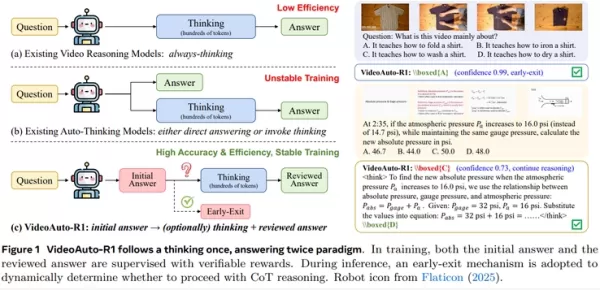
Multimodal models have long relied on "chain of thought" (CoT) for logical reasoning. However, recent findings suggest this constant reasoning is often inefficient. The VideoAuto-R1 framework introduces "on-demand reasoning": it answers simple perceptual queries directly and triggers reasoning only for complex logic. This method maintains peak performance while cutting average output length by 3.3x.
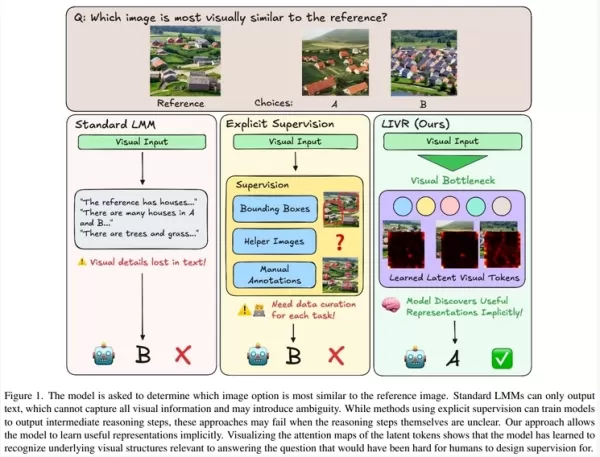
The medium of reasoning is also evolving. Previously, models depended on language to describe spatial relationships, which failed with puzzles or geometric structures. The new trend involves implicit visual reasoning within the "latent space," bypassing linear text conversion to better capture complex visual structures.
Rethinking Evaluation: Breaking the Multiple-Choice Illusion
Current visual-language model evaluations rely heavily on multiple-choice questions (MCQA), potentially overestimating capabilities. Research indicates models often "cheat" via elimination or option bias, inflating scores by roughly 20 points. To fix this, the industry is adopting "verifiable open QA," forcing models to genuinely understand visual content rather than exploiting option clues.
Meanwhile, evaluation scenarios are shifting from single-agent static images to multi-agent environments. Benchmarks like VS-Bench require models to not only comprehend the environment but also demonstrate strategic reasoning and decision-making in complex interactions, such as collaboration and competition. This marks the transition of visual intelligence from a passive "understander" to an active "decision-maker."
Infrastructure Upgrades: Open-Source Models and Real-World Data
The open-source community is increasing transparency. Models like Molmo2 release not just weights but also full data and training processes. These models expand capabilities from single images to videos, adding precise localization features and achieving a leap from "understanding" to "pointing out locations."
This progress is backed by comprehensive data infrastructure. For text-driven image editing, large-scale real-world datasets like Pico-Banana-400K address the gap caused by over-reliance on synthetic data. Supporting multi-turn editing and preference alignment, this dataset provides a solid foundation for training editing models with enhanced common sense and logic.
In summary, visual intelligence is evolving from single perception to integrated intelligence combining perception, cognition, and action. This shift represents more than minor performance boosts; it is a systematic reconstruction of reasoning mechanisms, evaluation paradigms, and data supply chains.
Related article
 Meta Removes AI Photo Editing Feature Following User Backlash
Meta, the social media giant, is once again embroiled in a public debate regarding the delicate balance between artificial intelligence and user privacy. According to TechCrunch, Meta’s Superintelligence Labs introduced a new AI image generator, Muse
DeepMind CEO Hassabis: I sleep six hours a day, usually feel energetic around 1 a.m.
Fortune recently featured an interview with Demis Hassabis, CEO of Google DeepMind, revealing his unconventional approach to rest and productivity. Hassabis disclosed that he sleeps very little, structuring his waking hours into two distinct work blo
OpenAI, Anthropic Vie for Market Share Despite Revenue Shortfalls
Despite recent reports suggesting OpenAI missed revenue targets, creating pressure on tech stocks this Tuesday, private AI lab investors remain resilient. Seasoned backers have confirmed they will not reduce investment despite negative media coverage
Related Special Topic Recommendations
Video creation
Meta Removes AI Photo Editing Feature Following User Backlash
Meta, the social media giant, is once again embroiled in a public debate regarding the delicate balance between artificial intelligence and user privacy. According to TechCrunch, Meta’s Superintelligence Labs introduced a new AI image generator, Muse
DeepMind CEO Hassabis: I sleep six hours a day, usually feel energetic around 1 a.m.
Fortune recently featured an interview with Demis Hassabis, CEO of Google DeepMind, revealing his unconventional approach to rest and productivity. Hassabis disclosed that he sleeps very little, structuring his waking hours into two distinct work blo
OpenAI, Anthropic Vie for Market Share Despite Revenue Shortfalls
Despite recent reports suggesting OpenAI missed revenue targets, creating pressure on tech stocks this Tuesday, private AI lab investors remain resilient. Seasoned backers have confirmed they will not reduce investment despite negative media coverage
Related Special Topic Recommendations
Video creation
 AI Short-Form Video Hook Generators for Reels, Shorts, and Product Launch Campaigns
2026 Latest Best AI Short-Form Video Hook Generators for Reels Shorts and Product Launch Campaigns! XIX.AI curates top-rated powerful game-changing tools that deliver must-try results through real-world tests. This weekly updated page offers free vs paid comparison rankings to help you find the perfect solution for boosting content creativity and productivity. Explore now to Unlock your AI edge!
 11 tools
 xix.ai
writing
AI Article Outline Tools for Long Form Writing
xix.ai
writing
AI Article Outline Tools for Long Form Writing
2026 Latest Best Top-Rated AI Article Outline Tools for Long Form Writing! This curated collection features powerful, game-changing tools that deliver accurate, structured outlines with real-world tests to boost writing efficiency significantly. XIX.AI is part of this elite selection. Get a free vs paid comparison to help you choose the perfect tool. Explore now and Unlock your AI edge!
9 tools
xix.ai
chatbot
Best AI Roleplay Chat Apps for Language Practice, Interview Prep, and Daily Fluency
2026 Latest Best Top-rated AI Roleplay Chat Apps for Language Practice, Interview Prep, and Daily Fluency! XIX.AI curates a powerful game-changing collection that offers free vs paid comparison, real-world tests, and updated rankings weekly. These must-try tools help you boost writing skills, overcome fluency challenges, and improve communication efficiency across all daily scenarios. Explore now to discover your perfect tool for language growth!
10 tools
xix.ai
Music composition
AI Stem Separation Tools for Remix Production, Sampling Prep, and Karaoke Masters
2026 Latest Best Top-rated AI Stem Separation Tools Curated for Remix Production, Sampling Prep, and Karaoke Masters. These powerful game-changing tools offer real-world tests to deliver precise audio isolation, boosting productivity significantly. XIX.AI provides a weekly updated free vs paid comparison guide to help you find the must-try solution that suits your needs. Explore now to unlock your AI edge.
8 tools
xix.ai
Data Analysis
AI SQL Copilots for Revenue Dashboards, Funnel Analysis, and Product Metrics
2026 Latest Best AI SQL Copilots Ranked Top-Rated! XIX.AI curates a powerful game-changing collection for weekly updated real-world tests. These must-try tools help you generate accurate revenue dashboards, analyze sales funnels, and track product metrics swiftly, boosting productivity massively. Explore now to Discover your perfect tool for data-driven decision making! 238 characters
9 tools
xix.ai
Music composition
Best AI Melody Writing Tools for Song Drafts
2026 Latest Best Top-Rated AI Melody Writing Tools for Song Drafts! XIX.AI has curated a highly powerful game-changing collection that goes through rigorous real-world tests to deliver the best writing experience. You can find detailed free vs paid comparisons, accurate rankings, and must-try options designed to help you create stunning song drafts effortlessly and boost your creative productivity significantly. Explore now to discover your perfect tool!
8 tools
xix.ai

 Comments (0)
0/500
Comments (0)
0/500
Over the last decade, computer vision has evolved from ImageNet classification to diffusion models, aiming to enable machines to "see the world." Yet, as perceptual capabilities near human levels, the returns on pure accuracy gains are fading. At CVPR 2026, visual intelligence research has shifted: vision is no longer the final goal but a bridge for reasoning, decision-making, and interaction.
Moving Beyond "Blind Reasoning": Adaptive and Implicit Approaches
Multimodal models have long relied on "chain of thought" (CoT) for logical reasoning. However, recent findings suggest this constant reasoning is often inefficient. The VideoAuto-R1 framework introduces "on-demand reasoning": it answers simple perceptual queries directly and triggers reasoning only for complex logic. This method maintains peak performance while cutting average output length by 3.3x.
The medium of reasoning is also evolving. Previously, models depended on language to describe spatial relationships, which failed with puzzles or geometric structures. The new trend involves implicit visual reasoning within the "latent space," bypassing linear text conversion to better capture complex visual structures.
Rethinking Evaluation: Breaking the Multiple-Choice Illusion
Current visual-language model evaluations rely heavily on multiple-choice questions (MCQA), potentially overestimating capabilities. Research indicates models often "cheat" via elimination or option bias, inflating scores by roughly 20 points. To fix this, the industry is adopting "verifiable open QA," forcing models to genuinely understand visual content rather than exploiting option clues.
Meanwhile, evaluation scenarios are shifting from single-agent static images to multi-agent environments. Benchmarks like VS-Bench require models to not only comprehend the environment but also demonstrate strategic reasoning and decision-making in complex interactions, such as collaboration and competition. This marks the transition of visual intelligence from a passive "understander" to an active "decision-maker."
Infrastructure Upgrades: Open-Source Models and Real-World Data
The open-source community is increasing transparency. Models like Molmo2 release not just weights but also full data and training processes. These models expand capabilities from single images to videos, adding precise localization features and achieving a leap from "understanding" to "pointing out locations."
This progress is backed by comprehensive data infrastructure. For text-driven image editing, large-scale real-world datasets like Pico-Banana-400K address the gap caused by over-reliance on synthetic data. Supporting multi-turn editing and preference alignment, this dataset provides a solid foundation for training editing models with enhanced common sense and logic.
In summary, visual intelligence is evolving from single perception to integrated intelligence combining perception, cognition, and action. This shift represents more than minor performance boosts; it is a systematic reconstruction of reasoning mechanisms, evaluation paradigms, and data supply chains.








 Meta Removes AI Photo Editing Feature Following User Backlash
Meta, the social media giant, is once again embroiled in a public debate regarding the delicate balance between artificial intelligence and user privacy. According to TechCrunch, Meta’s Superintelligence Labs introduced a new AI image generator, Muse
Meta Removes AI Photo Editing Feature Following User Backlash
Meta, the social media giant, is once again embroiled in a public debate regarding the delicate balance between artificial intelligence and user privacy. According to TechCrunch, Meta’s Superintelligence Labs introduced a new AI image generator, Muse
 DeepMind CEO Hassabis: I sleep six hours a day, usually feel energetic around 1 a.m.
Fortune recently featured an interview with Demis Hassabis, CEO of Google DeepMind, revealing his unconventional approach to rest and productivity. Hassabis disclosed that he sleeps very little, structuring his waking hours into two distinct work blo
DeepMind CEO Hassabis: I sleep six hours a day, usually feel energetic around 1 a.m.
Fortune recently featured an interview with Demis Hassabis, CEO of Google DeepMind, revealing his unconventional approach to rest and productivity. Hassabis disclosed that he sleeps very little, structuring his waking hours into two distinct work blo
 OpenAI, Anthropic Vie for Market Share Despite Revenue Shortfalls
Despite recent reports suggesting OpenAI missed revenue targets, creating pressure on tech stocks this Tuesday, private AI lab investors remain resilient. Seasoned backers have confirmed they will not reduce investment despite negative media coverage
OpenAI, Anthropic Vie for Market Share Despite Revenue Shortfalls
Despite recent reports suggesting OpenAI missed revenue targets, creating pressure on tech stocks this Tuesday, private AI lab investors remain resilient. Seasoned backers have confirmed they will not reduce investment despite negative media coverage

2026 Latest Best AI Short-Form Video Hook Generators for Reels Shorts and Product Launch Campaigns! XIX.AI curates top-rated powerful game-changing tools that deliver must-try results through real-world tests. This weekly updated page offers free vs paid comparison rankings to help you find the perfect solution for boosting content creativity and productivity. Explore now to Unlock your AI edge!
11 tools
xix.ai

2026 Latest Best Top-Rated AI Article Outline Tools for Long Form Writing! This curated collection features powerful, game-changing tools that deliver accurate, structured outlines with real-world tests to boost writing efficiency significantly. XIX.AI is part of this elite selection. Get a free vs paid comparison to help you choose the perfect tool. Explore now and Unlock your AI edge!
9 tools
xix.ai

2026 Latest Best Top-rated AI Roleplay Chat Apps for Language Practice, Interview Prep, and Daily Fluency! XIX.AI curates a powerful game-changing collection that offers free vs paid comparison, real-world tests, and updated rankings weekly. These must-try tools help you boost writing skills, overcome fluency challenges, and improve communication efficiency across all daily scenarios. Explore now to discover your perfect tool for language growth!
10 tools
xix.ai

2026 Latest Best Top-rated AI Stem Separation Tools Curated for Remix Production, Sampling Prep, and Karaoke Masters. These powerful game-changing tools offer real-world tests to deliver precise audio isolation, boosting productivity significantly. XIX.AI provides a weekly updated free vs paid comparison guide to help you find the must-try solution that suits your needs. Explore now to unlock your AI edge.
8 tools
xix.ai

2026 Latest Best AI SQL Copilots Ranked Top-Rated! XIX.AI curates a powerful game-changing collection for weekly updated real-world tests. These must-try tools help you generate accurate revenue dashboards, analyze sales funnels, and track product metrics swiftly, boosting productivity massively. Explore now to Discover your perfect tool for data-driven decision making! 238 characters
9 tools
xix.ai

2026 Latest Best Top-Rated AI Melody Writing Tools for Song Drafts! XIX.AI has curated a highly powerful game-changing collection that goes through rigorous real-world tests to deliver the best writing experience. You can find detailed free vs paid comparisons, accurate rankings, and must-try options designed to help you create stunning song drafts effortlessly and boost your creative productivity significantly. Explore now to discover your perfect tool!
8 tools
xix.ai












