


 Home
HomeAnthropic Users Must Choose: Share AI Chats for Training or Opt Out
Anthropic is implementing major changes to its user data policies, requiring all Claude users to decide by September 28 whether they consent to having their conversations used for AI model training. While the company pointed to its blog post about the policy updates when questioned about the reasoning, we have developed our own interpretations.
First, let's examine the changes: Previously, Anthropic did not utilize consumer chat data for model training. Now, the company intends to train its AI systems on user conversations and coding sessions, extending data retention to five years for users who do not opt out.
This represents a significant shift. Before this update, users of Anthropic's consumer products were informed that their prompts and conversation outputs would be automatically removed from Anthropic's systems within 30 days, unless legal or policy requirements mandated longer retention, or if their content violated policies - in which case inputs and outputs could be stored for up to two years.
These new policies apply to Claude Free, Pro, and Max users, including those using Claude Code. Business customers utilizing Claude Gov, Claude for Work, Claude for Education, or API access remain unaffected, mirroring how OpenAI similarly shields enterprise clients from data training policies.
So what's driving these changes? In its announcement, Anthropic presents the update as being about user choice, suggesting that by not opting out, users will "help us improve model safety, making our systems for detecting harmful content more accurate and reducing false positives." Users will "also contribute to enhancing future Claude models' capabilities in areas like coding, analysis, and reasoning, ultimately benefiting all users."
In essence: help us help you. However, the complete picture may be somewhat less altruistic.
Like other major language model companies, Anthropic's need for data outweighs concerns about brand perception. Training AI models requires enormous volumes of high-quality conversational data, and access to millions of Claude interactions provides precisely the type of real-world content that could strengthen Anthropic's competitive standing against rivals like OpenAI and Google.
Techcrunch event Tech and VC heavyweights join the Disrupt 2025 agenda
Netflix, ElevenLabs, Wayve, Sequoia Capital, Elad Gil — just some of the influential leaders joining the Disrupt 2025 agenda. They're here to share insights that drive startup growth and enhance your competitive advantage. Don't miss the 20th anniversary of TechCrunch Disrupt, and this opportunity to learn from technology's leading voices — secure your ticket now and save up to $600+ before prices increase.
Tech and VC heavyweights join the Disrupt 2025 agenda
Netflix, ElevenLabs, Wayve, Sequoia Capital — just some of the prominent figures joining the Disrupt 2025 agenda. They're here to provide the insights that fuel startup growth and sharpen your competitive edge. Don't miss the 20th anniversary of TechCrunch Disrupt, and your chance to learn from top technology experts — purchase your ticket now and save up to $675 before prices rise.
San Francisco | October 27-29, 2025 REGISTER NOW Beyond competitive pressures in AI development, these changes also reflect broader industry shifts in data policies, as companies like Anthropic and OpenAI face increasing scrutiny over their data retention practices. OpenAI, for example, is currently challenging a court order requiring the company to retain all consumer ChatGPT conversations indefinitely, including deleted chats, resulting from a lawsuit filed by The New York Times and other publishers.
In June, OpenAI COO Brad Lightcap described this as "a sweeping and unnecessary demand" that "fundamentally conflicts with the privacy commitments we've made to our users." The court order affects ChatGPT Free, Plus, Pro, and Team users, though enterprise customers and those with Zero Data Retention agreements remain protected.
What's concerning is the considerable confusion these evolving usage policies are generating among users, many of whom remain unaware of them.
Admittedly, the technology sector is evolving rapidly, so privacy policies inevitably change alongside technological advances. However, many of these modifications are quite substantial yet receive only brief mention amid other company announcements. (Based on its placement on Anthropic's press page, you wouldn't suspect Tuesday's policy changes for users were particularly significant.)
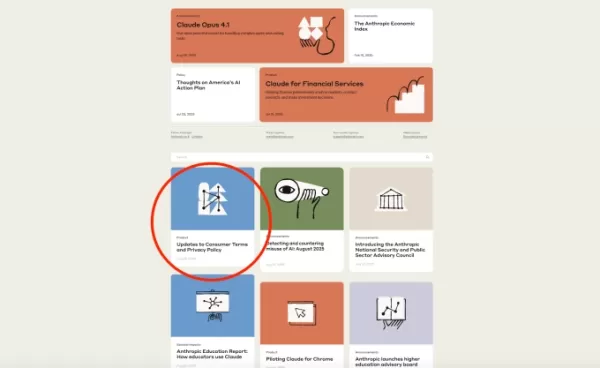
Image Credits: Anthropic
Many users remain unaware that the guidelines they've agreed to have changed because the interface design practically ensures this oversight. Most ChatGPT users continue clicking "delete" options that technically don't remove anything. Meanwhile, Anthropic's implementation of its new policy follows a familiar approach.
How? New users select their preference during registration, but existing users encounter a pop-up featuring "Updates to Consumer Terms and Policies" in large text with a prominent black "Accept" button, while the much smaller training permission toggle appears below in finer print — preset to "On."
As The Verge noted earlier today, this design raises concerns that users might hastily click "Accept" without realizing they're consenting to data sharing.
Meanwhile, the importance of user awareness has never been greater. Privacy experts have long cautioned that AI's complexity makes genuine user consent notoriously difficult to achieve. Under the Biden administration, the Federal Trade Commission even intervened, warning that AI companies risk enforcement action if they engage in "surreptitiously modifying terms of service or privacy policies, or concealing disclosures behind hyperlinks, legal jargon, or fine print."
Whether the commission — currently operating with only three of its five commissioners — continues monitoring these practices remains uncertain, a question we've posed directly to the FTC.
Related article
 Anthropic launches Opus 4.8 featuring new dynamic workflow tool
Anthropic unveiled Opus 4.8 on Thursday, marking the latest iteration of its premier public model. Priced identically to its predecessor, this update is now accessible across all platforms.Releasing just 41 days after Opus 4.7, Anthropic has accelera
Anthropic debuts Claude Fable 5, a public version of Mythos
Anthropic is making its most powerful AI model available to the general public for the first time — but with safety measures in place.
On Tuesday, the company launched Claude Fable 5, the first public release of its Mythos model. According to Anthrop
SandboxAQ brings drug discovery AI to Claude, no computing PhD needed
Drug discovery remains one of the costliest challenges in modern industry. Identifying a single viable molecule can take a decade and billions of dollars, and most candidates still fail. A wave of AI startups has promised to change that — though most
Related Special Topic Recommendations
Video creation
Anthropic launches Opus 4.8 featuring new dynamic workflow tool
Anthropic unveiled Opus 4.8 on Thursday, marking the latest iteration of its premier public model. Priced identically to its predecessor, this update is now accessible across all platforms.Releasing just 41 days after Opus 4.7, Anthropic has accelera
Anthropic debuts Claude Fable 5, a public version of Mythos
Anthropic is making its most powerful AI model available to the general public for the first time — but with safety measures in place.
On Tuesday, the company launched Claude Fable 5, the first public release of its Mythos model. According to Anthrop
SandboxAQ brings drug discovery AI to Claude, no computing PhD needed
Drug discovery remains one of the costliest challenges in modern industry. Identifying a single viable molecule can take a decade and billions of dollars, and most candidates still fail. A wave of AI startups has promised to change that — though most
Related Special Topic Recommendations
Video creation
 AI Short-Form Video Hook Generators for Reels, Shorts, and Product Launch Campaigns
2026 Latest Best AI Short-Form Video Hook Generators for Reels Shorts and Product Launch Campaigns! XIX.AI curates top-rated powerful game-changing tools that deliver must-try results through real-world tests. This weekly updated page offers free vs paid comparison rankings to help you find the perfect solution for boosting content creativity and productivity. Explore now to Unlock your AI edge!
 11 tools
 xix.ai
writing
AI Article Outline Tools for Long Form Writing
xix.ai
writing
AI Article Outline Tools for Long Form Writing
2026 Latest Best Top-Rated AI Article Outline Tools for Long Form Writing! This curated collection features powerful, game-changing tools that deliver accurate, structured outlines with real-world tests to boost writing efficiency significantly. XIX.AI is part of this elite selection. Get a free vs paid comparison to help you choose the perfect tool. Explore now and Unlock your AI edge!
9 tools
xix.ai
chatbot
Best AI Roleplay Chat Apps for Language Practice, Interview Prep, and Daily Fluency
2026 Latest Best Top-rated AI Roleplay Chat Apps for Language Practice, Interview Prep, and Daily Fluency! XIX.AI curates a powerful game-changing collection that offers free vs paid comparison, real-world tests, and updated rankings weekly. These must-try tools help you boost writing skills, overcome fluency challenges, and improve communication efficiency across all daily scenarios. Explore now to discover your perfect tool for language growth!
10 tools
xix.ai
Music composition
AI Stem Separation Tools for Remix Production, Sampling Prep, and Karaoke Masters
2026 Latest Best Top-rated AI Stem Separation Tools Curated for Remix Production, Sampling Prep, and Karaoke Masters. These powerful game-changing tools offer real-world tests to deliver precise audio isolation, boosting productivity significantly. XIX.AI provides a weekly updated free vs paid comparison guide to help you find the must-try solution that suits your needs. Explore now to unlock your AI edge.
8 tools
xix.ai
Data Analysis
AI SQL Copilots for Revenue Dashboards, Funnel Analysis, and Product Metrics
2026 Latest Best AI SQL Copilots Ranked Top-Rated! XIX.AI curates a powerful game-changing collection for weekly updated real-world tests. These must-try tools help you generate accurate revenue dashboards, analyze sales funnels, and track product metrics swiftly, boosting productivity massively. Explore now to Discover your perfect tool for data-driven decision making! 238 characters
9 tools
xix.ai
Music composition
Best AI Melody Writing Tools for Song Drafts
2026 Latest Best Top-Rated AI Melody Writing Tools for Song Drafts! XIX.AI has curated a highly powerful game-changing collection that goes through rigorous real-world tests to deliver the best writing experience. You can find detailed free vs paid comparisons, accurate rankings, and must-try options designed to help you create stunning song drafts effortlessly and boost your creative productivity significantly. Explore now to discover your perfect tool!
8 tools
xix.ai

 Comments (1)
0/500
Comments (1)
0/500
![FrankSanchez]()
Hmm, another 'choose or lose' situation. I get that they need data, but why not offer some incentive instead of just a deadline? Feels a bit pushy. 😒
Anthropic is implementing major changes to its user data policies, requiring all Claude users to decide by September 28 whether they consent to having their conversations used for AI model training. While the company pointed to its blog post about the policy updates when questioned about the reasoning, we have developed our own interpretations.
First, let's examine the changes: Previously, Anthropic did not utilize consumer chat data for model training. Now, the company intends to train its AI systems on user conversations and coding sessions, extending data retention to five years for users who do not opt out.
This represents a significant shift. Before this update, users of Anthropic's consumer products were informed that their prompts and conversation outputs would be automatically removed from Anthropic's systems within 30 days, unless legal or policy requirements mandated longer retention, or if their content violated policies - in which case inputs and outputs could be stored for up to two years.
These new policies apply to Claude Free, Pro, and Max users, including those using Claude Code. Business customers utilizing Claude Gov, Claude for Work, Claude for Education, or API access remain unaffected, mirroring how OpenAI similarly shields enterprise clients from data training policies.
So what's driving these changes? In its announcement, Anthropic presents the update as being about user choice, suggesting that by not opting out, users will "help us improve model safety, making our systems for detecting harmful content more accurate and reducing false positives." Users will "also contribute to enhancing future Claude models' capabilities in areas like coding, analysis, and reasoning, ultimately benefiting all users."
In essence: help us help you. However, the complete picture may be somewhat less altruistic.
Like other major language model companies, Anthropic's need for data outweighs concerns about brand perception. Training AI models requires enormous volumes of high-quality conversational data, and access to millions of Claude interactions provides precisely the type of real-world content that could strengthen Anthropic's competitive standing against rivals like OpenAI and Google.
Techcrunch eventTech and VC heavyweights join the Disrupt 2025 agenda
Netflix, ElevenLabs, Wayve, Sequoia Capital, Elad Gil — just some of the influential leaders joining the Disrupt 2025 agenda. They're here to share insights that drive startup growth and enhance your competitive advantage. Don't miss the 20th anniversary of TechCrunch Disrupt, and this opportunity to learn from technology's leading voices — secure your ticket now and save up to $600+ before prices increase.
Tech and VC heavyweights join the Disrupt 2025 agenda
Netflix, ElevenLabs, Wayve, Sequoia Capital — just some of the prominent figures joining the Disrupt 2025 agenda. They're here to provide the insights that fuel startup growth and sharpen your competitive edge. Don't miss the 20th anniversary of TechCrunch Disrupt, and your chance to learn from top technology experts — purchase your ticket now and save up to $675 before prices rise.
San Francisco | October 27-29, 2025 REGISTER NOWBeyond competitive pressures in AI development, these changes also reflect broader industry shifts in data policies, as companies like Anthropic and OpenAI face increasing scrutiny over their data retention practices. OpenAI, for example, is currently challenging a court order requiring the company to retain all consumer ChatGPT conversations indefinitely, including deleted chats, resulting from a lawsuit filed by The New York Times and other publishers.
In June, OpenAI COO Brad Lightcap described this as "a sweeping and unnecessary demand" that "fundamentally conflicts with the privacy commitments we've made to our users." The court order affects ChatGPT Free, Plus, Pro, and Team users, though enterprise customers and those with Zero Data Retention agreements remain protected.
What's concerning is the considerable confusion these evolving usage policies are generating among users, many of whom remain unaware of them.
Admittedly, the technology sector is evolving rapidly, so privacy policies inevitably change alongside technological advances. However, many of these modifications are quite substantial yet receive only brief mention amid other company announcements. (Based on its placement on Anthropic's press page, you wouldn't suspect Tuesday's policy changes for users were particularly significant.)
Many users remain unaware that the guidelines they've agreed to have changed because the interface design practically ensures this oversight. Most ChatGPT users continue clicking "delete" options that technically don't remove anything. Meanwhile, Anthropic's implementation of its new policy follows a familiar approach.
How? New users select their preference during registration, but existing users encounter a pop-up featuring "Updates to Consumer Terms and Policies" in large text with a prominent black "Accept" button, while the much smaller training permission toggle appears below in finer print — preset to "On."
As The Verge noted earlier today, this design raises concerns that users might hastily click "Accept" without realizing they're consenting to data sharing.
Meanwhile, the importance of user awareness has never been greater. Privacy experts have long cautioned that AI's complexity makes genuine user consent notoriously difficult to achieve. Under the Biden administration, the Federal Trade Commission even intervened, warning that AI companies risk enforcement action if they engage in "surreptitiously modifying terms of service or privacy policies, or concealing disclosures behind hyperlinks, legal jargon, or fine print."
Whether the commission — currently operating with only three of its five commissioners — continues monitoring these practices remains uncertain, a question we've posed directly to the FTC.








 Anthropic launches Opus 4.8 featuring new dynamic workflow tool
Anthropic unveiled Opus 4.8 on Thursday, marking the latest iteration of its premier public model. Priced identically to its predecessor, this update is now accessible across all platforms.Releasing just 41 days after Opus 4.7, Anthropic has accelera
Anthropic launches Opus 4.8 featuring new dynamic workflow tool
Anthropic unveiled Opus 4.8 on Thursday, marking the latest iteration of its premier public model. Priced identically to its predecessor, this update is now accessible across all platforms.Releasing just 41 days after Opus 4.7, Anthropic has accelera
 Anthropic debuts Claude Fable 5, a public version of Mythos
Anthropic is making its most powerful AI model available to the general public for the first time — but with safety measures in place.
On Tuesday, the company launched Claude Fable 5, the first public release of its Mythos model. According to Anthrop
Anthropic debuts Claude Fable 5, a public version of Mythos
Anthropic is making its most powerful AI model available to the general public for the first time — but with safety measures in place.
On Tuesday, the company launched Claude Fable 5, the first public release of its Mythos model. According to Anthrop
 SandboxAQ brings drug discovery AI to Claude, no computing PhD needed
Drug discovery remains one of the costliest challenges in modern industry. Identifying a single viable molecule can take a decade and billions of dollars, and most candidates still fail. A wave of AI startups has promised to change that — though most
SandboxAQ brings drug discovery AI to Claude, no computing PhD needed
Drug discovery remains one of the costliest challenges in modern industry. Identifying a single viable molecule can take a decade and billions of dollars, and most candidates still fail. A wave of AI startups has promised to change that — though most

2026 Latest Best AI Short-Form Video Hook Generators for Reels Shorts and Product Launch Campaigns! XIX.AI curates top-rated powerful game-changing tools that deliver must-try results through real-world tests. This weekly updated page offers free vs paid comparison rankings to help you find the perfect solution for boosting content creativity and productivity. Explore now to Unlock your AI edge!
11 tools
xix.ai

2026 Latest Best Top-Rated AI Article Outline Tools for Long Form Writing! This curated collection features powerful, game-changing tools that deliver accurate, structured outlines with real-world tests to boost writing efficiency significantly. XIX.AI is part of this elite selection. Get a free vs paid comparison to help you choose the perfect tool. Explore now and Unlock your AI edge!
9 tools
xix.ai

2026 Latest Best Top-rated AI Roleplay Chat Apps for Language Practice, Interview Prep, and Daily Fluency! XIX.AI curates a powerful game-changing collection that offers free vs paid comparison, real-world tests, and updated rankings weekly. These must-try tools help you boost writing skills, overcome fluency challenges, and improve communication efficiency across all daily scenarios. Explore now to discover your perfect tool for language growth!
10 tools
xix.ai

2026 Latest Best Top-rated AI Stem Separation Tools Curated for Remix Production, Sampling Prep, and Karaoke Masters. These powerful game-changing tools offer real-world tests to deliver precise audio isolation, boosting productivity significantly. XIX.AI provides a weekly updated free vs paid comparison guide to help you find the must-try solution that suits your needs. Explore now to unlock your AI edge.
8 tools
xix.ai

2026 Latest Best AI SQL Copilots Ranked Top-Rated! XIX.AI curates a powerful game-changing collection for weekly updated real-world tests. These must-try tools help you generate accurate revenue dashboards, analyze sales funnels, and track product metrics swiftly, boosting productivity massively. Explore now to Discover your perfect tool for data-driven decision making! 238 characters
9 tools
xix.ai

2026 Latest Best Top-Rated AI Melody Writing Tools for Song Drafts! XIX.AI has curated a highly powerful game-changing collection that goes through rigorous real-world tests to deliver the best writing experience. You can find detailed free vs paid comparisons, accurate rankings, and must-try options designed to help you create stunning song drafts effortlessly and boost your creative productivity significantly. Explore now to discover your perfect tool!
8 tools
xix.ai

Hmm, another 'choose or lose' situation. I get that they need data, but why not offer some incentive instead of just a deadline? Feels a bit pushy. 😒












