


 Home
Home
Alibaba's Tongyi Unveils Fun-CineForge: Open-Source AI Model Achieves Film-Grade Voice Synthesis
Alibaba Tongyi Lab officially launched and open-sourced the film-grade, multi-scenario voice synthesis multimodal model Fun-CineForge on March 16. This model addresses core challenges in AI dubbing, including lip-sync mismatch, lack of emotional expression, and inconsistent voice characteristics across multiple characters. It also introduces a high-quality method for dataset construction.
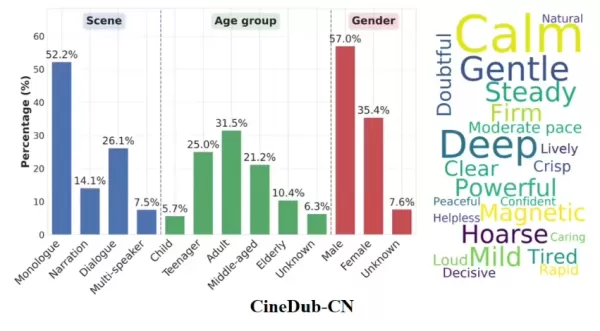
Technically, Fun-CineForge pioneers the concept of "temporal modality." Unlike conventional models that focus solely on text or visuals, it ensures voice synthesis occurs within precise time intervals through accurate timestamp control. Even in complex film scenes with occluded characters, frequent camera cuts, or blurred faces, the model maintains a high degree of audio-visual synchronization and adherence to instructions.
The accompanying open-source CineDub dataset construction pipeline is another key innovation. Tongyi Lab employed large language model chain-of-thought reasoning to automatically transform raw film footage into structured data, significantly reducing the need for manual annotation. This process achieves a word error rate of approximately 1% and a speaker diarization error rate of just 1.20%, providing a highly competitive training foundation for large models.
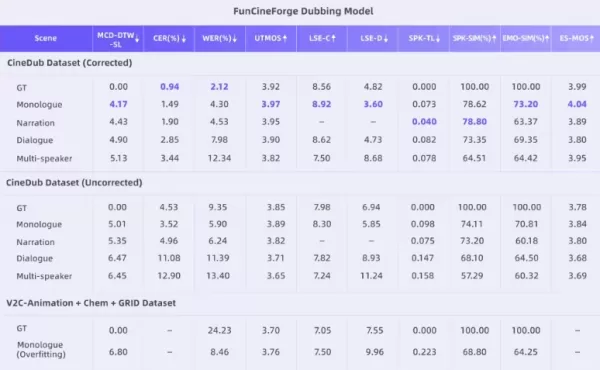
Fun-CineForge is now available on GitHub, HuggingFace, and the ModelScope community, supporting inference for video clips up to 30 seconds long. It excels not only in single-speaker monologues but also offers professional-grade support for duet and multi-speaker dialogue scenarios. This advancement signals AI voice technology's evolution from basic customer service and assistant roles into high-standard animation and film post-production.
GitHub: https://github.com/FunAudioLLM/FunCineForge
HuggingFace: https://huggingface.co/FunAudioLLM/Fun-CineForge
ModelScope: https://www.modelscope.cn/models/FunAudioLLM/Fun-CineForge/
Related article
 DeepMind CEO Hassabis: I sleep six hours a day, usually feel energetic around 1 a.m.
Fortune recently featured an interview with Demis Hassabis, CEO of Google DeepMind, revealing his unconventional approach to rest and productivity. Hassabis disclosed that he sleeps very little, structuring his waking hours into two distinct work blo
OpenAI, Anthropic Vie for Market Share Despite Revenue Shortfalls
Despite recent reports suggesting OpenAI missed revenue targets, creating pressure on tech stocks this Tuesday, private AI lab investors remain resilient. Seasoned backers have confirmed they will not reduce investment despite negative media coverage
California AV Compliance: A New Era of Tickets, Geofences, and 1M Miles
Guident operates an AuveTech shuttle in South Florida, managing a four-mile route in West Palm Beach and a one-mile route in Boca Raton using its remote monitoring technology. | Credit: GuidentCalifornia is redefining the regulatory landscape for dri
Related Special Topic Recommendations
writing
DeepMind CEO Hassabis: I sleep six hours a day, usually feel energetic around 1 a.m.
Fortune recently featured an interview with Demis Hassabis, CEO of Google DeepMind, revealing his unconventional approach to rest and productivity. Hassabis disclosed that he sleeps very little, structuring his waking hours into two distinct work blo
OpenAI, Anthropic Vie for Market Share Despite Revenue Shortfalls
Despite recent reports suggesting OpenAI missed revenue targets, creating pressure on tech stocks this Tuesday, private AI lab investors remain resilient. Seasoned backers have confirmed they will not reduce investment despite negative media coverage
California AV Compliance: A New Era of Tickets, Geofences, and 1M Miles
Guident operates an AuveTech shuttle in South Florida, managing a four-mile route in West Palm Beach and a one-mile route in Boca Raton using its remote monitoring technology. | Credit: GuidentCalifornia is redefining the regulatory landscape for dri
Related Special Topic Recommendations
writing
 AI Article Outline Tools for Long Form Writing
2026 Latest Best Top-Rated AI Article Outline Tools for Long Form Writing! This curated collection features powerful, game-changing tools that deliver accurate, structured outlines with real-world tests to boost writing efficiency significantly. XIX.AI is part of this elite selection. Get a free vs paid comparison to help you choose the perfect tool. Explore now and Unlock your AI edge!
 9 tools
 xix.ai
chatbot
Best AI Roleplay Chat Apps for Language Practice, Interview Prep, and Daily Fluency
xix.ai
chatbot
Best AI Roleplay Chat Apps for Language Practice, Interview Prep, and Daily Fluency
2026 Latest Best Top-rated AI Roleplay Chat Apps for Language Practice, Interview Prep, and Daily Fluency! XIX.AI curates a powerful game-changing collection that offers free vs paid comparison, real-world tests, and updated rankings weekly. These must-try tools help you boost writing skills, overcome fluency challenges, and improve communication efficiency across all daily scenarios. Explore now to discover your perfect tool for language growth!
10 tools
xix.ai
Music composition
AI Stem Separation Tools for Remix Production, Sampling Prep, and Karaoke Masters
2026 Latest Best Top-rated AI Stem Separation Tools Curated for Remix Production, Sampling Prep, and Karaoke Masters. These powerful game-changing tools offer real-world tests to deliver precise audio isolation, boosting productivity significantly. XIX.AI provides a weekly updated free vs paid comparison guide to help you find the must-try solution that suits your needs. Explore now to unlock your AI edge.
8 tools
xix.ai
Data Analysis
AI SQL Copilots for Revenue Dashboards, Funnel Analysis, and Product Metrics
2026 Latest Best AI SQL Copilots Ranked Top-Rated! XIX.AI curates a powerful game-changing collection for weekly updated real-world tests. These must-try tools help you generate accurate revenue dashboards, analyze sales funnels, and track product metrics swiftly, boosting productivity massively. Explore now to Discover your perfect tool for data-driven decision making! 238 characters
9 tools
xix.ai
Music composition
Best AI Melody Writing Tools for Song Drafts
2026 Latest Best Top-Rated AI Melody Writing Tools for Song Drafts! XIX.AI has curated a highly powerful game-changing collection that goes through rigorous real-world tests to deliver the best writing experience. You can find detailed free vs paid comparisons, accurate rankings, and must-try options designed to help you create stunning song drafts effortlessly and boost your creative productivity significantly. Explore now to discover your perfect tool!
8 tools
xix.ai
chatbot
Best AI Conversation Trainer Tools for Interview Practice
2026 Latest Best Top-rated AI Conversation Trainer Tools for Interview Practice are here on XIX.AI! This curated collection features powerful, game-changing tools that go through rigorous real-world tests to deliver accurate feedback. You’ll find a free vs paid comparison and detailed rankings to help you choose the must-try option that boosts your confidence and skills. Explore now to Discover your perfect tool for interview success!
12 tools
xix.ai

 Comments (1)
0/500
Comments (1)
0/500
![NicholasThomas]()
Just tried the demo and honestly blown away by how natural the lip-sync feels now! 😮 Always thought AI dubbing sounded a bit robotic, but this seems like a huge leap. Wonder if this will start being used in indie films or even gaming soon? The open-source move is pretty bold too—curious to see how other companies respond.
Alibaba Tongyi Lab officially launched and open-sourced the film-grade, multi-scenario voice synthesis multimodal model Fun-CineForge on March 16. This model addresses core challenges in AI dubbing, including lip-sync mismatch, lack of emotional expression, and inconsistent voice characteristics across multiple characters. It also introduces a high-quality method for dataset construction.
Technically, Fun-CineForge pioneers the concept of "temporal modality." Unlike conventional models that focus solely on text or visuals, it ensures voice synthesis occurs within precise time intervals through accurate timestamp control. Even in complex film scenes with occluded characters, frequent camera cuts, or blurred faces, the model maintains a high degree of audio-visual synchronization and adherence to instructions.
The accompanying open-source CineDub dataset construction pipeline is another key innovation. Tongyi Lab employed large language model chain-of-thought reasoning to automatically transform raw film footage into structured data, significantly reducing the need for manual annotation. This process achieves a word error rate of approximately 1% and a speaker diarization error rate of just 1.20%, providing a highly competitive training foundation for large models.
Fun-CineForge is now available on GitHub, HuggingFace, and the ModelScope community, supporting inference for video clips up to 30 seconds long. It excels not only in single-speaker monologues but also offers professional-grade support for duet and multi-speaker dialogue scenarios. This advancement signals AI voice technology's evolution from basic customer service and assistant roles into high-standard animation and film post-production.
GitHub: https://github.com/FunAudioLLM/FunCineForge
HuggingFace: https://huggingface.co/FunAudioLLM/Fun-CineForge
ModelScope: https://www.modelscope.cn/models/FunAudioLLM/Fun-CineForge/








 DeepMind CEO Hassabis: I sleep six hours a day, usually feel energetic around 1 a.m.
Fortune recently featured an interview with Demis Hassabis, CEO of Google DeepMind, revealing his unconventional approach to rest and productivity. Hassabis disclosed that he sleeps very little, structuring his waking hours into two distinct work blo
DeepMind CEO Hassabis: I sleep six hours a day, usually feel energetic around 1 a.m.
Fortune recently featured an interview with Demis Hassabis, CEO of Google DeepMind, revealing his unconventional approach to rest and productivity. Hassabis disclosed that he sleeps very little, structuring his waking hours into two distinct work blo
 OpenAI, Anthropic Vie for Market Share Despite Revenue Shortfalls
Despite recent reports suggesting OpenAI missed revenue targets, creating pressure on tech stocks this Tuesday, private AI lab investors remain resilient. Seasoned backers have confirmed they will not reduce investment despite negative media coverage
California AV Compliance: A New Era of Tickets, Geofences, and 1M Miles
Guident operates an AuveTech shuttle in South Florida, managing a four-mile route in West Palm Beach and a one-mile route in Boca Raton using its remote monitoring technology. | Credit: GuidentCalifornia is redefining the regulatory landscape for dri
OpenAI, Anthropic Vie for Market Share Despite Revenue Shortfalls
Despite recent reports suggesting OpenAI missed revenue targets, creating pressure on tech stocks this Tuesday, private AI lab investors remain resilient. Seasoned backers have confirmed they will not reduce investment despite negative media coverage
California AV Compliance: A New Era of Tickets, Geofences, and 1M Miles
Guident operates an AuveTech shuttle in South Florida, managing a four-mile route in West Palm Beach and a one-mile route in Boca Raton using its remote monitoring technology. | Credit: GuidentCalifornia is redefining the regulatory landscape for dri

2026 Latest Best Top-Rated AI Article Outline Tools for Long Form Writing! This curated collection features powerful, game-changing tools that deliver accurate, structured outlines with real-world tests to boost writing efficiency significantly. XIX.AI is part of this elite selection. Get a free vs paid comparison to help you choose the perfect tool. Explore now and Unlock your AI edge!
9 tools
xix.ai

2026 Latest Best Top-rated AI Roleplay Chat Apps for Language Practice, Interview Prep, and Daily Fluency! XIX.AI curates a powerful game-changing collection that offers free vs paid comparison, real-world tests, and updated rankings weekly. These must-try tools help you boost writing skills, overcome fluency challenges, and improve communication efficiency across all daily scenarios. Explore now to discover your perfect tool for language growth!
10 tools
xix.ai
2026 Latest Best Top-rated AI Stem Separation Tools Curated for Remix Production, Sampling Prep, and Karaoke Masters. These powerful game-changing tools offer real-world tests to deliver precise audio isolation, boosting productivity significantly. XIX.AI provides a weekly updated free vs paid comparison guide to help you find the must-try solution that suits your needs. Explore now to unlock your AI edge.
8 tools
xix.ai

2026 Latest Best AI SQL Copilots Ranked Top-Rated! XIX.AI curates a powerful game-changing collection for weekly updated real-world tests. These must-try tools help you generate accurate revenue dashboards, analyze sales funnels, and track product metrics swiftly, boosting productivity massively. Explore now to Discover your perfect tool for data-driven decision making! 238 characters
9 tools
xix.ai

2026 Latest Best Top-Rated AI Melody Writing Tools for Song Drafts! XIX.AI has curated a highly powerful game-changing collection that goes through rigorous real-world tests to deliver the best writing experience. You can find detailed free vs paid comparisons, accurate rankings, and must-try options designed to help you create stunning song drafts effortlessly and boost your creative productivity significantly. Explore now to discover your perfect tool!
8 tools
xix.ai

2026 Latest Best Top-rated AI Conversation Trainer Tools for Interview Practice are here on XIX.AI! This curated collection features powerful, game-changing tools that go through rigorous real-world tests to deliver accurate feedback. You’ll find a free vs paid comparison and detailed rankings to help you choose the must-try option that boosts your confidence and skills. Explore now to Discover your perfect tool for interview success!
12 tools
xix.ai

Just tried the demo and honestly blown away by how natural the lip-sync feels now! 😮 Always thought AI dubbing sounded a bit robotic, but this seems like a huge leap. Wonder if this will start being used in indie films or even gaming soon? The open-source move is pretty bold too—curious to see how other companies respond.












