


 Home
HomeAI's potential creates jobs but drives controlled workforce shifts
The cognitive migration is already in motion. Stations overflow as some eagerly board while others hesitate, questioning if the destination warrants leaving familiar ground.
Harvard professor and future of work expert Christopher Stanton recently noted AI's unprecedented adoption rate, calling it "an extraordinarily fast-diffusing technology." This blistering pace sets the AI revolution apart from past technological shifts like personal computing or the internet. Google DeepMind CEO Demis Hassabis predicts AI's impact could dwarf the Industrial Revolution in both scale and speed.
Human-machine intelligence sharing grows increasingly seamless. Early adopters weave AI into daily workflows, while pioneers fully integrate it into creative processes and professional identities. These willing participants include prompt engineering consultants, system-redesigning product managers, and entrepreneurs leveraging AI across coding, design, and marketing operations.
For them, this new landscape feels navigable and exciting. Yet many remain unsettled, facing not just obsolescence risk but deeper uncertainty about when and how to engage with AI's still-murky future. This dual readiness challenge transforms how people perceive AI's promises and pressures.
Reality check
Across sectors, AI reshapes workflows faster than strategy teams can respond. The ultimate implications remain unclear - is there even an endgame? With breathless predictions about superintelligent machines emerging within years, employees receive urgent adaptation mandates lacking concrete guidance.
Could history repeat itself with another AI winter? Previous downturns emerged from overpromising - 1970s computational limits and late-1980s expert system failures both triggered funding collapses. Today's landscape differs markedly with stronger institutional commitment, consumer adoption and technological infrastructure. If failure comes now, it won't stem from lacking resources but broken trust.
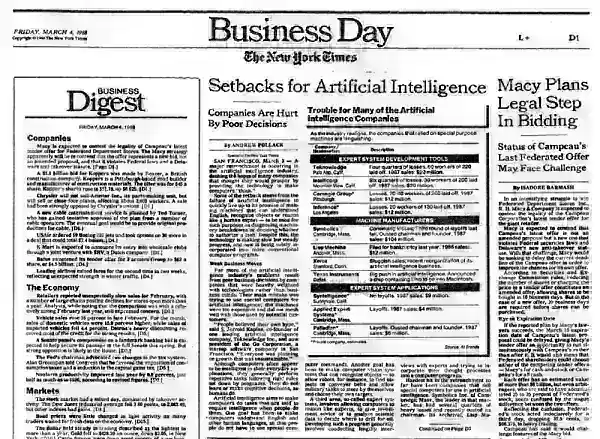
The 1988 AI retrenchment after unmet promises. The New York Times Migration underway
The cognitive migration's early stages reveal stark divisions - some board eagerly while others linger anxiously at the station. Beneath surface calm, workplace unease grows as AI accelerates software development 100-fold, generates client-facing code, and even assists classicists deciphering ancient texts.
Willing participants chart their course, but pressured workers experience unsettling anticipation. This transcends tool adoption - many question whether emerging workplace cultures will accommodate them at all. Delayed engagement risks becoming permanent displacement, leaving even experienced professionals uncertain about their roles.
The reliability paradox
Despite astonishing progress, AI systems remain temperamental - confident yet unaccountable, sophisticated yet forgetful. Chatbots still hallucinate facts and lose conversational threads. Their frozen "intelligence" contrasts with human learning, limited only by expanding context windows.
Global trust surveys reveal stark cultural divides - 72% acceptance in China versus 32% in the U.S. Perfecting recall and reducing hallucinations could boost confidence, but absent meaningful public involvement in AI governance, skepticism persists.
Calculated risks
The industry charges ahead betting current limitations will yield to engineering breakthroughs. The wager assumes productivity gains will outweigh disruption costs, and that expanded access will democratize opportunity rather than concentrate power.
Yet between gamble and dream lies uncertainty - unprecedented transformation speed overwhelms societal adaptation capacity. As cognitive migration accelerates, critical questions remain unanswered about our destination's coordinates and who will find welcome upon arrival.
Gary Grossman is EVP of technology practice at Edelman and global lead of the Edelman AI Center of Excellence.
Related article
 RSI becomes the new AGI, equally elusive to define
The term "recursion" has become the latest catchword in artificial intelligence. Two distinct startups have adopted it as their name, and many others now reference Recursive Self-Improvement (RSI) in their development plans. Much like AGI before it,
OpenAI outlines AI economy with public wealth funds, robot taxes, and four-day week
As governments struggle to manage the economic impact of superintelligent machines, OpenAI has released a set of policy proposals outlining how wealth and work could be reshaped in an "intelligence age." The ideas blend traditional left-leaning mecha
Databricks Co-Founder Claims AGI Arrival After Winning ACM Award
Databricks co-founder and CTO Matei Zaharia nearly overlooked the email informing him he had been awarded the 2026 ACM Prize in Computing. "It was certainly a surprise," he shared with TechCrunch.In 2009, the technology Zaharia developed during his P
Related Special Topic Recommendations
Design & Art
RSI becomes the new AGI, equally elusive to define
The term "recursion" has become the latest catchword in artificial intelligence. Two distinct startups have adopted it as their name, and many others now reference Recursive Self-Improvement (RSI) in their development plans. Much like AGI before it,
OpenAI outlines AI economy with public wealth funds, robot taxes, and four-day week
As governments struggle to manage the economic impact of superintelligent machines, OpenAI has released a set of policy proposals outlining how wealth and work could be reshaped in an "intelligence age." The ideas blend traditional left-leaning mecha
Databricks Co-Founder Claims AGI Arrival After Winning ACM Award
Databricks co-founder and CTO Matei Zaharia nearly overlooked the email informing him he had been awarded the 2026 ACM Prize in Computing. "It was certainly a surprise," he shared with TechCrunch.In 2009, the technology Zaharia developed during his P
Related Special Topic Recommendations
Design & Art
 Top AI Illustration Tools: Create Editorial Scenes and Cover Art Faster
2026 Latest Top-rated AI Illustration Tools: Our curated list features the best powerfully designed tools for creating stunning editorial scenes and eye-catching cover art quickly. Each option has gone through rigorous real-world tests, offering a free vs paid comparison to help you find the perfect match for your workflow. Try these must-try solutions today to unlock your AI edge and boost your creative productivity. Explore now at XIX.AI.
 10 tools
 xix.ai
Education and Learning
Top AI Tutors for Exam Prep: Practice Math, Science, and English
xix.ai
Education and Learning
Top AI Tutors for Exam Prep: Practice Math, Science, and English
2026 Latest Top-Rated Best AI Tutors for Exam Prep are here on XIX.AI! Our curated list features powerful game-changing tools that offer free vs paid comparison, real-world tests, and weekly updated rankings. They help boost your writing efficiency, simplify complex topic learning, and unlock your academic potential. Explore now to Discover your perfect exam prep tool and Start creating today to Unlock your AI edge!
10 tools
xix.ai
Finance
AI Budget Planning Tools for Personal Money Management
2026 Latest Best Top-Rated AI Budget Planning Tools for Personal Money Management are here on XIX.AI! This curated collection features powerful, game-changing solutions that help you conduct real-world tests, understand spending habits, and create personalized plans to boost productivity. Enjoy a free vs paid comparison along with detailed rankings. Must-try tools designed to simplify money management and unlock your AI edge. Explore now!
11 tools
xix.ai
Health & Wellness
AI Sleep Tracking Assistants: Improve Recovery with Better Bedtime Habits
2026 Latest Best Top-Rated AI Sleep Tracking Assistants curated for ultimate recovery. This fully updated weekly guide features powerful tools that deliver real-world tests, free vs paid comparison, and detailed rankings to help you find the must-try solution that boosts sleep quality and supports better bedtime habits. Explore now at XIX.AI to Unlock your AI edge.
10 tools
xix.ai
Data Analysis
AI SQL Copilots for Product and Revenue Analytics
2026 Latest Best Top-Rated AI SQL Copilots for Product and Revenue Analytics! XIX.AI has curated a powerful, game-changing collection of must-try tools that undergo real-world tests through weekly updated rankings. These tools help users boost productivity significantly by accelerating data analysis, streamlining complex queries, and generating accurate insights to drive smarter business decisions. Explore now to Discover your perfect tool for unlocking your AI edge!
14 tools
xix.ai
Education and Learning
Best AI Homework Helpers That Teach: Learn Concepts, Not Just Answers
2026 Latest Best Top-Rated AI Homework Helpers That Teach Core Concepts Not Just Answers Powerful Tools for Students Must-Try Curated List Weekly Updated Free vs Paid Comparison Real-World Tests Accurate Rankings to Help You Unlock Your Full Learning Potential Explore now to Discover your perfect tool for smarter studying.
10 tools
xix.ai

 Comments (3)
0/500
Comments (3)
0/500
![FrankMartínez]()
Interesting perspective, but I wonder if the 'cognitive migration' is just a fancy term for job displacement? 🤔 Seems like the ones hesitating are the ones who'll be left behind.
![LucasWalker]()
AIに仕事を奪われる心配より、適応できるスキルをどう身につけるかが大事だよね。ハーバードの教授も指摘してるけど、変化自体は避けられない。むしろ、新しい役割が生まれる可能性に期待してる!😊 個人的には、教育システムのアップデートが鍵かな?
![DouglasAnderson]()
Na ja, "kognitive Migration" ist aber ein schicker Euphemismus für den Realitätsschock, den viele erleben. In meiner Branche (Marketing) verdrängen KI-Tools jetzt schon Junior-Stellen, während gleichzeitig händeringend nach Leuten gesucht wird, die die KI-Ausgaben überprüfen und steuern können. Das erinnert mich an die Industrialisierung: Es entstehen neue Jobs, aber die Übergangsfrist ist für die Betroffenen oft brutal. Wohin wandern die "Zögernden" eigentlich ab? In den Niedriglohnsektor? Die soziale Abfederung dieses Wandels wird zur Schlüsselfrage. 🧐
The cognitive migration is already in motion. Stations overflow as some eagerly board while others hesitate, questioning if the destination warrants leaving familiar ground.
Harvard professor and future of work expert Christopher Stanton recently noted AI's unprecedented adoption rate, calling it "an extraordinarily fast-diffusing technology." This blistering pace sets the AI revolution apart from past technological shifts like personal computing or the internet. Google DeepMind CEO Demis Hassabis predicts AI's impact could dwarf the Industrial Revolution in both scale and speed.
Human-machine intelligence sharing grows increasingly seamless. Early adopters weave AI into daily workflows, while pioneers fully integrate it into creative processes and professional identities. These willing participants include prompt engineering consultants, system-redesigning product managers, and entrepreneurs leveraging AI across coding, design, and marketing operations.
For them, this new landscape feels navigable and exciting. Yet many remain unsettled, facing not just obsolescence risk but deeper uncertainty about when and how to engage with AI's still-murky future. This dual readiness challenge transforms how people perceive AI's promises and pressures.
Reality check
Across sectors, AI reshapes workflows faster than strategy teams can respond. The ultimate implications remain unclear - is there even an endgame? With breathless predictions about superintelligent machines emerging within years, employees receive urgent adaptation mandates lacking concrete guidance.
Could history repeat itself with another AI winter? Previous downturns emerged from overpromising - 1970s computational limits and late-1980s expert system failures both triggered funding collapses. Today's landscape differs markedly with stronger institutional commitment, consumer adoption and technological infrastructure. If failure comes now, it won't stem from lacking resources but broken trust.
Migration underway
The cognitive migration's early stages reveal stark divisions - some board eagerly while others linger anxiously at the station. Beneath surface calm, workplace unease grows as AI accelerates software development 100-fold, generates client-facing code, and even assists classicists deciphering ancient texts.
Willing participants chart their course, but pressured workers experience unsettling anticipation. This transcends tool adoption - many question whether emerging workplace cultures will accommodate them at all. Delayed engagement risks becoming permanent displacement, leaving even experienced professionals uncertain about their roles.
The reliability paradox
Despite astonishing progress, AI systems remain temperamental - confident yet unaccountable, sophisticated yet forgetful. Chatbots still hallucinate facts and lose conversational threads. Their frozen "intelligence" contrasts with human learning, limited only by expanding context windows.
Global trust surveys reveal stark cultural divides - 72% acceptance in China versus 32% in the U.S. Perfecting recall and reducing hallucinations could boost confidence, but absent meaningful public involvement in AI governance, skepticism persists.
Calculated risks
The industry charges ahead betting current limitations will yield to engineering breakthroughs. The wager assumes productivity gains will outweigh disruption costs, and that expanded access will democratize opportunity rather than concentrate power.
Yet between gamble and dream lies uncertainty - unprecedented transformation speed overwhelms societal adaptation capacity. As cognitive migration accelerates, critical questions remain unanswered about our destination's coordinates and who will find welcome upon arrival.
Gary Grossman is EVP of technology practice at Edelman and global lead of the Edelman AI Center of Excellence.








 RSI becomes the new AGI, equally elusive to define
The term "recursion" has become the latest catchword in artificial intelligence. Two distinct startups have adopted it as their name, and many others now reference Recursive Self-Improvement (RSI) in their development plans. Much like AGI before it,
RSI becomes the new AGI, equally elusive to define
The term "recursion" has become the latest catchword in artificial intelligence. Two distinct startups have adopted it as their name, and many others now reference Recursive Self-Improvement (RSI) in their development plans. Much like AGI before it,
 OpenAI outlines AI economy with public wealth funds, robot taxes, and four-day week
As governments struggle to manage the economic impact of superintelligent machines, OpenAI has released a set of policy proposals outlining how wealth and work could be reshaped in an "intelligence age." The ideas blend traditional left-leaning mecha
OpenAI outlines AI economy with public wealth funds, robot taxes, and four-day week
As governments struggle to manage the economic impact of superintelligent machines, OpenAI has released a set of policy proposals outlining how wealth and work could be reshaped in an "intelligence age." The ideas blend traditional left-leaning mecha
 Databricks Co-Founder Claims AGI Arrival After Winning ACM Award
Databricks co-founder and CTO Matei Zaharia nearly overlooked the email informing him he had been awarded the 2026 ACM Prize in Computing. "It was certainly a surprise," he shared with TechCrunch.In 2009, the technology Zaharia developed during his P
Databricks Co-Founder Claims AGI Arrival After Winning ACM Award
Databricks co-founder and CTO Matei Zaharia nearly overlooked the email informing him he had been awarded the 2026 ACM Prize in Computing. "It was certainly a surprise," he shared with TechCrunch.In 2009, the technology Zaharia developed during his P

2026 Latest Top-rated AI Illustration Tools: Our curated list features the best powerfully designed tools for creating stunning editorial scenes and eye-catching cover art quickly. Each option has gone through rigorous real-world tests, offering a free vs paid comparison to help you find the perfect match for your workflow. Try these must-try solutions today to unlock your AI edge and boost your creative productivity. Explore now at XIX.AI.
10 tools
xix.ai
2026 Latest Top-Rated Best AI Tutors for Exam Prep are here on XIX.AI! Our curated list features powerful game-changing tools that offer free vs paid comparison, real-world tests, and weekly updated rankings. They help boost your writing efficiency, simplify complex topic learning, and unlock your academic potential. Explore now to Discover your perfect exam prep tool and Start creating today to Unlock your AI edge!
10 tools
xix.ai

2026 Latest Best Top-Rated AI Budget Planning Tools for Personal Money Management are here on XIX.AI! This curated collection features powerful, game-changing solutions that help you conduct real-world tests, understand spending habits, and create personalized plans to boost productivity. Enjoy a free vs paid comparison along with detailed rankings. Must-try tools designed to simplify money management and unlock your AI edge. Explore now!
11 tools
xix.ai
2026 Latest Best Top-Rated AI Sleep Tracking Assistants curated for ultimate recovery. This fully updated weekly guide features powerful tools that deliver real-world tests, free vs paid comparison, and detailed rankings to help you find the must-try solution that boosts sleep quality and supports better bedtime habits. Explore now at XIX.AI to Unlock your AI edge.
10 tools
xix.ai

2026 Latest Best Top-Rated AI SQL Copilots for Product and Revenue Analytics! XIX.AI has curated a powerful, game-changing collection of must-try tools that undergo real-world tests through weekly updated rankings. These tools help users boost productivity significantly by accelerating data analysis, streamlining complex queries, and generating accurate insights to drive smarter business decisions. Explore now to Discover your perfect tool for unlocking your AI edge!
14 tools
xix.ai
2026 Latest Best Top-Rated AI Homework Helpers That Teach Core Concepts Not Just Answers Powerful Tools for Students Must-Try Curated List Weekly Updated Free vs Paid Comparison Real-World Tests Accurate Rankings to Help You Unlock Your Full Learning Potential Explore now to Discover your perfect tool for smarter studying.
10 tools
xix.ai

Interesting perspective, but I wonder if the 'cognitive migration' is just a fancy term for job displacement? 🤔 Seems like the ones hesitating are the ones who'll be left behind.
AIに仕事を奪われる心配より、適応できるスキルをどう身につけるかが大事だよね。ハーバードの教授も指摘してるけど、変化自体は避けられない。むしろ、新しい役割が生まれる可能性に期待してる!😊 個人的には、教育システムのアップデートが鍵かな?
Na ja, "kognitive Migration" ist aber ein schicker Euphemismus für den Realitätsschock, den viele erleben. In meiner Branche (Marketing) verdrängen KI-Tools jetzt schon Junior-Stellen, während gleichzeitig händeringend nach Leuten gesucht wird, die die KI-Ausgaben überprüfen und steuern können. Das erinnert mich an die Industrialisierung: Es entstehen neue Jobs, aber die Übergangsfrist ist für die Betroffenen oft brutal. Wohin wandern die "Zögernden" eigentlich ab? In den Niedriglohnsektor? Die soziale Abfederung dieses Wandels wird zur Schlüsselfrage. 🧐












