


 Home
HomeAI Boosts Healthcare and Science
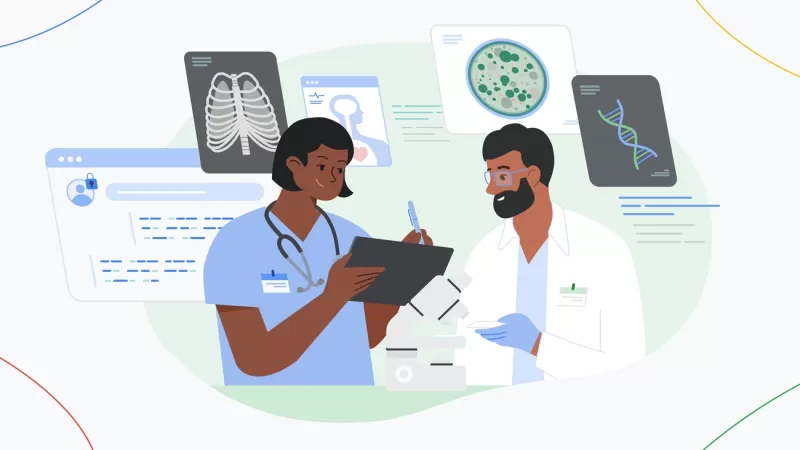
Last week at the Lake Nona Impact Forum, I talked about how AI could revolutionize healthcare and science. With our latest AI advancements, we're on the cusp of making healthcare more accessible, personalized, and effective for everyone, while also speeding up scientific breakthroughs. Here's a rundown of what we've been up to, our collaborations to bring AI into healthcare worldwide, and our newly announced AI co-scientist.
AI is making accurate health information more accessible
When folks need health info, they often turn to Google first. That's why we're committed to making sure everyone can get high-quality, relevant health info when they need it most. With Google Lens, you can snap a pic to search for skin conditions that look like what you're seeing on your own skin. Over on YouTube, we've been testing AI tools with health creators and groups like the Cleveland Clinic to help them put out top-notch, authoritative content more easily.
For healthcare providers, we've rolled out MedLM and Search for Healthcare, which can answer medical queries. These tools are available on the Google Cloud Vertex AI platform, helping doctors make better decisions and ensuring patients get the precise care they need. We're also working hard to make sure the health-related content from our language models is as accurate and fact-based as possible.
Generative AI is paving the way for personalized healthcare
Thanks to progress in multimodality and conversational AI, we're rethinking how we can tailor patient care to each individual, focusing especially on preventive healthcare.
Healthcare is all about different types of data, from X-rays to digital records. Building on our MedLM research, we've created Med-Gemini, a new set of models for healthcare that leverage Gemini's strong multimodal and reasoning skills, fine-tuned with de-identified medical data. In our published research, Med-Gemini scored 91.1% accuracy on U.S. medical exam-style questions, and we've shown how these models can effectively interpret 3D scans or tackle complex clinical questions.
We're also exploring how AI can act as a conversational diagnostic tool in clinics with our Articulate Medical Intelligence Explorer (AMIE). This AI system is designed to take a "clinical history" and ask smart questions to help reach a differential diagnosis, all while handling discussions with empathy, even in specialized fields.
Mobile and wearable tech is another exciting area where generative AI can offer personalized health and wellness insights, using data like step count and heart rate. We've developed the Personal Health Large Language Model, a fine-tuned version of Gemini, which can analyze sensor data to provide insights and recommendations on an individual's sleep and fitness patterns.
AI is improving health outcomes globally
Catching diseases early can make a huge difference in health outcomes. Over the last ten years, we've harnessed AI's imaging and diagnostic powers to develop models that help detect diseases like breast cancer, lung cancer, and diabetic retinopathy. Through partnerships, we're now scaling these solutions in clinical settings, helping more patients get timely and accurate screenings. This is especially impactful in areas with limited medical resources and fewer specialists. In the coming decade, our partners in India and Thailand plan to provide 6 million free diabetic retinopathy screenings, while Apollo Radiology International will use our AI models to offer 3 million free screenings for tuberculosis, lung cancer, and breast cancer in India. We're also working on maternal health in Africa, developing an ML model for cardiotocography to predict fetal well-being, and looking at how it can be used in resource-limited settings.
We're also building the tech foundations to make healthcare more accessible. Our Health AI Developer Foundations include open-weight models and resources to help developers build AI models for healthcare more efficiently. Solutions powered by our Open Health Stack (OHS) — a set of open-source tools that make it easier for developers to create next-gen digital health solutions — are already being used in Africa, South Asia, and Southeast Asia to support millions of patients.
AI is accelerating scientific discovery
Healthcare is built on science, and AI's knack for synthesizing information and performing complex reasoning tasks is helping us explore new ways to boost scientific and biomedical discovery. Our AI co-scientist, a multi-agent system based on Gemini 2.0, is designed to be a collaborative tool for scientists. It aims to uncover new knowledge, help formulate novel research hypotheses and proposals based on existing evidence, and tailor them to specific research goals. It's already shown promise in areas like drug repurposing for acute myeloid leukemia, suggesting new treatment targets for liver fibrosis, and explaining mechanisms of horizontal gene transfer related to antimicrobial resistance — each a complex challenge in its own right.
We're seeing the huge potential of AI to push forward science and make healthcare more personalized and accessible. The cycle of turning research breakthroughs into real-world impact is speeding up and growing wider. We're committed to doing this responsibly, working with global partners, and sharing our research — in 2024 alone, we published over 50 papers on cutting-edge health research, and we've just released our 2025 Health Impact Report. We believe AI will keep advancing healthcare and science, benefiting billions of people.
Related article
 Stripe to Acquire OpenRouter as AI Model Routing Gains Momentum
Stripe has agreed to acquire OpenRouter, an AI model-routing platform that gives developers access to hundreds of models through a single interface. The deal adds model selection and routing to Stripe’s existing work around AI usage and token-based b
Google AI Overviews Gain Ground in Search Results
According to Similarweb’s 2026 Generative AI Landscape report, Google’s AI-generated summaries appeared in 43% of US searches, a significant rise from 15% recorded a year prior.While AI Overviews present generated summaries within standard search res
Sequoia-backed Empirik raises $21M to forecast outages before they strike
Before joining Sequoia Capital in 2020 as chief digital and information officer, Avon Puri spent over a decade running infrastructure at Rubrik and VMware. Three years ago, as large language models began showing their true potential, Puri, alongside
Related Special Topic Recommendations
Design & Art
Stripe to Acquire OpenRouter as AI Model Routing Gains Momentum
Stripe has agreed to acquire OpenRouter, an AI model-routing platform that gives developers access to hundreds of models through a single interface. The deal adds model selection and routing to Stripe’s existing work around AI usage and token-based b
Google AI Overviews Gain Ground in Search Results
According to Similarweb’s 2026 Generative AI Landscape report, Google’s AI-generated summaries appeared in 43% of US searches, a significant rise from 15% recorded a year prior.While AI Overviews present generated summaries within standard search res
Sequoia-backed Empirik raises $21M to forecast outages before they strike
Before joining Sequoia Capital in 2020 as chief digital and information officer, Avon Puri spent over a decade running infrastructure at Rubrik and VMware. Three years ago, as large language models began showing their true potential, Puri, alongside
Related Special Topic Recommendations
Design & Art
 Top AI Illustration Tools: Create Editorial Scenes and Cover Art Faster
2026 Latest Top-rated AI Illustration Tools: Our curated list features the best powerfully designed tools for creating stunning editorial scenes and eye-catching cover art quickly. Each option has gone through rigorous real-world tests, offering a free vs paid comparison to help you find the perfect match for your workflow. Try these must-try solutions today to unlock your AI edge and boost your creative productivity. Explore now at XIX.AI.
 10 tools
 xix.ai
Education and Learning
Top AI Tutors for Exam Prep: Practice Math, Science, and English
xix.ai
Education and Learning
Top AI Tutors for Exam Prep: Practice Math, Science, and English
2026 Latest Top-Rated Best AI Tutors for Exam Prep are here on XIX.AI! Our curated list features powerful game-changing tools that offer free vs paid comparison, real-world tests, and weekly updated rankings. They help boost your writing efficiency, simplify complex topic learning, and unlock your academic potential. Explore now to Discover your perfect exam prep tool and Start creating today to Unlock your AI edge!
10 tools
xix.ai
Finance
AI Budget Planning Tools for Personal Money Management
2026 Latest Best Top-Rated AI Budget Planning Tools for Personal Money Management are here on XIX.AI! This curated collection features powerful, game-changing solutions that help you conduct real-world tests, understand spending habits, and create personalized plans to boost productivity. Enjoy a free vs paid comparison along with detailed rankings. Must-try tools designed to simplify money management and unlock your AI edge. Explore now!
11 tools
xix.ai
Health & Wellness
AI Sleep Tracking Assistants: Improve Recovery with Better Bedtime Habits
2026 Latest Best Top-Rated AI Sleep Tracking Assistants curated for ultimate recovery. This fully updated weekly guide features powerful tools that deliver real-world tests, free vs paid comparison, and detailed rankings to help you find the must-try solution that boosts sleep quality and supports better bedtime habits. Explore now at XIX.AI to Unlock your AI edge.
10 tools
xix.ai
Data Analysis
AI SQL Copilots for Product and Revenue Analytics
2026 Latest Best Top-Rated AI SQL Copilots for Product and Revenue Analytics! XIX.AI has curated a powerful, game-changing collection of must-try tools that undergo real-world tests through weekly updated rankings. These tools help users boost productivity significantly by accelerating data analysis, streamlining complex queries, and generating accurate insights to drive smarter business decisions. Explore now to Discover your perfect tool for unlocking your AI edge!
14 tools
xix.ai
Education and Learning
Best AI Homework Helpers That Teach: Learn Concepts, Not Just Answers
2026 Latest Best Top-Rated AI Homework Helpers That Teach Core Concepts Not Just Answers Powerful Tools for Students Must-Try Curated List Weekly Updated Free vs Paid Comparison Real-World Tests Accurate Rankings to Help You Unlock Your Full Learning Potential Explore now to Discover your perfect tool for smarter studying.
10 tools
xix.ai

 Comments (59)
0/500
Comments (59)
0/500
![KevinBrown]()
Ces avancées en IA pour la santé sont prometteuses, mais j'espère que l'aspect éthique et l'accessibilité financière ne seront pas oubliés en chemin... Parfois, je me demande si ces technologies resteront réservées à une élite. 😅
![WillieMiller]()
Этот пост о внедрении ИИ в здравоохранение интересен, но вызывает некоторые размышления. Как насчёт защиты данных пациентов? 🤔 Кажется, что технологический прогресс часто обгоняет этические нормы. Не могли бы вы рассказать поподробнее о безопасности?
![FrankMartínez]()
AI in healthcare sounds like a game-changer! Can't wait to see how it makes treatments more tailored. But, is it just me, or does anyone else worry about data privacy with all this tech? 😅
![EdwardYoung]()
AI in healthcare sounds like a game-changer! Can't wait to see how it makes treatments more tailored. But, gotta ask, will it make doctor visits less of a hassle? 🩺
![PaulThomas]()
AI Boosts Healthcare and Science действительно революционен! Идея персонализированной медицины и ускоренных научных прорывов звучит как сон, ставший реальностью. Не могу дождаться, чтобы увидеть, как это изменит нашу жизнь! 🚀
![WillMartinez]()
AI in healthcare and science? Count me in! This tool shows how AI can make a real difference, but sometimes it feels a bit too optimistic. Still, it's exciting to see where this could go! 🚀
Last week at the Lake Nona Impact Forum, I talked about how AI could revolutionize healthcare and science. With our latest AI advancements, we're on the cusp of making healthcare more accessible, personalized, and effective for everyone, while also speeding up scientific breakthroughs. Here's a rundown of what we've been up to, our collaborations to bring AI into healthcare worldwide, and our newly announced AI co-scientist.
AI is making accurate health information more accessible
When folks need health info, they often turn to Google first. That's why we're committed to making sure everyone can get high-quality, relevant health info when they need it most. With Google Lens, you can snap a pic to search for skin conditions that look like what you're seeing on your own skin. Over on YouTube, we've been testing AI tools with health creators and groups like the Cleveland Clinic to help them put out top-notch, authoritative content more easily.
For healthcare providers, we've rolled out MedLM and Search for Healthcare, which can answer medical queries. These tools are available on the Google Cloud Vertex AI platform, helping doctors make better decisions and ensuring patients get the precise care they need. We're also working hard to make sure the health-related content from our language models is as accurate and fact-based as possible.
Generative AI is paving the way for personalized healthcare
Thanks to progress in multimodality and conversational AI, we're rethinking how we can tailor patient care to each individual, focusing especially on preventive healthcare.
Healthcare is all about different types of data, from X-rays to digital records. Building on our MedLM research, we've created Med-Gemini, a new set of models for healthcare that leverage Gemini's strong multimodal and reasoning skills, fine-tuned with de-identified medical data. In our published research, Med-Gemini scored 91.1% accuracy on U.S. medical exam-style questions, and we've shown how these models can effectively interpret 3D scans or tackle complex clinical questions.
We're also exploring how AI can act as a conversational diagnostic tool in clinics with our Articulate Medical Intelligence Explorer (AMIE). This AI system is designed to take a "clinical history" and ask smart questions to help reach a differential diagnosis, all while handling discussions with empathy, even in specialized fields.
Mobile and wearable tech is another exciting area where generative AI can offer personalized health and wellness insights, using data like step count and heart rate. We've developed the Personal Health Large Language Model, a fine-tuned version of Gemini, which can analyze sensor data to provide insights and recommendations on an individual's sleep and fitness patterns.
AI is improving health outcomes globally
Catching diseases early can make a huge difference in health outcomes. Over the last ten years, we've harnessed AI's imaging and diagnostic powers to develop models that help detect diseases like breast cancer, lung cancer, and diabetic retinopathy. Through partnerships, we're now scaling these solutions in clinical settings, helping more patients get timely and accurate screenings. This is especially impactful in areas with limited medical resources and fewer specialists. In the coming decade, our partners in India and Thailand plan to provide 6 million free diabetic retinopathy screenings, while Apollo Radiology International will use our AI models to offer 3 million free screenings for tuberculosis, lung cancer, and breast cancer in India. We're also working on maternal health in Africa, developing an ML model for cardiotocography to predict fetal well-being, and looking at how it can be used in resource-limited settings.
We're also building the tech foundations to make healthcare more accessible. Our Health AI Developer Foundations include open-weight models and resources to help developers build AI models for healthcare more efficiently. Solutions powered by our Open Health Stack (OHS) — a set of open-source tools that make it easier for developers to create next-gen digital health solutions — are already being used in Africa, South Asia, and Southeast Asia to support millions of patients.
AI is accelerating scientific discovery
Healthcare is built on science, and AI's knack for synthesizing information and performing complex reasoning tasks is helping us explore new ways to boost scientific and biomedical discovery. Our AI co-scientist, a multi-agent system based on Gemini 2.0, is designed to be a collaborative tool for scientists. It aims to uncover new knowledge, help formulate novel research hypotheses and proposals based on existing evidence, and tailor them to specific research goals. It's already shown promise in areas like drug repurposing for acute myeloid leukemia, suggesting new treatment targets for liver fibrosis, and explaining mechanisms of horizontal gene transfer related to antimicrobial resistance — each a complex challenge in its own right.
We're seeing the huge potential of AI to push forward science and make healthcare more personalized and accessible. The cycle of turning research breakthroughs into real-world impact is speeding up and growing wider. We're committed to doing this responsibly, working with global partners, and sharing our research — in 2024 alone, we published over 50 papers on cutting-edge health research, and we've just released our 2025 Health Impact Report. We believe AI will keep advancing healthcare and science, benefiting billions of people.








 Stripe to Acquire OpenRouter as AI Model Routing Gains Momentum
Stripe has agreed to acquire OpenRouter, an AI model-routing platform that gives developers access to hundreds of models through a single interface. The deal adds model selection and routing to Stripe’s existing work around AI usage and token-based b
Stripe to Acquire OpenRouter as AI Model Routing Gains Momentum
Stripe has agreed to acquire OpenRouter, an AI model-routing platform that gives developers access to hundreds of models through a single interface. The deal adds model selection and routing to Stripe’s existing work around AI usage and token-based b
 Google AI Overviews Gain Ground in Search Results
According to Similarweb’s 2026 Generative AI Landscape report, Google’s AI-generated summaries appeared in 43% of US searches, a significant rise from 15% recorded a year prior.While AI Overviews present generated summaries within standard search res
Google AI Overviews Gain Ground in Search Results
According to Similarweb’s 2026 Generative AI Landscape report, Google’s AI-generated summaries appeared in 43% of US searches, a significant rise from 15% recorded a year prior.While AI Overviews present generated summaries within standard search res
 Sequoia-backed Empirik raises $21M to forecast outages before they strike
Before joining Sequoia Capital in 2020 as chief digital and information officer, Avon Puri spent over a decade running infrastructure at Rubrik and VMware. Three years ago, as large language models began showing their true potential, Puri, alongside
Sequoia-backed Empirik raises $21M to forecast outages before they strike
Before joining Sequoia Capital in 2020 as chief digital and information officer, Avon Puri spent over a decade running infrastructure at Rubrik and VMware. Three years ago, as large language models began showing their true potential, Puri, alongside

2026 Latest Top-rated AI Illustration Tools: Our curated list features the best powerfully designed tools for creating stunning editorial scenes and eye-catching cover art quickly. Each option has gone through rigorous real-world tests, offering a free vs paid comparison to help you find the perfect match for your workflow. Try these must-try solutions today to unlock your AI edge and boost your creative productivity. Explore now at XIX.AI.
10 tools
xix.ai

2026 Latest Top-Rated Best AI Tutors for Exam Prep are here on XIX.AI! Our curated list features powerful game-changing tools that offer free vs paid comparison, real-world tests, and weekly updated rankings. They help boost your writing efficiency, simplify complex topic learning, and unlock your academic potential. Explore now to Discover your perfect exam prep tool and Start creating today to Unlock your AI edge!
10 tools
xix.ai

2026 Latest Best Top-Rated AI Budget Planning Tools for Personal Money Management are here on XIX.AI! This curated collection features powerful, game-changing solutions that help you conduct real-world tests, understand spending habits, and create personalized plans to boost productivity. Enjoy a free vs paid comparison along with detailed rankings. Must-try tools designed to simplify money management and unlock your AI edge. Explore now!
11 tools
xix.ai

2026 Latest Best Top-Rated AI Sleep Tracking Assistants curated for ultimate recovery. This fully updated weekly guide features powerful tools that deliver real-world tests, free vs paid comparison, and detailed rankings to help you find the must-try solution that boosts sleep quality and supports better bedtime habits. Explore now at XIX.AI to Unlock your AI edge.
10 tools
xix.ai

2026 Latest Best Top-Rated AI SQL Copilots for Product and Revenue Analytics! XIX.AI has curated a powerful, game-changing collection of must-try tools that undergo real-world tests through weekly updated rankings. These tools help users boost productivity significantly by accelerating data analysis, streamlining complex queries, and generating accurate insights to drive smarter business decisions. Explore now to Discover your perfect tool for unlocking your AI edge!
14 tools
xix.ai

2026 Latest Best Top-Rated AI Homework Helpers That Teach Core Concepts Not Just Answers Powerful Tools for Students Must-Try Curated List Weekly Updated Free vs Paid Comparison Real-World Tests Accurate Rankings to Help You Unlock Your Full Learning Potential Explore now to Discover your perfect tool for smarter studying.
10 tools
xix.ai

Ces avancées en IA pour la santé sont prometteuses, mais j'espère que l'aspect éthique et l'accessibilité financière ne seront pas oubliés en chemin... Parfois, je me demande si ces technologies resteront réservées à une élite. 😅
Этот пост о внедрении ИИ в здравоохранение интересен, но вызывает некоторые размышления. Как насчёт защиты данных пациентов? 🤔 Кажется, что технологический прогресс часто обгоняет этические нормы. Не могли бы вы рассказать поподробнее о безопасности?
AI in healthcare sounds like a game-changer! Can't wait to see how it makes treatments more tailored. But, is it just me, or does anyone else worry about data privacy with all this tech? 😅
AI in healthcare sounds like a game-changer! Can't wait to see how it makes treatments more tailored. But, gotta ask, will it make doctor visits less of a hassle? 🩺
AI Boosts Healthcare and Science действительно революционен! Идея персонализированной медицины и ускоренных научных прорывов звучит как сон, ставший реальностью. Не могу дождаться, чтобы увидеть, как это изменит нашу жизнь! 🚀
AI in healthcare and science? Count me in! This tool shows how AI can make a real difference, but sometimes it feels a bit too optimistic. Still, it's exciting to see where this could go! 🚀












