


 Home
HomeXiaomi Miloco 2.0: Open-Source AI That Makes Homes Remember, Recognize People, and Act
Xiaomi has officially released and open-sourced its forward-looking "All-Household Smart AI Open Source Solution" — Xiaomi Miloco 2.0. Built on Xiaomi's proprietary MiMo large model, the solution is integrated into the OpenClaw framework as an Agent, delivering a comprehensive upgrade across interaction methods, product features, and memory systems.
Unlike the first-generation Miloco, version 2.0 has undergone a fundamental reconstruction of its underlying logic, evolving from traditional rule-based triggers into a family smart agent with autonomous reasoning capabilities. This marks a true entry into a new stage of proactive intelligence, defined by "memory, recognition, and execution." The code is fully open-sourced on GitHub.
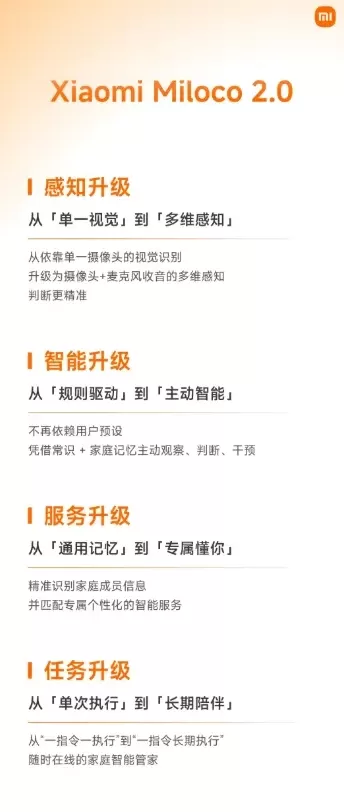
Four Core Capabilities That Redefine Home Intelligence
Miloco 2.0 introduces four core capabilities: general common sense, identity recognition, family memory, and family tasks. Without any pre-set rules, the system can automatically detect potential hazards and issue tiered alerts — for example, reminding when children are playing with knives or when an elderly person falls. Additionally, it integrates facial and posture data, enabling the large model to identify family members, automatically register new members, and deliver personalized interactions.
The family memory function gathers long-term habits and preferences from daily interactions, providing a reference for the Agent's decision-making. Stable habits can be upgraded into automated family tasks, moving beyond simple conditional triggers like "turn on the lights when someone enters" to more complex scenarios such as scheduled medication reminders and daily exercise tracking — tasks the Agent can complete autonomously after understanding the intent.
Proactive Intelligence Brings a Butler into Your Home
Building on these four capabilities, Miloco 2.0 delivers "proactive intelligence" — the system behaves like a butler who is knowledgeable, family-aware, and good at planning, completing tasks before users even issue a command. In a demonstration scenario, when the male owner comes home later than usual, the system infers he may have worked overtime, and the Xiaoai speaker automatically plays a caring voice message: "It's tiring working late, make sure to rest early."
For deployment, the solution requires at least 4GB of memory and 256GB of storage. A Mac mini running 24/7 is recommended, and both macOS and Linux are supported. Windows users need to run it through WSL. You'll also need a Xiaomi account, devices already connected to Mi Home, and a multimodal large model API key. The official recommendation is to use the MiMo-v2.5 series model. Additionally, the accompanying Web home panel lets you view the home overview, device status, family member profiles, and historical event logs in real time, giving you full control over the entire smart home system.
Related article
 DeepMind CEO Hassabis: I sleep six hours a day, usually feel energetic around 1 a.m.
Fortune recently featured an interview with Demis Hassabis, CEO of Google DeepMind, revealing his unconventional approach to rest and productivity. Hassabis disclosed that he sleeps very little, structuring his waking hours into two distinct work blo
OpenAI, Anthropic Vie for Market Share Despite Revenue Shortfalls
Despite recent reports suggesting OpenAI missed revenue targets, creating pressure on tech stocks this Tuesday, private AI lab investors remain resilient. Seasoned backers have confirmed they will not reduce investment despite negative media coverage
California AV Compliance: A New Era of Tickets, Geofences, and 1M Miles
Guident operates an AuveTech shuttle in South Florida, managing a four-mile route in West Palm Beach and a one-mile route in Boca Raton using its remote monitoring technology. | Credit: GuidentCalifornia is redefining the regulatory landscape for dri
Related Special Topic Recommendations
writing
DeepMind CEO Hassabis: I sleep six hours a day, usually feel energetic around 1 a.m.
Fortune recently featured an interview with Demis Hassabis, CEO of Google DeepMind, revealing his unconventional approach to rest and productivity. Hassabis disclosed that he sleeps very little, structuring his waking hours into two distinct work blo
OpenAI, Anthropic Vie for Market Share Despite Revenue Shortfalls
Despite recent reports suggesting OpenAI missed revenue targets, creating pressure on tech stocks this Tuesday, private AI lab investors remain resilient. Seasoned backers have confirmed they will not reduce investment despite negative media coverage
California AV Compliance: A New Era of Tickets, Geofences, and 1M Miles
Guident operates an AuveTech shuttle in South Florida, managing a four-mile route in West Palm Beach and a one-mile route in Boca Raton using its remote monitoring technology. | Credit: GuidentCalifornia is redefining the regulatory landscape for dri
Related Special Topic Recommendations
writing
 AI Article Outline Tools for Long Form Writing
2026 Latest Best Top-Rated AI Article Outline Tools for Long Form Writing! This curated collection features powerful, game-changing tools that deliver accurate, structured outlines with real-world tests to boost writing efficiency significantly. XIX.AI is part of this elite selection. Get a free vs paid comparison to help you choose the perfect tool. Explore now and Unlock your AI edge!
 9 tools
 xix.ai
chatbot
Best AI Roleplay Chat Apps for Language Practice, Interview Prep, and Daily Fluency
xix.ai
chatbot
Best AI Roleplay Chat Apps for Language Practice, Interview Prep, and Daily Fluency
2026 Latest Best Top-rated AI Roleplay Chat Apps for Language Practice, Interview Prep, and Daily Fluency! XIX.AI curates a powerful game-changing collection that offers free vs paid comparison, real-world tests, and updated rankings weekly. These must-try tools help you boost writing skills, overcome fluency challenges, and improve communication efficiency across all daily scenarios. Explore now to discover your perfect tool for language growth!
10 tools
xix.ai
Music composition
AI Stem Separation Tools for Remix Production, Sampling Prep, and Karaoke Masters
2026 Latest Best Top-rated AI Stem Separation Tools Curated for Remix Production, Sampling Prep, and Karaoke Masters. These powerful game-changing tools offer real-world tests to deliver precise audio isolation, boosting productivity significantly. XIX.AI provides a weekly updated free vs paid comparison guide to help you find the must-try solution that suits your needs. Explore now to unlock your AI edge.
8 tools
xix.ai
Data Analysis
AI SQL Copilots for Revenue Dashboards, Funnel Analysis, and Product Metrics
2026 Latest Best AI SQL Copilots Ranked Top-Rated! XIX.AI curates a powerful game-changing collection for weekly updated real-world tests. These must-try tools help you generate accurate revenue dashboards, analyze sales funnels, and track product metrics swiftly, boosting productivity massively. Explore now to Discover your perfect tool for data-driven decision making! 238 characters
9 tools
xix.ai
Music composition
Best AI Melody Writing Tools for Song Drafts
2026 Latest Best Top-Rated AI Melody Writing Tools for Song Drafts! XIX.AI has curated a highly powerful game-changing collection that goes through rigorous real-world tests to deliver the best writing experience. You can find detailed free vs paid comparisons, accurate rankings, and must-try options designed to help you create stunning song drafts effortlessly and boost your creative productivity significantly. Explore now to discover your perfect tool!
8 tools
xix.ai
chatbot
Best AI Conversation Trainer Tools for Interview Practice
2026 Latest Best Top-rated AI Conversation Trainer Tools for Interview Practice are here on XIX.AI! This curated collection features powerful, game-changing tools that go through rigorous real-world tests to deliver accurate feedback. You’ll find a free vs paid comparison and detailed rankings to help you choose the must-try option that boosts your confidence and skills. Explore now to Discover your perfect tool for interview success!
12 tools
xix.ai

 Comments (0)
0/500
Comments (0)
0/500
Xiaomi has officially released and open-sourced its forward-looking "All-Household Smart AI Open Source Solution" — Xiaomi Miloco 2.0. Built on Xiaomi's proprietary MiMo large model, the solution is integrated into the OpenClaw framework as an Agent, delivering a comprehensive upgrade across interaction methods, product features, and memory systems.
Unlike the first-generation Miloco, version 2.0 has undergone a fundamental reconstruction of its underlying logic, evolving from traditional rule-based triggers into a family smart agent with autonomous reasoning capabilities. This marks a true entry into a new stage of proactive intelligence, defined by "memory, recognition, and execution." The code is fully open-sourced on GitHub.
Four Core Capabilities That Redefine Home Intelligence
Miloco 2.0 introduces four core capabilities: general common sense, identity recognition, family memory, and family tasks. Without any pre-set rules, the system can automatically detect potential hazards and issue tiered alerts — for example, reminding when children are playing with knives or when an elderly person falls. Additionally, it integrates facial and posture data, enabling the large model to identify family members, automatically register new members, and deliver personalized interactions.
The family memory function gathers long-term habits and preferences from daily interactions, providing a reference for the Agent's decision-making. Stable habits can be upgraded into automated family tasks, moving beyond simple conditional triggers like "turn on the lights when someone enters" to more complex scenarios such as scheduled medication reminders and daily exercise tracking — tasks the Agent can complete autonomously after understanding the intent.
Proactive Intelligence Brings a Butler into Your Home
Building on these four capabilities, Miloco 2.0 delivers "proactive intelligence" — the system behaves like a butler who is knowledgeable, family-aware, and good at planning, completing tasks before users even issue a command. In a demonstration scenario, when the male owner comes home later than usual, the system infers he may have worked overtime, and the Xiaoai speaker automatically plays a caring voice message: "It's tiring working late, make sure to rest early."
For deployment, the solution requires at least 4GB of memory and 256GB of storage. A Mac mini running 24/7 is recommended, and both macOS and Linux are supported. Windows users need to run it through WSL. You'll also need a Xiaomi account, devices already connected to Mi Home, and a multimodal large model API key. The official recommendation is to use the MiMo-v2.5 series model. Additionally, the accompanying Web home panel lets you view the home overview, device status, family member profiles, and historical event logs in real time, giving you full control over the entire smart home system.








 DeepMind CEO Hassabis: I sleep six hours a day, usually feel energetic around 1 a.m.
Fortune recently featured an interview with Demis Hassabis, CEO of Google DeepMind, revealing his unconventional approach to rest and productivity. Hassabis disclosed that he sleeps very little, structuring his waking hours into two distinct work blo
DeepMind CEO Hassabis: I sleep six hours a day, usually feel energetic around 1 a.m.
Fortune recently featured an interview with Demis Hassabis, CEO of Google DeepMind, revealing his unconventional approach to rest and productivity. Hassabis disclosed that he sleeps very little, structuring his waking hours into two distinct work blo
 OpenAI, Anthropic Vie for Market Share Despite Revenue Shortfalls
Despite recent reports suggesting OpenAI missed revenue targets, creating pressure on tech stocks this Tuesday, private AI lab investors remain resilient. Seasoned backers have confirmed they will not reduce investment despite negative media coverage
California AV Compliance: A New Era of Tickets, Geofences, and 1M Miles
Guident operates an AuveTech shuttle in South Florida, managing a four-mile route in West Palm Beach and a one-mile route in Boca Raton using its remote monitoring technology. | Credit: GuidentCalifornia is redefining the regulatory landscape for dri
OpenAI, Anthropic Vie for Market Share Despite Revenue Shortfalls
Despite recent reports suggesting OpenAI missed revenue targets, creating pressure on tech stocks this Tuesday, private AI lab investors remain resilient. Seasoned backers have confirmed they will not reduce investment despite negative media coverage
California AV Compliance: A New Era of Tickets, Geofences, and 1M Miles
Guident operates an AuveTech shuttle in South Florida, managing a four-mile route in West Palm Beach and a one-mile route in Boca Raton using its remote monitoring technology. | Credit: GuidentCalifornia is redefining the regulatory landscape for dri

2026 Latest Best Top-Rated AI Article Outline Tools for Long Form Writing! This curated collection features powerful, game-changing tools that deliver accurate, structured outlines with real-world tests to boost writing efficiency significantly. XIX.AI is part of this elite selection. Get a free vs paid comparison to help you choose the perfect tool. Explore now and Unlock your AI edge!
9 tools
xix.ai

2026 Latest Best Top-rated AI Roleplay Chat Apps for Language Practice, Interview Prep, and Daily Fluency! XIX.AI curates a powerful game-changing collection that offers free vs paid comparison, real-world tests, and updated rankings weekly. These must-try tools help you boost writing skills, overcome fluency challenges, and improve communication efficiency across all daily scenarios. Explore now to discover your perfect tool for language growth!
10 tools
xix.ai

2026 Latest Best Top-rated AI Stem Separation Tools Curated for Remix Production, Sampling Prep, and Karaoke Masters. These powerful game-changing tools offer real-world tests to deliver precise audio isolation, boosting productivity significantly. XIX.AI provides a weekly updated free vs paid comparison guide to help you find the must-try solution that suits your needs. Explore now to unlock your AI edge.
8 tools
xix.ai

2026 Latest Best AI SQL Copilots Ranked Top-Rated! XIX.AI curates a powerful game-changing collection for weekly updated real-world tests. These must-try tools help you generate accurate revenue dashboards, analyze sales funnels, and track product metrics swiftly, boosting productivity massively. Explore now to Discover your perfect tool for data-driven decision making! 238 characters
9 tools
xix.ai

2026 Latest Best Top-Rated AI Melody Writing Tools for Song Drafts! XIX.AI has curated a highly powerful game-changing collection that goes through rigorous real-world tests to deliver the best writing experience. You can find detailed free vs paid comparisons, accurate rankings, and must-try options designed to help you create stunning song drafts effortlessly and boost your creative productivity significantly. Explore now to discover your perfect tool!
8 tools
xix.ai

2026 Latest Best Top-rated AI Conversation Trainer Tools for Interview Practice are here on XIX.AI! This curated collection features powerful, game-changing tools that go through rigorous real-world tests to deliver accurate feedback. You’ll find a free vs paid comparison and detailed rankings to help you choose the must-try option that boosts your confidence and skills. Explore now to Discover your perfect tool for interview success!
12 tools
xix.ai












