


 Home
HomeTmall Unveils MAOSS AI Model for Fatty Liver Disease Screening
Alibaba DAMO Academy has announced the joint development of an AI model for fatty liver screening, named MAOSS, in collaboration with several institutions including Shengjing Hospital of China Medical University and Nanjing University's Gulou Hospital. The study's findings were published in the prestigious international journal, Nature Communications, in February of this year.
Fatty liver disease affects over 30% of the population. Early symptoms are often mild and easily overlooked, allowing the condition to progress to liver fibrosis or cirrhosis. Traditional screening methods like B-ultrasound have limited sensitivity, while more specialized examinations are expensive. This frequently results in missed diagnoses for high-risk patients in clinical settings.
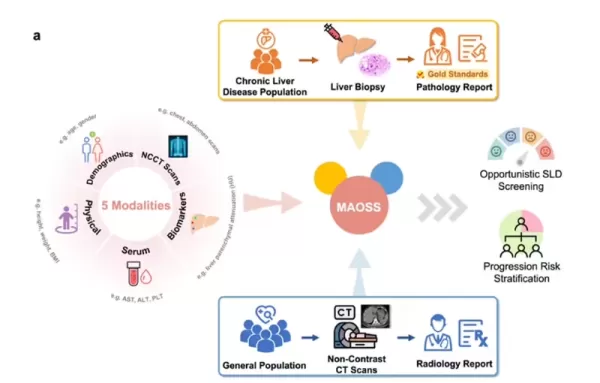
Key breakthroughs and advantages of the MAOSS model:
Deep analysis of non-contrast CT scans: DAMO Academy employed "non-contrast CT + AI" technology, enabling the AI to automatically extract high-dimensional features such as liver texture and density. This marks the first time liver steatosis and fibrosis staging can be assessed simultaneously using only a standard non-contrast CT scan.
Diagnostic accuracy exceeding physicians: In multi-center validation trials, the MAOSS model achieved an area under the curve (AUC) of 0.904-0.917 for liver steatosis staging, significantly higher than the average radiologist score of 0.709.
Doubled detection rate for high-risk cases: For the critical window to prevent cirrhosis (stage 2 fibrosis), the model identified 52.4% of high-risk patients, compared to a mere 16.6% detected through traditional clinical pathways—more than doubling the detection rate.
Early warning for cirrhosis risk: Follow-up data indicates that patients flagged as high-risk by MAOSS had a 45.5% probability of developing cirrhosis within two years, a rate far exceeding that of the low-risk group.
Experts from DAMO Academy noted that the model can leverage existing non-contrast CT data from routine physical exams and outpatient visits. This facilitates "front-end prevention" in chronic liver disease management without incurring additional patient costs. In the future, primary care hospitals could use this AI technology to provide high-risk warnings during standard health screenings, enabling earlier detection and potential reversal of the condition.
Related article
 Indian Tech Tycoon Invests $30M in AI Rival to Microsoft Office
Serial entrepreneur Bhavin Turakhia is investing $30 million of his own capital, betting that the enterprise AI sector still has room for new players. His latest startup, Neo, operates on a core belief: legacy workplace software cannot simply be patc
Former OpenAI Chief Scientist Ilya’s SSI Unveils First Model
AI has achieved another major milestone. Following his departure from OpenAI, former chief scientist Ilya Sutskever established Safe Superintelligence Inc. (SSI), which has recently unveiled details regarding its inaugural model. Reports from oversea
Lovable Leads Atech's Seed Round as AI Ambient Coding Officially Enters the Hardware Field
On May 14, 2026, AI application development platform Lovable announced its participation in the $800,000 seed funding round for Danish hardware startup Atech. Led by Lovable, the round attracted top-tier venture capital firms including the a16z Scout
Related Special Topic Recommendations
chatbot
Indian Tech Tycoon Invests $30M in AI Rival to Microsoft Office
Serial entrepreneur Bhavin Turakhia is investing $30 million of his own capital, betting that the enterprise AI sector still has room for new players. His latest startup, Neo, operates on a core belief: legacy workplace software cannot simply be patc
Former OpenAI Chief Scientist Ilya’s SSI Unveils First Model
AI has achieved another major milestone. Following his departure from OpenAI, former chief scientist Ilya Sutskever established Safe Superintelligence Inc. (SSI), which has recently unveiled details regarding its inaugural model. Reports from oversea
Lovable Leads Atech's Seed Round as AI Ambient Coding Officially Enters the Hardware Field
On May 14, 2026, AI application development platform Lovable announced its participation in the $800,000 seed funding round for Danish hardware startup Atech. Led by Lovable, the round attracted top-tier venture capital firms including the a16z Scout
Related Special Topic Recommendations
chatbot
 Best AI Conversation Trainer Tools for Interview Practice
2026 Latest Best Top-rated AI Conversation Trainer Tools for Interview Practice are here on XIX.AI! This curated collection features powerful, game-changing tools that go through rigorous real-world tests to deliver accurate feedback. You’ll find a free vs paid comparison and detailed rankings to help you choose the must-try option that boosts your confidence and skills. Explore now to Discover your perfect tool for interview success!
 12 tools
 xix.ai
Design & Art
Best AI Style Transfer Tools for Creative Experiments
xix.ai
Design & Art
Best AI Style Transfer Tools for Creative Experiments
2026 Latest Best Top-rated AI Style Transfer Tools for Creative Experiments! XIX.AI has curated a powerful, game-changing collection of must-try tools that deliver exceptional results through real-world tests and rigorous rankings. These top solutions help creatives boost productivity significantly by accelerating content creation and unlocking endless creative possibilities. Explore now to discover your perfect tool and start creating today!
9 tools
xix.ai
Comic Creation
Best AI Dialogue Bubble Tools for Visual Storytelling
2026 Latest Best Top-Rated AI Dialogue Bubble Tools for Visual Storytelling are here on XIX.AI! This curated collection features powerful, game-changing tools that help creators boost productivity and overcome creative bottlenecks. Get a free vs paid comparison, see real-world tests, and check the latest rankings to find the must-try solutions perfect for crafting engaging visual narratives. Explore now to discover your ideal tool!
10 tools
xix.ai
Meeting Assistant
Top AI Meeting Summary Tools: Track Decisions and Follow-Ups Clearly
2026 Latest Top-Rated Best AI Meeting Summary Tools for Clear Decision Tracking and Effortless Follow-Ups. This curated list showcases powerful, game-changing solutions that boost productivity dramatically by automating meeting notes, identifying key action items, and streamlining team coordination across all projects. Get a free vs paid comparison along with real-world tests and weekly updated rankings to help you find the perfect tool. Explore now to unlock your AI edge!
9 tools
xix.ai
Data Analysis
Best AI Data Cleaning Tools: Fix Missing Values and Duplicates Fast
2026 Latest Best Top-rated AI Data Cleaning Tools for quick fixing of missing values and duplicates. This curated list showcases powerful, game-changing solutions that boost productivity significantly. Each option has undergone rigorous real-world tests to ensure reliability. Get a free vs paid comparison and discover the must-try tool that fits your needs best. Explore now at XIX.AI to Unlock your AI edge.
11 tools
xix.ai
Design & Art
Best AI Creative Ideation Tools for Artists: Break Through Visual Blocks
2026 Latest Best Top-Rated AI Creative Ideation Tools for Artists are curated by XIX.AI to help creators break through visual blocks and boost creativity instantly. These powerful game-changing tools offer real-world tests, detailed free vs paid comparison, and weekly updated rankings. Discover your perfect tool to accelerate content creation and unlock your AI edge today. Explore now!
14 tools
xix.ai

 Comments (0)
0/500
Comments (0)
0/500
Alibaba DAMO Academy has announced the joint development of an AI model for fatty liver screening, named MAOSS, in collaboration with several institutions including Shengjing Hospital of China Medical University and Nanjing University's Gulou Hospital. The study's findings were published in the prestigious international journal, Nature Communications, in February of this year.
Fatty liver disease affects over 30% of the population. Early symptoms are often mild and easily overlooked, allowing the condition to progress to liver fibrosis or cirrhosis. Traditional screening methods like B-ultrasound have limited sensitivity, while more specialized examinations are expensive. This frequently results in missed diagnoses for high-risk patients in clinical settings.
Key breakthroughs and advantages of the MAOSS model:
Deep analysis of non-contrast CT scans: DAMO Academy employed "non-contrast CT + AI" technology, enabling the AI to automatically extract high-dimensional features such as liver texture and density. This marks the first time liver steatosis and fibrosis staging can be assessed simultaneously using only a standard non-contrast CT scan.
Diagnostic accuracy exceeding physicians: In multi-center validation trials, the MAOSS model achieved an area under the curve (AUC) of 0.904-0.917 for liver steatosis staging, significantly higher than the average radiologist score of 0.709.
Doubled detection rate for high-risk cases: For the critical window to prevent cirrhosis (stage 2 fibrosis), the model identified 52.4% of high-risk patients, compared to a mere 16.6% detected through traditional clinical pathways—more than doubling the detection rate.
Early warning for cirrhosis risk: Follow-up data indicates that patients flagged as high-risk by MAOSS had a 45.5% probability of developing cirrhosis within two years, a rate far exceeding that of the low-risk group.
Experts from DAMO Academy noted that the model can leverage existing non-contrast CT data from routine physical exams and outpatient visits. This facilitates "front-end prevention" in chronic liver disease management without incurring additional patient costs. In the future, primary care hospitals could use this AI technology to provide high-risk warnings during standard health screenings, enabling earlier detection and potential reversal of the condition.








 Indian Tech Tycoon Invests $30M in AI Rival to Microsoft Office
Serial entrepreneur Bhavin Turakhia is investing $30 million of his own capital, betting that the enterprise AI sector still has room for new players. His latest startup, Neo, operates on a core belief: legacy workplace software cannot simply be patc
Indian Tech Tycoon Invests $30M in AI Rival to Microsoft Office
Serial entrepreneur Bhavin Turakhia is investing $30 million of his own capital, betting that the enterprise AI sector still has room for new players. His latest startup, Neo, operates on a core belief: legacy workplace software cannot simply be patc
 Former OpenAI Chief Scientist Ilya’s SSI Unveils First Model
AI has achieved another major milestone. Following his departure from OpenAI, former chief scientist Ilya Sutskever established Safe Superintelligence Inc. (SSI), which has recently unveiled details regarding its inaugural model. Reports from oversea
Former OpenAI Chief Scientist Ilya’s SSI Unveils First Model
AI has achieved another major milestone. Following his departure from OpenAI, former chief scientist Ilya Sutskever established Safe Superintelligence Inc. (SSI), which has recently unveiled details regarding its inaugural model. Reports from oversea
 Lovable Leads Atech's Seed Round as AI Ambient Coding Officially Enters the Hardware Field
On May 14, 2026, AI application development platform Lovable announced its participation in the $800,000 seed funding round for Danish hardware startup Atech. Led by Lovable, the round attracted top-tier venture capital firms including the a16z Scout
Lovable Leads Atech's Seed Round as AI Ambient Coding Officially Enters the Hardware Field
On May 14, 2026, AI application development platform Lovable announced its participation in the $800,000 seed funding round for Danish hardware startup Atech. Led by Lovable, the round attracted top-tier venture capital firms including the a16z Scout
2026 Latest Best Top-rated AI Conversation Trainer Tools for Interview Practice are here on XIX.AI! This curated collection features powerful, game-changing tools that go through rigorous real-world tests to deliver accurate feedback. You’ll find a free vs paid comparison and detailed rankings to help you choose the must-try option that boosts your confidence and skills. Explore now to Discover your perfect tool for interview success!
12 tools
xix.ai

2026 Latest Best Top-rated AI Style Transfer Tools for Creative Experiments! XIX.AI has curated a powerful, game-changing collection of must-try tools that deliver exceptional results through real-world tests and rigorous rankings. These top solutions help creatives boost productivity significantly by accelerating content creation and unlocking endless creative possibilities. Explore now to discover your perfect tool and start creating today!
9 tools
xix.ai

2026 Latest Best Top-Rated AI Dialogue Bubble Tools for Visual Storytelling are here on XIX.AI! This curated collection features powerful, game-changing tools that help creators boost productivity and overcome creative bottlenecks. Get a free vs paid comparison, see real-world tests, and check the latest rankings to find the must-try solutions perfect for crafting engaging visual narratives. Explore now to discover your ideal tool!
10 tools
xix.ai
2026 Latest Top-Rated Best AI Meeting Summary Tools for Clear Decision Tracking and Effortless Follow-Ups. This curated list showcases powerful, game-changing solutions that boost productivity dramatically by automating meeting notes, identifying key action items, and streamlining team coordination across all projects. Get a free vs paid comparison along with real-world tests and weekly updated rankings to help you find the perfect tool. Explore now to unlock your AI edge!
9 tools
xix.ai

2026 Latest Best Top-rated AI Data Cleaning Tools for quick fixing of missing values and duplicates. This curated list showcases powerful, game-changing solutions that boost productivity significantly. Each option has undergone rigorous real-world tests to ensure reliability. Get a free vs paid comparison and discover the must-try tool that fits your needs best. Explore now at XIX.AI to Unlock your AI edge.
11 tools
xix.ai

2026 Latest Best Top-Rated AI Creative Ideation Tools for Artists are curated by XIX.AI to help creators break through visual blocks and boost creativity instantly. These powerful game-changing tools offer real-world tests, detailed free vs paid comparison, and weekly updated rankings. Discover your perfect tool to accelerate content creation and unlock your AI edge today. Explore now!
14 tools
xix.ai












