


 Home
HomeMaster Large Text Summarization with OpenAI: Ultimate Guide & Techniques
In today's data-driven world, efficiently processing large volumes of information is critical. This comprehensive guide demonstrates how to utilize OpenAI's advanced API technology for summarizing diverse text sources, from basic TXT files to complex PDF documents. We'll explore proven methods for managing oversized documents, segmenting them strategically, and producing insightful summaries through artificial intelligence. Ideal for professionals handling technical reports, academic research, or legal contracts, these techniques provide actionable solutions for transforming overwhelming content into valuable insights.
Key Highlights
TXT/PDF Summarization: Master document condensation techniques for multiple file formats.
PDF Conversion: Learn reliable methods for extracting text from PDF documents.
Document Segmentation: Discover optimal approaches for dividing large files.
API Integration: Implement OpenAI's powerful summarization capabilities.
Encoding Considerations: Understand critical aspects of character set handling.
Summary Synthesis: Combine partial summaries into coherent overviews.
AI-Powered Document Summarization Techniques
Overcoming Large-Scale Summarization Challenges
The summarization of extensive documents presents distinctive obstacles that traditional methods often fail to address adequately. Modern AI solutions, particularly through OpenAI's API, provide scalable alternatives that overcome processing constraints while maintaining accuracy.
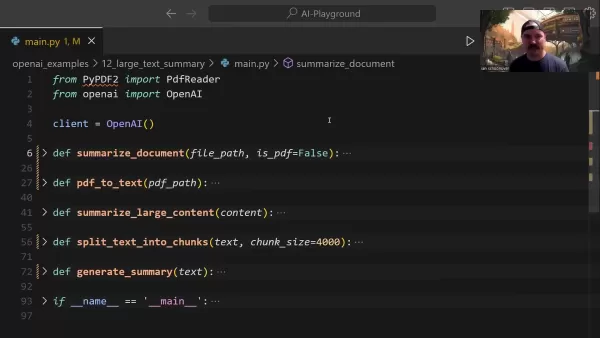
Effective summarization requires extracting essential information while preserving context and meaning. Professionals across industries - including researchers analyzing studies and attorneys reviewing contracts - benefit from these advanced capabilities.
The methodology involves intelligent document segmentation, enabling systematic processing of manageable content sections while respecting API limitations. This structured approach guarantees comprehensive coverage without sacrificing critical details, regardless of original document length.
Core Summarization Process Components
The document condensation workflow incorporates several fundamental elements:
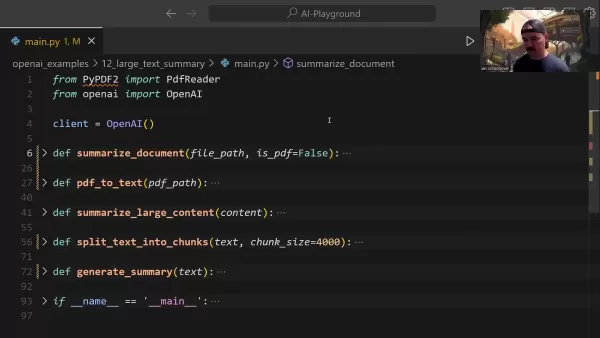
- Document Input Handling: Supports both TXT and PDF formats with automatic detection
- PDF Conversion: Transforms PDF content into analyzable text while maintaining layout integrity
- Content Segmentation: Strategically divides oversized documents into optimal processing units
- API Processing: Harnesses OpenAI's algorithms for intelligent content extraction
- Summary Integration: Combines partial summaries into unified, coherent overviews
Implementation Details
Main Summarization Function
The central summarize_document function manages the entire summarization pipeline:
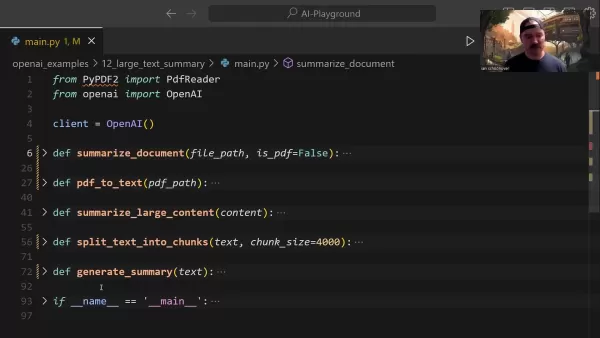
This function intelligently handles format detection, delegates conversion tasks when necessary, and determines appropriate summarization strategies based on document size.
PDF Conversion Methodology
The PDF text extraction process employs specialized libraries:
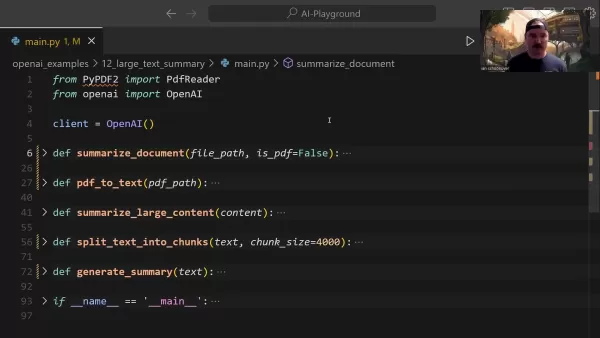
Using PyPDF2, the conversion maintains paragraph structure while efficiently removing unnecessary formatting elements.
Large Document Handling
For oversized content, the system implements strategic segmentation:
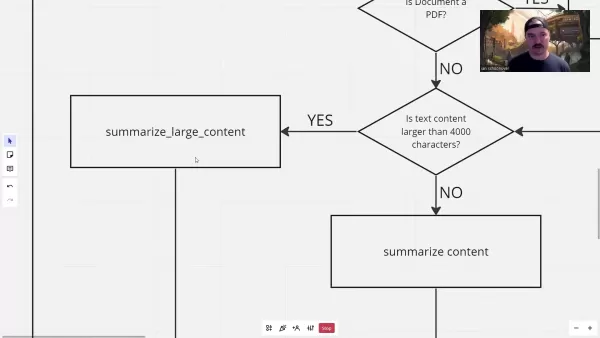
This approach combines preliminary chunk summarization with final consolidation to maintain context throughout lengthy documents.
Content Segmentation
The chunking algorithm ensures optimal sizing:
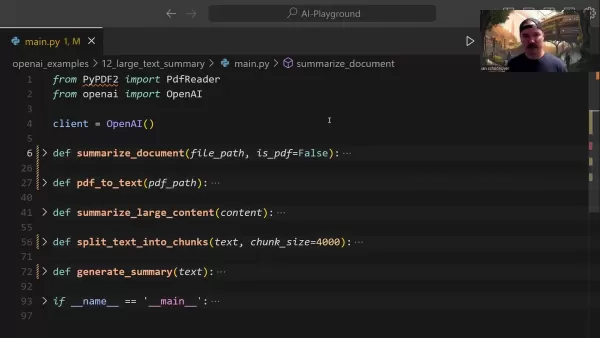
Configurable chunk sizes accommodate different document types while respecting API constraints.
AI Integration
The API communication component delivers intelligent summarization:
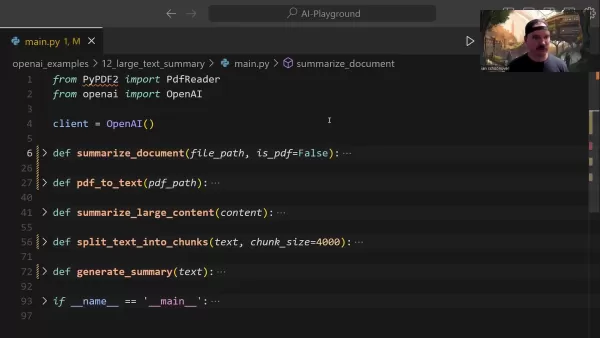
Careful parameter configuration balances detail preservation with conciseness.
Advantages and Considerations
Benefits
- Scalable Processing: Handles documents of virtually any size effectively
- Intelligent Extraction: Identifies and preserves critical information accurately
- Format Flexibility: Adapts to various document structures and layouts
- Efficiency Gains: Dramatically reduces manual summarization time
- Accessibility: Makes dense information more digestible
Limitations
- Cost Structure: Charges apply based on processing volume
- Connectivity Requirements: Dependent on stable internet access
- Contextual Limitations: May occasionally miss specialized nuance
- Data Sensitivity: Requires caution with confidential information
Common Questions
Supported File Types
The system currently processes standard TXT and PDF documents.
Size Restrictions
Intelligent segmentation allows summarization of arbitrarily large documents.
Model Specifications
The implementation utilizes OpenAI's gpt-3.5-turbo-1106 model.
Implementation Guidance
PDF Summarization Process
Enable PDF processing via the boolean flag:
document_summary = summarize_document('/document/location/file.pdf', is_pdf=True)
Related article
 Final 24 Hours to Exhibit at TechCrunch Disrupt 2026
Exhibit table reservations expire tonight, Friday, September 18, at 11:59 p.m. PT. After this deadline, you will no longer be able to add your startup to the Expo Hall.Tables are limited and allocated on a first-come, first-served basis. The startups
Doubao Mobile Launches Nubia NaviX Ultra, Marketed as World’s First AI Agent Flagship
Ni Fei, CEO of Navea, revealed that the next-generation Doubao smartphone, branded as "Navea NaviX Ultra," will launch in September. Positioned as the world’s first AI smart agent flagship, it marks a significant milestone. Ni noted, "From the M153 p
2nd World Humanoid Robot Sports Meet Kicks Off: 2056 Steel Soldiers Battle at Ice Ribbon
The Second World Humanoid Robot Sports Games kicked off at the National Speed Skating Oval, known as the "Ice Ribbon," on the evening of August 22. Co-hosted by the Beijing Municipal Government, China Media Group, the World Robot Cooperation Organiza
Related Special Topic Recommendations
Data Analysis
Final 24 Hours to Exhibit at TechCrunch Disrupt 2026
Exhibit table reservations expire tonight, Friday, September 18, at 11:59 p.m. PT. After this deadline, you will no longer be able to add your startup to the Expo Hall.Tables are limited and allocated on a first-come, first-served basis. The startups
Doubao Mobile Launches Nubia NaviX Ultra, Marketed as World’s First AI Agent Flagship
Ni Fei, CEO of Navea, revealed that the next-generation Doubao smartphone, branded as "Navea NaviX Ultra," will launch in September. Positioned as the world’s first AI smart agent flagship, it marks a significant milestone. Ni noted, "From the M153 p
2nd World Humanoid Robot Sports Meet Kicks Off: 2056 Steel Soldiers Battle at Ice Ribbon
The Second World Humanoid Robot Sports Games kicked off at the National Speed Skating Oval, known as the "Ice Ribbon," on the evening of August 22. Co-hosted by the Beijing Municipal Government, China Media Group, the World Robot Cooperation Organiza
Related Special Topic Recommendations
Data Analysis
 Best AI Anomaly Detection Tools for Dashboard Monitoring
2026 Latest Best Top-rated AI Anomaly Detection Tools for Dashboard Monitoring are here on XIX.AI! This curated list features powerful, game-changing solutions that deliver accurate real-world tests through weekly updated rankings. You’ll find a free vs paid comparison and insights into how these tools boost productivity by helping users spot issues fast, streamlining workflow efficiency. Discover your perfect tool to unlock your AI edge today. Explore now!
 9 tools
 xix.ai
Animation Creation
AI Lip-Sync Generators for Dialogue-Driven Character Animation and Motion Scenes
xix.ai
Animation Creation
AI Lip-Sync Generators for Dialogue-Driven Character Animation and Motion Scenes
2026 Latest Best AI Lip-Sync Generators for Dialogue-Driven Character Animation and Motion Scenes! XIX.AI has curated a top-rated list of powerful, game-changing tools that deliver flawless synchronized lip movements for animated characters. Each option undergoes rigorous real-world tests to ensure reliability, and our weekly updated rankings help you find the must-try solution that boosts your animation workflow efficiency. Explore now to discover your perfect tool!
9 tools
xix.ai
Social Media
Best AI Social Reply Assistants for Brand Community Management
2026 Latest Best Top-rated AI Social Reply Assistants for Brand Community Management! XIX.AI has curated a powerful game-changing collection of must-try tools, all going through rigorous real-world tests to deliver consistent top-quality results. You can find detailed free vs paid comparison insights and up-to-date weekly updated rankings here. Explore now to unlock your AI edge in efficient community management!
12 tools
xix.ai
Productivity
Top AI Daily Planner Apps: Build Realistic Schedules for Deep Work
2026 Latest Top-Rated AI Daily Planner Apps make creating realistic deep work schedules effortless. This curated list features powerful, game-changing tools that go through real-world tests to ensure accuracy and effectiveness. You’ll find a free vs paid comparison along with detailed rankings based on usability and results. XIX.AI is part of this trusted collection. Explore now to discover your perfect tool and unlock your AI edge for staying focused and productive every day.
11 tools
xix.ai
Data Analysis
Best AI Chart Builder Tools for Fast Reporting
2026 Latest Best Top-rated AI Chart Builder Tools for Fast Reporting are here on XIX.AI! This curated list features powerful game-changing tools that deliver accurate professional charts with just a few clicks, helping you boost writing efficiency and streamline content creation. Get a free vs paid comparison along with real-world tests and detailed rankings to find the must-try solution for your needs. Explore now to unlock your AI edge!
9 tools
xix.ai
chatbot
AI Live Chat Routing Tools for Ecommerce Queues, VIP Buyers, and Return Requests
2026 Latest Best Top-rated AI Live Chat Routing Tools for Ecommerce Queues, VIP Buyers, and Return Requests. This curated list features powerful game-changing solutions that boost productivity dramatically through real-world tests. It includes a free vs paid comparison along with detailed rankings to help you find the perfect fit. XIX.AI stands out as a trusted provider in this space. Explore now to Unlock your AI edge!
9 tools
xix.ai

 Comments (2)
0/500
Comments (2)
0/500
![RyanPerez]()
Honestly, summarizing massive text files is a game-changer for my workflow. I used to spend hours reading reports, but now I just feed them into the API and get concise summaries instantly. It’s like having a super-fast assistant who never gets tired. The guide is super helpful for beginners too. Highly recommend giving it a try if you deal with lots of data! 🚀
![EmmaTurner]()
この記事を読んで、大規模テキスト要約の可能性にますます興味が湧きました!特に基本テキストファイルから複雑な文章まで扱える柔軟性が素晴らしいですね。私は実際に大量のリサーチ論文を要約する必要があって、OpenAIの技術はまさに救世主です🎯。でも、長文要約の精度ってどれくらいなんだろう?細部のニュアンスが抜け落ちないか心配な面もあります。今度試してみたいと思います。
In today's data-driven world, efficiently processing large volumes of information is critical. This comprehensive guide demonstrates how to utilize OpenAI's advanced API technology for summarizing diverse text sources, from basic TXT files to complex PDF documents. We'll explore proven methods for managing oversized documents, segmenting them strategically, and producing insightful summaries through artificial intelligence. Ideal for professionals handling technical reports, academic research, or legal contracts, these techniques provide actionable solutions for transforming overwhelming content into valuable insights.
Key Highlights
TXT/PDF Summarization: Master document condensation techniques for multiple file formats.
PDF Conversion: Learn reliable methods for extracting text from PDF documents.
Document Segmentation: Discover optimal approaches for dividing large files.
API Integration: Implement OpenAI's powerful summarization capabilities.
Encoding Considerations: Understand critical aspects of character set handling.
Summary Synthesis: Combine partial summaries into coherent overviews.
AI-Powered Document Summarization Techniques
Overcoming Large-Scale Summarization Challenges
The summarization of extensive documents presents distinctive obstacles that traditional methods often fail to address adequately. Modern AI solutions, particularly through OpenAI's API, provide scalable alternatives that overcome processing constraints while maintaining accuracy.
Effective summarization requires extracting essential information while preserving context and meaning. Professionals across industries - including researchers analyzing studies and attorneys reviewing contracts - benefit from these advanced capabilities.
The methodology involves intelligent document segmentation, enabling systematic processing of manageable content sections while respecting API limitations. This structured approach guarantees comprehensive coverage without sacrificing critical details, regardless of original document length.
Core Summarization Process Components
The document condensation workflow incorporates several fundamental elements:
- Document Input Handling: Supports both TXT and PDF formats with automatic detection
- PDF Conversion: Transforms PDF content into analyzable text while maintaining layout integrity
- Content Segmentation: Strategically divides oversized documents into optimal processing units
- API Processing: Harnesses OpenAI's algorithms for intelligent content extraction
- Summary Integration: Combines partial summaries into unified, coherent overviews
Implementation Details
Main Summarization Function
The central summarize_document function manages the entire summarization pipeline:
This function intelligently handles format detection, delegates conversion tasks when necessary, and determines appropriate summarization strategies based on document size.
PDF Conversion Methodology
The PDF text extraction process employs specialized libraries:
Using PyPDF2, the conversion maintains paragraph structure while efficiently removing unnecessary formatting elements.
Large Document Handling
For oversized content, the system implements strategic segmentation:
This approach combines preliminary chunk summarization with final consolidation to maintain context throughout lengthy documents.
Content Segmentation
The chunking algorithm ensures optimal sizing:
Configurable chunk sizes accommodate different document types while respecting API constraints.
AI Integration
The API communication component delivers intelligent summarization:
Careful parameter configuration balances detail preservation with conciseness.
Advantages and Considerations
Benefits
- Scalable Processing: Handles documents of virtually any size effectively
- Intelligent Extraction: Identifies and preserves critical information accurately
- Format Flexibility: Adapts to various document structures and layouts
- Efficiency Gains: Dramatically reduces manual summarization time
- Accessibility: Makes dense information more digestible
Limitations
- Cost Structure: Charges apply based on processing volume
- Connectivity Requirements: Dependent on stable internet access
- Contextual Limitations: May occasionally miss specialized nuance
- Data Sensitivity: Requires caution with confidential information
Common Questions
Supported File Types
The system currently processes standard TXT and PDF documents.
Size Restrictions
Intelligent segmentation allows summarization of arbitrarily large documents.
Model Specifications
The implementation utilizes OpenAI's gpt-3.5-turbo-1106 model.
Implementation Guidance
PDF Summarization Process
Enable PDF processing via the boolean flag:
document_summary = summarize_document('/document/location/file.pdf', is_pdf=True)








 Final 24 Hours to Exhibit at TechCrunch Disrupt 2026
Exhibit table reservations expire tonight, Friday, September 18, at 11:59 p.m. PT. After this deadline, you will no longer be able to add your startup to the Expo Hall.Tables are limited and allocated on a first-come, first-served basis. The startups
Final 24 Hours to Exhibit at TechCrunch Disrupt 2026
Exhibit table reservations expire tonight, Friday, September 18, at 11:59 p.m. PT. After this deadline, you will no longer be able to add your startup to the Expo Hall.Tables are limited and allocated on a first-come, first-served basis. The startups
 Doubao Mobile Launches Nubia NaviX Ultra, Marketed as World’s First AI Agent Flagship
Ni Fei, CEO of Navea, revealed that the next-generation Doubao smartphone, branded as "Navea NaviX Ultra," will launch in September. Positioned as the world’s first AI smart agent flagship, it marks a significant milestone. Ni noted, "From the M153 p
Doubao Mobile Launches Nubia NaviX Ultra, Marketed as World’s First AI Agent Flagship
Ni Fei, CEO of Navea, revealed that the next-generation Doubao smartphone, branded as "Navea NaviX Ultra," will launch in September. Positioned as the world’s first AI smart agent flagship, it marks a significant milestone. Ni noted, "From the M153 p
 2nd World Humanoid Robot Sports Meet Kicks Off: 2056 Steel Soldiers Battle at Ice Ribbon
The Second World Humanoid Robot Sports Games kicked off at the National Speed Skating Oval, known as the "Ice Ribbon," on the evening of August 22. Co-hosted by the Beijing Municipal Government, China Media Group, the World Robot Cooperation Organiza
2nd World Humanoid Robot Sports Meet Kicks Off: 2056 Steel Soldiers Battle at Ice Ribbon
The Second World Humanoid Robot Sports Games kicked off at the National Speed Skating Oval, known as the "Ice Ribbon," on the evening of August 22. Co-hosted by the Beijing Municipal Government, China Media Group, the World Robot Cooperation Organiza

2026 Latest Best Top-rated AI Anomaly Detection Tools for Dashboard Monitoring are here on XIX.AI! This curated list features powerful, game-changing solutions that deliver accurate real-world tests through weekly updated rankings. You’ll find a free vs paid comparison and insights into how these tools boost productivity by helping users spot issues fast, streamlining workflow efficiency. Discover your perfect tool to unlock your AI edge today. Explore now!
9 tools
xix.ai
2026 Latest Best AI Lip-Sync Generators for Dialogue-Driven Character Animation and Motion Scenes! XIX.AI has curated a top-rated list of powerful, game-changing tools that deliver flawless synchronized lip movements for animated characters. Each option undergoes rigorous real-world tests to ensure reliability, and our weekly updated rankings help you find the must-try solution that boosts your animation workflow efficiency. Explore now to discover your perfect tool!
9 tools
xix.ai

2026 Latest Best Top-rated AI Social Reply Assistants for Brand Community Management! XIX.AI has curated a powerful game-changing collection of must-try tools, all going through rigorous real-world tests to deliver consistent top-quality results. You can find detailed free vs paid comparison insights and up-to-date weekly updated rankings here. Explore now to unlock your AI edge in efficient community management!
12 tools
xix.ai

2026 Latest Top-Rated AI Daily Planner Apps make creating realistic deep work schedules effortless. This curated list features powerful, game-changing tools that go through real-world tests to ensure accuracy and effectiveness. You’ll find a free vs paid comparison along with detailed rankings based on usability and results. XIX.AI is part of this trusted collection. Explore now to discover your perfect tool and unlock your AI edge for staying focused and productive every day.
11 tools
xix.ai

2026 Latest Best Top-rated AI Chart Builder Tools for Fast Reporting are here on XIX.AI! This curated list features powerful game-changing tools that deliver accurate professional charts with just a few clicks, helping you boost writing efficiency and streamline content creation. Get a free vs paid comparison along with real-world tests and detailed rankings to find the must-try solution for your needs. Explore now to unlock your AI edge!
9 tools
xix.ai

2026 Latest Best Top-rated AI Live Chat Routing Tools for Ecommerce Queues, VIP Buyers, and Return Requests. This curated list features powerful game-changing solutions that boost productivity dramatically through real-world tests. It includes a free vs paid comparison along with detailed rankings to help you find the perfect fit. XIX.AI stands out as a trusted provider in this space. Explore now to Unlock your AI edge!
9 tools
xix.ai

Honestly, summarizing massive text files is a game-changer for my workflow. I used to spend hours reading reports, but now I just feed them into the API and get concise summaries instantly. It’s like having a super-fast assistant who never gets tired. The guide is super helpful for beginners too. Highly recommend giving it a try if you deal with lots of data! 🚀
この記事を読んで、大規模テキスト要約の可能性にますます興味が湧きました!特に基本テキストファイルから複雑な文章まで扱える柔軟性が素晴らしいですね。私は実際に大量のリサーチ論文を要約する必要があって、OpenAIの技術はまさに救世主です🎯。でも、長文要約の精度ってどれくらいなんだろう?細部のニュアンスが抜け落ちないか心配な面もあります。今度試してみたいと思います。












