


 Home
HomeStanford Report Reveals Widening AI Perception Gap Between Experts and Public
According to Stanford University's latest annual AI industry report, a significant gap is emerging between the views of AI experts and the general public. The report highlights a rising sense of anxiety surrounding AI, with Americans expressing particular concern over its potential effects on employment, healthcare, and the economy.
This growing negativity is reflected in recent sentiment, with a Gallup poll indicating Generation Z is at the forefront. The study found younger demographics are becoming less optimistic and more frustrated with AI, despite roughly half using the technology on a daily or weekly basis.
For many in the tech industry, this public backlash is unexpected. While AI leaders have been preoccupied with managing the long-term risks of Artificial General Intelligence (AGI), everyday people are more worried about immediate impacts on their livelihoods and living costs, such as rising utility bills from energy-intensive data centers.
Honestly, it's strange that some in tech are still surprised by the anti-AI sentiment.
When the heads of OpenAI and Anthropic say, "If we do nothing, this will be bad for many people," what kind of public reaction do they expect?
— David Zhou (@dz) April 13, 2026
Many AI leaders seem out of touch with ordinary people. They don't realize that fear of a "Skynet"-like scenario isn't the main driver of anti-AI sentiment. While that exists, most people are far more concerned about their paychecks and monthly bills.
— Caroline Orr Bueno, Ph.D (@RVAwonk) April 13, 2026
The divide became starkly visible online following recent attacks on OpenAI CEO Sam Altman's home. On platforms like X, AI insiders expressed shock at Instagram comments that appeared to condone the incident. The tone of these online reactions echoed sentiments seen after the 2024 shooting of a UnitedHealthcare CEO and the arson of a Kimberly-Clark warehouse by a worker protesting low wages, with some comments even calling for more radical action.
I didn't grasp the severity of the sentiment until I saw this Instagram comment section. https://t.co/xxlHiM7r4P pic.twitter.com/j1qMwqWVrl
— “paula” (@paularambles) April 12, 2026
Stanford's report sheds light on the roots of this negativity by aggregating data on public AI sentiment from various sources.
It references a recent Pew Research study showing only 10% of Americans are more excited than concerned about AI's growing role in daily life. In contrast, 56% of AI experts believe AI will positively impact the U.S. over the next two decades.
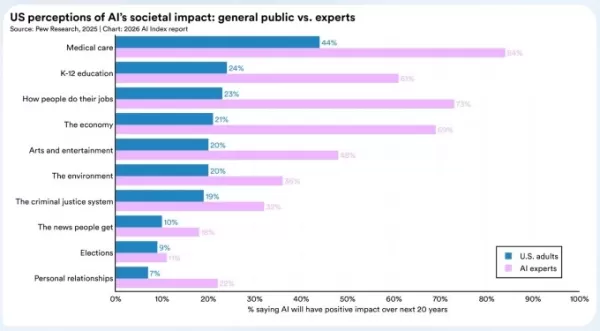
The gap is especially wide in specific societal areas. While 84% of experts predict AI will significantly benefit healthcare in the next 20 years, only 44% of the U.S. public agrees.
ScreenshotImage Credits:Pew Research data, via Stanford
A large majority of experts (73%) are optimistic about AI's impact on work, compared to just 23% of the public. Similarly, 69% of experts foresee a positive economic impact from AI. Given widespread reports of AI-related layoffs and workplace disruption, it's understandable that only 21% of the public shares this view.
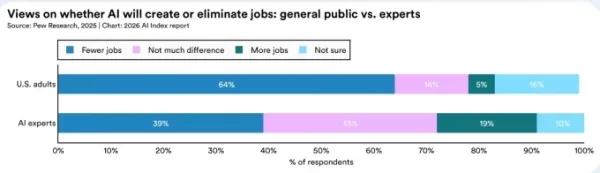
Additional Pew data cited in the report shows experts are less pessimistic about AI's effect on the job market. Nearly two-thirds of Americans (64%) believe AI will reduce job opportunities over the next 20 years.
ScreenshotImage Credits:Pew Research data, via Stanford (opens in a new window)
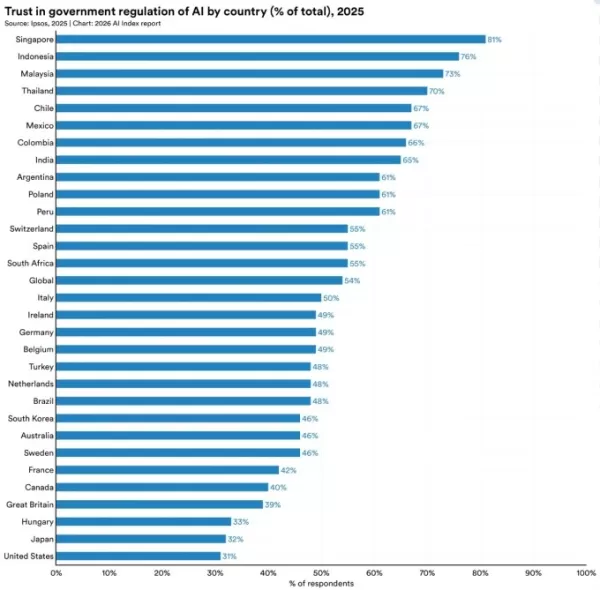
The U.S. also shows the lowest level of trust in its government to regulate AI responsibly among nations surveyed, at just 31%. According to Ipsos data in Stanford's report, Singapore ranks highest at 81%.
ScreenshotImage Credits:Ipsos data, via Stanford (opens in a new window)
Another state-level analysis on regulatory concerns found that 41% of respondents nationwide believe federal AI regulation will be insufficient, while only 27% fear it will go "too far."
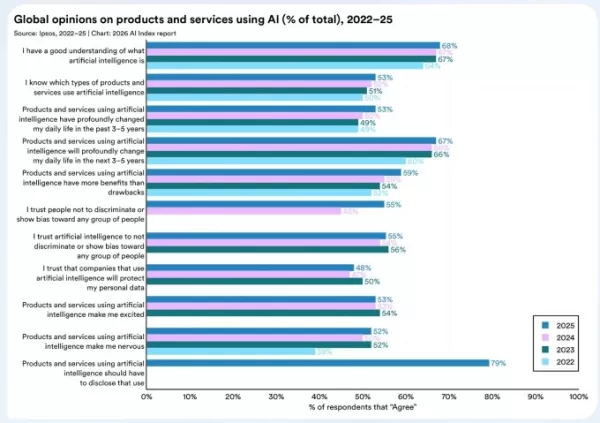
Despite these concerns, AI received one positive note: globally, the percentage of people who feel AI offers more benefits than drawbacks increased slightly from 55% in 2024 to 59% in 2025.
ScreenshotImage Credits:Ipsos data, via Stanford (opens in a new window)
However, during the same period, the proportion of respondents who said AI makes them "nervous" also grew, from 50% to 52%.
Related article
 Warner Music acquires AI attribution startup Sureel AI
Warner Music Group (WMG) confirmed on Wednesday that it is acquiring Sureel AI, an artificial intelligence attribution startup. Sureel’s proprietary technology generates “AI DNA” for musical tracks, deconstructing them into constituent elements to tr
Amazon introduces Alexa for Shopping while pushing Rufus to the background
Amazon has launched Alexa for Shopping, merging its Rufus shopping chatbot with Alexa+ across the app, website, and Echo Show devices.The assistant answers product queries, compares items, tracks prices, and supports shopping reminders. It also handl
Microsoft, Azure and AI Tech Combat California Wildfire Risks
Microsoft invests in AI-driven wildfire detection, with Juan Lavista Ferres, CVP and Chief Data Scientist, discussing strategies to mitigate environmental damage.According to NASA, climate change impacts everyone on Earth, manifesting as rising tempe
Related Special Topic Recommendations
Design & Art
Warner Music acquires AI attribution startup Sureel AI
Warner Music Group (WMG) confirmed on Wednesday that it is acquiring Sureel AI, an artificial intelligence attribution startup. Sureel’s proprietary technology generates “AI DNA” for musical tracks, deconstructing them into constituent elements to tr
Amazon introduces Alexa for Shopping while pushing Rufus to the background
Amazon has launched Alexa for Shopping, merging its Rufus shopping chatbot with Alexa+ across the app, website, and Echo Show devices.The assistant answers product queries, compares items, tracks prices, and supports shopping reminders. It also handl
Microsoft, Azure and AI Tech Combat California Wildfire Risks
Microsoft invests in AI-driven wildfire detection, with Juan Lavista Ferres, CVP and Chief Data Scientist, discussing strategies to mitigate environmental damage.According to NASA, climate change impacts everyone on Earth, manifesting as rising tempe
Related Special Topic Recommendations
Design & Art
 Best AI Style Transfer Tools for Creative Experiments
2026 Latest Best Top-rated AI Style Transfer Tools for Creative Experiments! XIX.AI has curated a powerful, game-changing collection of must-try tools that deliver exceptional results through real-world tests and rigorous rankings. These top solutions help creatives boost productivity significantly by accelerating content creation and unlocking endless creative possibilities. Explore now to discover your perfect tool and start creating today!
 9 tools
 xix.ai
Comic Creation
Best AI Dialogue Bubble Tools for Visual Storytelling
xix.ai
Comic Creation
Best AI Dialogue Bubble Tools for Visual Storytelling
2026 Latest Best Top-Rated AI Dialogue Bubble Tools for Visual Storytelling are here on XIX.AI! This curated collection features powerful, game-changing tools that help creators boost productivity and overcome creative bottlenecks. Get a free vs paid comparison, see real-world tests, and check the latest rankings to find the must-try solutions perfect for crafting engaging visual narratives. Explore now to discover your ideal tool!
10 tools
xix.ai
Meeting Assistant
Top AI Meeting Summary Tools: Track Decisions and Follow-Ups Clearly
2026 Latest Top-Rated Best AI Meeting Summary Tools for Clear Decision Tracking and Effortless Follow-Ups. This curated list showcases powerful, game-changing solutions that boost productivity dramatically by automating meeting notes, identifying key action items, and streamlining team coordination across all projects. Get a free vs paid comparison along with real-world tests and weekly updated rankings to help you find the perfect tool. Explore now to unlock your AI edge!
9 tools
xix.ai
Data Analysis
Best AI Data Cleaning Tools: Fix Missing Values and Duplicates Fast
2026 Latest Best Top-rated AI Data Cleaning Tools for quick fixing of missing values and duplicates. This curated list showcases powerful, game-changing solutions that boost productivity significantly. Each option has undergone rigorous real-world tests to ensure reliability. Get a free vs paid comparison and discover the must-try tool that fits your needs best. Explore now at XIX.AI to Unlock your AI edge.
11 tools
xix.ai
Design & Art
Best AI Creative Ideation Tools for Artists: Break Through Visual Blocks
2026 Latest Best Top-Rated AI Creative Ideation Tools for Artists are curated by XIX.AI to help creators break through visual blocks and boost creativity instantly. These powerful game-changing tools offer real-world tests, detailed free vs paid comparison, and weekly updated rankings. Discover your perfect tool to accelerate content creation and unlock your AI edge today. Explore now!
14 tools
xix.ai
Music composition
AI Beat Makers for TikTok Background Tracks, Reels Audio, and Creator Promo Music
2026 Latest Best AI Beat Makers for TikTok Background Tracks, Reels Audio, and Creator Promo Music! XIX.AI has curated a top-rated list of powerful game-changing tools that go through real-world tests to deliver flawless music for every content need. You’ll find detailed free vs paid comparison data, weekly updated rankings, and must-try options to help you boost creativity and productivity. Explore now to discover your perfect tool!
11 tools
xix.ai

 Comments (0)
0/500
Comments (0)
0/500
According to Stanford University's latest annual AI industry report, a significant gap is emerging between the views of AI experts and the general public. The report highlights a rising sense of anxiety surrounding AI, with Americans expressing particular concern over its potential effects on employment, healthcare, and the economy.
This growing negativity is reflected in recent sentiment, with a Gallup poll indicating Generation Z is at the forefront. The study found younger demographics are becoming less optimistic and more frustrated with AI, despite roughly half using the technology on a daily or weekly basis.
For many in the tech industry, this public backlash is unexpected. While AI leaders have been preoccupied with managing the long-term risks of Artificial General Intelligence (AGI), everyday people are more worried about immediate impacts on their livelihoods and living costs, such as rising utility bills from energy-intensive data centers.
Honestly, it's strange that some in tech are still surprised by the anti-AI sentiment.
— David Zhou (@dz) April 13, 2026
When the heads of OpenAI and Anthropic say, "If we do nothing, this will be bad for many people," what kind of public reaction do they expect?
Many AI leaders seem out of touch with ordinary people. They don't realize that fear of a "Skynet"-like scenario isn't the main driver of anti-AI sentiment. While that exists, most people are far more concerned about their paychecks and monthly bills.
— Caroline Orr Bueno, Ph.D (@RVAwonk) April 13, 2026
The divide became starkly visible online following recent attacks on OpenAI CEO Sam Altman's home. On platforms like X, AI insiders expressed shock at Instagram comments that appeared to condone the incident. The tone of these online reactions echoed sentiments seen after the 2024 shooting of a UnitedHealthcare CEO and the arson of a Kimberly-Clark warehouse by a worker protesting low wages, with some comments even calling for more radical action.
I didn't grasp the severity of the sentiment until I saw this Instagram comment section. https://t.co/xxlHiM7r4P pic.twitter.com/j1qMwqWVrl
— “paula” (@paularambles) April 12, 2026
Stanford's report sheds light on the roots of this negativity by aggregating data on public AI sentiment from various sources.
It references a recent Pew Research study showing only 10% of Americans are more excited than concerned about AI's growing role in daily life. In contrast, 56% of AI experts believe AI will positively impact the U.S. over the next two decades.
The gap is especially wide in specific societal areas. While 84% of experts predict AI will significantly benefit healthcare in the next 20 years, only 44% of the U.S. public agrees.
ScreenshotImage Credits:Pew Research data, via Stanford
A large majority of experts (73%) are optimistic about AI's impact on work, compared to just 23% of the public. Similarly, 69% of experts foresee a positive economic impact from AI. Given widespread reports of AI-related layoffs and workplace disruption, it's understandable that only 21% of the public shares this view.
Additional Pew data cited in the report shows experts are less pessimistic about AI's effect on the job market. Nearly two-thirds of Americans (64%) believe AI will reduce job opportunities over the next 20 years.
ScreenshotImage Credits:Pew Research data, via Stanford (opens in a new window)
The U.S. also shows the lowest level of trust in its government to regulate AI responsibly among nations surveyed, at just 31%. According to Ipsos data in Stanford's report, Singapore ranks highest at 81%.
ScreenshotImage Credits:Ipsos data, via Stanford (opens in a new window)
Another state-level analysis on regulatory concerns found that 41% of respondents nationwide believe federal AI regulation will be insufficient, while only 27% fear it will go "too far."
Despite these concerns, AI received one positive note: globally, the percentage of people who feel AI offers more benefits than drawbacks increased slightly from 55% in 2024 to 59% in 2025.
ScreenshotImage Credits:Ipsos data, via Stanford (opens in a new window)
However, during the same period, the proportion of respondents who said AI makes them "nervous" also grew, from 50% to 52%.








 Warner Music acquires AI attribution startup Sureel AI
Warner Music Group (WMG) confirmed on Wednesday that it is acquiring Sureel AI, an artificial intelligence attribution startup. Sureel’s proprietary technology generates “AI DNA” for musical tracks, deconstructing them into constituent elements to tr
Amazon introduces Alexa for Shopping while pushing Rufus to the background
Amazon has launched Alexa for Shopping, merging its Rufus shopping chatbot with Alexa+ across the app, website, and Echo Show devices.The assistant answers product queries, compares items, tracks prices, and supports shopping reminders. It also handl
Warner Music acquires AI attribution startup Sureel AI
Warner Music Group (WMG) confirmed on Wednesday that it is acquiring Sureel AI, an artificial intelligence attribution startup. Sureel’s proprietary technology generates “AI DNA” for musical tracks, deconstructing them into constituent elements to tr
Amazon introduces Alexa for Shopping while pushing Rufus to the background
Amazon has launched Alexa for Shopping, merging its Rufus shopping chatbot with Alexa+ across the app, website, and Echo Show devices.The assistant answers product queries, compares items, tracks prices, and supports shopping reminders. It also handl
 Microsoft, Azure and AI Tech Combat California Wildfire Risks
Microsoft invests in AI-driven wildfire detection, with Juan Lavista Ferres, CVP and Chief Data Scientist, discussing strategies to mitigate environmental damage.According to NASA, climate change impacts everyone on Earth, manifesting as rising tempe
Microsoft, Azure and AI Tech Combat California Wildfire Risks
Microsoft invests in AI-driven wildfire detection, with Juan Lavista Ferres, CVP and Chief Data Scientist, discussing strategies to mitigate environmental damage.According to NASA, climate change impacts everyone on Earth, manifesting as rising tempe

2026 Latest Best Top-rated AI Style Transfer Tools for Creative Experiments! XIX.AI has curated a powerful, game-changing collection of must-try tools that deliver exceptional results through real-world tests and rigorous rankings. These top solutions help creatives boost productivity significantly by accelerating content creation and unlocking endless creative possibilities. Explore now to discover your perfect tool and start creating today!
9 tools
xix.ai

2026 Latest Best Top-Rated AI Dialogue Bubble Tools for Visual Storytelling are here on XIX.AI! This curated collection features powerful, game-changing tools that help creators boost productivity and overcome creative bottlenecks. Get a free vs paid comparison, see real-world tests, and check the latest rankings to find the must-try solutions perfect for crafting engaging visual narratives. Explore now to discover your ideal tool!
10 tools
xix.ai
2026 Latest Top-Rated Best AI Meeting Summary Tools for Clear Decision Tracking and Effortless Follow-Ups. This curated list showcases powerful, game-changing solutions that boost productivity dramatically by automating meeting notes, identifying key action items, and streamlining team coordination across all projects. Get a free vs paid comparison along with real-world tests and weekly updated rankings to help you find the perfect tool. Explore now to unlock your AI edge!
9 tools
xix.ai

2026 Latest Best Top-rated AI Data Cleaning Tools for quick fixing of missing values and duplicates. This curated list showcases powerful, game-changing solutions that boost productivity significantly. Each option has undergone rigorous real-world tests to ensure reliability. Get a free vs paid comparison and discover the must-try tool that fits your needs best. Explore now at XIX.AI to Unlock your AI edge.
11 tools
xix.ai

2026 Latest Best Top-Rated AI Creative Ideation Tools for Artists are curated by XIX.AI to help creators break through visual blocks and boost creativity instantly. These powerful game-changing tools offer real-world tests, detailed free vs paid comparison, and weekly updated rankings. Discover your perfect tool to accelerate content creation and unlock your AI edge today. Explore now!
14 tools
xix.ai

2026 Latest Best AI Beat Makers for TikTok Background Tracks, Reels Audio, and Creator Promo Music! XIX.AI has curated a top-rated list of powerful game-changing tools that go through real-world tests to deliver flawless music for every content need. You’ll find detailed free vs paid comparison data, weekly updated rankings, and must-try options to help you boost creativity and productivity. Explore now to discover your perfect tool!
11 tools
xix.ai












