


 Home
Home
Official support for Tongyi Qianwen arrives as Unsloth Dynamic V3 shrinks Qwen3.8-27B with a 1-bit version running on 8GB memory
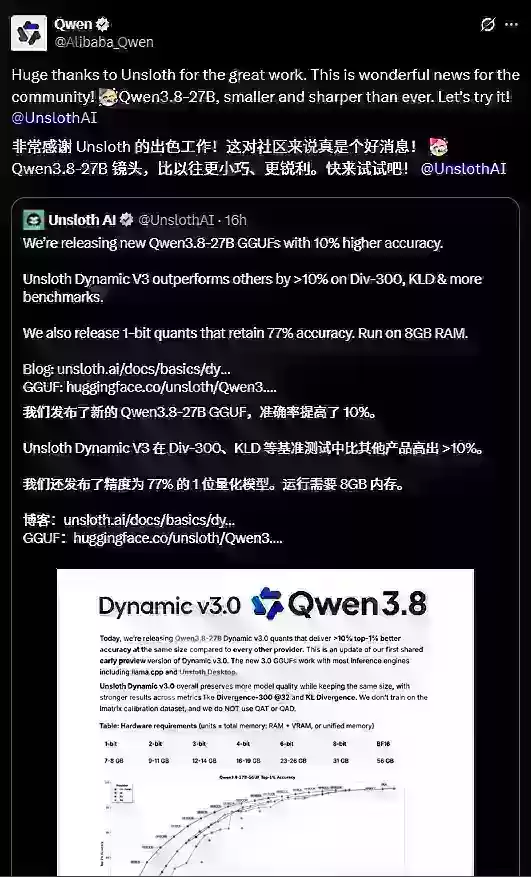
Tongyi Qianwen (Qwen) recently publicly acknowledged the Unsloth team for releasing the Qwen3.8-27B GGUF quantized version, praising it as "smaller and smarter." This exchange has ignited widespread discussion in the open-source community, underscoring the steadily lowering barriers to local large model deployment.
Official Interaction: Tongyi Qianwen Thanks Unsloth
In its official statement, Tongyi Qianwen expressed sincere appreciation for Unsloth’s work, calling it excellent news for the community and encouraging users to try this "smaller and smarter" Qwen3.8-27B version. This move highlights the growing synergy between open-source model developers and quantization optimization providers.
Unsloth Dynamic V3 Quantization Major Upgrade
Unsloth’s latest Dynamic V3 (v3.0) quantization solution is specifically optimized for Qwen3.8-27B. According to official data, this approach boosts accuracy by over 10% compared to other mainstream quantization methods at the same file size, delivering exceptional performance on key benchmarks like Div-300 and KLD (KL Divergence).
This upgrade goes beyond simple compression. By leveraging improved post-training quantization techniques, it better preserves the original model’s output quality, closely matching full-precision performance in intelligent agent coding, dialogue, and multilingual tasks. The corresponding GGUF files are now available on Hugging Face and support mainstream inference tools such as llama.cpp and Unsloth Desktop.
1-bit Quantization Version: Runs with 8GB Memory
Notably, Unsloth has also released a 1-bit quantization version. This variant retains approximately 77% accuracy while drastically cutting resource demands, enabling operation on devices with just 8GB of memory. Some ultra-compressed variants (such as UD-IQ1_S, around 6.2GB) reduce file size by roughly 89% compared to full precision, while still delivering usable performance.
Previously, running a 4-bit quantized Qwen3.8-27B typically required 16–19GB of VRAM or system memory. Now, these low-bit options make it possible for standard laptops and consumer devices to experiment with this 27-billion-parameter multimodal model.
Significance for Local AI Ecosystem
Qwen3.8-27B natively supports multimodal capabilities, features a 262K context window (expandable to approximately 1 million tokens), and excels in coding and office workflow scenarios. Licensed under Apache 2.0, it combines seamlessly with Unsloth’s Dynamic V3 quantization, allowing developers to perform inference and fine-tuning locally with greater ease and reduced reliance on cloud infrastructure.
AIbase views the positive collaboration between Tongyi Qianwen and Unsloth, along with the dual breakthroughs in accuracy and efficiency offered by Dynamic V3, as marking a new era in the localization of open-source large models. Interested developers can download the latest GGUF files from Hugging Face and consult Unsloth’s official documentation for setup guides.
Related article
 OpenAI launches GPT-6 Astra, marking a major step toward artificial general intelligence
OpenAI has officially introduced its newest flagship large language model, GPT-6Astra. During a media briefing, company president Greg Brockman praised the model highly, suggesting that it may mark humanity’s entry into the era of artificial general
Wayve Launches $85M Employee Tender Offer at $8.5B Valuation
Wayve, a UK-based autonomous driving technology startup, is enabling employees to sell a portion of their vested equity through an $85 million tender offer. This structured opportunity allows staff to sell shares back to investors at the company’s la
Sam Altman Warns Against Claiming Claude Is Conscious
Mustafa Suleyman, Microsoft’s AI chief, recently labeled Anthropic’s speculation that its large language model, Claude, possesses consciousness as “highly dangerous” during an appearance on the “Decoder” podcast.Suleyman argued that Anthropic anthrop
Related Special Topic Recommendations
Animation Creation
OpenAI launches GPT-6 Astra, marking a major step toward artificial general intelligence
OpenAI has officially introduced its newest flagship large language model, GPT-6Astra. During a media briefing, company president Greg Brockman praised the model highly, suggesting that it may mark humanity’s entry into the era of artificial general
Wayve Launches $85M Employee Tender Offer at $8.5B Valuation
Wayve, a UK-based autonomous driving technology startup, is enabling employees to sell a portion of their vested equity through an $85 million tender offer. This structured opportunity allows staff to sell shares back to investors at the company’s la
Sam Altman Warns Against Claiming Claude Is Conscious
Mustafa Suleyman, Microsoft’s AI chief, recently labeled Anthropic’s speculation that its large language model, Claude, possesses consciousness as “highly dangerous” during an appearance on the “Decoder” podcast.Suleyman argued that Anthropic anthrop
Related Special Topic Recommendations
Animation Creation
 Best AI Lip-Sync Generators for Dialogue Scenes
2026 Latest Best Top-Rated AI Lip-Sync Generators for Dialogue Scenes are here on XIX.AI! This curated collection features powerful, game-changing tools that deliver flawless synchronized lip movements for any script, boosting your video editing efficiency significantly. Enjoy a free vs paid comparison along with real-world tests and weekly updated rankings to help you find the must-try perfect fit. Explore now to unlock your AI edge!
 8 tools
 xix.ai
Prompt
AI Prompt Optimizers: Refine Instructions for Better Output Quality
xix.ai
Prompt
AI Prompt Optimizers: Refine Instructions for Better Output Quality
2026 Latest Best Top-Rated AI Prompt Optimizers Curated for Maximum Output Quality! XIX.AI delivers powerful game-changing solutions that help you refine instructions effortlessly, boost writing efficiency, and unlock higher-quality results every time. Get a free vs paid comparison along with real-world tests and weekly updated rankings. Explore now to Discover your perfect tool and Unlock your AI edge!
16 tools
xix.ai
Animation Creation
Runway AI Motion Tools for Ad Storyboards, Character Scenes, and Visual Prototypes
2026 Latest Best Runway AI Motion Tools Top-rated curated powerful game-changing options for creating ad storyboards character scenes and visual prototypes through real-world tests Weekly updated free vs paid comparison rankings Help you boost productivity significantly Explore now
9 tools
xix.ai
Academic Research
AI Dataset Discovery Tools for Academic Projects
2026 Latest Best Top-Rated AI Dataset Discovery Tools for Academic Projects! XIX.AI has curated a powerful, game-changing collection of highly reliable options, all going through strict real-world tests and updated weekly. You can find detailed free vs paid comparison info to help you pick the perfect tool that boosts your research efficiency and delivers top-quality results. Explore now to unlock your AI edge!
16 tools
xix.ai
Social Media
Best AI Caption Generators: Write Platform-Specific Social Posts Fast
2026 Latest Best AI Caption Generators page! XIX.AI curated a top-rated list of must-try powerful tools for writing platform-specific social posts quickly. These tools go through rigorous real-world tests, offering free vs paid comparison and clear rankings to help you find the best option that boosts your productivity and unlocks your AI edge. Explore now!
11 tools
xix.ai
Health & Wellness
Best AI Sleep Coaching Tools for Shift Workers, Jet Lag Recovery, and Better Routines
2026 Latest Best AI Sleep Coaching Tools for Shift Workers, Jet Lag Recovery, and Better Routines! XIX.AI has curated a top-rated list of powerful game-changing tools that go through real-world tests to deliver accurate guidance. You can find detailed free vs paid comparison info and see how these must-try solutions help boost sleep quality, speed up jet lag recovery, and build healthier routines. Explore now to discover your perfect tool!
7 tools
xix.ai

 Comments (0)
0/500
Comments (0)
0/500
Tongyi Qianwen (Qwen) recently publicly acknowledged the Unsloth team for releasing the Qwen3.8-27B GGUF quantized version, praising it as "smaller and smarter." This exchange has ignited widespread discussion in the open-source community, underscoring the steadily lowering barriers to local large model deployment.
Official Interaction: Tongyi Qianwen Thanks Unsloth
In its official statement, Tongyi Qianwen expressed sincere appreciation for Unsloth’s work, calling it excellent news for the community and encouraging users to try this "smaller and smarter" Qwen3.8-27B version. This move highlights the growing synergy between open-source model developers and quantization optimization providers.
Unsloth Dynamic V3 Quantization Major Upgrade
Unsloth’s latest Dynamic V3 (v3.0) quantization solution is specifically optimized for Qwen3.8-27B. According to official data, this approach boosts accuracy by over 10% compared to other mainstream quantization methods at the same file size, delivering exceptional performance on key benchmarks like Div-300 and KLD (KL Divergence).
This upgrade goes beyond simple compression. By leveraging improved post-training quantization techniques, it better preserves the original model’s output quality, closely matching full-precision performance in intelligent agent coding, dialogue, and multilingual tasks. The corresponding GGUF files are now available on Hugging Face and support mainstream inference tools such as llama.cpp and Unsloth Desktop.
1-bit Quantization Version: Runs with 8GB Memory
Notably, Unsloth has also released a 1-bit quantization version. This variant retains approximately 77% accuracy while drastically cutting resource demands, enabling operation on devices with just 8GB of memory. Some ultra-compressed variants (such as UD-IQ1_S, around 6.2GB) reduce file size by roughly 89% compared to full precision, while still delivering usable performance.
Previously, running a 4-bit quantized Qwen3.8-27B typically required 16–19GB of VRAM or system memory. Now, these low-bit options make it possible for standard laptops and consumer devices to experiment with this 27-billion-parameter multimodal model.
Significance for Local AI Ecosystem
Qwen3.8-27B natively supports multimodal capabilities, features a 262K context window (expandable to approximately 1 million tokens), and excels in coding and office workflow scenarios. Licensed under Apache 2.0, it combines seamlessly with Unsloth’s Dynamic V3 quantization, allowing developers to perform inference and fine-tuning locally with greater ease and reduced reliance on cloud infrastructure.
AIbase views the positive collaboration between Tongyi Qianwen and Unsloth, along with the dual breakthroughs in accuracy and efficiency offered by Dynamic V3, as marking a new era in the localization of open-source large models. Interested developers can download the latest GGUF files from Hugging Face and consult Unsloth’s official documentation for setup guides.








 OpenAI launches GPT-6 Astra, marking a major step toward artificial general intelligence
OpenAI has officially introduced its newest flagship large language model, GPT-6Astra. During a media briefing, company president Greg Brockman praised the model highly, suggesting that it may mark humanity’s entry into the era of artificial general
OpenAI launches GPT-6 Astra, marking a major step toward artificial general intelligence
OpenAI has officially introduced its newest flagship large language model, GPT-6Astra. During a media briefing, company president Greg Brockman praised the model highly, suggesting that it may mark humanity’s entry into the era of artificial general
 Wayve Launches $85M Employee Tender Offer at $8.5B Valuation
Wayve, a UK-based autonomous driving technology startup, is enabling employees to sell a portion of their vested equity through an $85 million tender offer. This structured opportunity allows staff to sell shares back to investors at the company’s la
Wayve Launches $85M Employee Tender Offer at $8.5B Valuation
Wayve, a UK-based autonomous driving technology startup, is enabling employees to sell a portion of their vested equity through an $85 million tender offer. This structured opportunity allows staff to sell shares back to investors at the company’s la
 Sam Altman Warns Against Claiming Claude Is Conscious
Mustafa Suleyman, Microsoft’s AI chief, recently labeled Anthropic’s speculation that its large language model, Claude, possesses consciousness as “highly dangerous” during an appearance on the “Decoder” podcast.Suleyman argued that Anthropic anthrop
Sam Altman Warns Against Claiming Claude Is Conscious
Mustafa Suleyman, Microsoft’s AI chief, recently labeled Anthropic’s speculation that its large language model, Claude, possesses consciousness as “highly dangerous” during an appearance on the “Decoder” podcast.Suleyman argued that Anthropic anthrop

2026 Latest Best Top-Rated AI Lip-Sync Generators for Dialogue Scenes are here on XIX.AI! This curated collection features powerful, game-changing tools that deliver flawless synchronized lip movements for any script, boosting your video editing efficiency significantly. Enjoy a free vs paid comparison along with real-world tests and weekly updated rankings to help you find the must-try perfect fit. Explore now to unlock your AI edge!
8 tools
xix.ai
2026 Latest Best Top-Rated AI Prompt Optimizers Curated for Maximum Output Quality! XIX.AI delivers powerful game-changing solutions that help you refine instructions effortlessly, boost writing efficiency, and unlock higher-quality results every time. Get a free vs paid comparison along with real-world tests and weekly updated rankings. Explore now to Discover your perfect tool and Unlock your AI edge!
16 tools
xix.ai

2026 Latest Best Runway AI Motion Tools Top-rated curated powerful game-changing options for creating ad storyboards character scenes and visual prototypes through real-world tests Weekly updated free vs paid comparison rankings Help you boost productivity significantly Explore now
9 tools
xix.ai
2026 Latest Best Top-Rated AI Dataset Discovery Tools for Academic Projects! XIX.AI has curated a powerful, game-changing collection of highly reliable options, all going through strict real-world tests and updated weekly. You can find detailed free vs paid comparison info to help you pick the perfect tool that boosts your research efficiency and delivers top-quality results. Explore now to unlock your AI edge!
16 tools
xix.ai

2026 Latest Best AI Caption Generators page! XIX.AI curated a top-rated list of must-try powerful tools for writing platform-specific social posts quickly. These tools go through rigorous real-world tests, offering free vs paid comparison and clear rankings to help you find the best option that boosts your productivity and unlocks your AI edge. Explore now!
11 tools
xix.ai

2026 Latest Best AI Sleep Coaching Tools for Shift Workers, Jet Lag Recovery, and Better Routines! XIX.AI has curated a top-rated list of powerful game-changing tools that go through real-world tests to deliver accurate guidance. You can find detailed free vs paid comparison info and see how these must-try solutions help boost sleep quality, speed up jet lag recovery, and build healthier routines. Explore now to discover your perfect tool!
7 tools
xix.ai












