


 Home
Home
Moonshot AI and Tsinghua University Unveil PrfaaS Architecture to Break Large Model Computing Power Bottleneck
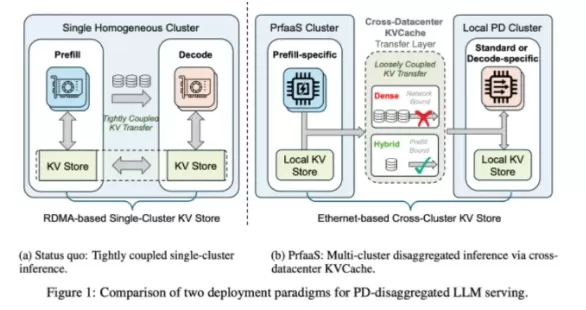
New technologies are breaking the performance bottleneck of large language models (LLMs). Recently, researchers from Moonshot AI (Moonshot) and Tsinghua University introduced a novel architecture called Prefill-as-a-Service (PrfaaS). This study tackles hardware constraints in data center deployments of large model services by optimizing compute resource allocation, thereby significantly boosting inference efficiency.
Technical Breakthrough: A "Surgical" Separation of Prefill and Decode
Currently, the inference process for large language models comprises two distinct phases:
Prefill Phase: This phase is compute-intensive, handling input processing and generating key-value cache (KVCache).
Decode Phase: This phase is memory-bandwidth-intensive, generating output word by word.
In traditional architectures, both phases are typically handled within the same data center or even the same server. Because they have different hardware resource needs, this "forced bundling" often creates an imbalance in compute and bandwidth allocation, leading to service congestion.
Core Innovation: Efficient Cross-Region Collaboration
PrfaaS ’s core highlight is achieving a decoupled service. It offloads the compute-intensive prefill tasks to specialized high-compute clusters. After task completion, the system uses standard Ethernet to transfer the generated KVCache remotely to a local decoding cluster.
This design removes physical space constraints, enabling prefill and decoding to run concurrently across different data centers. To ensure efficient transfer, PrfaaS incorporates a two-time-scale scheduling mechanism that flexibly allocates resources based on real-time traffic fluctuations, paired with precise routing to prevent long text requests from being delayed by uneven resource distribution.
Test Results: Optimizing Throughput and Latency
Research data demonstrates that the PrfaaS architecture delivers remarkable performance in real-world applications:
Service throughput increased by 54%, significantly improving the number of requests handled per unit time.
Response latency decreased significantly, making the first token generation faster from the user's perspective.
Maximized resource utilization by separating compute, network, and storage subsystems, avoiding congestion issues seen in traditional architectures.
The collaboration between Moonshot AI and Tsinghua University not only offers new engineering approaches for large-scale AI inference but also lays the groundwork for future cross-regional computing networks. This Prefill-as-a-Service model could become a key milestone in moving large models toward industrial deployment.
Related article
 DeepMind CEO Hassabis: I sleep six hours a day, usually feel energetic around 1 a.m.
Fortune recently featured an interview with Demis Hassabis, CEO of Google DeepMind, revealing his unconventional approach to rest and productivity. Hassabis disclosed that he sleeps very little, structuring his waking hours into two distinct work blo
OpenAI, Anthropic Vie for Market Share Despite Revenue Shortfalls
Despite recent reports suggesting OpenAI missed revenue targets, creating pressure on tech stocks this Tuesday, private AI lab investors remain resilient. Seasoned backers have confirmed they will not reduce investment despite negative media coverage
California AV Compliance: A New Era of Tickets, Geofences, and 1M Miles
Guident operates an AuveTech shuttle in South Florida, managing a four-mile route in West Palm Beach and a one-mile route in Boca Raton using its remote monitoring technology. | Credit: GuidentCalifornia is redefining the regulatory landscape for dri
Related Special Topic Recommendations
chatbot
DeepMind CEO Hassabis: I sleep six hours a day, usually feel energetic around 1 a.m.
Fortune recently featured an interview with Demis Hassabis, CEO of Google DeepMind, revealing his unconventional approach to rest and productivity. Hassabis disclosed that he sleeps very little, structuring his waking hours into two distinct work blo
OpenAI, Anthropic Vie for Market Share Despite Revenue Shortfalls
Despite recent reports suggesting OpenAI missed revenue targets, creating pressure on tech stocks this Tuesday, private AI lab investors remain resilient. Seasoned backers have confirmed they will not reduce investment despite negative media coverage
California AV Compliance: A New Era of Tickets, Geofences, and 1M Miles
Guident operates an AuveTech shuttle in South Florida, managing a four-mile route in West Palm Beach and a one-mile route in Boca Raton using its remote monitoring technology. | Credit: GuidentCalifornia is redefining the regulatory landscape for dri
Related Special Topic Recommendations
chatbot
 Best AI Roleplay Chat Apps for Language Practice, Interview Prep, and Daily Fluency
2026 Latest Best Top-rated AI Roleplay Chat Apps for Language Practice, Interview Prep, and Daily Fluency! XIX.AI curates a powerful game-changing collection that offers free vs paid comparison, real-world tests, and updated rankings weekly. These must-try tools help you boost writing skills, overcome fluency challenges, and improve communication efficiency across all daily scenarios. Explore now to discover your perfect tool for language growth!
 10 tools
 xix.ai
Music composition
AI Stem Separation Tools for Remix Production, Sampling Prep, and Karaoke Masters
xix.ai
Music composition
AI Stem Separation Tools for Remix Production, Sampling Prep, and Karaoke Masters
2026 Latest Best Top-rated AI Stem Separation Tools Curated for Remix Production, Sampling Prep, and Karaoke Masters. These powerful game-changing tools offer real-world tests to deliver precise audio isolation, boosting productivity significantly. XIX.AI provides a weekly updated free vs paid comparison guide to help you find the must-try solution that suits your needs. Explore now to unlock your AI edge.
8 tools
xix.ai
Data Analysis
AI SQL Copilots for Revenue Dashboards, Funnel Analysis, and Product Metrics
2026 Latest Best AI SQL Copilots Ranked Top-Rated! XIX.AI curates a powerful game-changing collection for weekly updated real-world tests. These must-try tools help you generate accurate revenue dashboards, analyze sales funnels, and track product metrics swiftly, boosting productivity massively. Explore now to Discover your perfect tool for data-driven decision making! 238 characters
9 tools
xix.ai
Music composition
Best AI Melody Writing Tools for Song Drafts
2026 Latest Best Top-Rated AI Melody Writing Tools for Song Drafts! XIX.AI has curated a highly powerful game-changing collection that goes through rigorous real-world tests to deliver the best writing experience. You can find detailed free vs paid comparisons, accurate rankings, and must-try options designed to help you create stunning song drafts effortlessly and boost your creative productivity significantly. Explore now to discover your perfect tool!
8 tools
xix.ai
chatbot
Best AI Conversation Trainer Tools for Interview Practice
2026 Latest Best Top-rated AI Conversation Trainer Tools for Interview Practice are here on XIX.AI! This curated collection features powerful, game-changing tools that go through rigorous real-world tests to deliver accurate feedback. You’ll find a free vs paid comparison and detailed rankings to help you choose the must-try option that boosts your confidence and skills. Explore now to Discover your perfect tool for interview success!
12 tools
xix.ai
Design & Art
Best AI Style Transfer Tools for Creative Experiments
2026 Latest Best Top-rated AI Style Transfer Tools for Creative Experiments! XIX.AI has curated a powerful, game-changing collection of must-try tools that deliver exceptional results through real-world tests and rigorous rankings. These top solutions help creatives boost productivity significantly by accelerating content creation and unlocking endless creative possibilities. Explore now to discover your perfect tool and start creating today!
9 tools
xix.ai

 Comments (1)
0/500
Comments (1)
0/500
![HarryRoberts]()
Wait, so PrfaaS separates prefill from decode? That sounds like a smart way to reduce latency, but how does it handle memory overhead? 🤔
New technologies are breaking the performance bottleneck of large language models (LLMs). Recently, researchers from Moonshot AI (Moonshot) and Tsinghua University introduced a novel architecture called Prefill-as-a-Service (PrfaaS). This study tackles hardware constraints in data center deployments of large model services by optimizing compute resource allocation, thereby significantly boosting inference efficiency.
Technical Breakthrough: A "Surgical" Separation of Prefill and Decode
Currently, the inference process for large language models comprises two distinct phases:
Prefill Phase: This phase is compute-intensive, handling input processing and generating key-value cache (KVCache).
Decode Phase: This phase is memory-bandwidth-intensive, generating output word by word.
In traditional architectures, both phases are typically handled within the same data center or even the same server. Because they have different hardware resource needs, this "forced bundling" often creates an imbalance in compute and bandwidth allocation, leading to service congestion.
Core Innovation: Efficient Cross-Region Collaboration
This design removes physical space constraints, enabling prefill and decoding to run concurrently across different data centers. To ensure efficient transfer, PrfaaS incorporates a two-time-scale scheduling mechanism that flexibly allocates resources based on real-time traffic fluctuations, paired with precise routing to prevent long text requests from being delayed by uneven resource distribution.
Test Results: Optimizing Throughput and Latency
Research data demonstrates that the PrfaaS architecture delivers remarkable performance in real-world applications:
Service throughput increased by 54%, significantly improving the number of requests handled per unit time.
Response latency decreased significantly, making the first token generation faster from the user's perspective.
Maximized resource utilization by separating compute, network, and storage subsystems, avoiding congestion issues seen in traditional architectures.
The collaboration between Moonshot AI and Tsinghua University not only offers new engineering approaches for large-scale AI inference but also lays the groundwork for future cross-regional computing networks. This Prefill-as-a-Service model could become a key milestone in moving large models toward industrial deployment.








 DeepMind CEO Hassabis: I sleep six hours a day, usually feel energetic around 1 a.m.
Fortune recently featured an interview with Demis Hassabis, CEO of Google DeepMind, revealing his unconventional approach to rest and productivity. Hassabis disclosed that he sleeps very little, structuring his waking hours into two distinct work blo
DeepMind CEO Hassabis: I sleep six hours a day, usually feel energetic around 1 a.m.
Fortune recently featured an interview with Demis Hassabis, CEO of Google DeepMind, revealing his unconventional approach to rest and productivity. Hassabis disclosed that he sleeps very little, structuring his waking hours into two distinct work blo
 OpenAI, Anthropic Vie for Market Share Despite Revenue Shortfalls
Despite recent reports suggesting OpenAI missed revenue targets, creating pressure on tech stocks this Tuesday, private AI lab investors remain resilient. Seasoned backers have confirmed they will not reduce investment despite negative media coverage
California AV Compliance: A New Era of Tickets, Geofences, and 1M Miles
Guident operates an AuveTech shuttle in South Florida, managing a four-mile route in West Palm Beach and a one-mile route in Boca Raton using its remote monitoring technology. | Credit: GuidentCalifornia is redefining the regulatory landscape for dri
OpenAI, Anthropic Vie for Market Share Despite Revenue Shortfalls
Despite recent reports suggesting OpenAI missed revenue targets, creating pressure on tech stocks this Tuesday, private AI lab investors remain resilient. Seasoned backers have confirmed they will not reduce investment despite negative media coverage
California AV Compliance: A New Era of Tickets, Geofences, and 1M Miles
Guident operates an AuveTech shuttle in South Florida, managing a four-mile route in West Palm Beach and a one-mile route in Boca Raton using its remote monitoring technology. | Credit: GuidentCalifornia is redefining the regulatory landscape for dri

2026 Latest Best Top-rated AI Roleplay Chat Apps for Language Practice, Interview Prep, and Daily Fluency! XIX.AI curates a powerful game-changing collection that offers free vs paid comparison, real-world tests, and updated rankings weekly. These must-try tools help you boost writing skills, overcome fluency challenges, and improve communication efficiency across all daily scenarios. Explore now to discover your perfect tool for language growth!
10 tools
xix.ai
2026 Latest Best Top-rated AI Stem Separation Tools Curated for Remix Production, Sampling Prep, and Karaoke Masters. These powerful game-changing tools offer real-world tests to deliver precise audio isolation, boosting productivity significantly. XIX.AI provides a weekly updated free vs paid comparison guide to help you find the must-try solution that suits your needs. Explore now to unlock your AI edge.
8 tools
xix.ai
2026 Latest Best AI SQL Copilots Ranked Top-Rated! XIX.AI curates a powerful game-changing collection for weekly updated real-world tests. These must-try tools help you generate accurate revenue dashboards, analyze sales funnels, and track product metrics swiftly, boosting productivity massively. Explore now to Discover your perfect tool for data-driven decision making! 238 characters
9 tools
xix.ai

2026 Latest Best Top-Rated AI Melody Writing Tools for Song Drafts! XIX.AI has curated a highly powerful game-changing collection that goes through rigorous real-world tests to deliver the best writing experience. You can find detailed free vs paid comparisons, accurate rankings, and must-try options designed to help you create stunning song drafts effortlessly and boost your creative productivity significantly. Explore now to discover your perfect tool!
8 tools
xix.ai

2026 Latest Best Top-rated AI Conversation Trainer Tools for Interview Practice are here on XIX.AI! This curated collection features powerful, game-changing tools that go through rigorous real-world tests to deliver accurate feedback. You’ll find a free vs paid comparison and detailed rankings to help you choose the must-try option that boosts your confidence and skills. Explore now to Discover your perfect tool for interview success!
12 tools
xix.ai

2026 Latest Best Top-rated AI Style Transfer Tools for Creative Experiments! XIX.AI has curated a powerful, game-changing collection of must-try tools that deliver exceptional results through real-world tests and rigorous rankings. These top solutions help creatives boost productivity significantly by accelerating content creation and unlocking endless creative possibilities. Explore now to discover your perfect tool and start creating today!
9 tools
xix.ai

Wait, so PrfaaS separates prefill from decode? That sounds like a smart way to reduce latency, but how does it handle memory overhead? 🤔












