


 Home
HomeJensen Huang Reveals Nvidia’s ‘Brand New’ $200B Market Opportunity
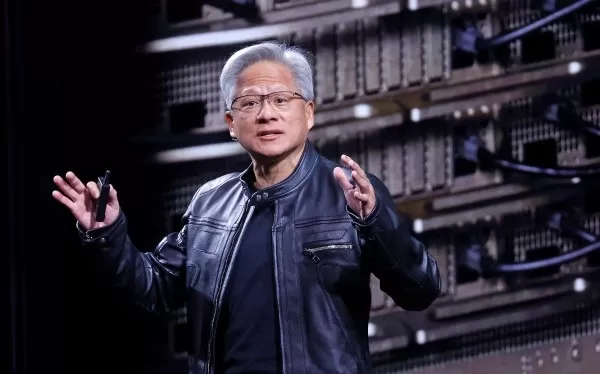
Nvidia founder and CEO Jensen Huang stands out as one of the most compelling corporate visionaries, if not the greatest, in driving his company’s narrative. He may even eclipse Salesforce’s Marc Benioff in his unwavering optimism regarding the firm’s future prospects and revenue streams.
Yet, he consistently backs up this enthusiasm with results, quarter after quarter.
Rather than urging skepticism toward his claim of discovering a “brand new $200 billion TAM for Nvidia,” I believe he has earned a measure of credibility.
Huang attributed this massive new market opportunity to Nvidia’s latest CPU offering, Vera, launched in March. During Wednesday’s earnings call—following another record-breaking quarter with $81.6 billion in revenue and a forecast of $91 billion for the next period—Huang presented Vera as a potentially transformative product with promising early sales.
However, regardless of Nvidia’s performance, Wall Street remains anxious about what might displace the company from its dominant position.
Recently, these concerns have focused on CPUs. While Nvidia reigns supreme in GPUs, the CPU market has historically been dominated by companies like Intel and AMD. (Nvidia has produced CPUs before, but that was never its core business.)
For instance, last month, Amazon Web Services highlighted a major contract with Meta for millions of its proprietary AI CPUs. AWS CEO Andy Jassy has made it clear that he believes AWS can produce AI chips, both GPUs and CPUs, at least as effectively, if not better, than Nvidia.
Now, with the Vera CPU—sold separately and bundled with the Rubin GPU—Huang believes he has unlocked “a major new growth driver” for his company. He stated on the call that Vera is “the world’s first CPU, purpose-built for agentic AI.”
“Vera opens a brand new $200 billion TAM for Nvidia, a market we have never addressed before, and every major hyperscaler and system maker is partnering with us to deploy it. The world is rebuilding computing for agentic AI and robotic physical AI. Nvidia sits at the center of these transitions,” Huang declared, embracing his role as a visionary promoter.
He explained that while the “thinking” component of an AI model relies on GPUs, agents primarily operate on CPUs. These agents use CPUs to execute assigned tasks and will, he predicts, run their own version of CPU-driven personal computers.
Vera is designed specifically for agents because it is optimized to process tokens at maximum speed. This contrasts with traditional cloud architecture CPUs, which are designed with “cores” to run multiple application instances as efficiently as possible.
This logic seems sound, but with major cloud providers and startups actively pursuing AI chip development, what convinces him that Nvidia will be the preferred source for agentic CPUs?
According to Huang, it is because Nvidia has already sold $20 billion worth of standalone Vera CPUs this year, and we are only at the beginning.
“The world has a billion users, human users. My sense is that the world is going to have billions of agents, not today. I mean, we’re going to grow into it, but we’ll have billions of agents, and those billions of agents will all use tools. And those tools are going to be like PCs, just like us humans using PCs today,” he remarked.
“We’re going to need a lot more CPUs,” he concluded.
Related article
 OneRail Leverages Nvidia AI to Optimize Real-Time Last-Mile Delivery
OneRail has introduced an AI-driven delivery platform leveraging Nvidia technology to assist retailers, wholesalers, and distributors in determining the most efficient delivery methods for individual orders.Named OmniSTAR, the system assesses various
Apple's New Hardware Chief John Ternus Steers Vision for Future Products
Loading the player…The Ternus era at Apple has officially begun.Tim Cook stepped down as CEO this week, handing leadership to former hardware chief John Ternus. Ternus’s first memo promised a “huge launch next week,” meaning the next iPhone event lan
Groq raises $350M to fuel its pivot from AI chips to neocloud
AI infrastructure firm Groq has secured $350 million in fresh funding, marking its ongoing transition from a specialized chip developer to a neocloud provider offering robust GPU and AI infrastructure services.Backed by Disruptive Technologies, with
Related Special Topic Recommendations
Comic Creation
OneRail Leverages Nvidia AI to Optimize Real-Time Last-Mile Delivery
OneRail has introduced an AI-driven delivery platform leveraging Nvidia technology to assist retailers, wholesalers, and distributors in determining the most efficient delivery methods for individual orders.Named OmniSTAR, the system assesses various
Apple's New Hardware Chief John Ternus Steers Vision for Future Products
Loading the player…The Ternus era at Apple has officially begun.Tim Cook stepped down as CEO this week, handing leadership to former hardware chief John Ternus. Ternus’s first memo promised a “huge launch next week,” meaning the next iPhone event lan
Groq raises $350M to fuel its pivot from AI chips to neocloud
AI infrastructure firm Groq has secured $350 million in fresh funding, marking its ongoing transition from a specialized chip developer to a neocloud provider offering robust GPU and AI infrastructure services.Backed by Disruptive Technologies, with
Related Special Topic Recommendations
Comic Creation
 Best AI Comic Generators: Turn Story Ideas into Illustrated Panels
2026 Latest Best Top-rated AI Comic Generators ranked by actual user performance. This curated collection features powerful game-changing tools that help creators turn unique story ideas into polished illustrated panels fast, boosting productivity significantly. XIX.AI offers a detailed free vs paid comparison along with real-world tests to guide your choice. Explore now and Discover your perfect tool to unlock your AI edge in comic creation.
 15 tools
 xix.ai
Animation Creation
AI Scene Animation Tools for Social Media Content
xix.ai
Animation Creation
AI Scene Animation Tools for Social Media Content
2026 Latest Best Top-rated AI Scene Animation Tools for Social Media Content are curated here by XIX.AI. These powerful game-changing tools offer real-world tests and detailed free vs paid comparison, helping creators boost productivity significantly. Explore now to unlock your AI edge.
9 tools
xix.ai
Video creation
AI Short-Form Video Hook Generators for Reels, Shorts, and Product Launch Campaigns
2026 Latest Best AI Short-Form Video Hook Generators for Reels Shorts and Product Launch Campaigns! XIX.AI curates top-rated powerful game-changing tools that deliver must-try results through real-world tests. This weekly updated page offers free vs paid comparison rankings to help you find the perfect solution for boosting content creativity and productivity. Explore now to Unlock your AI edge!
11 tools
xix.ai
writing
AI Article Outline Tools for Long Form Writing
2026 Latest Best Top-Rated AI Article Outline Tools for Long Form Writing! This curated collection features powerful, game-changing tools that deliver accurate, structured outlines with real-world tests to boost writing efficiency significantly. XIX.AI is part of this elite selection. Get a free vs paid comparison to help you choose the perfect tool. Explore now and Unlock your AI edge!
9 tools
xix.ai
chatbot
Best AI Roleplay Chat Apps for Language Practice, Interview Prep, and Daily Fluency
2026 Latest Best Top-rated AI Roleplay Chat Apps for Language Practice, Interview Prep, and Daily Fluency! XIX.AI curates a powerful game-changing collection that offers free vs paid comparison, real-world tests, and updated rankings weekly. These must-try tools help you boost writing skills, overcome fluency challenges, and improve communication efficiency across all daily scenarios. Explore now to discover your perfect tool for language growth!
10 tools
xix.ai
Music composition
AI Stem Separation Tools for Remix Production, Sampling Prep, and Karaoke Masters
2026 Latest Best Top-rated AI Stem Separation Tools Curated for Remix Production, Sampling Prep, and Karaoke Masters. These powerful game-changing tools offer real-world tests to deliver precise audio isolation, boosting productivity significantly. XIX.AI provides a weekly updated free vs paid comparison guide to help you find the must-try solution that suits your needs. Explore now to unlock your AI edge.
8 tools
xix.ai

 Comments (0)
0/500
Comments (0)
0/500
Nvidia founder and CEO Jensen Huang stands out as one of the most compelling corporate visionaries, if not the greatest, in driving his company’s narrative. He may even eclipse Salesforce’s Marc Benioff in his unwavering optimism regarding the firm’s future prospects and revenue streams.
Yet, he consistently backs up this enthusiasm with results, quarter after quarter.
Rather than urging skepticism toward his claim of discovering a “brand new $200 billion TAM for Nvidia,” I believe he has earned a measure of credibility.
Huang attributed this massive new market opportunity to Nvidia’s latest CPU offering, Vera, launched in March. During Wednesday’s earnings call—following another record-breaking quarter with $81.6 billion in revenue and a forecast of $91 billion for the next period—Huang presented Vera as a potentially transformative product with promising early sales.
However, regardless of Nvidia’s performance, Wall Street remains anxious about what might displace the company from its dominant position.
Recently, these concerns have focused on CPUs. While Nvidia reigns supreme in GPUs, the CPU market has historically been dominated by companies like Intel and AMD. (Nvidia has produced CPUs before, but that was never its core business.)
For instance, last month, Amazon Web Services highlighted a major contract with Meta for millions of its proprietary AI CPUs. AWS CEO Andy Jassy has made it clear that he believes AWS can produce AI chips, both GPUs and CPUs, at least as effectively, if not better, than Nvidia.
Now, with the Vera CPU—sold separately and bundled with the Rubin GPU—Huang believes he has unlocked “a major new growth driver” for his company. He stated on the call that Vera is “the world’s first CPU, purpose-built for agentic AI.”
“Vera opens a brand new $200 billion TAM for Nvidia, a market we have never addressed before, and every major hyperscaler and system maker is partnering with us to deploy it. The world is rebuilding computing for agentic AI and robotic physical AI. Nvidia sits at the center of these transitions,” Huang declared, embracing his role as a visionary promoter.
He explained that while the “thinking” component of an AI model relies on GPUs, agents primarily operate on CPUs. These agents use CPUs to execute assigned tasks and will, he predicts, run their own version of CPU-driven personal computers.
Vera is designed specifically for agents because it is optimized to process tokens at maximum speed. This contrasts with traditional cloud architecture CPUs, which are designed with “cores” to run multiple application instances as efficiently as possible.
This logic seems sound, but with major cloud providers and startups actively pursuing AI chip development, what convinces him that Nvidia will be the preferred source for agentic CPUs?
According to Huang, it is because Nvidia has already sold $20 billion worth of standalone Vera CPUs this year, and we are only at the beginning.
“The world has a billion users, human users. My sense is that the world is going to have billions of agents, not today. I mean, we’re going to grow into it, but we’ll have billions of agents, and those billions of agents will all use tools. And those tools are going to be like PCs, just like us humans using PCs today,” he remarked.
“We’re going to need a lot more CPUs,” he concluded.








 OneRail Leverages Nvidia AI to Optimize Real-Time Last-Mile Delivery
OneRail has introduced an AI-driven delivery platform leveraging Nvidia technology to assist retailers, wholesalers, and distributors in determining the most efficient delivery methods for individual orders.Named OmniSTAR, the system assesses various
OneRail Leverages Nvidia AI to Optimize Real-Time Last-Mile Delivery
OneRail has introduced an AI-driven delivery platform leveraging Nvidia technology to assist retailers, wholesalers, and distributors in determining the most efficient delivery methods for individual orders.Named OmniSTAR, the system assesses various
 Apple's New Hardware Chief John Ternus Steers Vision for Future Products
Loading the player…The Ternus era at Apple has officially begun.Tim Cook stepped down as CEO this week, handing leadership to former hardware chief John Ternus. Ternus’s first memo promised a “huge launch next week,” meaning the next iPhone event lan
Apple's New Hardware Chief John Ternus Steers Vision for Future Products
Loading the player…The Ternus era at Apple has officially begun.Tim Cook stepped down as CEO this week, handing leadership to former hardware chief John Ternus. Ternus’s first memo promised a “huge launch next week,” meaning the next iPhone event lan
 Groq raises $350M to fuel its pivot from AI chips to neocloud
AI infrastructure firm Groq has secured $350 million in fresh funding, marking its ongoing transition from a specialized chip developer to a neocloud provider offering robust GPU and AI infrastructure services.Backed by Disruptive Technologies, with
Groq raises $350M to fuel its pivot from AI chips to neocloud
AI infrastructure firm Groq has secured $350 million in fresh funding, marking its ongoing transition from a specialized chip developer to a neocloud provider offering robust GPU and AI infrastructure services.Backed by Disruptive Technologies, with

2026 Latest Best Top-rated AI Comic Generators ranked by actual user performance. This curated collection features powerful game-changing tools that help creators turn unique story ideas into polished illustrated panels fast, boosting productivity significantly. XIX.AI offers a detailed free vs paid comparison along with real-world tests to guide your choice. Explore now and Discover your perfect tool to unlock your AI edge in comic creation.
15 tools
xix.ai

2026 Latest Best Top-rated AI Scene Animation Tools for Social Media Content are curated here by XIX.AI. These powerful game-changing tools offer real-world tests and detailed free vs paid comparison, helping creators boost productivity significantly. Explore now to unlock your AI edge.
9 tools
xix.ai

2026 Latest Best AI Short-Form Video Hook Generators for Reels Shorts and Product Launch Campaigns! XIX.AI curates top-rated powerful game-changing tools that deliver must-try results through real-world tests. This weekly updated page offers free vs paid comparison rankings to help you find the perfect solution for boosting content creativity and productivity. Explore now to Unlock your AI edge!
11 tools
xix.ai

2026 Latest Best Top-Rated AI Article Outline Tools for Long Form Writing! This curated collection features powerful, game-changing tools that deliver accurate, structured outlines with real-world tests to boost writing efficiency significantly. XIX.AI is part of this elite selection. Get a free vs paid comparison to help you choose the perfect tool. Explore now and Unlock your AI edge!
9 tools
xix.ai

2026 Latest Best Top-rated AI Roleplay Chat Apps for Language Practice, Interview Prep, and Daily Fluency! XIX.AI curates a powerful game-changing collection that offers free vs paid comparison, real-world tests, and updated rankings weekly. These must-try tools help you boost writing skills, overcome fluency challenges, and improve communication efficiency across all daily scenarios. Explore now to discover your perfect tool for language growth!
10 tools
xix.ai
2026 Latest Best Top-rated AI Stem Separation Tools Curated for Remix Production, Sampling Prep, and Karaoke Masters. These powerful game-changing tools offer real-world tests to deliver precise audio isolation, boosting productivity significantly. XIX.AI provides a weekly updated free vs paid comparison guide to help you find the must-try solution that suits your needs. Explore now to unlock your AI edge.
8 tools
xix.ai












