


 Home
HomeInspiration Fuels Side Hustles as Independent Workers Rise
The Spring Festival holiday witnessed the rise of a "handcrafted economy."
AIbase observed that numerous users shared and sold their handcrafted flash apps via the Lingguang App on social platforms, with single mini-apps selling from hundreds to thousands of units. The barrier to creating these flash apps is remarkably low; users can converse with the Lingguang App using natural language to build interactive mini-applications at zero cost, with no coding required. Due to its ease of production and no restrictions on the field, it has become a popular "side hustle" for young people. For instance, one user created a personal growth goal tracker called "36 10-Day Goals" to aid their self-improvement and listed it in their personal store. It not only accumulated nearly a thousand orders but also received numerous positive reviews, with buyers praising its "simple interface and lack of intrusive ads." According to an incomplete statistical report, on one social media platform alone, personal growth mini-apps built with Lingguang had already sold thousands of units.
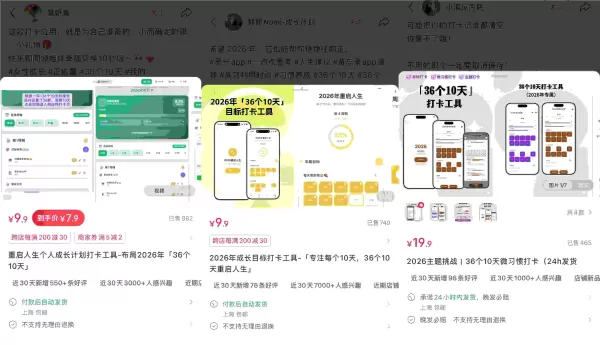
(Check-in style apps crafted by Lingguang users have received close to a thousand orders)
As AI gradually evolves from "content generation" to "tool creation," individuals without programming backgrounds can now produce interactive digital tools at minimal cost. On just one social media platform, multiple Lingguang flash apps were found being sold. Beyond the ultra-low-barrier AI app Lingguang, users can also gain app-crafting capabilities without writing code through various code large language models and intelligent agent platforms.
According to AIbase's observations, as handcrafted apps gain popularity, a niche business of "debugging handcrafted apps" has emerged on social platforms, teaching beginners how to craft applications. An entire ecosystem around "app crafting" is beginning to take shape.
The term "handcrafting" originally described playing computer games without using shortcut keys, relying entirely on manual input. In recent years, with advancements in AI technology, it has become commonly associated with individuals using AI to develop programs and applications. Last November, the launch of the Lingguang App, with its flagship feature—flash apps—empowered ordinary people to create apps with minimal barriers, truly igniting the first wave of mass app handcrafting. Reports indicate that within a month of its launch, over 12 million handcrafted mini-apps were created on Lingguang.
According to information released by Ant Group's AI assistant, the Lingguang App, during this Spring Festival, users employed natural language instructions to "craft" personalized mini-applications covering scenarios like travel, parent-child education, cultural tourism guidance, and elderly care. People created mini-apps such as "homework assignment manager," "household chore motivation chart," and "vocabulary challenge game" to address fragmented needs in daily life.
The emergence of the "handcrafted economy" reflects a shift in AI development—from pursuing general capabilities to focusing on practical, scenario-specific value. However, current "handcrafted" tools are primarily concentrated in lightweight scenarios, and complex application logic (such as payment systems and multi-device collaboration) still requires professional development.
Related article
 DeepMind CEO Hassabis: I sleep six hours a day, usually feel energetic around 1 a.m.
Fortune recently featured an interview with Demis Hassabis, CEO of Google DeepMind, revealing his unconventional approach to rest and productivity. Hassabis disclosed that he sleeps very little, structuring his waking hours into two distinct work blo
OpenAI, Anthropic Vie for Market Share Despite Revenue Shortfalls
Despite recent reports suggesting OpenAI missed revenue targets, creating pressure on tech stocks this Tuesday, private AI lab investors remain resilient. Seasoned backers have confirmed they will not reduce investment despite negative media coverage
California AV Compliance: A New Era of Tickets, Geofences, and 1M Miles
Guident operates an AuveTech shuttle in South Florida, managing a four-mile route in West Palm Beach and a one-mile route in Boca Raton using its remote monitoring technology. | Credit: GuidentCalifornia is redefining the regulatory landscape for dri
Related Special Topic Recommendations
Video creation
DeepMind CEO Hassabis: I sleep six hours a day, usually feel energetic around 1 a.m.
Fortune recently featured an interview with Demis Hassabis, CEO of Google DeepMind, revealing his unconventional approach to rest and productivity. Hassabis disclosed that he sleeps very little, structuring his waking hours into two distinct work blo
OpenAI, Anthropic Vie for Market Share Despite Revenue Shortfalls
Despite recent reports suggesting OpenAI missed revenue targets, creating pressure on tech stocks this Tuesday, private AI lab investors remain resilient. Seasoned backers have confirmed they will not reduce investment despite negative media coverage
California AV Compliance: A New Era of Tickets, Geofences, and 1M Miles
Guident operates an AuveTech shuttle in South Florida, managing a four-mile route in West Palm Beach and a one-mile route in Boca Raton using its remote monitoring technology. | Credit: GuidentCalifornia is redefining the regulatory landscape for dri
Related Special Topic Recommendations
Video creation
 AI Short-Form Video Hook Generators for Reels, Shorts, and Product Launch Campaigns
2026 Latest Best AI Short-Form Video Hook Generators for Reels Shorts and Product Launch Campaigns! XIX.AI curates top-rated powerful game-changing tools that deliver must-try results through real-world tests. This weekly updated page offers free vs paid comparison rankings to help you find the perfect solution for boosting content creativity and productivity. Explore now to Unlock your AI edge!
 11 tools
 xix.ai
writing
AI Article Outline Tools for Long Form Writing
xix.ai
writing
AI Article Outline Tools for Long Form Writing
2026 Latest Best Top-Rated AI Article Outline Tools for Long Form Writing! This curated collection features powerful, game-changing tools that deliver accurate, structured outlines with real-world tests to boost writing efficiency significantly. XIX.AI is part of this elite selection. Get a free vs paid comparison to help you choose the perfect tool. Explore now and Unlock your AI edge!
9 tools
xix.ai
chatbot
Best AI Roleplay Chat Apps for Language Practice, Interview Prep, and Daily Fluency
2026 Latest Best Top-rated AI Roleplay Chat Apps for Language Practice, Interview Prep, and Daily Fluency! XIX.AI curates a powerful game-changing collection that offers free vs paid comparison, real-world tests, and updated rankings weekly. These must-try tools help you boost writing skills, overcome fluency challenges, and improve communication efficiency across all daily scenarios. Explore now to discover your perfect tool for language growth!
10 tools
xix.ai
Music composition
AI Stem Separation Tools for Remix Production, Sampling Prep, and Karaoke Masters
2026 Latest Best Top-rated AI Stem Separation Tools Curated for Remix Production, Sampling Prep, and Karaoke Masters. These powerful game-changing tools offer real-world tests to deliver precise audio isolation, boosting productivity significantly. XIX.AI provides a weekly updated free vs paid comparison guide to help you find the must-try solution that suits your needs. Explore now to unlock your AI edge.
8 tools
xix.ai
Data Analysis
AI SQL Copilots for Revenue Dashboards, Funnel Analysis, and Product Metrics
2026 Latest Best AI SQL Copilots Ranked Top-Rated! XIX.AI curates a powerful game-changing collection for weekly updated real-world tests. These must-try tools help you generate accurate revenue dashboards, analyze sales funnels, and track product metrics swiftly, boosting productivity massively. Explore now to Discover your perfect tool for data-driven decision making! 238 characters
9 tools
xix.ai
Music composition
Best AI Melody Writing Tools for Song Drafts
2026 Latest Best Top-Rated AI Melody Writing Tools for Song Drafts! XIX.AI has curated a highly powerful game-changing collection that goes through rigorous real-world tests to deliver the best writing experience. You can find detailed free vs paid comparisons, accurate rankings, and must-try options designed to help you create stunning song drafts effortlessly and boost your creative productivity significantly. Explore now to discover your perfect tool!
8 tools
xix.ai

 Comments (4)
0/500
Comments (4)
0/500
![JackCarter]()
Crazy how the Spring Festival 'handcrafted economy' is booming! Selling mini-apps for hundreds or thousands? That's a serious side hustle. AI really is fueling these independent workers. 🚀
![AnthonyPerez]()
Wait, so people are actually selling flash apps they made during Spring Festival? That's wild. I've seen some on social media but never thought they'd go for hundreds. Makes me wonder if I should finally learn to code something simple and cash in. 😅
![EmmaJohnson]()
この記事を読んで、AIが個人の副業をこんなに変えるなんて驚きです。手作りアプリを売るって、まるでデジタル時代の職人みたいですね。でも、こういうプラットフォームって本当にクリエイターの権利を守れるのかな?ちょっと心配にもなります。🤔
![GeorgeThomas]()
哇,這個『手工經濟』的現象真有趣!春節期間大家居然在社交平台賣自己做的閃光小程式,價格從幾百到幾千都有。這讓我想到,AI工具降低了創作門檻,是不是也讓更多人有機會把靈感變現?不過市場會不會很快飽和啊?😂
The Spring Festival holiday witnessed the rise of a "handcrafted economy."
AIbase observed that numerous users shared and sold their handcrafted flash apps via the Lingguang App on social platforms, with single mini-apps selling from hundreds to thousands of units. The barrier to creating these flash apps is remarkably low; users can converse with the Lingguang App using natural language to build interactive mini-applications at zero cost, with no coding required. Due to its ease of production and no restrictions on the field, it has become a popular "side hustle" for young people. For instance, one user created a personal growth goal tracker called "36 10-Day Goals" to aid their self-improvement and listed it in their personal store. It not only accumulated nearly a thousand orders but also received numerous positive reviews, with buyers praising its "simple interface and lack of intrusive ads." According to an incomplete statistical report, on one social media platform alone, personal growth mini-apps built with Lingguang had already sold thousands of units.
(Check-in style apps crafted by Lingguang users have received close to a thousand orders)
As AI gradually evolves from "content generation" to "tool creation," individuals without programming backgrounds can now produce interactive digital tools at minimal cost. On just one social media platform, multiple Lingguang flash apps were found being sold. Beyond the ultra-low-barrier AI app Lingguang, users can also gain app-crafting capabilities without writing code through various code large language models and intelligent agent platforms.
According to AIbase's observations, as handcrafted apps gain popularity, a niche business of "debugging handcrafted apps" has emerged on social platforms, teaching beginners how to craft applications. An entire ecosystem around "app crafting" is beginning to take shape.
The term "handcrafting" originally described playing computer games without using shortcut keys, relying entirely on manual input. In recent years, with advancements in AI technology, it has become commonly associated with individuals using AI to develop programs and applications. Last November, the launch of the Lingguang App, with its flagship feature—flash apps—empowered ordinary people to create apps with minimal barriers, truly igniting the first wave of mass app handcrafting. Reports indicate that within a month of its launch, over 12 million handcrafted mini-apps were created on Lingguang.
According to information released by Ant Group's AI assistant, the Lingguang App, during this Spring Festival, users employed natural language instructions to "craft" personalized mini-applications covering scenarios like travel, parent-child education, cultural tourism guidance, and elderly care. People created mini-apps such as "homework assignment manager," "household chore motivation chart," and "vocabulary challenge game" to address fragmented needs in daily life.
The emergence of the "handcrafted economy" reflects a shift in AI development—from pursuing general capabilities to focusing on practical, scenario-specific value. However, current "handcrafted" tools are primarily concentrated in lightweight scenarios, and complex application logic (such as payment systems and multi-device collaboration) still requires professional development.








 DeepMind CEO Hassabis: I sleep six hours a day, usually feel energetic around 1 a.m.
Fortune recently featured an interview with Demis Hassabis, CEO of Google DeepMind, revealing his unconventional approach to rest and productivity. Hassabis disclosed that he sleeps very little, structuring his waking hours into two distinct work blo
DeepMind CEO Hassabis: I sleep six hours a day, usually feel energetic around 1 a.m.
Fortune recently featured an interview with Demis Hassabis, CEO of Google DeepMind, revealing his unconventional approach to rest and productivity. Hassabis disclosed that he sleeps very little, structuring his waking hours into two distinct work blo
 OpenAI, Anthropic Vie for Market Share Despite Revenue Shortfalls
Despite recent reports suggesting OpenAI missed revenue targets, creating pressure on tech stocks this Tuesday, private AI lab investors remain resilient. Seasoned backers have confirmed they will not reduce investment despite negative media coverage
California AV Compliance: A New Era of Tickets, Geofences, and 1M Miles
Guident operates an AuveTech shuttle in South Florida, managing a four-mile route in West Palm Beach and a one-mile route in Boca Raton using its remote monitoring technology. | Credit: GuidentCalifornia is redefining the regulatory landscape for dri
OpenAI, Anthropic Vie for Market Share Despite Revenue Shortfalls
Despite recent reports suggesting OpenAI missed revenue targets, creating pressure on tech stocks this Tuesday, private AI lab investors remain resilient. Seasoned backers have confirmed they will not reduce investment despite negative media coverage
California AV Compliance: A New Era of Tickets, Geofences, and 1M Miles
Guident operates an AuveTech shuttle in South Florida, managing a four-mile route in West Palm Beach and a one-mile route in Boca Raton using its remote monitoring technology. | Credit: GuidentCalifornia is redefining the regulatory landscape for dri

2026 Latest Best AI Short-Form Video Hook Generators for Reels Shorts and Product Launch Campaigns! XIX.AI curates top-rated powerful game-changing tools that deliver must-try results through real-world tests. This weekly updated page offers free vs paid comparison rankings to help you find the perfect solution for boosting content creativity and productivity. Explore now to Unlock your AI edge!
11 tools
xix.ai

2026 Latest Best Top-Rated AI Article Outline Tools for Long Form Writing! This curated collection features powerful, game-changing tools that deliver accurate, structured outlines with real-world tests to boost writing efficiency significantly. XIX.AI is part of this elite selection. Get a free vs paid comparison to help you choose the perfect tool. Explore now and Unlock your AI edge!
9 tools
xix.ai

2026 Latest Best Top-rated AI Roleplay Chat Apps for Language Practice, Interview Prep, and Daily Fluency! XIX.AI curates a powerful game-changing collection that offers free vs paid comparison, real-world tests, and updated rankings weekly. These must-try tools help you boost writing skills, overcome fluency challenges, and improve communication efficiency across all daily scenarios. Explore now to discover your perfect tool for language growth!
10 tools
xix.ai
2026 Latest Best Top-rated AI Stem Separation Tools Curated for Remix Production, Sampling Prep, and Karaoke Masters. These powerful game-changing tools offer real-world tests to deliver precise audio isolation, boosting productivity significantly. XIX.AI provides a weekly updated free vs paid comparison guide to help you find the must-try solution that suits your needs. Explore now to unlock your AI edge.
8 tools
xix.ai

2026 Latest Best AI SQL Copilots Ranked Top-Rated! XIX.AI curates a powerful game-changing collection for weekly updated real-world tests. These must-try tools help you generate accurate revenue dashboards, analyze sales funnels, and track product metrics swiftly, boosting productivity massively. Explore now to Discover your perfect tool for data-driven decision making! 238 characters
9 tools
xix.ai

2026 Latest Best Top-Rated AI Melody Writing Tools for Song Drafts! XIX.AI has curated a highly powerful game-changing collection that goes through rigorous real-world tests to deliver the best writing experience. You can find detailed free vs paid comparisons, accurate rankings, and must-try options designed to help you create stunning song drafts effortlessly and boost your creative productivity significantly. Explore now to discover your perfect tool!
8 tools
xix.ai

Crazy how the Spring Festival 'handcrafted economy' is booming! Selling mini-apps for hundreds or thousands? That's a serious side hustle. AI really is fueling these independent workers. 🚀
Wait, so people are actually selling flash apps they made during Spring Festival? That's wild. I've seen some on social media but never thought they'd go for hundreds. Makes me wonder if I should finally learn to code something simple and cash in. 😅
この記事を読んで、AIが個人の副業をこんなに変えるなんて驚きです。手作りアプリを売るって、まるでデジタル時代の職人みたいですね。でも、こういうプラットフォームって本当にクリエイターの権利を守れるのかな?ちょっと心配にもなります。🤔
哇,這個『手工經濟』的現象真有趣!春節期間大家居然在社交平台賣自己做的閃光小程式,價格從幾百到幾千都有。這讓我想到,AI工具降低了創作門檻,是不是也讓更多人有機會把靈感變現?不過市場會不會很快飽和啊?😂












