


 Home
HomeVibe-Coding Mobile Apps Struggle to Find User Adoption
Although numerous vibe coding startups have achieved unicorn status with billion-dollar valuations, AI-assisted coding has yet to make significant inroads on mobile devices. Despite the growing number of apps offering vibe coding tools on mobile platforms, none have garnered substantial download numbers, and very few are generating meaningful revenue.
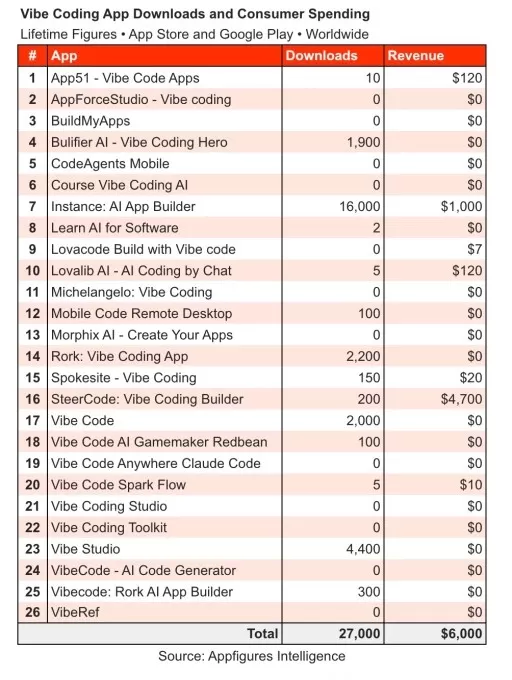
An analysis of global app store trends by app intelligence firm Appfigures reveals that only a small selection of mobile apps providing vibe coding tools have attracted any downloads, with even fewer managing to produce revenue.
The most prominent example, Instance: AI App Builder, has reached just 16,000 downloads with approximately $1,000 in consumer spending. The next largest, Vibe Studio, has achieved only 4,000 downloads and has not earned any income.
Screenshot from Appfigures This landscape could still shift, of course. The market is nascent, and vibe coding applications continue to evolve and resolve technical issues.
New entrants in this space are consistently emerging. This year, a startup named Vibecode launched with $9.4 million in seed funding from Reddit co-founder Alexis Ohanian’s venture firm, Seven Seven Six. Its service enables users to build mobile applications using AI directly within its iOS app. Since Vibecode is so new, Appfigures has not yet collected performance data for it.
For the time being, most individuals experimenting with vibe coding technology are doing so on desktop computers. However, vibe coding does maintain another form of presence on mobile devices: it is increasingly powering the development of existing mobile applications.
For example, RevenueCat, a subscription platform provider now utilized by over 50,000 apps, reports that it handles in-app purchases for more than 50% of all AI-built iOS apps available today.
The company informed TechCrunch that the proportion of new signups originating from an AI assistant or platform—meaning an AI chatbot recommended its service—jumped to over 35% in the second quarter of this year, a significant increase from under 5% during the same period last year.
RevenueCat, which is already employed by nearly half of all monetized mobile apps, observes that vibe coders are leveraging its service to automatically set up subscriptions using tools like Cursor and Claude Code via its RevenueCat MCP server. This allows developers to swiftly create subscription models and test various plans and features.
While interest in vibe coding is undoubtedly growing, the general consensus is that the technology is not yet mature enough for widespread, mainstream adoption.
TechCrunch recently interviewed developers working with AI-generated code, who indicated that the technology still requires substantial refinement. A separate survey from Fastly found that approximately 95% of the nearly 800 developers surveyed reported needing to dedicate extra time to correct issues in AI-generated code.
Despite these challenges, user demand persists. A 2025 Stack Overflow survey indicated that 84% of respondents are currently using or planning to use AI tools in their development workflow, up from 76% the previous year. Another survey conducted this summer by The Information found that 75% of respondents had at least experimented with vibe coding. A May 2025 study by the software intelligence platform Jellyfish, as reported by Business Insider, revealed that 90% of developers had integrated AI into their work, a notable rise from 61% the year before.
Related article
 Google AI Overviews Gain Ground in Search Results
According to Similarweb’s 2026 Generative AI Landscape report, Google’s AI-generated summaries appeared in 43% of US searches, a significant rise from 15% recorded a year prior.While AI Overviews present generated summaries within standard search res
Sequoia-backed Empirik raises $21M to forecast outages before they strike
Before joining Sequoia Capital in 2020 as chief digital and information officer, Avon Puri spent over a decade running infrastructure at Rubrik and VMware. Three years ago, as large language models began showing their true potential, Puri, alongside
Meta's Muse outpaces ChatGPT in early mobile launch
New data suggests Meta’s latest AI app, Muse, could become the social giant’s next major success. According to recent estimates from Appfigures, Muse has been downloaded on mobile devices more times in its first twelve days than ChatGPT did in the tw
Related Special Topic Recommendations
Design & Art
Google AI Overviews Gain Ground in Search Results
According to Similarweb’s 2026 Generative AI Landscape report, Google’s AI-generated summaries appeared in 43% of US searches, a significant rise from 15% recorded a year prior.While AI Overviews present generated summaries within standard search res
Sequoia-backed Empirik raises $21M to forecast outages before they strike
Before joining Sequoia Capital in 2020 as chief digital and information officer, Avon Puri spent over a decade running infrastructure at Rubrik and VMware. Three years ago, as large language models began showing their true potential, Puri, alongside
Meta's Muse outpaces ChatGPT in early mobile launch
New data suggests Meta’s latest AI app, Muse, could become the social giant’s next major success. According to recent estimates from Appfigures, Muse has been downloaded on mobile devices more times in its first twelve days than ChatGPT did in the tw
Related Special Topic Recommendations
Design & Art
 Top AI Illustration Tools: Create Editorial Scenes and Cover Art Faster
2026 Latest Top-rated AI Illustration Tools: Our curated list features the best powerfully designed tools for creating stunning editorial scenes and eye-catching cover art quickly. Each option has gone through rigorous real-world tests, offering a free vs paid comparison to help you find the perfect match for your workflow. Try these must-try solutions today to unlock your AI edge and boost your creative productivity. Explore now at XIX.AI.
 10 tools
 xix.ai
Education and Learning
Top AI Tutors for Exam Prep: Practice Math, Science, and English
xix.ai
Education and Learning
Top AI Tutors for Exam Prep: Practice Math, Science, and English
2026 Latest Top-Rated Best AI Tutors for Exam Prep are here on XIX.AI! Our curated list features powerful game-changing tools that offer free vs paid comparison, real-world tests, and weekly updated rankings. They help boost your writing efficiency, simplify complex topic learning, and unlock your academic potential. Explore now to Discover your perfect exam prep tool and Start creating today to Unlock your AI edge!
10 tools
xix.ai
Finance
AI Budget Planning Tools for Personal Money Management
2026 Latest Best Top-Rated AI Budget Planning Tools for Personal Money Management are here on XIX.AI! This curated collection features powerful, game-changing solutions that help you conduct real-world tests, understand spending habits, and create personalized plans to boost productivity. Enjoy a free vs paid comparison along with detailed rankings. Must-try tools designed to simplify money management and unlock your AI edge. Explore now!
11 tools
xix.ai
Health & Wellness
AI Sleep Tracking Assistants: Improve Recovery with Better Bedtime Habits
2026 Latest Best Top-Rated AI Sleep Tracking Assistants curated for ultimate recovery. This fully updated weekly guide features powerful tools that deliver real-world tests, free vs paid comparison, and detailed rankings to help you find the must-try solution that boosts sleep quality and supports better bedtime habits. Explore now at XIX.AI to Unlock your AI edge.
10 tools
xix.ai
Data Analysis
AI SQL Copilots for Product and Revenue Analytics
2026 Latest Best Top-Rated AI SQL Copilots for Product and Revenue Analytics! XIX.AI has curated a powerful, game-changing collection of must-try tools that undergo real-world tests through weekly updated rankings. These tools help users boost productivity significantly by accelerating data analysis, streamlining complex queries, and generating accurate insights to drive smarter business decisions. Explore now to Discover your perfect tool for unlocking your AI edge!
14 tools
xix.ai
Education and Learning
Best AI Homework Helpers That Teach: Learn Concepts, Not Just Answers
2026 Latest Best Top-Rated AI Homework Helpers That Teach Core Concepts Not Just Answers Powerful Tools for Students Must-Try Curated List Weekly Updated Free vs Paid Comparison Real-World Tests Accurate Rankings to Help You Unlock Your Full Learning Potential Explore now to Discover your perfect tool for smarter studying.
10 tools
xix.ai

 Comments (1)
0/500
Comments (1)
0/500
![ThomasRoberts]()
看完有點感觸,AI寫程式在電腦上好像很炫,但手機App用起來總覺得卡卡的,大概螢幕小、操作不順手吧。會不會是因為開發者自己都比較習慣用筆電寫code,所以手機版就隨便做做?😂 不過,如果哪天真的能在捷運上用手機順順寫程式,感覺會很酷,希望廠商能多優化介面跟體驗。
Although numerous vibe coding startups have achieved unicorn status with billion-dollar valuations, AI-assisted coding has yet to make significant inroads on mobile devices. Despite the growing number of apps offering vibe coding tools on mobile platforms, none have garnered substantial download numbers, and very few are generating meaningful revenue.
An analysis of global app store trends by app intelligence firm Appfigures reveals that only a small selection of mobile apps providing vibe coding tools have attracted any downloads, with even fewer managing to produce revenue.
The most prominent example, Instance: AI App Builder, has reached just 16,000 downloads with approximately $1,000 in consumer spending. The next largest, Vibe Studio, has achieved only 4,000 downloads and has not earned any income.
This landscape could still shift, of course. The market is nascent, and vibe coding applications continue to evolve and resolve technical issues.
New entrants in this space are consistently emerging. This year, a startup named Vibecode launched with $9.4 million in seed funding from Reddit co-founder Alexis Ohanian’s venture firm, Seven Seven Six. Its service enables users to build mobile applications using AI directly within its iOS app. Since Vibecode is so new, Appfigures has not yet collected performance data for it.
For the time being, most individuals experimenting with vibe coding technology are doing so on desktop computers. However, vibe coding does maintain another form of presence on mobile devices: it is increasingly powering the development of existing mobile applications.
For example, RevenueCat, a subscription platform provider now utilized by over 50,000 apps, reports that it handles in-app purchases for more than 50% of all AI-built iOS apps available today.
The company informed TechCrunch that the proportion of new signups originating from an AI assistant or platform—meaning an AI chatbot recommended its service—jumped to over 35% in the second quarter of this year, a significant increase from under 5% during the same period last year.
RevenueCat, which is already employed by nearly half of all monetized mobile apps, observes that vibe coders are leveraging its service to automatically set up subscriptions using tools like Cursor and Claude Code via its RevenueCat MCP server. This allows developers to swiftly create subscription models and test various plans and features.
While interest in vibe coding is undoubtedly growing, the general consensus is that the technology is not yet mature enough for widespread, mainstream adoption.
TechCrunch recently interviewed developers working with AI-generated code, who indicated that the technology still requires substantial refinement. A separate survey from Fastly found that approximately 95% of the nearly 800 developers surveyed reported needing to dedicate extra time to correct issues in AI-generated code.
Despite these challenges, user demand persists. A 2025 Stack Overflow survey indicated that 84% of respondents are currently using or planning to use AI tools in their development workflow, up from 76% the previous year. Another survey conducted this summer by The Information found that 75% of respondents had at least experimented with vibe coding. A May 2025 study by the software intelligence platform Jellyfish, as reported by Business Insider, revealed that 90% of developers had integrated AI into their work, a notable rise from 61% the year before.








 Google AI Overviews Gain Ground in Search Results
According to Similarweb’s 2026 Generative AI Landscape report, Google’s AI-generated summaries appeared in 43% of US searches, a significant rise from 15% recorded a year prior.While AI Overviews present generated summaries within standard search res
Google AI Overviews Gain Ground in Search Results
According to Similarweb’s 2026 Generative AI Landscape report, Google’s AI-generated summaries appeared in 43% of US searches, a significant rise from 15% recorded a year prior.While AI Overviews present generated summaries within standard search res
 Sequoia-backed Empirik raises $21M to forecast outages before they strike
Before joining Sequoia Capital in 2020 as chief digital and information officer, Avon Puri spent over a decade running infrastructure at Rubrik and VMware. Three years ago, as large language models began showing their true potential, Puri, alongside
Sequoia-backed Empirik raises $21M to forecast outages before they strike
Before joining Sequoia Capital in 2020 as chief digital and information officer, Avon Puri spent over a decade running infrastructure at Rubrik and VMware. Three years ago, as large language models began showing their true potential, Puri, alongside
 Meta's Muse outpaces ChatGPT in early mobile launch
New data suggests Meta’s latest AI app, Muse, could become the social giant’s next major success. According to recent estimates from Appfigures, Muse has been downloaded on mobile devices more times in its first twelve days than ChatGPT did in the tw
Meta's Muse outpaces ChatGPT in early mobile launch
New data suggests Meta’s latest AI app, Muse, could become the social giant’s next major success. According to recent estimates from Appfigures, Muse has been downloaded on mobile devices more times in its first twelve days than ChatGPT did in the tw

2026 Latest Top-rated AI Illustration Tools: Our curated list features the best powerfully designed tools for creating stunning editorial scenes and eye-catching cover art quickly. Each option has gone through rigorous real-world tests, offering a free vs paid comparison to help you find the perfect match for your workflow. Try these must-try solutions today to unlock your AI edge and boost your creative productivity. Explore now at XIX.AI.
10 tools
xix.ai

2026 Latest Top-Rated Best AI Tutors for Exam Prep are here on XIX.AI! Our curated list features powerful game-changing tools that offer free vs paid comparison, real-world tests, and weekly updated rankings. They help boost your writing efficiency, simplify complex topic learning, and unlock your academic potential. Explore now to Discover your perfect exam prep tool and Start creating today to Unlock your AI edge!
10 tools
xix.ai

2026 Latest Best Top-Rated AI Budget Planning Tools for Personal Money Management are here on XIX.AI! This curated collection features powerful, game-changing solutions that help you conduct real-world tests, understand spending habits, and create personalized plans to boost productivity. Enjoy a free vs paid comparison along with detailed rankings. Must-try tools designed to simplify money management and unlock your AI edge. Explore now!
11 tools
xix.ai

2026 Latest Best Top-Rated AI Sleep Tracking Assistants curated for ultimate recovery. This fully updated weekly guide features powerful tools that deliver real-world tests, free vs paid comparison, and detailed rankings to help you find the must-try solution that boosts sleep quality and supports better bedtime habits. Explore now at XIX.AI to Unlock your AI edge.
10 tools
xix.ai

2026 Latest Best Top-Rated AI SQL Copilots for Product and Revenue Analytics! XIX.AI has curated a powerful, game-changing collection of must-try tools that undergo real-world tests through weekly updated rankings. These tools help users boost productivity significantly by accelerating data analysis, streamlining complex queries, and generating accurate insights to drive smarter business decisions. Explore now to Discover your perfect tool for unlocking your AI edge!
14 tools
xix.ai

2026 Latest Best Top-Rated AI Homework Helpers That Teach Core Concepts Not Just Answers Powerful Tools for Students Must-Try Curated List Weekly Updated Free vs Paid Comparison Real-World Tests Accurate Rankings to Help You Unlock Your Full Learning Potential Explore now to Discover your perfect tool for smarter studying.
10 tools
xix.ai

看完有點感觸,AI寫程式在電腦上好像很炫,但手機App用起來總覺得卡卡的,大概螢幕小、操作不順手吧。會不會是因為開發者自己都比較習慣用筆電寫code,所以手機版就隨便做做?😂 不過,如果哪天真的能在捷運上用手機順順寫程式,感覺會很酷,希望廠商能多優化介面跟體驗。












