


 Home
HomeCursor Composer 2 vs Claude Opus 4.6: Benchmark Test Ignites Fresh AI Coding Debate
On March 19, Cursor officially released its in-house coding model, Composer 2. The announcement sparked immediate discussion in the developer community – according to Cursor, Composer 2 scored 61.7% on Terminal-Bench 2.0, notably surpassing Claude Opus 4.6's 58.0% under identical test conditions.
Did Anthropic's flagship model get outperformed by a model built into its own IDE? As the news circulated, debates quickly emerged.
Three Key Benchmark Results
Cursor published three sets of benchmark results, all made public:
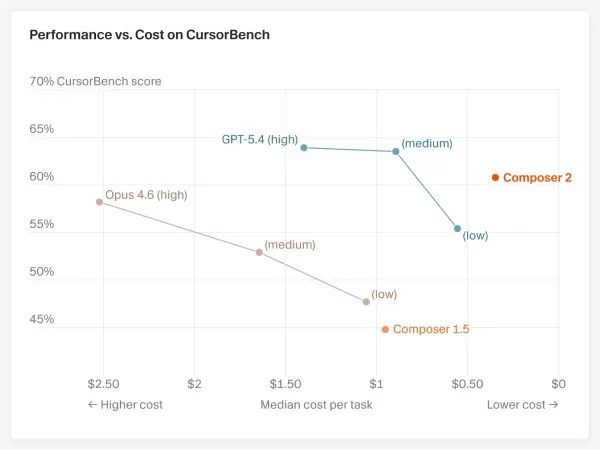
Terminal-Bench 2.0 (agent-style terminal coding tasks): Composer 2 scored 61.7%, beating Claude Opus 4.6's 58.0%. However, OpenAI GPT-5.4 remains ahead at 75.1%.CursorBench (real-world coding scenarios within Cursor): Composer 2 reached 61.3%, a substantial jump from the previous Composer 1.5's 44.2%, and also higher than Claude Opus 4.6's 58.2%.SWE-bench Multilingual (multilingual software engineering): Composer 2 achieved 73.7%, a notable improvement over its predecessor.However, one detail is worth noting: Anthropic previously reported that Claude Opus 4.6 scored 65.4% on Terminal-Bench 2.0 under optimized settings, much higher than the 58.0% cited by Cursor. The discrepancy stems from the testing framework – Cursor used third-party agent environments like Harbor and averaged results over five runs, while Anthropic's numbers came from its own optimized configuration. These two sets of figures are not directly comparable, as they use different reference systems. Cursor did not shy away from this; the announcement explicitly stated that "the results depend on the agent, harness, and settings."
Cost at Just One-Tenth of Opus 4.6
Cost-effectiveness is Composer 2's true hidden advantage.
Priced at $0.50 / $2.50 per million input/output tokens, versus Claude Opus 4.6's $5 / $25 and GPT-5.4's $2.5 / $15, the contrast is stark. Cursor explains that Composer 2 was built from the ground up for long-horizon coding tasks, using its proprietary RL training and "self-summarization" technology to lower both latency and cost – what they describe as "frontier intelligence + extreme speed."
Composer 2 is Cursor's third in-house model, succeeding Composer 1 (October 2025) and version 1.5 (February 2026). This release emphasizes "long-horizon tasks" and makes a faster, lighter variant the default model in Cursor IDE.
What This "Rise from the Ashes" Means
Cursor's decision to directly compare its model with Opus 4.6 signals a shift in the broader AI coding tools landscape.
OpenAI and Anthropic compete on general frontier capabilities, while vertical tool providers like Cursor have taken a different route: honing performance on specific tasks to an exceptional level and then using price advantages to stand out. Media outlets such as VentureBeat and The New Stack noted that Composer 2 will speed up the practical rollout of "multi-model routing" – using Opus or GPT for complex reasoning and switching to Composer 2 for everyday, high-frequency coding, gaining benefits on both sides.
Claude Opus 4.6 launched on February 5 and led in several benchmarks including Terminal-Bench 2.0, Humanity's Last Exam, and GDPval-AA. Cursor's new results at least raise questions about that dominance in the specialized coding segment.
Developer response has been largely positive so far, but many say they want to see real-world project performance before drawing conclusions – a fair stance, since benchmarks are only benchmarks. Cursor has already made Composer 2 available for free trial within the IDE for subscription users.
Data source: Official Cursor announcements and major tech media, as of March 20, 2026. Current rankings can be viewed at tbench.ai or Cursor's website.
Related article
 Stripe to Acquire OpenRouter as AI Model Routing Gains Momentum
Stripe has agreed to acquire OpenRouter, an AI model-routing platform that gives developers access to hundreds of models through a single interface. The deal adds model selection and routing to Stripe’s existing work around AI usage and token-based b
Former OpenAI Researcher Barrett Zoph Returns to Google to Support Gemini Development
Barret Zoph, who previously abruptly left and joined OpenAI due to a disagreement with Thinking Machines Lab CEO Miriam Mularati, has once again changed employers. Alphabet's Google announced that Zoph will return as Vice President of Research, bring
How Recursive Intelligence Raised $335M at $4B Valuation in 4 Months
The co-founders of startup Ricursive Intelligence seemed destined to be co-founders.Anna Goldie, CEO, and Azalia Mirhoseini, CTO, are so well-known in the AI community that they were among those AI engineers who “got those weird emails from Zuckerber
Related Special Topic Recommendations
Design & Art
Stripe to Acquire OpenRouter as AI Model Routing Gains Momentum
Stripe has agreed to acquire OpenRouter, an AI model-routing platform that gives developers access to hundreds of models through a single interface. The deal adds model selection and routing to Stripe’s existing work around AI usage and token-based b
Former OpenAI Researcher Barrett Zoph Returns to Google to Support Gemini Development
Barret Zoph, who previously abruptly left and joined OpenAI due to a disagreement with Thinking Machines Lab CEO Miriam Mularati, has once again changed employers. Alphabet's Google announced that Zoph will return as Vice President of Research, bring
How Recursive Intelligence Raised $335M at $4B Valuation in 4 Months
The co-founders of startup Ricursive Intelligence seemed destined to be co-founders.Anna Goldie, CEO, and Azalia Mirhoseini, CTO, are so well-known in the AI community that they were among those AI engineers who “got those weird emails from Zuckerber
Related Special Topic Recommendations
Design & Art
 Top AI Illustration Tools: Create Editorial Scenes and Cover Art Faster
2026 Latest Top-rated AI Illustration Tools: Our curated list features the best powerfully designed tools for creating stunning editorial scenes and eye-catching cover art quickly. Each option has gone through rigorous real-world tests, offering a free vs paid comparison to help you find the perfect match for your workflow. Try these must-try solutions today to unlock your AI edge and boost your creative productivity. Explore now at XIX.AI.
 10 tools
 xix.ai
Education and Learning
Top AI Tutors for Exam Prep: Practice Math, Science, and English
xix.ai
Education and Learning
Top AI Tutors for Exam Prep: Practice Math, Science, and English
2026 Latest Top-Rated Best AI Tutors for Exam Prep are here on XIX.AI! Our curated list features powerful game-changing tools that offer free vs paid comparison, real-world tests, and weekly updated rankings. They help boost your writing efficiency, simplify complex topic learning, and unlock your academic potential. Explore now to Discover your perfect exam prep tool and Start creating today to Unlock your AI edge!
10 tools
xix.ai
Finance
AI Budget Planning Tools for Personal Money Management
2026 Latest Best Top-Rated AI Budget Planning Tools for Personal Money Management are here on XIX.AI! This curated collection features powerful, game-changing solutions that help you conduct real-world tests, understand spending habits, and create personalized plans to boost productivity. Enjoy a free vs paid comparison along with detailed rankings. Must-try tools designed to simplify money management and unlock your AI edge. Explore now!
11 tools
xix.ai
Health & Wellness
AI Sleep Tracking Assistants: Improve Recovery with Better Bedtime Habits
2026 Latest Best Top-Rated AI Sleep Tracking Assistants curated for ultimate recovery. This fully updated weekly guide features powerful tools that deliver real-world tests, free vs paid comparison, and detailed rankings to help you find the must-try solution that boosts sleep quality and supports better bedtime habits. Explore now at XIX.AI to Unlock your AI edge.
10 tools
xix.ai
Data Analysis
AI SQL Copilots for Product and Revenue Analytics
2026 Latest Best Top-Rated AI SQL Copilots for Product and Revenue Analytics! XIX.AI has curated a powerful, game-changing collection of must-try tools that undergo real-world tests through weekly updated rankings. These tools help users boost productivity significantly by accelerating data analysis, streamlining complex queries, and generating accurate insights to drive smarter business decisions. Explore now to Discover your perfect tool for unlocking your AI edge!
14 tools
xix.ai
Education and Learning
Best AI Homework Helpers That Teach: Learn Concepts, Not Just Answers
2026 Latest Best Top-Rated AI Homework Helpers That Teach Core Concepts Not Just Answers Powerful Tools for Students Must-Try Curated List Weekly Updated Free vs Paid Comparison Real-World Tests Accurate Rankings to Help You Unlock Your Full Learning Potential Explore now to Discover your perfect tool for smarter studying.
10 tools
xix.ai

 Comments (0)
0/500
Comments (0)
0/500
On March 19, Cursor officially released its in-house coding model, Composer 2. The announcement sparked immediate discussion in the developer community – according to Cursor, Composer 2 scored 61.7% on Terminal-Bench 2.0, notably surpassing Claude Opus 4.6's 58.0% under identical test conditions.
Did Anthropic's flagship model get outperformed by a model built into its own IDE? As the news circulated, debates quickly emerged.
Three Key Benchmark Results
Cursor published three sets of benchmark results, all made public:
Terminal-Bench 2.0 (agent-style terminal coding tasks): Composer 2 scored 61.7%, beating Claude Opus 4.6's 58.0%. However, OpenAI GPT-5.4 remains ahead at 75.1%.CursorBench (real-world coding scenarios within Cursor): Composer 2 reached 61.3%, a substantial jump from the previous Composer 1.5's 44.2%, and also higher than Claude Opus 4.6's 58.2%.SWE-bench Multilingual (multilingual software engineering): Composer 2 achieved 73.7%, a notable improvement over its predecessor.However, one detail is worth noting: Anthropic previously reported that Claude Opus 4.6 scored 65.4% on Terminal-Bench 2.0 under optimized settings, much higher than the 58.0% cited by Cursor. The discrepancy stems from the testing framework – Cursor used third-party agent environments like Harbor and averaged results over five runs, while Anthropic's numbers came from its own optimized configuration. These two sets of figures are not directly comparable, as they use different reference systems. Cursor did not shy away from this; the announcement explicitly stated that "the results depend on the agent, harness, and settings."
Cost at Just One-Tenth of Opus 4.6
Cost-effectiveness is Composer 2's true hidden advantage.
Priced at $0.50 / $2.50 per million input/output tokens, versus Claude Opus 4.6's $5 / $25 and GPT-5.4's $2.5 / $15, the contrast is stark. Cursor explains that Composer 2 was built from the ground up for long-horizon coding tasks, using its proprietary RL training and "self-summarization" technology to lower both latency and cost – what they describe as "frontier intelligence + extreme speed."
Composer 2 is Cursor's third in-house model, succeeding Composer 1 (October 2025) and version 1.5 (February 2026). This release emphasizes "long-horizon tasks" and makes a faster, lighter variant the default model in Cursor IDE.
What This "Rise from the Ashes" Means
Cursor's decision to directly compare its model with Opus 4.6 signals a shift in the broader AI coding tools landscape.
OpenAI and Anthropic compete on general frontier capabilities, while vertical tool providers like Cursor have taken a different route: honing performance on specific tasks to an exceptional level and then using price advantages to stand out. Media outlets such as VentureBeat and The New Stack noted that Composer 2 will speed up the practical rollout of "multi-model routing" – using Opus or GPT for complex reasoning and switching to Composer 2 for everyday, high-frequency coding, gaining benefits on both sides.
Claude Opus 4.6 launched on February 5 and led in several benchmarks including Terminal-Bench 2.0, Humanity's Last Exam, and GDPval-AA. Cursor's new results at least raise questions about that dominance in the specialized coding segment.
Developer response has been largely positive so far, but many say they want to see real-world project performance before drawing conclusions – a fair stance, since benchmarks are only benchmarks. Cursor has already made Composer 2 available for free trial within the IDE for subscription users.
Data source: Official Cursor announcements and major tech media, as of March 20, 2026. Current rankings can be viewed at tbench.ai or Cursor's website.








 Stripe to Acquire OpenRouter as AI Model Routing Gains Momentum
Stripe has agreed to acquire OpenRouter, an AI model-routing platform that gives developers access to hundreds of models through a single interface. The deal adds model selection and routing to Stripe’s existing work around AI usage and token-based b
Stripe to Acquire OpenRouter as AI Model Routing Gains Momentum
Stripe has agreed to acquire OpenRouter, an AI model-routing platform that gives developers access to hundreds of models through a single interface. The deal adds model selection and routing to Stripe’s existing work around AI usage and token-based b
 Former OpenAI Researcher Barrett Zoph Returns to Google to Support Gemini Development
Barret Zoph, who previously abruptly left and joined OpenAI due to a disagreement with Thinking Machines Lab CEO Miriam Mularati, has once again changed employers. Alphabet's Google announced that Zoph will return as Vice President of Research, bring
Former OpenAI Researcher Barrett Zoph Returns to Google to Support Gemini Development
Barret Zoph, who previously abruptly left and joined OpenAI due to a disagreement with Thinking Machines Lab CEO Miriam Mularati, has once again changed employers. Alphabet's Google announced that Zoph will return as Vice President of Research, bring
 How Recursive Intelligence Raised $335M at $4B Valuation in 4 Months
The co-founders of startup Ricursive Intelligence seemed destined to be co-founders.Anna Goldie, CEO, and Azalia Mirhoseini, CTO, are so well-known in the AI community that they were among those AI engineers who “got those weird emails from Zuckerber
How Recursive Intelligence Raised $335M at $4B Valuation in 4 Months
The co-founders of startup Ricursive Intelligence seemed destined to be co-founders.Anna Goldie, CEO, and Azalia Mirhoseini, CTO, are so well-known in the AI community that they were among those AI engineers who “got those weird emails from Zuckerber

2026 Latest Top-rated AI Illustration Tools: Our curated list features the best powerfully designed tools for creating stunning editorial scenes and eye-catching cover art quickly. Each option has gone through rigorous real-world tests, offering a free vs paid comparison to help you find the perfect match for your workflow. Try these must-try solutions today to unlock your AI edge and boost your creative productivity. Explore now at XIX.AI.
10 tools
xix.ai

2026 Latest Top-Rated Best AI Tutors for Exam Prep are here on XIX.AI! Our curated list features powerful game-changing tools that offer free vs paid comparison, real-world tests, and weekly updated rankings. They help boost your writing efficiency, simplify complex topic learning, and unlock your academic potential. Explore now to Discover your perfect exam prep tool and Start creating today to Unlock your AI edge!
10 tools
xix.ai

2026 Latest Best Top-Rated AI Budget Planning Tools for Personal Money Management are here on XIX.AI! This curated collection features powerful, game-changing solutions that help you conduct real-world tests, understand spending habits, and create personalized plans to boost productivity. Enjoy a free vs paid comparison along with detailed rankings. Must-try tools designed to simplify money management and unlock your AI edge. Explore now!
11 tools
xix.ai

2026 Latest Best Top-Rated AI Sleep Tracking Assistants curated for ultimate recovery. This fully updated weekly guide features powerful tools that deliver real-world tests, free vs paid comparison, and detailed rankings to help you find the must-try solution that boosts sleep quality and supports better bedtime habits. Explore now at XIX.AI to Unlock your AI edge.
10 tools
xix.ai

2026 Latest Best Top-Rated AI SQL Copilots for Product and Revenue Analytics! XIX.AI has curated a powerful, game-changing collection of must-try tools that undergo real-world tests through weekly updated rankings. These tools help users boost productivity significantly by accelerating data analysis, streamlining complex queries, and generating accurate insights to drive smarter business decisions. Explore now to Discover your perfect tool for unlocking your AI edge!
14 tools
xix.ai

2026 Latest Best Top-Rated AI Homework Helpers That Teach Core Concepts Not Just Answers Powerful Tools for Students Must-Try Curated List Weekly Updated Free vs Paid Comparison Real-World Tests Accurate Rankings to Help You Unlock Your Full Learning Potential Explore now to Discover your perfect tool for smarter studying.
10 tools
xix.ai












