


 Home
HomeCritical Flaw in NewAPI System Exposes Unsecured Keys to Unlimited Free Use
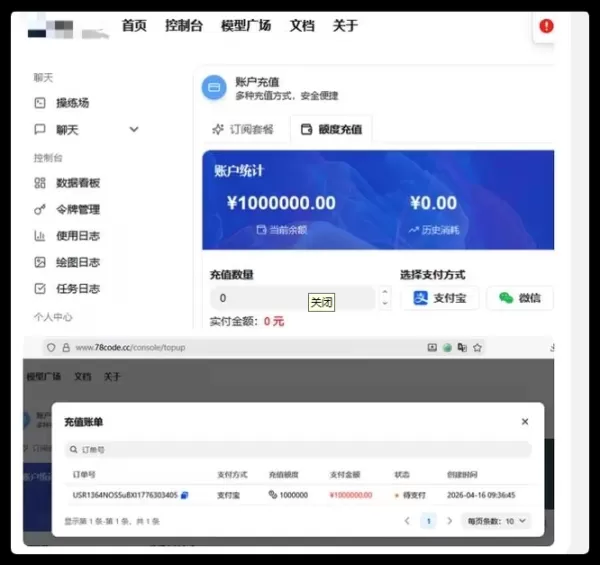
AIbase Report, April 16, 2026 — The widely used AI large-model interface aggregation and management system QuantumNous/new-api (commonly known as NewAPI), popular in open-source communities and among self-hosted site administrators, has been confirmed to contain a high-risk vulnerability in its payment logic. When the Stripe payment key is not properly configured, attackers can forge Webhook events to bypass the actual payment process, enabling "zero-cost" recharges of arbitrary amounts.
The attack methodology and mitigation strategies for this vulnerability have sparked extensive discussion on developer forums and public technical communities like X (formerly Twitter). Given that the system is often used for commercial operations or token-based billing, the discoverer has temporarily withheld the full proof-of-concept exploit code (PoC) to prevent malicious exploitation and potential financial losses.
Vulnerability Principle Analysis
NewAPI is a management system that handles intermediate processing, billing, and recharge functions for large-model interfaces such as OpenAI and Claude. The core of the exposed vulnerability lies in its failure to rigorously validate empty Stripe keys within the payment success callback (asynchronous Webhook processing logic).
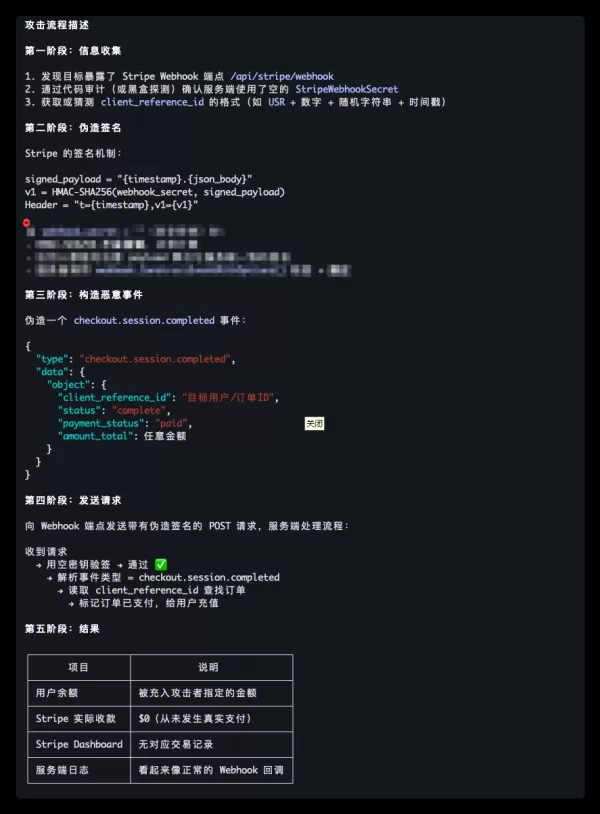
Based on attack flow analysis circulating in technical communities, when the server-side Stripe webhook_secret is not configured (i.e., left as an empty string), it creates a critical trust breakdown:
Signature Mechanism Failure: The HMAC-SHA256 algorithm does not generate an error when processing an empty key. This allows any attacker to compute a forged signature that perfectly matches the server's validation logic for a custom payload.
Constructing a Malicious Event: Attackers only need to obtain or guess the order number format to forge a checkout.session.completed event and set an arbitrarily high amount_total (recharge amount) in the data packet.
Funds Credited Without Actual Payment: After sending the forged request to the server's Webhook endpoint, the server validates the signature using the empty key. Upon successful validation, the system incorrectly treats it as a legitimate paid order and credits the attacker's account balance.
The Final Outcome: Stripe receives $0, and no transaction records appear in the official Stripe dashboard. However, the server logs show normal Webhook callbacks, and the attacker's account balance is successfully increased.
Vulnerability Impact Scope
This vulnerability only affects instances where the Stripe Secret Key is not properly configured. Many administrators overlook configuring this key when setting up test environments or when their sites primarily rely on other payment methods (such as WeChat or Alipay) and do not use the Stripe module, leaving them highly vulnerable.
Official Fix and Recommendations
In response to this serious security risk, the project team acted swiftly and released the latest v0.12.10 version today. The update log clearly indicates the fix direction: “Improved Stripe payment processing to better handle asynchronous webhook events,” addressing the security blind spot in callback verification at a fundamental level.
Security experts strongly recommend all NewAPI users take the following actions:
Upgrade Immediately: Update your instance to the latest v0.12.10 or a higher version (it is recommended to directly pull the latest release or nightly build).
Enforce Key Configuration: Even if your site does not plan to use Stripe payments, after upgrading, you must configure the Stripe Secret Key in the backend. It is recommended to use a randomly generated strong password string or strictly control it via environment variables to eliminate the possibility of an empty key.
Conduct a Billing Self-Audit: Immediately review existing user orders and recharge records within the system (especially in test environments), cross-reference them with actual funds received, and check for any fraudulent high-value recharges.
Improve Payment Authentication: For production environments, it is recommended to thoroughly review the asynchronous callback logic for all payment channels to ensure dual verification of both signature validity and order status authenticity.
The technical details of this vulnerability are now public. Due to its relatively low exploitation barrier, it is recommended that all relevant administrators take immediate action to perform self-inspections and upgrades to prevent potential digital asset losses.
Related article
 Stripe to Acquire OpenRouter as AI Model Routing Gains Momentum
Stripe has agreed to acquire OpenRouter, an AI model-routing platform that gives developers access to hundreds of models through a single interface. The deal adds model selection and routing to Stripe’s existing work around AI usage and token-based b
Former OpenAI Researcher Barrett Zoph Returns to Google to Support Gemini Development
Barret Zoph, who previously abruptly left and joined OpenAI due to a disagreement with Thinking Machines Lab CEO Miriam Mularati, has once again changed employers. Alphabet's Google announced that Zoph will return as Vice President of Research, bring
How Recursive Intelligence Raised $335M at $4B Valuation in 4 Months
The co-founders of startup Ricursive Intelligence seemed destined to be co-founders.Anna Goldie, CEO, and Azalia Mirhoseini, CTO, are so well-known in the AI community that they were among those AI engineers who “got those weird emails from Zuckerber
Related Special Topic Recommendations
Design & Art
Stripe to Acquire OpenRouter as AI Model Routing Gains Momentum
Stripe has agreed to acquire OpenRouter, an AI model-routing platform that gives developers access to hundreds of models through a single interface. The deal adds model selection and routing to Stripe’s existing work around AI usage and token-based b
Former OpenAI Researcher Barrett Zoph Returns to Google to Support Gemini Development
Barret Zoph, who previously abruptly left and joined OpenAI due to a disagreement with Thinking Machines Lab CEO Miriam Mularati, has once again changed employers. Alphabet's Google announced that Zoph will return as Vice President of Research, bring
How Recursive Intelligence Raised $335M at $4B Valuation in 4 Months
The co-founders of startup Ricursive Intelligence seemed destined to be co-founders.Anna Goldie, CEO, and Azalia Mirhoseini, CTO, are so well-known in the AI community that they were among those AI engineers who “got those weird emails from Zuckerber
Related Special Topic Recommendations
Design & Art
 Top AI Illustration Tools: Create Editorial Scenes and Cover Art Faster
2026 Latest Top-rated AI Illustration Tools: Our curated list features the best powerfully designed tools for creating stunning editorial scenes and eye-catching cover art quickly. Each option has gone through rigorous real-world tests, offering a free vs paid comparison to help you find the perfect match for your workflow. Try these must-try solutions today to unlock your AI edge and boost your creative productivity. Explore now at XIX.AI.
 10 tools
 xix.ai
Education and Learning
Top AI Tutors for Exam Prep: Practice Math, Science, and English
xix.ai
Education and Learning
Top AI Tutors for Exam Prep: Practice Math, Science, and English
2026 Latest Top-Rated Best AI Tutors for Exam Prep are here on XIX.AI! Our curated list features powerful game-changing tools that offer free vs paid comparison, real-world tests, and weekly updated rankings. They help boost your writing efficiency, simplify complex topic learning, and unlock your academic potential. Explore now to Discover your perfect exam prep tool and Start creating today to Unlock your AI edge!
10 tools
xix.ai
Finance
AI Budget Planning Tools for Personal Money Management
2026 Latest Best Top-Rated AI Budget Planning Tools for Personal Money Management are here on XIX.AI! This curated collection features powerful, game-changing solutions that help you conduct real-world tests, understand spending habits, and create personalized plans to boost productivity. Enjoy a free vs paid comparison along with detailed rankings. Must-try tools designed to simplify money management and unlock your AI edge. Explore now!
11 tools
xix.ai
Health & Wellness
AI Sleep Tracking Assistants: Improve Recovery with Better Bedtime Habits
2026 Latest Best Top-Rated AI Sleep Tracking Assistants curated for ultimate recovery. This fully updated weekly guide features powerful tools that deliver real-world tests, free vs paid comparison, and detailed rankings to help you find the must-try solution that boosts sleep quality and supports better bedtime habits. Explore now at XIX.AI to Unlock your AI edge.
10 tools
xix.ai
Data Analysis
AI SQL Copilots for Product and Revenue Analytics
2026 Latest Best Top-Rated AI SQL Copilots for Product and Revenue Analytics! XIX.AI has curated a powerful, game-changing collection of must-try tools that undergo real-world tests through weekly updated rankings. These tools help users boost productivity significantly by accelerating data analysis, streamlining complex queries, and generating accurate insights to drive smarter business decisions. Explore now to Discover your perfect tool for unlocking your AI edge!
14 tools
xix.ai
Education and Learning
Best AI Homework Helpers That Teach: Learn Concepts, Not Just Answers
2026 Latest Best Top-Rated AI Homework Helpers That Teach Core Concepts Not Just Answers Powerful Tools for Students Must-Try Curated List Weekly Updated Free vs Paid Comparison Real-World Tests Accurate Rankings to Help You Unlock Your Full Learning Potential Explore now to Discover your perfect tool for smarter studying.
10 tools
xix.ai

 Comments (1)
0/500
Comments (1)
0/500
![RoySmith]()
Wait, so anyone can just grab those unsecured keys and use the API for free? That's a massive security hole. Hope the devs patch it ASAP before someone exploits it for something worse. 😅
AIbase Report, April 16, 2026 — The widely used AI large-model interface aggregation and management system QuantumNous/new-api (commonly known as NewAPI), popular in open-source communities and among self-hosted site administrators, has been confirmed to contain a high-risk vulnerability in its payment logic. When the Stripe payment key is not properly configured, attackers can forge Webhook events to bypass the actual payment process, enabling "zero-cost" recharges of arbitrary amounts.
The attack methodology and mitigation strategies for this vulnerability have sparked extensive discussion on developer forums and public technical communities like X (formerly Twitter). Given that the system is often used for commercial operations or token-based billing, the discoverer has temporarily withheld the full proof-of-concept exploit code (PoC) to prevent malicious exploitation and potential financial losses.
Vulnerability Principle Analysis
NewAPI is a management system that handles intermediate processing, billing, and recharge functions for large-model interfaces such as OpenAI and Claude. The core of the exposed vulnerability lies in its failure to rigorously validate empty Stripe keys within the payment success callback (asynchronous Webhook processing logic).
Based on attack flow analysis circulating in technical communities, when the server-side Stripe webhook_secret is not configured (i.e., left as an empty string), it creates a critical trust breakdown:
Signature Mechanism Failure: The HMAC-SHA256 algorithm does not generate an error when processing an empty key. This allows any attacker to compute a forged signature that perfectly matches the server's validation logic for a custom payload.
Constructing a Malicious Event: Attackers only need to obtain or guess the order number format to forge a checkout.session.completed event and set an arbitrarily high amount_total (recharge amount) in the data packet.
Funds Credited Without Actual Payment: After sending the forged request to the server's Webhook endpoint, the server validates the signature using the empty key. Upon successful validation, the system incorrectly treats it as a legitimate paid order and credits the attacker's account balance.
The Final Outcome: Stripe receives $0, and no transaction records appear in the official Stripe dashboard. However, the server logs show normal Webhook callbacks, and the attacker's account balance is successfully increased.
Vulnerability Impact Scope
This vulnerability only affects instances where the Stripe Secret Key is not properly configured. Many administrators overlook configuring this key when setting up test environments or when their sites primarily rely on other payment methods (such as WeChat or Alipay) and do not use the Stripe module, leaving them highly vulnerable.
Official Fix and Recommendations
In response to this serious security risk, the project team acted swiftly and released the latest v0.12.10 version today. The update log clearly indicates the fix direction: “Improved Stripe payment processing to better handle asynchronous webhook events,” addressing the security blind spot in callback verification at a fundamental level.
Security experts strongly recommend all NewAPI users take the following actions:
Upgrade Immediately: Update your instance to the latest v0.12.10 or a higher version (it is recommended to directly pull the latest release or nightly build).
Enforce Key Configuration: Even if your site does not plan to use Stripe payments, after upgrading, you must configure the Stripe Secret Key in the backend. It is recommended to use a randomly generated strong password string or strictly control it via environment variables to eliminate the possibility of an empty key.
Conduct a Billing Self-Audit: Immediately review existing user orders and recharge records within the system (especially in test environments), cross-reference them with actual funds received, and check for any fraudulent high-value recharges.
Improve Payment Authentication: For production environments, it is recommended to thoroughly review the asynchronous callback logic for all payment channels to ensure dual verification of both signature validity and order status authenticity.
The technical details of this vulnerability are now public. Due to its relatively low exploitation barrier, it is recommended that all relevant administrators take immediate action to perform self-inspections and upgrades to prevent potential digital asset losses.








 Stripe to Acquire OpenRouter as AI Model Routing Gains Momentum
Stripe has agreed to acquire OpenRouter, an AI model-routing platform that gives developers access to hundreds of models through a single interface. The deal adds model selection and routing to Stripe’s existing work around AI usage and token-based b
Stripe to Acquire OpenRouter as AI Model Routing Gains Momentum
Stripe has agreed to acquire OpenRouter, an AI model-routing platform that gives developers access to hundreds of models through a single interface. The deal adds model selection and routing to Stripe’s existing work around AI usage and token-based b
 Former OpenAI Researcher Barrett Zoph Returns to Google to Support Gemini Development
Barret Zoph, who previously abruptly left and joined OpenAI due to a disagreement with Thinking Machines Lab CEO Miriam Mularati, has once again changed employers. Alphabet's Google announced that Zoph will return as Vice President of Research, bring
Former OpenAI Researcher Barrett Zoph Returns to Google to Support Gemini Development
Barret Zoph, who previously abruptly left and joined OpenAI due to a disagreement with Thinking Machines Lab CEO Miriam Mularati, has once again changed employers. Alphabet's Google announced that Zoph will return as Vice President of Research, bring
 How Recursive Intelligence Raised $335M at $4B Valuation in 4 Months
The co-founders of startup Ricursive Intelligence seemed destined to be co-founders.Anna Goldie, CEO, and Azalia Mirhoseini, CTO, are so well-known in the AI community that they were among those AI engineers who “got those weird emails from Zuckerber
How Recursive Intelligence Raised $335M at $4B Valuation in 4 Months
The co-founders of startup Ricursive Intelligence seemed destined to be co-founders.Anna Goldie, CEO, and Azalia Mirhoseini, CTO, are so well-known in the AI community that they were among those AI engineers who “got those weird emails from Zuckerber

2026 Latest Top-rated AI Illustration Tools: Our curated list features the best powerfully designed tools for creating stunning editorial scenes and eye-catching cover art quickly. Each option has gone through rigorous real-world tests, offering a free vs paid comparison to help you find the perfect match for your workflow. Try these must-try solutions today to unlock your AI edge and boost your creative productivity. Explore now at XIX.AI.
10 tools
xix.ai

2026 Latest Top-Rated Best AI Tutors for Exam Prep are here on XIX.AI! Our curated list features powerful game-changing tools that offer free vs paid comparison, real-world tests, and weekly updated rankings. They help boost your writing efficiency, simplify complex topic learning, and unlock your academic potential. Explore now to Discover your perfect exam prep tool and Start creating today to Unlock your AI edge!
10 tools
xix.ai

2026 Latest Best Top-Rated AI Budget Planning Tools for Personal Money Management are here on XIX.AI! This curated collection features powerful, game-changing solutions that help you conduct real-world tests, understand spending habits, and create personalized plans to boost productivity. Enjoy a free vs paid comparison along with detailed rankings. Must-try tools designed to simplify money management and unlock your AI edge. Explore now!
11 tools
xix.ai

2026 Latest Best Top-Rated AI Sleep Tracking Assistants curated for ultimate recovery. This fully updated weekly guide features powerful tools that deliver real-world tests, free vs paid comparison, and detailed rankings to help you find the must-try solution that boosts sleep quality and supports better bedtime habits. Explore now at XIX.AI to Unlock your AI edge.
10 tools
xix.ai

2026 Latest Best Top-Rated AI SQL Copilots for Product and Revenue Analytics! XIX.AI has curated a powerful, game-changing collection of must-try tools that undergo real-world tests through weekly updated rankings. These tools help users boost productivity significantly by accelerating data analysis, streamlining complex queries, and generating accurate insights to drive smarter business decisions. Explore now to Discover your perfect tool for unlocking your AI edge!
14 tools
xix.ai

2026 Latest Best Top-Rated AI Homework Helpers That Teach Core Concepts Not Just Answers Powerful Tools for Students Must-Try Curated List Weekly Updated Free vs Paid Comparison Real-World Tests Accurate Rankings to Help You Unlock Your Full Learning Potential Explore now to Discover your perfect tool for smarter studying.
10 tools
xix.ai

Wait, so anyone can just grab those unsecured keys and use the API for free? That's a massive security hole. Hope the devs patch it ASAP before someone exploits it for something worse. 😅












