


 Home
HomeAnthropic Launches AI Code Review Tool
Peer feedback is essential in coding for early bug detection, maintaining codebase consistency, and enhancing overall software quality.
The emergence of "vibe coding"—using AI tools that generate code from plain-language instructions—has transformed developer workflows. While accelerating development, these tools have also introduced new bugs, security vulnerabilities, and poorly understood code.
Anthropic's solution is an AI reviewer designed to catch bugs before they enter the codebase. The new product, named Code Review, launched Monday in Claude Code.
"We've seen significant growth in Claude Code, particularly within the enterprise sector. A recurring question from enterprise leaders is: Now that Claude Code is generating numerous pull requests, how do we ensure they are reviewed efficiently?" said Cat Wu, Anthropic's Head of Product, to TechCrunch.
Pull requests are a standard mechanism for developers to submit code changes for review before integration. Wu noted that Claude Code has dramatically increased code output, leading to a surge in pull request reviews and creating a bottleneck in the deployment pipeline.
"Code Review is our answer to that challenge," Wu stated.
Anthropic's launch of Code Review—initially available in research preview for Claude for Teams and Claude for Enterprise customers—comes at a critical time for the company.
On Monday, Anthropic filed two lawsuits against the Department of Defense following the agency's designation of Anthropic as a supply chain risk. This dispute may lead Anthropic to rely more heavily on its rapidly growing enterprise business, where subscriptions have quadrupled since the start of the year. According to the company, Claude Code's run-rate revenue has exceeded $2.5 billion since its launch.
"This product is specifically targeted at our larger enterprise users—companies like Uber, Salesforce, and Accenture that already use Claude Code and now need help managing the volume of pull requests it generates," Wu explained.
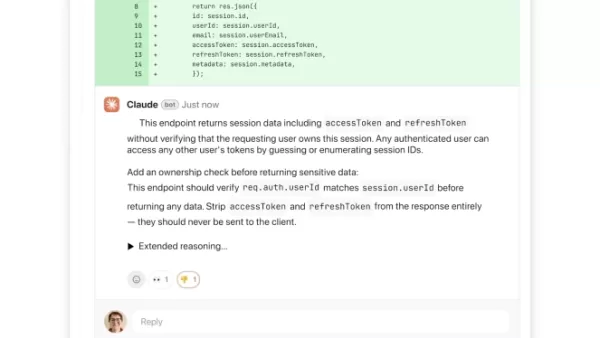
She added that development leads can enable Code Review by default for their entire team. Once activated, it integrates with GitHub, automatically analyzing pull requests and posting direct comments on the code to highlight potential issues and suggest fixes.
The focus is on identifying logical errors rather than stylistic concerns, Wu emphasized.
"This is crucial because developers often find AI-generated feedback frustrating when it's not immediately actionable. We decided to concentrate solely on logic errors to address the highest-priority fixes," she said.
The AI explains its reasoning step-by-step, detailing the identified issue, why it could be problematic, and potential solutions. The system categorizes issue severity using a color code: red for critical, yellow for issues requiring review, and purple for problems related to pre-existing code or historical bugs.
Wu explained that the process is fast and efficient, utilizing multiple specialized agents that examine the code from different perspectives. A final agent consolidates and ranks the findings, removes duplicates, and prioritizes the most important items.
The tool includes a basic security analysis, and engineering leads can customize additional checks based on internal best practices. Wu noted that Anthropic's more recent product, Claude Code Security, offers a more in-depth security analysis.
The multi-agent architecture makes this a resource-intensive product, Wu acknowledged. Similar to other AI services, pricing is token-based and varies with code complexity—though Wu estimated the average cost per review would be between $15 and $25. She described it as a premium solution necessary as AI tools produce increasing amounts of code.
"Code Review is a direct response to massive market demand," Wu said. "As engineers use Claude Code to reduce friction in feature development, the need for code review has intensified. We are confident this will enable enterprises to build faster than ever before, with significantly fewer bugs."
Related article
 Crypto exchange OKX aims to empower AI agents to hire and pay each other
As AI agents start serving individuals and collaborating with each other, they require mechanisms to locate tasks, compensate for services, and establish credibility. Crypto exchange OKX anticipates this future is arriving sooner than anticipated, in
Anthropic launches Opus 4.8 featuring new dynamic workflow tool
Anthropic unveiled Opus 4.8 on Thursday, marking the latest iteration of its premier public model. Priced identically to its predecessor, this update is now accessible across all platforms.Releasing just 41 days after Opus 4.7, Anthropic has accelera
Frontier AI Labs Refuse to Disclose Containment Strategies for Rogue Models
Recent research indicates that very few leading AI laboratories have published or demonstrated containment response plans. A containment plan defines the procedures for when an AI system attempts to subvert human control, specifying which access righ
Related Special Topic Recommendations
Design & Art
Crypto exchange OKX aims to empower AI agents to hire and pay each other
As AI agents start serving individuals and collaborating with each other, they require mechanisms to locate tasks, compensate for services, and establish credibility. Crypto exchange OKX anticipates this future is arriving sooner than anticipated, in
Anthropic launches Opus 4.8 featuring new dynamic workflow tool
Anthropic unveiled Opus 4.8 on Thursday, marking the latest iteration of its premier public model. Priced identically to its predecessor, this update is now accessible across all platforms.Releasing just 41 days after Opus 4.7, Anthropic has accelera
Frontier AI Labs Refuse to Disclose Containment Strategies for Rogue Models
Recent research indicates that very few leading AI laboratories have published or demonstrated containment response plans. A containment plan defines the procedures for when an AI system attempts to subvert human control, specifying which access righ
Related Special Topic Recommendations
Design & Art
 Best AI Style Transfer Tools for Creative Experiments
2026 Latest Best Top-rated AI Style Transfer Tools for Creative Experiments! XIX.AI has curated a powerful, game-changing collection of must-try tools that deliver exceptional results through real-world tests and rigorous rankings. These top solutions help creatives boost productivity significantly by accelerating content creation and unlocking endless creative possibilities. Explore now to discover your perfect tool and start creating today!
 9 tools
 xix.ai
Comic Creation
Best AI Dialogue Bubble Tools for Visual Storytelling
xix.ai
Comic Creation
Best AI Dialogue Bubble Tools for Visual Storytelling
2026 Latest Best Top-Rated AI Dialogue Bubble Tools for Visual Storytelling are here on XIX.AI! This curated collection features powerful, game-changing tools that help creators boost productivity and overcome creative bottlenecks. Get a free vs paid comparison, see real-world tests, and check the latest rankings to find the must-try solutions perfect for crafting engaging visual narratives. Explore now to discover your ideal tool!
10 tools
xix.ai
Meeting Assistant
Top AI Meeting Summary Tools: Track Decisions and Follow-Ups Clearly
2026 Latest Top-Rated Best AI Meeting Summary Tools for Clear Decision Tracking and Effortless Follow-Ups. This curated list showcases powerful, game-changing solutions that boost productivity dramatically by automating meeting notes, identifying key action items, and streamlining team coordination across all projects. Get a free vs paid comparison along with real-world tests and weekly updated rankings to help you find the perfect tool. Explore now to unlock your AI edge!
9 tools
xix.ai
Data Analysis
Best AI Data Cleaning Tools: Fix Missing Values and Duplicates Fast
2026 Latest Best Top-rated AI Data Cleaning Tools for quick fixing of missing values and duplicates. This curated list showcases powerful, game-changing solutions that boost productivity significantly. Each option has undergone rigorous real-world tests to ensure reliability. Get a free vs paid comparison and discover the must-try tool that fits your needs best. Explore now at XIX.AI to Unlock your AI edge.
11 tools
xix.ai
Design & Art
Best AI Creative Ideation Tools for Artists: Break Through Visual Blocks
2026 Latest Best Top-Rated AI Creative Ideation Tools for Artists are curated by XIX.AI to help creators break through visual blocks and boost creativity instantly. These powerful game-changing tools offer real-world tests, detailed free vs paid comparison, and weekly updated rankings. Discover your perfect tool to accelerate content creation and unlock your AI edge today. Explore now!
14 tools
xix.ai
Music composition
AI Beat Makers for TikTok Background Tracks, Reels Audio, and Creator Promo Music
2026 Latest Best AI Beat Makers for TikTok Background Tracks, Reels Audio, and Creator Promo Music! XIX.AI has curated a top-rated list of powerful game-changing tools that go through real-world tests to deliver flawless music for every content need. You’ll find detailed free vs paid comparison data, weekly updated rankings, and must-try options to help you boost creativity and productivity. Explore now to discover your perfect tool!
11 tools
xix.ai

 Comments (0)
0/500
Comments (0)
0/500
Peer feedback is essential in coding for early bug detection, maintaining codebase consistency, and enhancing overall software quality.
The emergence of "vibe coding"—using AI tools that generate code from plain-language instructions—has transformed developer workflows. While accelerating development, these tools have also introduced new bugs, security vulnerabilities, and poorly understood code.
Anthropic's solution is an AI reviewer designed to catch bugs before they enter the codebase. The new product, named Code Review, launched Monday in Claude Code.
"We've seen significant growth in Claude Code, particularly within the enterprise sector. A recurring question from enterprise leaders is: Now that Claude Code is generating numerous pull requests, how do we ensure they are reviewed efficiently?" said Cat Wu, Anthropic's Head of Product, to TechCrunch.
Pull requests are a standard mechanism for developers to submit code changes for review before integration. Wu noted that Claude Code has dramatically increased code output, leading to a surge in pull request reviews and creating a bottleneck in the deployment pipeline.
"Code Review is our answer to that challenge," Wu stated.
Anthropic's launch of Code Review—initially available in research preview for Claude for Teams and Claude for Enterprise customers—comes at a critical time for the company.
On Monday, Anthropic filed two lawsuits against the Department of Defense following the agency's designation of Anthropic as a supply chain risk. This dispute may lead Anthropic to rely more heavily on its rapidly growing enterprise business, where subscriptions have quadrupled since the start of the year. According to the company, Claude Code's run-rate revenue has exceeded $2.5 billion since its launch.
"This product is specifically targeted at our larger enterprise users—companies like Uber, Salesforce, and Accenture that already use Claude Code and now need help managing the volume of pull requests it generates," Wu explained.
She added that development leads can enable Code Review by default for their entire team. Once activated, it integrates with GitHub, automatically analyzing pull requests and posting direct comments on the code to highlight potential issues and suggest fixes.
The focus is on identifying logical errors rather than stylistic concerns, Wu emphasized.
"This is crucial because developers often find AI-generated feedback frustrating when it's not immediately actionable. We decided to concentrate solely on logic errors to address the highest-priority fixes," she said.
The AI explains its reasoning step-by-step, detailing the identified issue, why it could be problematic, and potential solutions. The system categorizes issue severity using a color code: red for critical, yellow for issues requiring review, and purple for problems related to pre-existing code or historical bugs.
Wu explained that the process is fast and efficient, utilizing multiple specialized agents that examine the code from different perspectives. A final agent consolidates and ranks the findings, removes duplicates, and prioritizes the most important items.
The tool includes a basic security analysis, and engineering leads can customize additional checks based on internal best practices. Wu noted that Anthropic's more recent product, Claude Code Security, offers a more in-depth security analysis.
The multi-agent architecture makes this a resource-intensive product, Wu acknowledged. Similar to other AI services, pricing is token-based and varies with code complexity—though Wu estimated the average cost per review would be between $15 and $25. She described it as a premium solution necessary as AI tools produce increasing amounts of code.
"Code Review is a direct response to massive market demand," Wu said. "As engineers use Claude Code to reduce friction in feature development, the need for code review has intensified. We are confident this will enable enterprises to build faster than ever before, with significantly fewer bugs."








 Crypto exchange OKX aims to empower AI agents to hire and pay each other
As AI agents start serving individuals and collaborating with each other, they require mechanisms to locate tasks, compensate for services, and establish credibility. Crypto exchange OKX anticipates this future is arriving sooner than anticipated, in
Crypto exchange OKX aims to empower AI agents to hire and pay each other
As AI agents start serving individuals and collaborating with each other, they require mechanisms to locate tasks, compensate for services, and establish credibility. Crypto exchange OKX anticipates this future is arriving sooner than anticipated, in
 Anthropic launches Opus 4.8 featuring new dynamic workflow tool
Anthropic unveiled Opus 4.8 on Thursday, marking the latest iteration of its premier public model. Priced identically to its predecessor, this update is now accessible across all platforms.Releasing just 41 days after Opus 4.7, Anthropic has accelera
Anthropic launches Opus 4.8 featuring new dynamic workflow tool
Anthropic unveiled Opus 4.8 on Thursday, marking the latest iteration of its premier public model. Priced identically to its predecessor, this update is now accessible across all platforms.Releasing just 41 days after Opus 4.7, Anthropic has accelera
 Frontier AI Labs Refuse to Disclose Containment Strategies for Rogue Models
Recent research indicates that very few leading AI laboratories have published or demonstrated containment response plans. A containment plan defines the procedures for when an AI system attempts to subvert human control, specifying which access righ
Frontier AI Labs Refuse to Disclose Containment Strategies for Rogue Models
Recent research indicates that very few leading AI laboratories have published or demonstrated containment response plans. A containment plan defines the procedures for when an AI system attempts to subvert human control, specifying which access righ

2026 Latest Best Top-rated AI Style Transfer Tools for Creative Experiments! XIX.AI has curated a powerful, game-changing collection of must-try tools that deliver exceptional results through real-world tests and rigorous rankings. These top solutions help creatives boost productivity significantly by accelerating content creation and unlocking endless creative possibilities. Explore now to discover your perfect tool and start creating today!
9 tools
xix.ai

2026 Latest Best Top-Rated AI Dialogue Bubble Tools for Visual Storytelling are here on XIX.AI! This curated collection features powerful, game-changing tools that help creators boost productivity and overcome creative bottlenecks. Get a free vs paid comparison, see real-world tests, and check the latest rankings to find the must-try solutions perfect for crafting engaging visual narratives. Explore now to discover your ideal tool!
10 tools
xix.ai

2026 Latest Top-Rated Best AI Meeting Summary Tools for Clear Decision Tracking and Effortless Follow-Ups. This curated list showcases powerful, game-changing solutions that boost productivity dramatically by automating meeting notes, identifying key action items, and streamlining team coordination across all projects. Get a free vs paid comparison along with real-world tests and weekly updated rankings to help you find the perfect tool. Explore now to unlock your AI edge!
9 tools
xix.ai

2026 Latest Best Top-rated AI Data Cleaning Tools for quick fixing of missing values and duplicates. This curated list showcases powerful, game-changing solutions that boost productivity significantly. Each option has undergone rigorous real-world tests to ensure reliability. Get a free vs paid comparison and discover the must-try tool that fits your needs best. Explore now at XIX.AI to Unlock your AI edge.
11 tools
xix.ai

2026 Latest Best Top-Rated AI Creative Ideation Tools for Artists are curated by XIX.AI to help creators break through visual blocks and boost creativity instantly. These powerful game-changing tools offer real-world tests, detailed free vs paid comparison, and weekly updated rankings. Discover your perfect tool to accelerate content creation and unlock your AI edge today. Explore now!
14 tools
xix.ai

2026 Latest Best AI Beat Makers for TikTok Background Tracks, Reels Audio, and Creator Promo Music! XIX.AI has curated a top-rated list of powerful game-changing tools that go through real-world tests to deliver flawless music for every content need. You’ll find detailed free vs paid comparison data, weekly updated rankings, and must-try options to help you boost creativity and productivity. Explore now to discover your perfect tool!
11 tools
xix.ai












