


 Home
Ant Group Unveils F2LLM-v2: A Multilingual, Full-Scale Embedding Model
Overcoming the "English-centric" limitation in semantic representation has emerged as a key frontier in the evolution of large language models.
On March 26, the CodeFuse team from Ant Group and Shanghai Jiao Tong University officially released the F2LLM-v2 series of Embedding models. This series not only achieved leading performance in authoritative benchmarks but also provides a high-performance, efficient semantic representation solution for developers worldwide through a fully open-source approach.

Exceptional Performance: Achieving 11 SOTA Results on MTEB
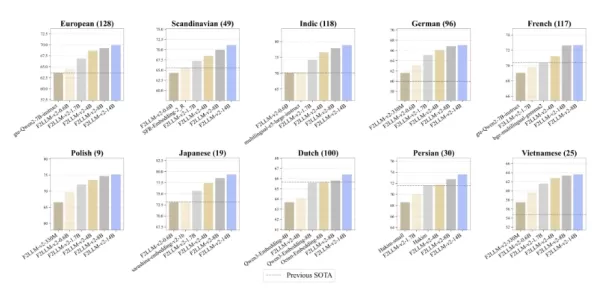
In the authoritative MTEB benchmark for evaluating Embedding models, F2LLM-v2 demonstrated comprehensive strengths:
11 Top Rankings: It secured first place across 11 language and domain-specific leaderboards, including German, French, Japanese, and code retrieval.
A Formidable Challenger: Even its lightweight variants consistently outperformed well-known industry models of comparable size.
Extensive Coverage: The evaluation encompassed 430 diverse sub-tasks, such as medical Q&A and code retrieval, achieving full-scenario coverage.
Comprehensive Understanding: Proficiency in 282 Natural Languages and Over 40 Programming Languages
The power of F2LLM-v2 stems from its highly inclusive training foundation:
Multilingual Enhancement: It features strengthened support for medium- and low-resource languages (such as Nordic and Southeast Asian language families), enabling genuine global language coverage.
Programming Expertise: With deep understanding of over 40 programming languages like Python, Java, and Go, it is an ideal choice for developers building RAG (Retrieval-Augmented Generation) systems and code assistants.
High-Quality Data: Built upon 60 million meticulously cleaned public samples, it ensures both the purity and breadth of the model's knowledge base.
Extreme Efficiency: A Complete Model Family Scaling from 80M to 14B Parameters
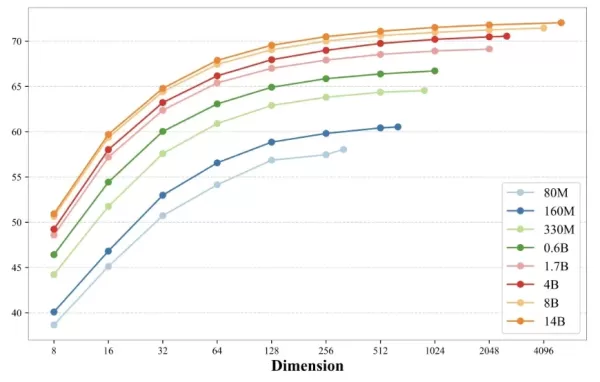
To address needs ranging from mobile devices to cloud computing, the CodeFuse team developed a comprehensive model matrix:
Mobile-Optimized: Compact models from 80M to 330M parameters utilize "model pruning" and "knowledge distillation" techniques, enabling smooth operation on mobile platforms.
"Nested" Innovation: It supports dynamic dimension adjustment, allowing users to flexibly switch between 8 dimensions and full dimensions, optimizing the trade-off between inference speed and storage cost.
Fully Open Source: Transparency Setting a New Community Standard
Unlike many "black box" models, F2LLM-v2 is committed to a fully open-source philosophy:
Complete Release: All model weights for every size variant are available for download.
Detailed Transparency: A comprehensive technical report is published, disclosing the entire training methodology.
Full Reproducibility: All code and training checkpoints are released, empowering researchers globally to build upon this work for further development.
Conclusion: Breaking Boundaries to Explore AI's Infinite Potential
As another significant milestone in the CodeFuse Open Source Series, the release of F2LLM-v2
Related article
 Stripe to Acquire OpenRouter as AI Model Routing Gains Momentum
Stripe has agreed to acquire OpenRouter, an AI model-routing platform that gives developers access to hundreds of models through a single interface. The deal adds model selection and routing to Stripe’s existing work around AI usage and token-based b
Former OpenAI Researcher Barrett Zoph Returns to Google to Support Gemini Development
Barret Zoph, who previously abruptly left and joined OpenAI due to a disagreement with Thinking Machines Lab CEO Miriam Mularati, has once again changed employers. Alphabet's Google announced that Zoph will return as Vice President of Research, bring
How Recursive Intelligence Raised $335M at $4B Valuation in 4 Months
The co-founders of startup Ricursive Intelligence seemed destined to be co-founders.Anna Goldie, CEO, and Azalia Mirhoseini, CTO, are so well-known in the AI community that they were among those AI engineers who “got those weird emails from Zuckerber
Related Special Topic Recommendations
Design & Art
 Top AI Illustration Tools: Create Editorial Scenes and Cover Art Faster
2026 Latest Top-rated AI Illustration Tools: Our curated list features the best powerfully designed tools for creating stunning editorial scenes and eye-catching cover art quickly. Each option has gone through rigorous real-world tests, offering a free vs paid comparison to help you find the perfect match for your workflow. Try these must-try solutions today to unlock your AI edge and boost your creative productivity. Explore now at XIX.AI.
 10 tools
 xix.ai
Education and Learning
Top AI Tutors for Exam Prep: Practice Math, Science, and English
2026 Latest Top-Rated Best AI Tutors for Exam Prep are here on XIX.AI! Our curated list features powerful game-changing tools that offer free vs paid comparison, real-world tests, and weekly updated rankings. They help boost your writing efficiency, simplify complex topic learning, and unlock your academic potential. Explore now to Discover your perfect exam prep tool and Start creating today to Unlock your AI edge!
10 tools
xix.ai
Finance
AI Budget Planning Tools for Personal Money Management
2026 Latest Best Top-Rated AI Budget Planning Tools for Personal Money Management are here on XIX.AI! This curated collection features powerful, game-changing solutions that help you conduct real-world tests, understand spending habits, and create personalized plans to boost productivity. Enjoy a free vs paid comparison along with detailed rankings. Must-try tools designed to simplify money management and unlock your AI edge. Explore now!
11 tools
xix.ai
Health & Wellness
AI Sleep Tracking Assistants: Improve Recovery with Better Bedtime Habits
2026 Latest Best Top-Rated AI Sleep Tracking Assistants curated for ultimate recovery. This fully updated weekly guide features powerful tools that deliver real-world tests, free vs paid comparison, and detailed rankings to help you find the must-try solution that boosts sleep quality and supports better bedtime habits. Explore now at XIX.AI to Unlock your AI edge.
10 tools
xix.ai
Data Analysis
AI SQL Copilots for Product and Revenue Analytics
2026 Latest Best Top-Rated AI SQL Copilots for Product and Revenue Analytics! XIX.AI has curated a powerful, game-changing collection of must-try tools that undergo real-world tests through weekly updated rankings. These tools help users boost productivity significantly by accelerating data analysis, streamlining complex queries, and generating accurate insights to drive smarter business decisions. Explore now to Discover your perfect tool for unlocking your AI edge!
14 tools
xix.ai
Education and Learning
Best AI Homework Helpers That Teach: Learn Concepts, Not Just Answers
2026 Latest Best Top-Rated AI Homework Helpers That Teach Core Concepts Not Just Answers Powerful Tools for Students Must-Try Curated List Weekly Updated Free vs Paid Comparison Real-World Tests Accurate Rankings to Help You Unlock Your Full Learning Potential Explore now to Discover your perfect tool for smarter studying.
10 tools
xix.ai

 Comments (0)
0/500
Overcoming the "English-centric" limitation in semantic representation has emerged as a key frontier in the evolution of large language models.
On March 26, the CodeFuse team from Ant Group and Shanghai Jiao Tong University officially released the F2LLM-v2 series of Embedding models. This series not only achieved leading performance in authoritative benchmarks but also provides a high-performance, efficient semantic representation solution for developers worldwide through a fully open-source approach.
Exceptional Performance: Achieving 11 SOTA Results on MTEB
In the authoritative MTEB benchmark for evaluating Embedding models, F2LLM-v2 demonstrated comprehensive strengths:
11 Top Rankings: It secured first place across 11 language and domain-specific leaderboards, including German, French, Japanese, and code retrieval.
A Formidable Challenger: Even its lightweight variants consistently outperformed well-known industry models of comparable size.
Extensive Coverage: The evaluation encompassed 430 diverse sub-tasks, such as medical Q&A and code retrieval, achieving full-scenario coverage.
Comprehensive Understanding: Proficiency in 282 Natural Languages and Over 40 Programming Languages
The power of F2LLM-v2 stems from its highly inclusive training foundation:
Multilingual Enhancement: It features strengthened support for medium- and low-resource languages (such as Nordic and Southeast Asian language families), enabling genuine global language coverage.
Programming Expertise: With deep understanding of over 40 programming languages like Python, Java, and Go, it is an ideal choice for developers building RAG (Retrieval-Augmented Generation) systems and code assistants.
High-Quality Data: Built upon 60 million meticulously cleaned public samples, it ensures both the purity and breadth of the model's knowledge base.
Extreme Efficiency: A Complete Model Family Scaling from 80M to 14B Parameters
To address needs ranging from mobile devices to cloud computing, the CodeFuse team developed a comprehensive model matrix:
Mobile-Optimized: Compact models from 80M to 330M parameters utilize "model pruning" and "knowledge distillation" techniques, enabling smooth operation on mobile platforms.
"Nested" Innovation: It supports dynamic dimension adjustment, allowing users to flexibly switch between 8 dimensions and full dimensions, optimizing the trade-off between inference speed and storage cost.
Fully Open Source: Transparency Setting a New Community Standard
Unlike many "black box" models, F2LLM-v2 is committed to a fully open-source philosophy:
Complete Release: All model weights for every size variant are available for download.
Detailed Transparency: A comprehensive technical report is published, disclosing the entire training methodology.
Full Reproducibility: All code and training checkpoints are released, empowering researchers globally to build upon this work for further development.
Conclusion: Breaking Boundaries to Explore AI's Infinite Potential
As another significant milestone in the CodeFuse Open Source Series, the release of F2LLM-v2








 Stripe to Acquire OpenRouter as AI Model Routing Gains Momentum
Stripe has agreed to acquire OpenRouter, an AI model-routing platform that gives developers access to hundreds of models through a single interface. The deal adds model selection and routing to Stripe’s existing work around AI usage and token-based b
 Former OpenAI Researcher Barrett Zoph Returns to Google to Support Gemini Development
Barret Zoph, who previously abruptly left and joined OpenAI due to a disagreement with Thinking Machines Lab CEO Miriam Mularati, has once again changed employers. Alphabet's Google announced that Zoph will return as Vice President of Research, bring
 How Recursive Intelligence Raised $335M at $4B Valuation in 4 Months
The co-founders of startup Ricursive Intelligence seemed destined to be co-founders.Anna Goldie, CEO, and Azalia Mirhoseini, CTO, are so well-known in the AI community that they were among those AI engineers who “got those weird emails from Zuckerber

2026 Latest Top-rated AI Illustration Tools: Our curated list features the best powerfully designed tools for creating stunning editorial scenes and eye-catching cover art quickly. Each option has gone through rigorous real-world tests, offering a free vs paid comparison to help you find the perfect match for your workflow. Try these must-try solutions today to unlock your AI edge and boost your creative productivity. Explore now at XIX.AI.
10 tools
xix.ai

2026 Latest Top-Rated Best AI Tutors for Exam Prep are here on XIX.AI! Our curated list features powerful game-changing tools that offer free vs paid comparison, real-world tests, and weekly updated rankings. They help boost your writing efficiency, simplify complex topic learning, and unlock your academic potential. Explore now to Discover your perfect exam prep tool and Start creating today to Unlock your AI edge!
10 tools
xix.ai

2026 Latest Best Top-Rated AI Budget Planning Tools for Personal Money Management are here on XIX.AI! This curated collection features powerful, game-changing solutions that help you conduct real-world tests, understand spending habits, and create personalized plans to boost productivity. Enjoy a free vs paid comparison along with detailed rankings. Must-try tools designed to simplify money management and unlock your AI edge. Explore now!
11 tools
xix.ai

2026 Latest Best Top-Rated AI Sleep Tracking Assistants curated for ultimate recovery. This fully updated weekly guide features powerful tools that deliver real-world tests, free vs paid comparison, and detailed rankings to help you find the must-try solution that boosts sleep quality and supports better bedtime habits. Explore now at XIX.AI to Unlock your AI edge.
10 tools
xix.ai

2026 Latest Best Top-Rated AI SQL Copilots for Product and Revenue Analytics! XIX.AI has curated a powerful, game-changing collection of must-try tools that undergo real-world tests through weekly updated rankings. These tools help users boost productivity significantly by accelerating data analysis, streamlining complex queries, and generating accurate insights to drive smarter business decisions. Explore now to Discover your perfect tool for unlocking your AI edge!
14 tools
xix.ai

2026 Latest Best Top-Rated AI Homework Helpers That Teach Core Concepts Not Just Answers Powerful Tools for Students Must-Try Curated List Weekly Updated Free vs Paid Comparison Real-World Tests Accurate Rankings to Help You Unlock Your Full Learning Potential Explore now to Discover your perfect tool for smarter studying.
10 tools
xix.ai












