


 Home
HomeAnt Forest LingBot Unveils Open-Source 2.7T Dataset with 2M Real Samples Across 6 Cameras
On March 31st, Ant Lingbo Technology officially open-sourced the large-scale RGB-D dataset, LingBot-Depth-Dataset. This collection contains 3 million high-quality sample pairs, with 2 million captured from real-world environments and 1 million synthetically rendered. Totaling 2.71TB, it encompasses data from six mainstream depth cameras, making it the largest open-source RGB-D dataset primarily based on real scenes. This release provides richer, more realistic data to advance research in embodied intelligence, spatial perception, and 3D vision.
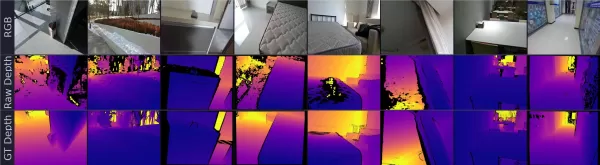
(Image: A sample from the LingBot-Depth-Dataset. From top to bottom: the RGB image, the sensor's raw depth map, and the ground truth depth map. The dataset provides both raw and ground truth depth information, offering robust support for training and evaluating models in real-world conditions.)
Publicly available depth datasets have long faced challenges of limited scale, inadequate real-world scene coverage, and reliance on single hardware types. Many datasets are largely synthetic, exhibiting significant gaps compared to real sensor data in terms of noise patterns, depth holes, and material representation, which hinders the practical deployment of trained models.
The LingBot-Depth-Dataset effectively addresses this data gap in spatial perception by providing large-scale, real-scene captures. Each sample includes an RGB image, a raw sensor depth map, and a corresponding ground truth depth map, making it directly applicable for training and evaluating depth estimation and depth completion models. It supports six popular depth cameras—Orbbec 335, 335L, and Intel RealSense D405, D415, D435, D455—facilitating better model generalization and evaluation across diverse devices and scenarios.
Ant Lingbo's previously open-sourced high-precision spatial perception model, LingBot-Depth, was trained using this dataset as its core data. Compared to mainstream industry methods like PromptDA and PriorDA, LingBot-Depth reduces depth prediction error by over 70% in indoor scenes and by approximately 47% in sparse depth completion tasks. When deployed, this model enables commercial depth cameras to produce more complete, smoother, and sharper depth maps in challenging conditions like transparent glass, reflective surfaces, and backlighting—all without hardware modifications. In certain scenarios, its performance rivals that of premium industrial-grade depth cameras.
For academic and research institutions, this open-source initiative lowers the barriers to data collection and annotation, accelerating the transition of spatial perception technologies from research to real-world application. As robotics and embodied intelligence rapidly integrate into physical environments, large-scale, high-quality datasets grounded in real-world data will become essential infrastructure for driving continued industry progress.
Related article
 Ctrip Business Travel Unveils AI Ecosystem with 7 Industry Agents and 17 Core Capabilities
Ctrip Business Travel has officially unveiled the "Ctrip Business Travel AI Ecosystem," leveraging large language models to fundamentally restructure corporate travel management. This comprehensive ecosystem addresses four core scenarios: travel arra
Stripe to Acquire OpenRouter as AI Model Routing Gains Momentum
Stripe has agreed to acquire OpenRouter, an AI model-routing platform that gives developers access to hundreds of models through a single interface. The deal adds model selection and routing to Stripe’s existing work around AI usage and token-based b
Former OpenAI Researcher Barrett Zoph Returns to Google to Support Gemini Development
Barret Zoph, who previously abruptly left and joined OpenAI due to a disagreement with Thinking Machines Lab CEO Miriam Mularati, has once again changed employers. Alphabet's Google announced that Zoph will return as Vice President of Research, bring
Related Special Topic Recommendations
Design & Art
Ctrip Business Travel Unveils AI Ecosystem with 7 Industry Agents and 17 Core Capabilities
Ctrip Business Travel has officially unveiled the "Ctrip Business Travel AI Ecosystem," leveraging large language models to fundamentally restructure corporate travel management. This comprehensive ecosystem addresses four core scenarios: travel arra
Stripe to Acquire OpenRouter as AI Model Routing Gains Momentum
Stripe has agreed to acquire OpenRouter, an AI model-routing platform that gives developers access to hundreds of models through a single interface. The deal adds model selection and routing to Stripe’s existing work around AI usage and token-based b
Former OpenAI Researcher Barrett Zoph Returns to Google to Support Gemini Development
Barret Zoph, who previously abruptly left and joined OpenAI due to a disagreement with Thinking Machines Lab CEO Miriam Mularati, has once again changed employers. Alphabet's Google announced that Zoph will return as Vice President of Research, bring
Related Special Topic Recommendations
Design & Art
 Top AI Illustration Tools: Create Editorial Scenes and Cover Art Faster
2026 Latest Top-rated AI Illustration Tools: Our curated list features the best powerfully designed tools for creating stunning editorial scenes and eye-catching cover art quickly. Each option has gone through rigorous real-world tests, offering a free vs paid comparison to help you find the perfect match for your workflow. Try these must-try solutions today to unlock your AI edge and boost your creative productivity. Explore now at XIX.AI.
 10 tools
 xix.ai
Education and Learning
Top AI Tutors for Exam Prep: Practice Math, Science, and English
xix.ai
Education and Learning
Top AI Tutors for Exam Prep: Practice Math, Science, and English
2026 Latest Top-Rated Best AI Tutors for Exam Prep are here on XIX.AI! Our curated list features powerful game-changing tools that offer free vs paid comparison, real-world tests, and weekly updated rankings. They help boost your writing efficiency, simplify complex topic learning, and unlock your academic potential. Explore now to Discover your perfect exam prep tool and Start creating today to Unlock your AI edge!
10 tools
xix.ai
Finance
AI Budget Planning Tools for Personal Money Management
2026 Latest Best Top-Rated AI Budget Planning Tools for Personal Money Management are here on XIX.AI! This curated collection features powerful, game-changing solutions that help you conduct real-world tests, understand spending habits, and create personalized plans to boost productivity. Enjoy a free vs paid comparison along with detailed rankings. Must-try tools designed to simplify money management and unlock your AI edge. Explore now!
11 tools
xix.ai
Health & Wellness
AI Sleep Tracking Assistants: Improve Recovery with Better Bedtime Habits
2026 Latest Best Top-Rated AI Sleep Tracking Assistants curated for ultimate recovery. This fully updated weekly guide features powerful tools that deliver real-world tests, free vs paid comparison, and detailed rankings to help you find the must-try solution that boosts sleep quality and supports better bedtime habits. Explore now at XIX.AI to Unlock your AI edge.
10 tools
xix.ai
Data Analysis
AI SQL Copilots for Product and Revenue Analytics
2026 Latest Best Top-Rated AI SQL Copilots for Product and Revenue Analytics! XIX.AI has curated a powerful, game-changing collection of must-try tools that undergo real-world tests through weekly updated rankings. These tools help users boost productivity significantly by accelerating data analysis, streamlining complex queries, and generating accurate insights to drive smarter business decisions. Explore now to Discover your perfect tool for unlocking your AI edge!
14 tools
xix.ai
Education and Learning
Best AI Homework Helpers That Teach: Learn Concepts, Not Just Answers
2026 Latest Best Top-Rated AI Homework Helpers That Teach Core Concepts Not Just Answers Powerful Tools for Students Must-Try Curated List Weekly Updated Free vs Paid Comparison Real-World Tests Accurate Rankings to Help You Unlock Your Full Learning Potential Explore now to Discover your perfect tool for smarter studying.
10 tools
xix.ai

 Comments (0)
0/500
Comments (0)
0/500
On March 31st, Ant Lingbo Technology officially open-sourced the large-scale RGB-D dataset, LingBot-Depth-Dataset. This collection contains 3 million high-quality sample pairs, with 2 million captured from real-world environments and 1 million synthetically rendered. Totaling 2.71TB, it encompasses data from six mainstream depth cameras, making it the largest open-source RGB-D dataset primarily based on real scenes. This release provides richer, more realistic data to advance research in embodied intelligence, spatial perception, and 3D vision.
(Image: A sample from the LingBot-Depth-Dataset. From top to bottom: the RGB image, the sensor's raw depth map, and the ground truth depth map. The dataset provides both raw and ground truth depth information, offering robust support for training and evaluating models in real-world conditions.)
Publicly available depth datasets have long faced challenges of limited scale, inadequate real-world scene coverage, and reliance on single hardware types. Many datasets are largely synthetic, exhibiting significant gaps compared to real sensor data in terms of noise patterns, depth holes, and material representation, which hinders the practical deployment of trained models.
The LingBot-Depth-Dataset effectively addresses this data gap in spatial perception by providing large-scale, real-scene captures. Each sample includes an RGB image, a raw sensor depth map, and a corresponding ground truth depth map, making it directly applicable for training and evaluating depth estimation and depth completion models. It supports six popular depth cameras—Orbbec 335, 335L, and Intel RealSense D405, D415, D435, D455—facilitating better model generalization and evaluation across diverse devices and scenarios.
Ant Lingbo's previously open-sourced high-precision spatial perception model, LingBot-Depth, was trained using this dataset as its core data. Compared to mainstream industry methods like PromptDA and PriorDA, LingBot-Depth reduces depth prediction error by over 70% in indoor scenes and by approximately 47% in sparse depth completion tasks. When deployed, this model enables commercial depth cameras to produce more complete, smoother, and sharper depth maps in challenging conditions like transparent glass, reflective surfaces, and backlighting—all without hardware modifications. In certain scenarios, its performance rivals that of premium industrial-grade depth cameras.
For academic and research institutions, this open-source initiative lowers the barriers to data collection and annotation, accelerating the transition of spatial perception technologies from research to real-world application. As robotics and embodied intelligence rapidly integrate into physical environments, large-scale, high-quality datasets grounded in real-world data will become essential infrastructure for driving continued industry progress.








 Ctrip Business Travel Unveils AI Ecosystem with 7 Industry Agents and 17 Core Capabilities
Ctrip Business Travel has officially unveiled the "Ctrip Business Travel AI Ecosystem," leveraging large language models to fundamentally restructure corporate travel management. This comprehensive ecosystem addresses four core scenarios: travel arra
Ctrip Business Travel Unveils AI Ecosystem with 7 Industry Agents and 17 Core Capabilities
Ctrip Business Travel has officially unveiled the "Ctrip Business Travel AI Ecosystem," leveraging large language models to fundamentally restructure corporate travel management. This comprehensive ecosystem addresses four core scenarios: travel arra
 Stripe to Acquire OpenRouter as AI Model Routing Gains Momentum
Stripe has agreed to acquire OpenRouter, an AI model-routing platform that gives developers access to hundreds of models through a single interface. The deal adds model selection and routing to Stripe’s existing work around AI usage and token-based b
Stripe to Acquire OpenRouter as AI Model Routing Gains Momentum
Stripe has agreed to acquire OpenRouter, an AI model-routing platform that gives developers access to hundreds of models through a single interface. The deal adds model selection and routing to Stripe’s existing work around AI usage and token-based b
 Former OpenAI Researcher Barrett Zoph Returns to Google to Support Gemini Development
Barret Zoph, who previously abruptly left and joined OpenAI due to a disagreement with Thinking Machines Lab CEO Miriam Mularati, has once again changed employers. Alphabet's Google announced that Zoph will return as Vice President of Research, bring
Former OpenAI Researcher Barrett Zoph Returns to Google to Support Gemini Development
Barret Zoph, who previously abruptly left and joined OpenAI due to a disagreement with Thinking Machines Lab CEO Miriam Mularati, has once again changed employers. Alphabet's Google announced that Zoph will return as Vice President of Research, bring

2026 Latest Top-rated AI Illustration Tools: Our curated list features the best powerfully designed tools for creating stunning editorial scenes and eye-catching cover art quickly. Each option has gone through rigorous real-world tests, offering a free vs paid comparison to help you find the perfect match for your workflow. Try these must-try solutions today to unlock your AI edge and boost your creative productivity. Explore now at XIX.AI.
10 tools
xix.ai

2026 Latest Top-Rated Best AI Tutors for Exam Prep are here on XIX.AI! Our curated list features powerful game-changing tools that offer free vs paid comparison, real-world tests, and weekly updated rankings. They help boost your writing efficiency, simplify complex topic learning, and unlock your academic potential. Explore now to Discover your perfect exam prep tool and Start creating today to Unlock your AI edge!
10 tools
xix.ai

2026 Latest Best Top-Rated AI Budget Planning Tools for Personal Money Management are here on XIX.AI! This curated collection features powerful, game-changing solutions that help you conduct real-world tests, understand spending habits, and create personalized plans to boost productivity. Enjoy a free vs paid comparison along with detailed rankings. Must-try tools designed to simplify money management and unlock your AI edge. Explore now!
11 tools
xix.ai

2026 Latest Best Top-Rated AI Sleep Tracking Assistants curated for ultimate recovery. This fully updated weekly guide features powerful tools that deliver real-world tests, free vs paid comparison, and detailed rankings to help you find the must-try solution that boosts sleep quality and supports better bedtime habits. Explore now at XIX.AI to Unlock your AI edge.
10 tools
xix.ai

2026 Latest Best Top-Rated AI SQL Copilots for Product and Revenue Analytics! XIX.AI has curated a powerful, game-changing collection of must-try tools that undergo real-world tests through weekly updated rankings. These tools help users boost productivity significantly by accelerating data analysis, streamlining complex queries, and generating accurate insights to drive smarter business decisions. Explore now to Discover your perfect tool for unlocking your AI edge!
14 tools
xix.ai

2026 Latest Best Top-Rated AI Homework Helpers That Teach Core Concepts Not Just Answers Powerful Tools for Students Must-Try Curated List Weekly Updated Free vs Paid Comparison Real-World Tests Accurate Rankings to Help You Unlock Your Full Learning Potential Explore now to Discover your perfect tool for smarter studying.
10 tools
xix.ai












