


 Home
Alibaba Open Sources Qwen3.6-35B-A3B: 30B activated-parameter model delivers programming leap
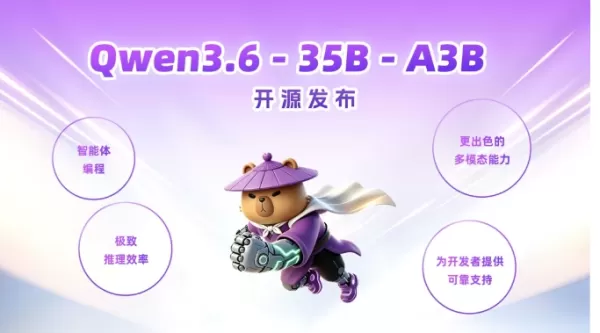
On April 16, 2026, the Alibaba Qwen large model team released the sparse mixture-of-experts (MoE) model Qwen3.6-35B-A3B as open source, marking a key milestone in lightweight models for intelligent agent programming.
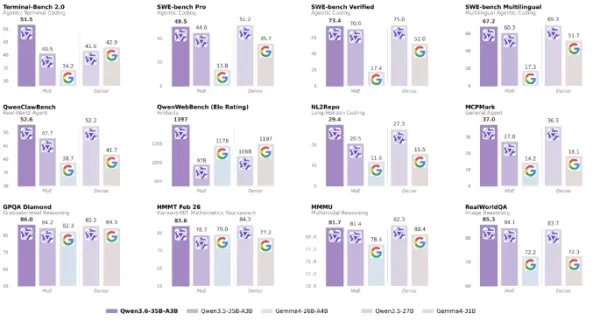
With 35 billion total parameters, the model activates only 3 billion during inference thanks to its sparse MoE architecture. In performance benchmarks, Qwen3.6-35B-A3B outpaces the dense 27-billion-parameter Qwen3.5-27B at a fraction of the computational cost, while also significantly outperforming its predecessor Qwen3.5-35B-A3B. It delivers logical reasoning and intelligent agent collaboration capabilities on par with large-scale models such as Gemma4-31B.
As a fully multimodal open-source model, Qwen3.6-35B-A3B excels in spatial intelligence and visual perception, achieving a RefCOCO score of 92.0. Some of its multimodal metrics already match the level of Claude Sonnet4.5. The model has been integrated into Qwen Studio and is available as the qwen3.6-flash API service on the Alibaba Cloud BaiLian platform. This API supports the preserve_thinking thinking chain retention function and seamlessly works with mainstream AI programming assistants like OpenClaw, Claude Code, and Qwen Code.
With rising demand for edge AI and automated intelligent agents, open-sourcing Qwen3.6-35B-A3B gives developers a high-performance, low-power option while signaling that MoE models with "small parameters, high intelligence" are becoming the new foundation for reshaping programming paradigms and multimodal interactions.
Related article
 MiniMax 2.5 Tops Global Usage With Over $150M Monthly Revenue; M3 Flagship Version Set for H1 Release
Chinese large language models are generating intense momentum across the global developer ecosystem, driven by their reputation for cost-efficiency and engineering excellence.As of March 3, 2026, data from OpenRouter, the world’s leading API aggregat
Meta's Muse outpaces ChatGPT in early mobile launch
New data suggests Meta’s latest AI app, Muse, could become the social giant’s next major success. According to recent estimates from Appfigures, Muse has been downloaded on mobile devices more times in its first twelve days than ChatGPT did in the tw
TechCrunch Disrupt 2026: Clay’s Kareem Amin on the rise of the GTM engineer
Two years ago, GTM engineers were virtually nonexistent in most organizations. Today, the role is emerging across the tech sector, with professionals leveraging AI and automation to construct revenue engines that previously demanded multiple hires, d
Related Special Topic Recommendations
Design & Art
 Top AI Illustration Tools: Create Editorial Scenes and Cover Art Faster
2026 Latest Top-rated AI Illustration Tools: Our curated list features the best powerfully designed tools for creating stunning editorial scenes and eye-catching cover art quickly. Each option has gone through rigorous real-world tests, offering a free vs paid comparison to help you find the perfect match for your workflow. Try these must-try solutions today to unlock your AI edge and boost your creative productivity. Explore now at XIX.AI.
 10 tools
 xix.ai
Education and Learning
Top AI Tutors for Exam Prep: Practice Math, Science, and English
2026 Latest Top-Rated Best AI Tutors for Exam Prep are here on XIX.AI! Our curated list features powerful game-changing tools that offer free vs paid comparison, real-world tests, and weekly updated rankings. They help boost your writing efficiency, simplify complex topic learning, and unlock your academic potential. Explore now to Discover your perfect exam prep tool and Start creating today to Unlock your AI edge!
10 tools
xix.ai
Finance
AI Budget Planning Tools for Personal Money Management
2026 Latest Best Top-Rated AI Budget Planning Tools for Personal Money Management are here on XIX.AI! This curated collection features powerful, game-changing solutions that help you conduct real-world tests, understand spending habits, and create personalized plans to boost productivity. Enjoy a free vs paid comparison along with detailed rankings. Must-try tools designed to simplify money management and unlock your AI edge. Explore now!
11 tools
xix.ai
Health & Wellness
AI Sleep Tracking Assistants: Improve Recovery with Better Bedtime Habits
2026 Latest Best Top-Rated AI Sleep Tracking Assistants curated for ultimate recovery. This fully updated weekly guide features powerful tools that deliver real-world tests, free vs paid comparison, and detailed rankings to help you find the must-try solution that boosts sleep quality and supports better bedtime habits. Explore now at XIX.AI to Unlock your AI edge.
10 tools
xix.ai
Data Analysis
AI SQL Copilots for Product and Revenue Analytics
2026 Latest Best Top-Rated AI SQL Copilots for Product and Revenue Analytics! XIX.AI has curated a powerful, game-changing collection of must-try tools that undergo real-world tests through weekly updated rankings. These tools help users boost productivity significantly by accelerating data analysis, streamlining complex queries, and generating accurate insights to drive smarter business decisions. Explore now to Discover your perfect tool for unlocking your AI edge!
14 tools
xix.ai
Education and Learning
Best AI Homework Helpers That Teach: Learn Concepts, Not Just Answers
2026 Latest Best Top-Rated AI Homework Helpers That Teach Core Concepts Not Just Answers Powerful Tools for Students Must-Try Curated List Weekly Updated Free vs Paid Comparison Real-World Tests Accurate Rankings to Help You Unlock Your Full Learning Potential Explore now to Discover your perfect tool for smarter studying.
10 tools
xix.ai

 Comments (0)
0/500
On April 16, 2026, the Alibaba Qwen large model team released the sparse mixture-of-experts (MoE) model Qwen3.6-35B-A3B as open source, marking a key milestone in lightweight models for intelligent agent programming.
With 35 billion total parameters, the model activates only 3 billion during inference thanks to its sparse MoE architecture. In performance benchmarks, Qwen3.6-35B-A3B outpaces the dense 27-billion-parameter Qwen3.5-27B at a fraction of the computational cost, while also significantly outperforming its predecessor Qwen3.5-35B-A3B. It delivers logical reasoning and intelligent agent collaboration capabilities on par with large-scale models such as Gemma4-31B.
As a fully multimodal open-source model, Qwen3.6-35B-A3B excels in spatial intelligence and visual perception, achieving a RefCOCO score of 92.0. Some of its multimodal metrics already match the level of Claude Sonnet4.5. The model has been integrated into Qwen Studio and is available as the qwen3.6-flash API service on the Alibaba Cloud BaiLian platform. This API supports the preserve_thinking thinking chain retention function and seamlessly works with mainstream AI programming assistants like OpenClaw, Claude Code, and Qwen Code.
With rising demand for edge AI and automated intelligent agents, open-sourcing Qwen3.6-35B-A3B gives developers a high-performance, low-power option while signaling that MoE models with "small parameters, high intelligence" are becoming the new foundation for reshaping programming paradigms and multimodal interactions.








 MiniMax 2.5 Tops Global Usage With Over $150M Monthly Revenue; M3 Flagship Version Set for H1 Release
Chinese large language models are generating intense momentum across the global developer ecosystem, driven by their reputation for cost-efficiency and engineering excellence.As of March 3, 2026, data from OpenRouter, the world’s leading API aggregat
 Meta's Muse outpaces ChatGPT in early mobile launch
New data suggests Meta’s latest AI app, Muse, could become the social giant’s next major success. According to recent estimates from Appfigures, Muse has been downloaded on mobile devices more times in its first twelve days than ChatGPT did in the tw
 TechCrunch Disrupt 2026: Clay’s Kareem Amin on the rise of the GTM engineer
Two years ago, GTM engineers were virtually nonexistent in most organizations. Today, the role is emerging across the tech sector, with professionals leveraging AI and automation to construct revenue engines that previously demanded multiple hires, d

2026 Latest Top-rated AI Illustration Tools: Our curated list features the best powerfully designed tools for creating stunning editorial scenes and eye-catching cover art quickly. Each option has gone through rigorous real-world tests, offering a free vs paid comparison to help you find the perfect match for your workflow. Try these must-try solutions today to unlock your AI edge and boost your creative productivity. Explore now at XIX.AI.
10 tools
xix.ai

2026 Latest Top-Rated Best AI Tutors for Exam Prep are here on XIX.AI! Our curated list features powerful game-changing tools that offer free vs paid comparison, real-world tests, and weekly updated rankings. They help boost your writing efficiency, simplify complex topic learning, and unlock your academic potential. Explore now to Discover your perfect exam prep tool and Start creating today to Unlock your AI edge!
10 tools
xix.ai

2026 Latest Best Top-Rated AI Budget Planning Tools for Personal Money Management are here on XIX.AI! This curated collection features powerful, game-changing solutions that help you conduct real-world tests, understand spending habits, and create personalized plans to boost productivity. Enjoy a free vs paid comparison along with detailed rankings. Must-try tools designed to simplify money management and unlock your AI edge. Explore now!
11 tools
xix.ai

2026 Latest Best Top-Rated AI Sleep Tracking Assistants curated for ultimate recovery. This fully updated weekly guide features powerful tools that deliver real-world tests, free vs paid comparison, and detailed rankings to help you find the must-try solution that boosts sleep quality and supports better bedtime habits. Explore now at XIX.AI to Unlock your AI edge.
10 tools
xix.ai

2026 Latest Best Top-Rated AI SQL Copilots for Product and Revenue Analytics! XIX.AI has curated a powerful, game-changing collection of must-try tools that undergo real-world tests through weekly updated rankings. These tools help users boost productivity significantly by accelerating data analysis, streamlining complex queries, and generating accurate insights to drive smarter business decisions. Explore now to Discover your perfect tool for unlocking your AI edge!
14 tools
xix.ai

2026 Latest Best Top-Rated AI Homework Helpers That Teach Core Concepts Not Just Answers Powerful Tools for Students Must-Try Curated List Weekly Updated Free vs Paid Comparison Real-World Tests Accurate Rankings to Help You Unlock Your Full Learning Potential Explore now to Discover your perfect tool for smarter studying.
10 tools
xix.ai












