New research reveals that open-source, ChatGPT-style AI systems can potentially use natural language to connect callers with the right person in a call center, bypassing the need to navigate frustrating and frequently changing menu systems that often feel deliberately obstructive.
Reaching a live agent can be a frustrating ordeal, as callers must slowly work through multiple-choice options, often unsure which selection fits their specific issue. When none do, savvy users often develop tricks and workarounds to reach a human representative and escape 'option hell'. For many, this experience feels adversarial and user-unfriendly.
It's no surprise that call centers are a primary target for AI augmentation or replacement. Despite some experts urging caution, automating call centers remains low-hanging fruit for tech headlines and a promising area for AI-driven innovation that can deliver an unusually quick return on investment.
Closed Shop
However, open-source principles and publicly available data are seldom applied in this domain, and for good reason. Companies automating their customer response systems have little incentive to share the data, methodologies, or corporate intellectual property that underpins their competitive advantage.
Sharing such resources would erode their market edge. More critically, as AI systems can be prone to leaking sensitive information, it also carries significant legal risks.
This has led to several well-funded companies developing AI-powered call center systems independently, inevitably duplicating some efforts. It has also fueled a surge in B2B startups and established players aiming to meet the growing demand for AI-driven customer service capabilities.
A PolyAI voice assistant initiates a customer service call for the fictional 'Augusta Lawn Care', leveraging extensive training conversations to automate responses within existing call center infrastructure. Source
Furthermore, the drive to eliminate the frustration of complex call-center menus has spurred research efforts. However, most findings are not published on Arxiv or other open platforms, reflecting the typically proprietary nature of Interactive Voice Response (IVR) development.
Consequently, research, data, and business intelligence related to AI automation in customer service are closely guarded. Very few open-source alternatives exist, even if using such systems with legally secure data were a viable option, which is doubtful.
Local Call
Against this backdrop, a new paper from Colombia is a welcome attempt to bring IVR development slightly out of its corporate vault. The concise study, titled Beyond IVR Touch-Tones: Customer Intent Routing using LLMs, comes from a researcher at Universidad Distrital Francisco José de Caldas in Bogotá. It claims to be the first non-proprietary project using Large Language Models (LLMs) to create a functional schema for a Customer Intent Routing (CIR) system.
Rather than using real call data or proprietary menu structures, the project generates all components from scratch using three AI models: one to design a realistic call center menu, another to simulate hundreds of caller complaints, and a third to function as the chatbot, routing these queries to the correct destination.
The outcome is a fully synthetic yet convincing test environment featuring a fictional telecommunications company and 920 distinct user queries. This setup allows the experiment to explore how well current AI interprets vague, unstructured speech and directs callers appropriately, all while avoiding legal risks.
Tests show the system can accurately map free-form caller complaints to the correct destination with up to 89.13% accuracy, particularly when provided with 'flattened' menu options instead of detailed descriptions.
The study also found that the AI made more errors when callers used casual or varied language. However, some mistakes occurred not because the AI misunderstood, but because the phone menu itself was confusing.
Examples of customer interactions shared as part of the new project. Source
The project's data has been made publicly available.
Method
The tripartite approach began with a model creating a detailed phone menu for a fictional telecom company. A second model generated unique caller messages—some straightforward, others rephrased or more casual—to simulate realistic speech patterns. A total of 920 examples were generated.
The third model was tasked with connecting each caller to the right department based solely on the message and a version of the menu. This framework made the experiment fully reproducible without needing real call data or exposing customer information.
The three systems selected for the tripartite approach. Source
The models used were gpt-3.5-turbo, gpt-4o-mini, and gpt-4.1-mini, respectively.
To simulate an authentic customer service setting, a complex phone menu needed to be synthesized from scratch. Due to a lack of relevant datasets, the gpt-3.5-turbo model was prompted to generate a complete, multi-branch structure for a fictional telecom provider.
Each branch represented service areas like billing, technical support, account management, and new services, complete with realistic sub-options and varying depths. Two menu versions were created for testing: a plain text hierarchy mimicking a human-readable format, and a list of endpoints with corresponding button sequences.
This enabled testing on both a detailed and a simplified version of the routing problem:
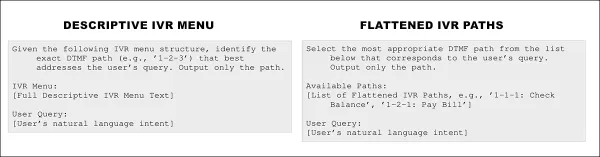
Two versions of the phone menu were provided to the AI: a detailed text hierarchy, and a simplified list of direct menu options, to compare how well each format supported routing callers to the right place.
To generate the test caller messages, a second language model produced a set of original complaints or requests, with ten unique examples per menu endpoint.
Each was then rephrased into several variations to reflect the diverse ways real people express their issues, incorporating changes in length, tone, and even minor errors or filler words.
The 920 initial messages were crafted to test the system's accuracy and simulate the unpredictability of natural conversation.
In the third stage, the final model's ability to map each message to the correct menu destination was tested using the two different IVR presentation formats.
For the first version, the AI received a full descriptive outline of the phone tree. For the second, it saw only a list of final destinations with their button sequences.
The aim was to determine if a simplified menu would help the model route calls more effectively. In both cases, the system processed one message at a time and was instructed to return only the path, with no extra text, to enable automated scoring.
Isolation
To prevent test result contamination, each model was kept isolated. The first model drafted the phone menu, but it was finalized manually to remain unfamiliar to the other systems.
The caller messages were generated separately by gpt-4o-mini, using only endpoint names without access to the menu structure. Finally, gpt-4.1-mini, which performed the routing, only had access to the menu text and incoming messages, having no role in creating them.
Metrics
Two standard metrics evaluated the routing system's performance: accuracy, defined as the percentage of cases where the model provided the exact correct path (e.g., 1-2-3). Confusion matrices were also generated* to pinpoint error locations. Evaluations were conducted in Python using the pandas and scikit-learn libraries.
Results
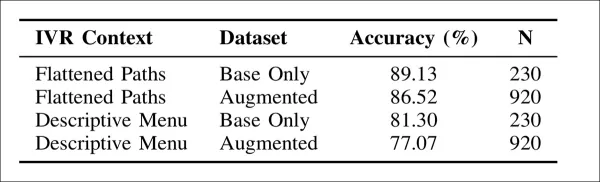
Testing revealed that the model's accuracy significantly depended on menu presentation. With a flattened list of menu paths, the system achieved 89.13% accuracy on the simpler dataset, compared to 81.30% with the full descriptive menu.
Routing accuracy for the third (LLM3) model, across different prompt formats and dataset types, showing that flattened menu paths consistently outperformed hierarchical descriptions, and accuracy decreased slightly with paraphrased or informal language inputs.
This trend continued with the larger, more linguistically diverse dataset, where the flattened version again performed better, scoring 86.52% versus 77.07% for the descriptive format.
The paper notes these results suggest simpler, list-based prompts helped the model match queries more reliably than lengthy hierarchical descriptions.
Accuracy also dipped slightly when paraphrased and informal caller messages were introduced, indicating that while increased variety enhanced realism, it also made classification more difficult.
The paper concludes:
‘Our results demonstrate that LLMs route customer intents more accurately when provided with flattened IVR paths (up to 89.13%) compared to verbose menu descriptions (as low as 77.07%). This suggests that concise, structured prompts reduce noise and are better suited for routing tasks.
‘This supports the idea that clarity and brevity improve LLM performance in classification scenarios.
‘Furthermore, converting menus into flattened paths is a straightforward, automatable process for real-world deployment.’
Conclusion
It is encouraging to see open research emerging in a field typically characterized by secrecy and exclusivity. A key question remains: will future systems require 'framing' architectures to contextualize LLMs, or will models simply need access to locally available business intelligence, eliminating the need for companies to share data with third parties.
Ultimately, the core design principles explored here seem likely to be naturally adopted by future AI systems, even beyond customer service, without requiring specific adaptation for that use case.
* Please consult the source paper for these details.
Stripe to Acquire OpenRouter as AI Model Routing Gains MomentumStripe has agreed to acquire OpenRouter, an AI model-routing platform that gives developers access to hundreds of models through a single interface. The deal adds model selection and routing to Stripe’s existing work around AI usage and token-based b
How Recursive Intelligence Raised $335M at $4B Valuation in 4 MonthsThe co-founders of startup Ricursive Intelligence seemed destined to be co-founders.Anna Goldie, CEO, and Azalia Mirhoseini, CTO, are so well-known in the AI community that they were among those AI engineers who “got those weird emails from Zuckerber
2026 Latest Top-rated AI Illustration Tools: Our curated list features the best powerfully designed tools for creating stunning editorial scenes and eye-catching cover art quickly. Each option has gone through rigorous real-world tests, offering a free vs paid comparison to help you find the perfect match for your workflow. Try these must-try solutions today to unlock your AI edge and boost your creative productivity. Explore now at XIX.AI.
2026 Latest Top-Rated Best AI Tutors for Exam Prep are here on XIX.AI! Our curated list features powerful game-changing tools that offer free vs paid comparison, real-world tests, and weekly updated rankings. They help boost your writing efficiency, simplify complex topic learning, and unlock your academic potential. Explore now to Discover your perfect exam prep tool and Start creating today to Unlock your AI edge!
2026 Latest Best Top-Rated AI Budget Planning Tools for Personal Money Management are here on XIX.AI! This curated collection features powerful, game-changing solutions that help you conduct real-world tests, understand spending habits, and create personalized plans to boost productivity. Enjoy a free vs paid comparison along with detailed rankings. Must-try tools designed to simplify money management and unlock your AI edge. Explore now!
2026 Latest Best Top-Rated AI Sleep Tracking Assistants curated for ultimate recovery. This fully updated weekly guide features powerful tools that deliver real-world tests, free vs paid comparison, and detailed rankings to help you find the must-try solution that boosts sleep quality and supports better bedtime habits. Explore now at XIX.AI to Unlock your AI edge.
2026 Latest Best Top-Rated AI SQL Copilots for Product and Revenue Analytics! XIX.AI has curated a powerful, game-changing collection of must-try tools that undergo real-world tests through weekly updated rankings. These tools help users boost productivity significantly by accelerating data analysis, streamlining complex queries, and generating accurate insights to drive smarter business decisions. Explore now to Discover your perfect tool for unlocking your AI edge!
2026 Latest Best Top-Rated AI Homework Helpers That Teach Core Concepts Not Just Answers Powerful Tools for Students Must-Try Curated List Weekly Updated Free vs Paid Comparison Real-World Tests Accurate Rankings to Help You Unlock Your Full Learning Potential Explore now to Discover your perfect tool for smarter studying.
By clicking "Accept All Cookies", you agree to the storing of cookies on your device to enhance site navigation, analyze site usage, and assist in our marketing efforts.Privacy Policy Notice
When you visit any website, it may store or retrieve information on your browser, mostly in the form of cookies. This information might be about you, your preferences or your device and is mostly used to make the site work as you expect it to. The information does not usually directly identify you, but it can give you a more personalized web experience. Because we respect your right to privacy, you can choose not to allow some types of cookies. Click on the different category headings to find out more and change our default settings.However, blocking some types of cookies may impact your experience of the site and the services we are able to offer. Privacy PolicyStatement
Manage Preferences
Strictly Necessary Cookie
Always Active
These cookies are necessary for the website to function and cannot be switched off in our systems. They are usually only set in response to actions made by you which amount to a request for services, such as setting your privacy preferences, logging in or filling in forms. You can set your browser to block or alert you about these cookies, but some parts of the site will not then work. These cookies do not store any personally identifiable information.



 Home
Home
![Examples of customer interactions, shared as part of the new project. [Source] https://figshare.com/articles/dataset/Beyond_IVR_Touch-Tones_Customer_Intent_Routing_using_LLMs/30118690](https://img.xix.ai/uploads/61/69023b8fbf62b.webp)
![The three systems chosen for the tripartite approach. [Source] https://arxiv.org/pdf/2510.21715](https://img.xix.ai/uploads/87/69023b91dcc46.webp)
 Stripe to Acquire OpenRouter as AI Model Routing Gains Momentum
Stripe has agreed to acquire OpenRouter, an AI model-routing platform that gives developers access to hundreds of models through a single interface. The deal adds model selection and routing to Stripe’s existing work around AI usage and token-based b
Stripe to Acquire OpenRouter as AI Model Routing Gains Momentum
Stripe has agreed to acquire OpenRouter, an AI model-routing platform that gives developers access to hundreds of models through a single interface. The deal adds model selection and routing to Stripe’s existing work around AI usage and token-based b
 Top AI Illustration Tools: Create Editorial Scenes and Cover Art Faster
 10 tools
 xix.ai
Education and Learning
xix.ai
Education and Learning

 Comments (0)
0/500
Comments (0)
0/500

![Examples of customer interactions, shared as part of the new project. [Source] https://figshare.com/articles/dataset/Beyond_IVR_Touch-Tones_Customer_Intent_Routing_using_LLMs/30118690](https://img.xix.ai/uploads/61/69023b8fbf62b.webp.webp)
![The three systems chosen for the tripartite approach. [Source] https://arxiv.org/pdf/2510.21715](https://img.xix.ai/uploads/87/69023b91dcc46.webp.webp)








 Stripe to Acquire OpenRouter as AI Model Routing Gains Momentum
Stripe has agreed to acquire OpenRouter, an AI model-routing platform that gives developers access to hundreds of models through a single interface. The deal adds model selection and routing to Stripe’s existing work around AI usage and token-based b
Stripe to Acquire OpenRouter as AI Model Routing Gains Momentum
Stripe has agreed to acquire OpenRouter, an AI model-routing platform that gives developers access to hundreds of models through a single interface. The deal adds model selection and routing to Stripe’s existing work around AI usage and token-based b
 Former OpenAI Researcher Barrett Zoph Returns to Google to Support Gemini Development
Barret Zoph, who previously abruptly left and joined OpenAI due to a disagreement with Thinking Machines Lab CEO Miriam Mularati, has once again changed employers. Alphabet's Google announced that Zoph will return as Vice President of Research, bring
Former OpenAI Researcher Barrett Zoph Returns to Google to Support Gemini Development
Barret Zoph, who previously abruptly left and joined OpenAI due to a disagreement with Thinking Machines Lab CEO Miriam Mularati, has once again changed employers. Alphabet's Google announced that Zoph will return as Vice President of Research, bring
 How Recursive Intelligence Raised $335M at $4B Valuation in 4 Months
The co-founders of startup Ricursive Intelligence seemed destined to be co-founders.Anna Goldie, CEO, and Azalia Mirhoseini, CTO, are so well-known in the AI community that they were among those AI engineers who “got those weird emails from Zuckerber
How Recursive Intelligence Raised $335M at $4B Valuation in 4 Months
The co-founders of startup Ricursive Intelligence seemed destined to be co-founders.Anna Goldie, CEO, and Azalia Mirhoseini, CTO, are so well-known in the AI community that they were among those AI engineers who “got those weird emails from Zuckerber