


 Home
AI labs pay XDOF for messy robot training data collection
Two weeks ago, OpenAI announced it would revive the robotics program it shut down in 2021 — the latest sign that major AI labs are competing to teach machines how to operate in the physical world. But building capable robots requires something the AI industry still lacks: training data equivalent to what language models use.
This gap is fueling a new type of infrastructure business. Unlike LLMs, which were trained on massive amounts of publicly available text, robots need data that captures physical interactions — and that kind of data barely exists. YouTube videos and footage from gig workers are low-fidelity and difficult to align with the physical world.
XDOF (pronounced “ecks-doff”), emerging from stealth today, believes the next major bottleneck in AI won’t be models or chips, but the data feedback loop needed to teach robots how to interact with the physical world.
The startup aims to build the data pipelines, collection tools, and annotation systems that frontier labs and robotics companies can’t easily develop on their own — and has raised $70 million from Thrive Capital, Spark Capital, a16z, Lux, and WndrCo to do so. Co-founder and CEO Philippe Wu says XDOF, which employs about 60 people, is already working with 20 customers including several frontier AI labs, though he cannot name them.
“All of the top labs are trying to pursue robotics,” Wu said. “We’ve already seen some of the downsides of falling slightly behind in the language model race … you don’t want to end up in a situation where you pursue this technology too late, and everyone is in the same boat where physical AI is the next frontier.”
Wu encountered this problem firsthand as a PhD student at UC Berkeley. His focus was on enabling robots to learn skills from large-scale datasets. There was just one problem.
“We didn’t have large-scale data to work with,” he told TechCrunch. “There was this chicken-and-egg problem — we first needed to actually collect data before we could even ask how to train a foundation model for robotics.”
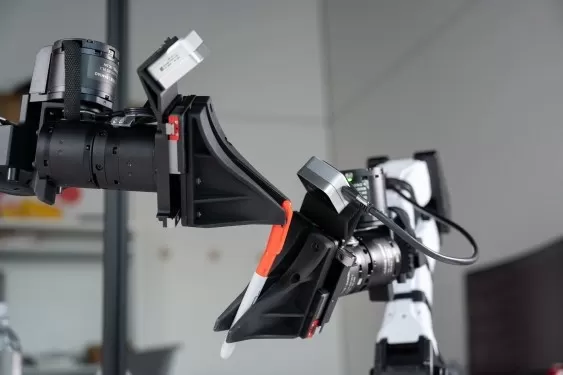
Wu and his future XDOF co-founder and CTO, Fred Shentu, worked on a project called GELLO, a low-cost teleoperation system that lets a human operator control a robotic arm to generate training data. “It ended up becoming a very influential paper in robotics, because a lot of people had similar needs and bottlenecks, and many started leveraging this type of device for data collection,” Wu said.
Spotting the opportunity, Wu, Shentu, and third co-founder and Chief Operating Officer Nemo Jin launched XDOF in October 2024 to provide a data ecosystem for companies pursuing robotics models. Mindful that data provision alone can be a dead-end business, the company is also focused on data cleaning, tooling, and annotation — creating a self-reinforcing feedback loop for robot trainers.
As a starting point, the company is partnering with UC Berkeley’s AI Research lab to release what it believes is the largest collection of high-quality robot training data ever assembled, dubbed ABC. It includes 130,000 trajectories of robot manipulation data, 300 hours of simulation, and 100 hours of evaluations. That kind of scaled-up pre-training data has never been available to academia before.
“We’ve seen in language, image generation, and other fields, that when models and data are released, the community achieves things that you wouldn’t necessarily have expected,” David McAllister, a Berkeley PhD student who helped organize the release, told TechCrunch.
The team has already used the data to train robots on benchmark tasks like folding T-shirts and flattening boxes, or loading AirPods into their cases.
Unlimited Degrees of Freedom
The company plans to work across three tiers of a data pyramid. The most valuable tier is teleoperation data collected on the actual robot being deployed; next comes teleoperated robots gathering more general data, as with GELLO; and finally “egocentric” data gathered by humans performing everyday tasks, for which XDOF plans to build its own wearable sensors.
“Your camera choice is going to affect the quality of your data — which is going to affect how your hand-tracking algorithm performs,” Wu said. “If you don’t design the hardware well from the start, the data you collect might have very specific problems that you didn’t anticipate.”
The company plans to hire and train armies of teleoperators and egocentric data operators around the world — a labor-intensive model that raises an obvious question: Why aren’t the major labs doing this data production work themselves?
“You need a warehouse of hundreds of thousands of square feet with hundreds of robots,” Wu said. “You need to maintain these robots, calibrate their physical parameters, and properly train operators.”
It’s a build-out that requires focus, capital, and operational scale that most AI labs would rather outsource — which is precisely the market XDOF is betting on.
The name XDOF is a play on the robotics term “degrees of freedom,” which describes the number of independent motions a robot can perform. Your arm, from shoulder to wrist, has seven degrees of freedom. Humanoid robotics company Figure.AI’s latest robot has 30. The X in the company’s name captures its ambition: “Arbitrary degrees of freedom, unlimited degrees of freedom,” Wu says.
Related article
 Huawei Qinyun Unveils Education AI Solution Integrating HarmonyOS and Large Models
During the inaugural Huawei Harmony Education AI Summit, Huawei and its ecosystem partners unveiled a comprehensive education AI strategy alongside an all-scenario campus solution. This initiative signals a pivotal stage in educational digital transf
Nvidia CEO Jensen Huang Dismisses AI Apocalypse Claims, Says 2030 Doomsday Probability Is Zero
In a recent CBS News interview, NVIDIA co-founder and CEO Jensen Huang dismissed warnings from certain researchers that artificial intelligence could lead to human extinction within a few years, labeling such apocalyptic narratives as exaggerated.“20
OpenAI launches GPT-Live-1 API with interruption handling, tool calls and phone agents
OpenAI has officially launched GPT-Live-1, a new API model designed to empower developers building full-duplex, real-time voice applications. This release signals a major shift in AI voice interaction, moving beyond traditional segmented processing t
Related Special Topic Recommendations
Design & Art
 Top AI Illustration Tools: Create Editorial Scenes and Cover Art Faster
2026 Latest Top-rated AI Illustration Tools: Our curated list features the best powerfully designed tools for creating stunning editorial scenes and eye-catching cover art quickly. Each option has gone through rigorous real-world tests, offering a free vs paid comparison to help you find the perfect match for your workflow. Try these must-try solutions today to unlock your AI edge and boost your creative productivity. Explore now at XIX.AI.
 10 tools
 xix.ai
Education and Learning
Top AI Tutors for Exam Prep: Practice Math, Science, and English
2026 Latest Top-Rated Best AI Tutors for Exam Prep are here on XIX.AI! Our curated list features powerful game-changing tools that offer free vs paid comparison, real-world tests, and weekly updated rankings. They help boost your writing efficiency, simplify complex topic learning, and unlock your academic potential. Explore now to Discover your perfect exam prep tool and Start creating today to Unlock your AI edge!
10 tools
xix.ai
Finance
AI Budget Planning Tools for Personal Money Management
2026 Latest Best Top-Rated AI Budget Planning Tools for Personal Money Management are here on XIX.AI! This curated collection features powerful, game-changing solutions that help you conduct real-world tests, understand spending habits, and create personalized plans to boost productivity. Enjoy a free vs paid comparison along with detailed rankings. Must-try tools designed to simplify money management and unlock your AI edge. Explore now!
11 tools
xix.ai
Health & Wellness
AI Sleep Tracking Assistants: Improve Recovery with Better Bedtime Habits
2026 Latest Best Top-Rated AI Sleep Tracking Assistants curated for ultimate recovery. This fully updated weekly guide features powerful tools that deliver real-world tests, free vs paid comparison, and detailed rankings to help you find the must-try solution that boosts sleep quality and supports better bedtime habits. Explore now at XIX.AI to Unlock your AI edge.
10 tools
xix.ai
Data Analysis
AI SQL Copilots for Product and Revenue Analytics
2026 Latest Best Top-Rated AI SQL Copilots for Product and Revenue Analytics! XIX.AI has curated a powerful, game-changing collection of must-try tools that undergo real-world tests through weekly updated rankings. These tools help users boost productivity significantly by accelerating data analysis, streamlining complex queries, and generating accurate insights to drive smarter business decisions. Explore now to Discover your perfect tool for unlocking your AI edge!
14 tools
xix.ai
Education and Learning
Best AI Homework Helpers That Teach: Learn Concepts, Not Just Answers
2026 Latest Best Top-Rated AI Homework Helpers That Teach Core Concepts Not Just Answers Powerful Tools for Students Must-Try Curated List Weekly Updated Free vs Paid Comparison Real-World Tests Accurate Rankings to Help You Unlock Your Full Learning Potential Explore now to Discover your perfect tool for smarter studying.
10 tools
xix.ai

 Comments (0)
0/500
Two weeks ago, OpenAI announced it would revive the robotics program it shut down in 2021 — the latest sign that major AI labs are competing to teach machines how to operate in the physical world. But building capable robots requires something the AI industry still lacks: training data equivalent to what language models use.
This gap is fueling a new type of infrastructure business. Unlike LLMs, which were trained on massive amounts of publicly available text, robots need data that captures physical interactions — and that kind of data barely exists. YouTube videos and footage from gig workers are low-fidelity and difficult to align with the physical world.
XDOF (pronounced “ecks-doff”), emerging from stealth today, believes the next major bottleneck in AI won’t be models or chips, but the data feedback loop needed to teach robots how to interact with the physical world.
The startup aims to build the data pipelines, collection tools, and annotation systems that frontier labs and robotics companies can’t easily develop on their own — and has raised $70 million from Thrive Capital, Spark Capital, a16z, Lux, and WndrCo to do so. Co-founder and CEO Philippe Wu says XDOF, which employs about 60 people, is already working with 20 customers including several frontier AI labs, though he cannot name them.
“All of the top labs are trying to pursue robotics,” Wu said. “We’ve already seen some of the downsides of falling slightly behind in the language model race … you don’t want to end up in a situation where you pursue this technology too late, and everyone is in the same boat where physical AI is the next frontier.”
Wu encountered this problem firsthand as a PhD student at UC Berkeley. His focus was on enabling robots to learn skills from large-scale datasets. There was just one problem.
“We didn’t have large-scale data to work with,” he told TechCrunch. “There was this chicken-and-egg problem — we first needed to actually collect data before we could even ask how to train a foundation model for robotics.”
Wu and his future XDOF co-founder and CTO, Fred Shentu, worked on a project called GELLO, a low-cost teleoperation system that lets a human operator control a robotic arm to generate training data. “It ended up becoming a very influential paper in robotics, because a lot of people had similar needs and bottlenecks, and many started leveraging this type of device for data collection,” Wu said.
Spotting the opportunity, Wu, Shentu, and third co-founder and Chief Operating Officer Nemo Jin launched XDOF in October 2024 to provide a data ecosystem for companies pursuing robotics models. Mindful that data provision alone can be a dead-end business, the company is also focused on data cleaning, tooling, and annotation — creating a self-reinforcing feedback loop for robot trainers.
As a starting point, the company is partnering with UC Berkeley’s AI Research lab to release what it believes is the largest collection of high-quality robot training data ever assembled, dubbed ABC. It includes 130,000 trajectories of robot manipulation data, 300 hours of simulation, and 100 hours of evaluations. That kind of scaled-up pre-training data has never been available to academia before.
“We’ve seen in language, image generation, and other fields, that when models and data are released, the community achieves things that you wouldn’t necessarily have expected,” David McAllister, a Berkeley PhD student who helped organize the release, told TechCrunch.
The team has already used the data to train robots on benchmark tasks like folding T-shirts and flattening boxes, or loading AirPods into their cases.
Unlimited Degrees of Freedom
The company plans to work across three tiers of a data pyramid. The most valuable tier is teleoperation data collected on the actual robot being deployed; next comes teleoperated robots gathering more general data, as with GELLO; and finally “egocentric” data gathered by humans performing everyday tasks, for which XDOF plans to build its own wearable sensors.
“Your camera choice is going to affect the quality of your data — which is going to affect how your hand-tracking algorithm performs,” Wu said. “If you don’t design the hardware well from the start, the data you collect might have very specific problems that you didn’t anticipate.”
The company plans to hire and train armies of teleoperators and egocentric data operators around the world — a labor-intensive model that raises an obvious question: Why aren’t the major labs doing this data production work themselves?
“You need a warehouse of hundreds of thousands of square feet with hundreds of robots,” Wu said. “You need to maintain these robots, calibrate their physical parameters, and properly train operators.”
It’s a build-out that requires focus, capital, and operational scale that most AI labs would rather outsource — which is precisely the market XDOF is betting on.
The name XDOF is a play on the robotics term “degrees of freedom,” which describes the number of independent motions a robot can perform. Your arm, from shoulder to wrist, has seven degrees of freedom. Humanoid robotics company Figure.AI’s latest robot has 30. The X in the company’s name captures its ambition: “Arbitrary degrees of freedom, unlimited degrees of freedom,” Wu says.








 Huawei Qinyun Unveils Education AI Solution Integrating HarmonyOS and Large Models
During the inaugural Huawei Harmony Education AI Summit, Huawei and its ecosystem partners unveiled a comprehensive education AI strategy alongside an all-scenario campus solution. This initiative signals a pivotal stage in educational digital transf
 Nvidia CEO Jensen Huang Dismisses AI Apocalypse Claims, Says 2030 Doomsday Probability Is Zero
In a recent CBS News interview, NVIDIA co-founder and CEO Jensen Huang dismissed warnings from certain researchers that artificial intelligence could lead to human extinction within a few years, labeling such apocalyptic narratives as exaggerated.“20
 OpenAI launches GPT-Live-1 API with interruption handling, tool calls and phone agents
OpenAI has officially launched GPT-Live-1, a new API model designed to empower developers building full-duplex, real-time voice applications. This release signals a major shift in AI voice interaction, moving beyond traditional segmented processing t

2026 Latest Top-rated AI Illustration Tools: Our curated list features the best powerfully designed tools for creating stunning editorial scenes and eye-catching cover art quickly. Each option has gone through rigorous real-world tests, offering a free vs paid comparison to help you find the perfect match for your workflow. Try these must-try solutions today to unlock your AI edge and boost your creative productivity. Explore now at XIX.AI.
10 tools
xix.ai

2026 Latest Top-Rated Best AI Tutors for Exam Prep are here on XIX.AI! Our curated list features powerful game-changing tools that offer free vs paid comparison, real-world tests, and weekly updated rankings. They help boost your writing efficiency, simplify complex topic learning, and unlock your academic potential. Explore now to Discover your perfect exam prep tool and Start creating today to Unlock your AI edge!
10 tools
xix.ai

2026 Latest Best Top-Rated AI Budget Planning Tools for Personal Money Management are here on XIX.AI! This curated collection features powerful, game-changing solutions that help you conduct real-world tests, understand spending habits, and create personalized plans to boost productivity. Enjoy a free vs paid comparison along with detailed rankings. Must-try tools designed to simplify money management and unlock your AI edge. Explore now!
11 tools
xix.ai

2026 Latest Best Top-Rated AI Sleep Tracking Assistants curated for ultimate recovery. This fully updated weekly guide features powerful tools that deliver real-world tests, free vs paid comparison, and detailed rankings to help you find the must-try solution that boosts sleep quality and supports better bedtime habits. Explore now at XIX.AI to Unlock your AI edge.
10 tools
xix.ai

2026 Latest Best Top-Rated AI SQL Copilots for Product and Revenue Analytics! XIX.AI has curated a powerful, game-changing collection of must-try tools that undergo real-world tests through weekly updated rankings. These tools help users boost productivity significantly by accelerating data analysis, streamlining complex queries, and generating accurate insights to drive smarter business decisions. Explore now to Discover your perfect tool for unlocking your AI edge!
14 tools
xix.ai

2026 Latest Best Top-Rated AI Homework Helpers That Teach Core Concepts Not Just Answers Powerful Tools for Students Must-Try Curated List Weekly Updated Free vs Paid Comparison Real-World Tests Accurate Rankings to Help You Unlock Your Full Learning Potential Explore now to Discover your perfect tool for smarter studying.
10 tools
xix.ai












