


 Home
HomeWhat are the Recent LLM Advancements and Challenges for AGI Reasoning in 2025?
The pursuit of Artificial General Intelligence is gaining momentum. This article explores cutting-edge research dedicated to enhancing the reasoning capacities of Large Language Models, highlighting innovative methods from institutions like Stanford, Harvard, MIT, NVIDIA, and Carnegie Mellon University. We will unpack the core ideas, address current limitations, and consider the future trajectory of AGI research, ultimately demystifying the path toward true general intelligence.
Key Points
Recent studies are concentrated on improving the reasoning skills of Large Language Models.
Emerging techniques involve training LLMs to identify abstract concepts and utilizing sophisticated information during model aggregation.
A major focus is on establishing reasoning foundations early by strategically leveraging both pre-training and post-training data.
Despite progress, significant hurdles remain, particularly with open-ended problem-solving.
Advancing beyond simple majority voting in multi-agent systems is considered essential for stronger, more reliable outcomes.
Rigorous experimentation and high-quality datasets are fundamental to improving the reasoning quality of AGI models.
Supervised pretraining within a low-dimensional model space is crucial for developing versatile models.
Fostering diversity and eliminating statistical biases contributes to a more resilient AI system.
The Landscape of LLM Reasoning Research
Latest Research in Artificial General Intelligence and Reasoning
The AGI field is progressing rapidly, with major inputs from leading academic and research organizations. Contemporary research strives to close the divide between specialized AI and broad, human-like intelligence. A central objective is equipping LLMs with advanced reasoning capabilities for tackling complex challenges and forming sound judgments.
The Challenge of Reasoning: While LLMs perform well in text generation and translation, reasoning presents a greater challenge. It typically requires:
- Abstraction: Distilling a problem down to its essential principles and concepts.
- Inference: Deriving logical conclusions from a given set of information.
- Planning: Formulating a step-by-step approach to reach a desired objective.
Many current models find these tasks difficult, especially when required to process data in one format and output it in another, unforeseen format. This complexity poses a significant barrier to robust AGI development.
Key Research Institutions and Their Contributions
Prominent institutions are leading the charge in LLM reasoning research:
- Stanford University: Pioneering methods for training LLMs to uncover abstractions that aid in problem-solving.
- Harvard University: Advancing LLM aggregation techniques that incorporate higher-order data relationships.
- MIT: Developing approaches that move beyond basic majority voting in collaborative AI systems.
- NVIDIA: Investigating how to optimally combine pre-training and post-training data to build reasoning skills from the start.
- Carnegie Mellon University: Focusing on training methodologies specifically geared toward solving reasoning-based problems.
These collaborative and diverse efforts underscore the multi-faceted challenge of achieving AGI.
Breaking Down The Key Papers
Training LLMs to Discover Abstractions
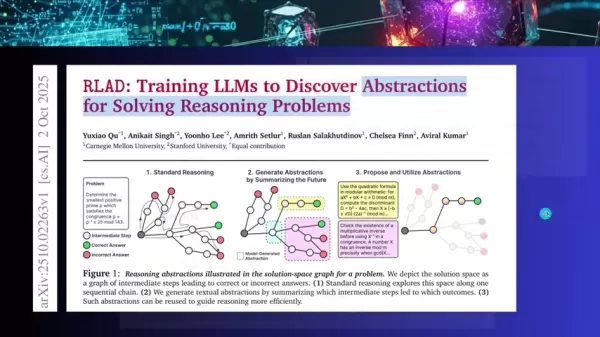
One significant study concentrates on teaching LLMs to grasp abstract principles. The objective is to boost their problem-solving and logical reasoning skills. Researchers devised a technique where the model generates abstractions to address problems. By conceptualizing an issue abstractly, the LLM can better comprehend it and devise effective solutions. This collaborative work from Carnegie Mellon and Stanford emphasizes training methods that reveal a problem's fundamental structure, making solution pathways clearer.
Training Details:
- The methodology focuses on understanding a problem's core elements.
- It represents a shift from single-step reasoning to layered, hierarchical strategies.
- A key innovation was separating the planning of a strategy from its execution.
Benefits
- Establishes a division of labor, enabling specialized optimization of different components.
- Promotes efficient learning as each part trains on relevant data.
- Simplifies complexity, making it easier for the model to process information.
Beyond Majority Voting: LLM Aggregation by Leveraging Higher-Order Information

This research critiques the common practice of relying solely on majority vote in multi-agent systems. Consensus can be limiting. The paper proposes using higher-order information to more accurately predict the best possible outcome.
Analogous to valuing a rocket scientist's opinion on aerospace topics over a general consensus, this approach weights the contributions of individual AI agents based on their expertise and correlations with others. This research is a collaboration between MIT, Harvard, and the University of Chicago.
Voting beyond majority:
- It utilizes first-order information, such as the known accuracy of each model.
- It also incorporates second-order information, which concerns how models' answers relate to one another.
- The method assesses questions like, "Given that models B and C answered X, how significant is it that model A answered Y?" to leverage collective intelligence fully.
Front-Loading Reasoning: The Synergy between Pretraining and Post-Training Data

A joint effort by NVIDIA, Carnegie Mellon, Boston University, and Stanford explores front-loading reasoning and the interplay between pre-training and post-training data. The goal is to determine the optimal timing for introducing different data types to maximize model efficiency and performance.
- Introducing reasoning data during pre-training leads to more lasting improvements.
- Supervised fine-tuning by itself is insufficient; a balance between data quality and diversity is key for significant gains.
- Proper implementation allows the model to perform well even on smaller test sets, indicating higher overall performance.
How to Apply These Research Findings
Practical Steps for Implementation
While full implementation may require substantial resources, developers can adopt several core principles:
- Prioritize High-Quality Pre-training Data: Invest in diverse, meticulously curated datasets for the initial training phase.
- Explore Hierarchical Reasoning Architectures: Adopt model designs that distinguish strategic planning from tactical execution.
- Implement Sophisticated Evaluation Metrics: Go beyond basic accuracy to include metrics that capture inter-model relationships for a truer performance assessment.
Applying these principles can lead to the development of more robust and capable models, contributing to the incremental progress toward AGI.
Exploring the Abstraction generator for Large Language Models
Pros
Improved performance results from separating strategy formulation from execution.
A division of labor enables specialization and more efficient learning processes.
Potential for achieving superior outcomes.
Reduces the amount of test data needed while improving results.
Cons
Many experiments are currently limited to mathematical reasoning tasks.
Further testing is required in scenarios involving human-like interaction.
Models were typically trained from scratch, which is resource-intensive.
Limited guidance is available for the model when tackling highly complex issues.
FAQ
What is AGI?
AGI, or Artificial General Intelligence, refers to a theoretical form of AI that possesses the ability to understand, learn, and apply knowledge across a wide range of tasks at a human level. Unlike narrow AI designed for specific functions, AGI would demonstrate adaptable problem-solving and reasoning skills.
How can i create high quality data set for models
Curating high-quality datasets is a resource-intensive process that often demands manual review and analysis. One approach is to employ a multi-agent system to assess and balance data quality across various dimensions. A dataset that is both high-quality and diverse leads to a more stable and generalized model capable of handling a wider array of inputs.
What does 'front-loading reasoning' mean?
'Front-loading reasoning' describes a strategy of embedding reasoning capabilities during the foundational pre-training stage of an LLM. This early emphasis helps the model build a solid base for abstract thinking and complex problem-solving from the outset.
Related Questions
What are the limitations of majority voting in multi-agent LLM systems?
While majority voting provides a simple baseline, it has shortcomings. It does not account for the varying accuracy of individual models, and if models share similar architectures, they may perpetuate the same systemic errors, stifling innovation. Utilizing higher-order information offers a way to make more nuanced and accurate decisions.
What is the best way to inject reasoning data into data tuning?
The most effective approach is to integrate reasoning-focused data during the initial pre-training phase. This foundational step yields the most durable improvements for developing models with advanced reasoning abilities.
Related article
 OpenAI, Anthropic Vie for Market Share Despite Revenue Shortfalls
Despite recent reports suggesting OpenAI missed revenue targets, creating pressure on tech stocks this Tuesday, private AI lab investors remain resilient. Seasoned backers have confirmed they will not reduce investment despite negative media coverage
California AV Compliance: A New Era of Tickets, Geofences, and 1M Miles
Guident operates an AuveTech shuttle in South Florida, managing a four-mile route in West Palm Beach and a one-mile route in Boca Raton using its remote monitoring technology. | Credit: GuidentCalifornia is redefining the regulatory landscape for dri
Apple Smart Glasses Could Debut at WWDC27, Highlighting Privacy Protection
Bloomberg’s Mark Gurman reports that Apple’s smart glasses, codenamed N50, are slated for a WWDC27 debut in June 2027, with a retail launch expected in autumn 2027. Originally targeted for late this year and early 2027, the device’s release has been
Related Special Topic Recommendations
Music composition
OpenAI, Anthropic Vie for Market Share Despite Revenue Shortfalls
Despite recent reports suggesting OpenAI missed revenue targets, creating pressure on tech stocks this Tuesday, private AI lab investors remain resilient. Seasoned backers have confirmed they will not reduce investment despite negative media coverage
California AV Compliance: A New Era of Tickets, Geofences, and 1M Miles
Guident operates an AuveTech shuttle in South Florida, managing a four-mile route in West Palm Beach and a one-mile route in Boca Raton using its remote monitoring technology. | Credit: GuidentCalifornia is redefining the regulatory landscape for dri
Apple Smart Glasses Could Debut at WWDC27, Highlighting Privacy Protection
Bloomberg’s Mark Gurman reports that Apple’s smart glasses, codenamed N50, are slated for a WWDC27 debut in June 2027, with a retail launch expected in autumn 2027. Originally targeted for late this year and early 2027, the device’s release has been
Related Special Topic Recommendations
Music composition
 AI Stem Separation Tools for Remix Production, Sampling Prep, and Karaoke Masters
2026 Latest Best Top-rated AI Stem Separation Tools Curated for Remix Production, Sampling Prep, and Karaoke Masters. These powerful game-changing tools offer real-world tests to deliver precise audio isolation, boosting productivity significantly. XIX.AI provides a weekly updated free vs paid comparison guide to help you find the must-try solution that suits your needs. Explore now to unlock your AI edge.
 8 tools
 xix.ai
Data Analysis
AI SQL Copilots for Revenue Dashboards, Funnel Analysis, and Product Metrics
xix.ai
Data Analysis
AI SQL Copilots for Revenue Dashboards, Funnel Analysis, and Product Metrics
2026 Latest Best AI SQL Copilots Ranked Top-Rated! XIX.AI curates a powerful game-changing collection for weekly updated real-world tests. These must-try tools help you generate accurate revenue dashboards, analyze sales funnels, and track product metrics swiftly, boosting productivity massively. Explore now to Discover your perfect tool for data-driven decision making! 238 characters
9 tools
xix.ai
Music composition
Best AI Melody Writing Tools for Song Drafts
2026 Latest Best Top-Rated AI Melody Writing Tools for Song Drafts! XIX.AI has curated a highly powerful game-changing collection that goes through rigorous real-world tests to deliver the best writing experience. You can find detailed free vs paid comparisons, accurate rankings, and must-try options designed to help you create stunning song drafts effortlessly and boost your creative productivity significantly. Explore now to discover your perfect tool!
8 tools
xix.ai
chatbot
Best AI Conversation Trainer Tools for Interview Practice
2026 Latest Best Top-rated AI Conversation Trainer Tools for Interview Practice are here on XIX.AI! This curated collection features powerful, game-changing tools that go through rigorous real-world tests to deliver accurate feedback. You’ll find a free vs paid comparison and detailed rankings to help you choose the must-try option that boosts your confidence and skills. Explore now to Discover your perfect tool for interview success!
12 tools
xix.ai
Design & Art
Best AI Style Transfer Tools for Creative Experiments
2026 Latest Best Top-rated AI Style Transfer Tools for Creative Experiments! XIX.AI has curated a powerful, game-changing collection of must-try tools that deliver exceptional results through real-world tests and rigorous rankings. These top solutions help creatives boost productivity significantly by accelerating content creation and unlocking endless creative possibilities. Explore now to discover your perfect tool and start creating today!
9 tools
xix.ai
Comic Creation
Best AI Dialogue Bubble Tools for Visual Storytelling
2026 Latest Best Top-Rated AI Dialogue Bubble Tools for Visual Storytelling are here on XIX.AI! This curated collection features powerful, game-changing tools that help creators boost productivity and overcome creative bottlenecks. Get a free vs paid comparison, see real-world tests, and check the latest rankings to find the must-try solutions perfect for crafting engaging visual narratives. Explore now to discover your ideal tool!
10 tools
xix.ai

 Comments (3)
0/500
Comments (3)
0/500
![HarryMartinez]()
Honestly, these reasoning benchmarks feel like measuring how well a parrot can mimic logic. Still cool though. 🦜
![WillieRamirez]()
Die Forschung zu Reasoning-Fähigkeiten bei LLMs ist echt spannend! Besonders interessant finde ich die Frage, ob solche Modelle irgendwann wirklich logische Schlüsse ziehen können oder ob sie nur Muster reproduzieren. Die ethischen Implikationen, wenn solche Systeme in kritischen Bereichen eingesetzt werden, machen mir aber auch etwas Sorgen. 🤔
![WillGarcía]()
2025年のAGI推論?ちょっと未来すぎるかな🤔 でもスタンフォードの研究はやっぱり面白いね。今のLLMってまだ「覚えたこと」しか答えられない気がする。本当の意味で考えられるようになるまで、まだまだ壁がありそう。個人的には、推論能力が上がると、AIとの会話がもっと自然になるのかなって期待してるよ。
The pursuit of Artificial General Intelligence is gaining momentum. This article explores cutting-edge research dedicated to enhancing the reasoning capacities of Large Language Models, highlighting innovative methods from institutions like Stanford, Harvard, MIT, NVIDIA, and Carnegie Mellon University. We will unpack the core ideas, address current limitations, and consider the future trajectory of AGI research, ultimately demystifying the path toward true general intelligence.
Key Points
Recent studies are concentrated on improving the reasoning skills of Large Language Models.
Emerging techniques involve training LLMs to identify abstract concepts and utilizing sophisticated information during model aggregation.
A major focus is on establishing reasoning foundations early by strategically leveraging both pre-training and post-training data.
Despite progress, significant hurdles remain, particularly with open-ended problem-solving.
Advancing beyond simple majority voting in multi-agent systems is considered essential for stronger, more reliable outcomes.
Rigorous experimentation and high-quality datasets are fundamental to improving the reasoning quality of AGI models.
Supervised pretraining within a low-dimensional model space is crucial for developing versatile models.
Fostering diversity and eliminating statistical biases contributes to a more resilient AI system.
The Landscape of LLM Reasoning Research
Latest Research in Artificial General Intelligence and Reasoning
The AGI field is progressing rapidly, with major inputs from leading academic and research organizations. Contemporary research strives to close the divide between specialized AI and broad, human-like intelligence. A central objective is equipping LLMs with advanced reasoning capabilities for tackling complex challenges and forming sound judgments.
The Challenge of Reasoning: While LLMs perform well in text generation and translation, reasoning presents a greater challenge. It typically requires:
- Abstraction: Distilling a problem down to its essential principles and concepts.
- Inference: Deriving logical conclusions from a given set of information.
- Planning: Formulating a step-by-step approach to reach a desired objective.
Many current models find these tasks difficult, especially when required to process data in one format and output it in another, unforeseen format. This complexity poses a significant barrier to robust AGI development.
Key Research Institutions and Their Contributions
Prominent institutions are leading the charge in LLM reasoning research:
- Stanford University: Pioneering methods for training LLMs to uncover abstractions that aid in problem-solving.
- Harvard University: Advancing LLM aggregation techniques that incorporate higher-order data relationships.
- MIT: Developing approaches that move beyond basic majority voting in collaborative AI systems.
- NVIDIA: Investigating how to optimally combine pre-training and post-training data to build reasoning skills from the start.
- Carnegie Mellon University: Focusing on training methodologies specifically geared toward solving reasoning-based problems.
These collaborative and diverse efforts underscore the multi-faceted challenge of achieving AGI.
Breaking Down The Key Papers
Training LLMs to Discover Abstractions
One significant study concentrates on teaching LLMs to grasp abstract principles. The objective is to boost their problem-solving and logical reasoning skills. Researchers devised a technique where the model generates abstractions to address problems. By conceptualizing an issue abstractly, the LLM can better comprehend it and devise effective solutions. This collaborative work from Carnegie Mellon and Stanford emphasizes training methods that reveal a problem's fundamental structure, making solution pathways clearer.
Training Details:
- The methodology focuses on understanding a problem's core elements.
- It represents a shift from single-step reasoning to layered, hierarchical strategies.
- A key innovation was separating the planning of a strategy from its execution.
Benefits
- Establishes a division of labor, enabling specialized optimization of different components.
- Promotes efficient learning as each part trains on relevant data.
- Simplifies complexity, making it easier for the model to process information.
Beyond Majority Voting: LLM Aggregation by Leveraging Higher-Order Information
This research critiques the common practice of relying solely on majority vote in multi-agent systems. Consensus can be limiting. The paper proposes using higher-order information to more accurately predict the best possible outcome.
Analogous to valuing a rocket scientist's opinion on aerospace topics over a general consensus, this approach weights the contributions of individual AI agents based on their expertise and correlations with others. This research is a collaboration between MIT, Harvard, and the University of Chicago.
Voting beyond majority:
- It utilizes first-order information, such as the known accuracy of each model.
- It also incorporates second-order information, which concerns how models' answers relate to one another.
- The method assesses questions like, "Given that models B and C answered X, how significant is it that model A answered Y?" to leverage collective intelligence fully.
Front-Loading Reasoning: The Synergy between Pretraining and Post-Training Data
A joint effort by NVIDIA, Carnegie Mellon, Boston University, and Stanford explores front-loading reasoning and the interplay between pre-training and post-training data. The goal is to determine the optimal timing for introducing different data types to maximize model efficiency and performance.
- Introducing reasoning data during pre-training leads to more lasting improvements.
- Supervised fine-tuning by itself is insufficient; a balance between data quality and diversity is key for significant gains.
- Proper implementation allows the model to perform well even on smaller test sets, indicating higher overall performance.
How to Apply These Research Findings
Practical Steps for Implementation
While full implementation may require substantial resources, developers can adopt several core principles:
- Prioritize High-Quality Pre-training Data: Invest in diverse, meticulously curated datasets for the initial training phase.
- Explore Hierarchical Reasoning Architectures: Adopt model designs that distinguish strategic planning from tactical execution.
- Implement Sophisticated Evaluation Metrics: Go beyond basic accuracy to include metrics that capture inter-model relationships for a truer performance assessment.
Applying these principles can lead to the development of more robust and capable models, contributing to the incremental progress toward AGI.
Exploring the Abstraction generator for Large Language Models
Pros
Improved performance results from separating strategy formulation from execution.
A division of labor enables specialization and more efficient learning processes.
Potential for achieving superior outcomes.
Reduces the amount of test data needed while improving results.
Cons
Many experiments are currently limited to mathematical reasoning tasks.
Further testing is required in scenarios involving human-like interaction.
Models were typically trained from scratch, which is resource-intensive.
Limited guidance is available for the model when tackling highly complex issues.
FAQ
What is AGI?
AGI, or Artificial General Intelligence, refers to a theoretical form of AI that possesses the ability to understand, learn, and apply knowledge across a wide range of tasks at a human level. Unlike narrow AI designed for specific functions, AGI would demonstrate adaptable problem-solving and reasoning skills.
How can i create high quality data set for models
Curating high-quality datasets is a resource-intensive process that often demands manual review and analysis. One approach is to employ a multi-agent system to assess and balance data quality across various dimensions. A dataset that is both high-quality and diverse leads to a more stable and generalized model capable of handling a wider array of inputs.
What does 'front-loading reasoning' mean?
'Front-loading reasoning' describes a strategy of embedding reasoning capabilities during the foundational pre-training stage of an LLM. This early emphasis helps the model build a solid base for abstract thinking and complex problem-solving from the outset.
Related Questions
What are the limitations of majority voting in multi-agent LLM systems?
While majority voting provides a simple baseline, it has shortcomings. It does not account for the varying accuracy of individual models, and if models share similar architectures, they may perpetuate the same systemic errors, stifling innovation. Utilizing higher-order information offers a way to make more nuanced and accurate decisions.
What is the best way to inject reasoning data into data tuning?
The most effective approach is to integrate reasoning-focused data during the initial pre-training phase. This foundational step yields the most durable improvements for developing models with advanced reasoning abilities.








 OpenAI, Anthropic Vie for Market Share Despite Revenue Shortfalls
Despite recent reports suggesting OpenAI missed revenue targets, creating pressure on tech stocks this Tuesday, private AI lab investors remain resilient. Seasoned backers have confirmed they will not reduce investment despite negative media coverage
California AV Compliance: A New Era of Tickets, Geofences, and 1M Miles
Guident operates an AuveTech shuttle in South Florida, managing a four-mile route in West Palm Beach and a one-mile route in Boca Raton using its remote monitoring technology. | Credit: GuidentCalifornia is redefining the regulatory landscape for dri
OpenAI, Anthropic Vie for Market Share Despite Revenue Shortfalls
Despite recent reports suggesting OpenAI missed revenue targets, creating pressure on tech stocks this Tuesday, private AI lab investors remain resilient. Seasoned backers have confirmed they will not reduce investment despite negative media coverage
California AV Compliance: A New Era of Tickets, Geofences, and 1M Miles
Guident operates an AuveTech shuttle in South Florida, managing a four-mile route in West Palm Beach and a one-mile route in Boca Raton using its remote monitoring technology. | Credit: GuidentCalifornia is redefining the regulatory landscape for dri
 Apple Smart Glasses Could Debut at WWDC27, Highlighting Privacy Protection
Bloomberg’s Mark Gurman reports that Apple’s smart glasses, codenamed N50, are slated for a WWDC27 debut in June 2027, with a retail launch expected in autumn 2027. Originally targeted for late this year and early 2027, the device’s release has been
Apple Smart Glasses Could Debut at WWDC27, Highlighting Privacy Protection
Bloomberg’s Mark Gurman reports that Apple’s smart glasses, codenamed N50, are slated for a WWDC27 debut in June 2027, with a retail launch expected in autumn 2027. Originally targeted for late this year and early 2027, the device’s release has been

2026 Latest Best Top-rated AI Stem Separation Tools Curated for Remix Production, Sampling Prep, and Karaoke Masters. These powerful game-changing tools offer real-world tests to deliver precise audio isolation, boosting productivity significantly. XIX.AI provides a weekly updated free vs paid comparison guide to help you find the must-try solution that suits your needs. Explore now to unlock your AI edge.
8 tools
xix.ai

2026 Latest Best AI SQL Copilots Ranked Top-Rated! XIX.AI curates a powerful game-changing collection for weekly updated real-world tests. These must-try tools help you generate accurate revenue dashboards, analyze sales funnels, and track product metrics swiftly, boosting productivity massively. Explore now to Discover your perfect tool for data-driven decision making! 238 characters
9 tools
xix.ai

2026 Latest Best Top-Rated AI Melody Writing Tools for Song Drafts! XIX.AI has curated a highly powerful game-changing collection that goes through rigorous real-world tests to deliver the best writing experience. You can find detailed free vs paid comparisons, accurate rankings, and must-try options designed to help you create stunning song drafts effortlessly and boost your creative productivity significantly. Explore now to discover your perfect tool!
8 tools
xix.ai

2026 Latest Best Top-rated AI Conversation Trainer Tools for Interview Practice are here on XIX.AI! This curated collection features powerful, game-changing tools that go through rigorous real-world tests to deliver accurate feedback. You’ll find a free vs paid comparison and detailed rankings to help you choose the must-try option that boosts your confidence and skills. Explore now to Discover your perfect tool for interview success!
12 tools
xix.ai

2026 Latest Best Top-rated AI Style Transfer Tools for Creative Experiments! XIX.AI has curated a powerful, game-changing collection of must-try tools that deliver exceptional results through real-world tests and rigorous rankings. These top solutions help creatives boost productivity significantly by accelerating content creation and unlocking endless creative possibilities. Explore now to discover your perfect tool and start creating today!
9 tools
xix.ai

2026 Latest Best Top-Rated AI Dialogue Bubble Tools for Visual Storytelling are here on XIX.AI! This curated collection features powerful, game-changing tools that help creators boost productivity and overcome creative bottlenecks. Get a free vs paid comparison, see real-world tests, and check the latest rankings to find the must-try solutions perfect for crafting engaging visual narratives. Explore now to discover your ideal tool!
10 tools
xix.ai

Honestly, these reasoning benchmarks feel like measuring how well a parrot can mimic logic. Still cool though. 🦜
Die Forschung zu Reasoning-Fähigkeiten bei LLMs ist echt spannend! Besonders interessant finde ich die Frage, ob solche Modelle irgendwann wirklich logische Schlüsse ziehen können oder ob sie nur Muster reproduzieren. Die ethischen Implikationen, wenn solche Systeme in kritischen Bereichen eingesetzt werden, machen mir aber auch etwas Sorgen. 🤔
2025年のAGI推論?ちょっと未来すぎるかな🤔 でもスタンフォードの研究はやっぱり面白いね。今のLLMってまだ「覚えたこと」しか答えられない気がする。本当の意味で考えられるようになるまで、まだまだ壁がありそう。個人的には、推論能力が上がると、AIとの会話がもっと自然になるのかなって期待してるよ。












