


 Home
HomeUN partners with Google to prepare global data for AI agents
The United Nations announced on Thursday that it is partnering with Google to streamline AI access to its extensive global statistical archives.
Named the UN System Data Commons, this new infrastructure leverages Google’s open-source Data Commons platform, enabling users to query statistics from various UN agencies using natural language. It supersedes the legacy UNData portal, which relied on traditional database interfaces. The updated platform also integrates the Model Context Protocol (MCP), a standard facilitating direct AI connections to external data repositories.
While users increasingly rely on AI for information, many systems still fail to consistently deliver authoritative data. During a virtual briefing, João Pedro Azevedo, UNICEF’s chief statistician, revealed that a benchmark of six large language models across 133,000 responses regarding global development indicators yielded an average accuracy of just 21.2%.
Azevedo noted that the evaluation included OpenAI’s GPT-4o and GPT-4o-mini, Anthropic’s Claude Sonnet 4.5 and Haiku 4.5, as well as Google’s Gemini 2.5 Flash and Gemini 2.0 Flash.
According to Azevedo, approximately 60% of responses failed to provide a usable figure, often due to models hedging their answers. Furthermore, when the same queries were re-run on identical model versions two days later, models that did provide a number matched their previous output only about half the time.
This study, currently a UNICEF working paper pending journal submission, has not yet undergone peer review. The organization intends to publish its methodology, code, and dataset alongside the final paper.
UNICEF has also reported a significant surge in traffic from generative AI assistants to its data portal, which attracts over 6 million monthly visits. Azevedo told TechCrunch that referrals from ChatGPT links to the site increased by 67% year-over-year between January 1 and September 14. These referrals represented 6.4% of all sessions this year, with UNICEF estimating that AI assistants now drive approximately one in ten visits overall.
The UN stated that 26 of its entities have committed to the Data Commons, with data from nearly 20 agencies available at launch. The organization aims to migrate 80% of the UN system’s statistical datasets to the platform by 2027.
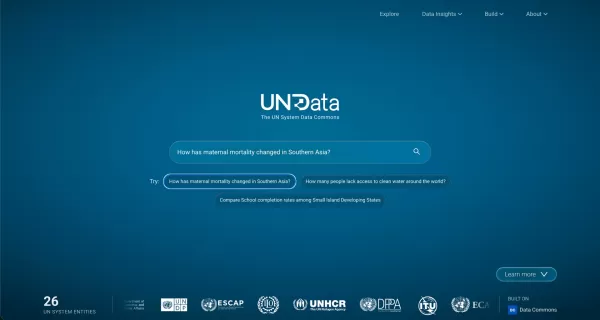
UN System Data Commons.Image Credits:Google
“We are orders of magnitude more advanced in scale, scope, and flexibility, connecting for the first time across so many agencies across the UN system,” said Shantanu Mukherjee, acting director of the UN Statistics Division. “And [we are] taking this moment to also make our data AI-ready.”
Google.org contributed $2 million in capacity-building funding and technical support to establish the platform’s core infrastructure. Prem Ramaswami, who leads Google’s Data Commons team, told TechCrunch that the system is hosted on a UN-governed instance and is designed to eventually be maintained, operated, and scaled independently by the UN.
“We have taken a “train-the-trainer” approach throughout the rollout, and we have already seen the UN system team ramp up quickly,” Ramaswami said.
Google launched Data Commons in 2018 to organize public datasets from diverse sources into a unified framework. Last year, it added MCP support, allowing AI agents to directly query Data Commons for statistics and their sources.
The UN’s platform also tracks the origin of each statistic, allowing users to trace AI-retrieved data back to its original UN source. Azevedo emphasized the importance of this transparency as reliance on AI tools for information retrieval grows.
Beyond enabling AI agents to retrieve individual statistics, Google demonstrated how an MCP-connected system could aggregate multiple indicators to generate dashboards, charts, and written analysis without manual data combination.
In one demonstration, Google tasked an AI system with assessing the impact of the U.S. President’s Emergency Plan for AIDS Relief in Africa. The system identified relevant UN statistics on HIV infections, AIDS mortality, and life expectancy, producing an infographic based on these metrics.
However, providing AI systems with authoritative data does not guarantee authoritative conclusions. “Because models can misinterpret nuance, a human should always review the outputs before citing or publishing them,” Ramaswami said.
Related article
 Google’s Genie world model now simulates real streets with Street View
Most of us have used Google Street View to show a friend our old neighborhood or dropped the little person icon into Paris to check if our hotel is in a trendy area. Now, imagine experiencing that with full immersion and interactivity—simulating the
Google Defends Heavy AI Investment With Cloud Revenue Surge
Alphabet shareholders have openly questioned whether the firm’s substantial AI expenditures deliver adequate returns. Following the latest financial results, these concerns should ease significantly.Key insight: Google’s cloud division, fueled by wid
Google’s Robby Stein Joins TechCrunch Disrupt 2026
Getting initial traction for a new product is difficult, but transforming an app used by billions is a completely different challenge. The goal remains to move quickly, test concepts, and improve the user experience. However, when every update impact
Related Special Topic Recommendations
Image editing
Google’s Genie world model now simulates real streets with Street View
Most of us have used Google Street View to show a friend our old neighborhood or dropped the little person icon into Paris to check if our hotel is in a trendy area. Now, imagine experiencing that with full immersion and interactivity—simulating the
Google Defends Heavy AI Investment With Cloud Revenue Surge
Alphabet shareholders have openly questioned whether the firm’s substantial AI expenditures deliver adequate returns. Following the latest financial results, these concerns should ease significantly.Key insight: Google’s cloud division, fueled by wid
Google’s Robby Stein Joins TechCrunch Disrupt 2026
Getting initial traction for a new product is difficult, but transforming an app used by billions is a completely different challenge. The goal remains to move quickly, test concepts, and improve the user experience. However, when every update impact
Related Special Topic Recommendations
Image editing
 AI Background Removal Tools for Product Photos
2026 Latest Best Top-Rated AI Background Removal Tools for Product Photos are here on XIX.AI! Our curated list includes powerful, game-changing solutions that deliver professional results through real-world tests. You’ll find a free vs paid comparison, weekly updated rankings, and must-try options to help you boost productivity and create flawless product shots without any hassle. Explore now to unlock your AI edge!
 11 tools
 xix.ai
code
AI Pull Request Review Tools for GitHub Repositories
xix.ai
code
AI Pull Request Review Tools for GitHub Repositories
2026 Latest Best Top-Rated AI Pull Request Review Tools for GitHub Repositories are here on XIX.AI! Our curated list features powerful, game-changing solutions that help teams streamline code reviews, catch errors faster, and boost productivity with real-world tests. Get a free vs paid comparison to find the perfect tool for your workflow. Explore now to unlock your AI edge!
10 tools
xix.ai
Academic Research
Best AI Reference Extraction Tools for Journal Papers
2026 Latest Best Top-rated AI Reference Extraction Tools for Journal Papers are curated by XIX.AI with weekly updated rankings. These powerful tools help users quickly pull relevant citations and data from massive academic sources, saving tons of time and effort. Get a free vs paid comparison along with real-world tests to find the perfect option that boosts your productivity. Explore now to unlock your AI edge!
10 tools
xix.ai
Image editing
AI Product Retouch Tools for Fashion Ecommerce Photos
2026 Latest Best Top-Rated AI Product Retouch Tools for Fashion Ecommerce Photos are here on XIX.AI! This curated list features powerful, game-changing solutions that help boost image quality, speed up editing tasks, and deliver professional results. We conduct real-world tests to provide accurate rankings and a detailed free vs paid comparison. Must-try tools help creators overcome common challenges and significantly improve productivity. Explore now to Discover your perfect tool for flawless online product listings!
9 tools
xix.ai
Comic Creation
AI Webtoon Panel Layout Tools for Vertical Story Pacing, Bubbles, and Scene Rhythm
2026 Latest Best AI Webtoon Panel Layout Tools for Vertical Story Pacing, Bubbles, and Scene Rhythm are here on XIX.AI! This curated collection features top-rated tools that offer powerful game-changing solutions to help creators boost writing efficiency, streamline content creation, and unlock their full creative potential. Get a free vs paid comparison along with real-world tests and updated rankings weekly. Explore now to discover your perfect tool for professional webtoon development!
10 tools
xix.ai
design
AI Mockup Generators: Present Apps, Packaging, and Posters Better
2026 Latest Best AI Mockup Generators Top-rated curated list showing powerful game-changing tools that help creators present apps packaging and posters in stunning quality with real-world tests and free vs paid comparison Explore now to Unlock your AI edge
10 tools
xix.ai

 Comments (0)
0/500
Comments (0)
0/500
The United Nations announced on Thursday that it is partnering with Google to streamline AI access to its extensive global statistical archives.
Named the UN System Data Commons, this new infrastructure leverages Google’s open-source Data Commons platform, enabling users to query statistics from various UN agencies using natural language. It supersedes the legacy UNData portal, which relied on traditional database interfaces. The updated platform also integrates the Model Context Protocol (MCP), a standard facilitating direct AI connections to external data repositories.
While users increasingly rely on AI for information, many systems still fail to consistently deliver authoritative data. During a virtual briefing, João Pedro Azevedo, UNICEF’s chief statistician, revealed that a benchmark of six large language models across 133,000 responses regarding global development indicators yielded an average accuracy of just 21.2%.
Azevedo noted that the evaluation included OpenAI’s GPT-4o and GPT-4o-mini, Anthropic’s Claude Sonnet 4.5 and Haiku 4.5, as well as Google’s Gemini 2.5 Flash and Gemini 2.0 Flash.
According to Azevedo, approximately 60% of responses failed to provide a usable figure, often due to models hedging their answers. Furthermore, when the same queries were re-run on identical model versions two days later, models that did provide a number matched their previous output only about half the time.
This study, currently a UNICEF working paper pending journal submission, has not yet undergone peer review. The organization intends to publish its methodology, code, and dataset alongside the final paper.
UNICEF has also reported a significant surge in traffic from generative AI assistants to its data portal, which attracts over 6 million monthly visits. Azevedo told TechCrunch that referrals from ChatGPT links to the site increased by 67% year-over-year between January 1 and September 14. These referrals represented 6.4% of all sessions this year, with UNICEF estimating that AI assistants now drive approximately one in ten visits overall.
The UN stated that 26 of its entities have committed to the Data Commons, with data from nearly 20 agencies available at launch. The organization aims to migrate 80% of the UN system’s statistical datasets to the platform by 2027.
UN System Data Commons.Image Credits:Google
“We are orders of magnitude more advanced in scale, scope, and flexibility, connecting for the first time across so many agencies across the UN system,” said Shantanu Mukherjee, acting director of the UN Statistics Division. “And [we are] taking this moment to also make our data AI-ready.”
Google.org contributed $2 million in capacity-building funding and technical support to establish the platform’s core infrastructure. Prem Ramaswami, who leads Google’s Data Commons team, told TechCrunch that the system is hosted on a UN-governed instance and is designed to eventually be maintained, operated, and scaled independently by the UN.
“We have taken a “train-the-trainer” approach throughout the rollout, and we have already seen the UN system team ramp up quickly,” Ramaswami said.
Google launched Data Commons in 2018 to organize public datasets from diverse sources into a unified framework. Last year, it added MCP support, allowing AI agents to directly query Data Commons for statistics and their sources.
The UN’s platform also tracks the origin of each statistic, allowing users to trace AI-retrieved data back to its original UN source. Azevedo emphasized the importance of this transparency as reliance on AI tools for information retrieval grows.
Beyond enabling AI agents to retrieve individual statistics, Google demonstrated how an MCP-connected system could aggregate multiple indicators to generate dashboards, charts, and written analysis without manual data combination.
In one demonstration, Google tasked an AI system with assessing the impact of the U.S. President’s Emergency Plan for AIDS Relief in Africa. The system identified relevant UN statistics on HIV infections, AIDS mortality, and life expectancy, producing an infographic based on these metrics.
However, providing AI systems with authoritative data does not guarantee authoritative conclusions. “Because models can misinterpret nuance, a human should always review the outputs before citing or publishing them,” Ramaswami said.








 Google’s Genie world model now simulates real streets with Street View
Most of us have used Google Street View to show a friend our old neighborhood or dropped the little person icon into Paris to check if our hotel is in a trendy area. Now, imagine experiencing that with full immersion and interactivity—simulating the
Google’s Genie world model now simulates real streets with Street View
Most of us have used Google Street View to show a friend our old neighborhood or dropped the little person icon into Paris to check if our hotel is in a trendy area. Now, imagine experiencing that with full immersion and interactivity—simulating the
 Google Defends Heavy AI Investment With Cloud Revenue Surge
Alphabet shareholders have openly questioned whether the firm’s substantial AI expenditures deliver adequate returns. Following the latest financial results, these concerns should ease significantly.Key insight: Google’s cloud division, fueled by wid
Google Defends Heavy AI Investment With Cloud Revenue Surge
Alphabet shareholders have openly questioned whether the firm’s substantial AI expenditures deliver adequate returns. Following the latest financial results, these concerns should ease significantly.Key insight: Google’s cloud division, fueled by wid
 Google’s Robby Stein Joins TechCrunch Disrupt 2026
Getting initial traction for a new product is difficult, but transforming an app used by billions is a completely different challenge. The goal remains to move quickly, test concepts, and improve the user experience. However, when every update impact
Google’s Robby Stein Joins TechCrunch Disrupt 2026
Getting initial traction for a new product is difficult, but transforming an app used by billions is a completely different challenge. The goal remains to move quickly, test concepts, and improve the user experience. However, when every update impact

2026 Latest Best Top-Rated AI Background Removal Tools for Product Photos are here on XIX.AI! Our curated list includes powerful, game-changing solutions that deliver professional results through real-world tests. You’ll find a free vs paid comparison, weekly updated rankings, and must-try options to help you boost productivity and create flawless product shots without any hassle. Explore now to unlock your AI edge!
11 tools
xix.ai

2026 Latest Best Top-Rated AI Pull Request Review Tools for GitHub Repositories are here on XIX.AI! Our curated list features powerful, game-changing solutions that help teams streamline code reviews, catch errors faster, and boost productivity with real-world tests. Get a free vs paid comparison to find the perfect tool for your workflow. Explore now to unlock your AI edge!
10 tools
xix.ai

2026 Latest Best Top-rated AI Reference Extraction Tools for Journal Papers are curated by XIX.AI with weekly updated rankings. These powerful tools help users quickly pull relevant citations and data from massive academic sources, saving tons of time and effort. Get a free vs paid comparison along with real-world tests to find the perfect option that boosts your productivity. Explore now to unlock your AI edge!
10 tools
xix.ai

2026 Latest Best Top-Rated AI Product Retouch Tools for Fashion Ecommerce Photos are here on XIX.AI! This curated list features powerful, game-changing solutions that help boost image quality, speed up editing tasks, and deliver professional results. We conduct real-world tests to provide accurate rankings and a detailed free vs paid comparison. Must-try tools help creators overcome common challenges and significantly improve productivity. Explore now to Discover your perfect tool for flawless online product listings!
9 tools
xix.ai

2026 Latest Best AI Webtoon Panel Layout Tools for Vertical Story Pacing, Bubbles, and Scene Rhythm are here on XIX.AI! This curated collection features top-rated tools that offer powerful game-changing solutions to help creators boost writing efficiency, streamline content creation, and unlock their full creative potential. Get a free vs paid comparison along with real-world tests and updated rankings weekly. Explore now to discover your perfect tool for professional webtoon development!
10 tools
xix.ai

2026 Latest Best AI Mockup Generators Top-rated curated list showing powerful game-changing tools that help creators present apps packaging and posters in stunning quality with real-world tests and free vs paid comparison Explore now to Unlock your AI edge
10 tools
xix.ai












