


 Home
HomeTongyi Lab Introduces Qwen3.6-Plus, Marking a Leap Forward in Reliable AI Programming
In February of this year, Tongyi Lab launched the Qwen3.5 series. Today, they have officially introduced Qwen3.6-Plus, designed to tackle a key challenge for developers: the "unstable execution" of tasks in agent-based programming. The model is now accessible via the Aliyun BaiLian API.
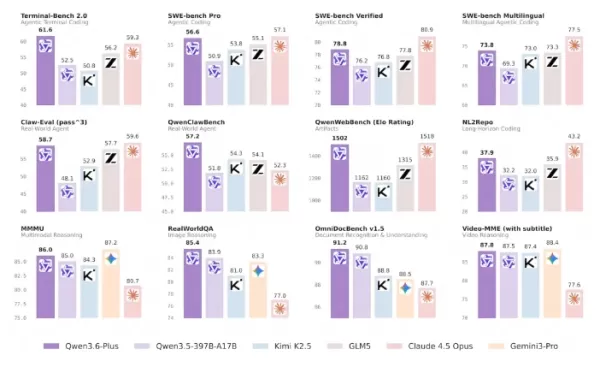
Key Improvements: Enhanced Focus on Coding Agents and Long-Context Handling
Qwen3.6-Plus is engineered to seamlessly blend deep logical reasoning, extensive memory, and precise execution. Its primary strengths are:
A Leap Forward in Coding Proficiency: The model excels in areas like front-end page generation, code debugging, and terminal automation. As the first domestic model in its class to achieve comprehensive leadership in agent programming, it delivers a more reliable agent experience at a reduced cost.
Million-Token Context Window: It natively supports a context of up to 1 million tokens, greatly enhancing the accuracy of parsing long documents and extracting information from multi-turn conversations.
Superior Cost Efficiency: With a model size less than half that of competitors like K2.5 or GLM5, its engineering and implementation capabilities remain highly competitive with industry leaders.
Ecosystem Compatibility: Smooth Integration with Popular Development Tools
To help developers get productive quickly, Qwen3.6-Plus offers deep compatibility with several third-party coding assistants:
OpenClaw (formerly Moltbot): An open-source, self-hostable AI coding agent. With minimal setup, it provides a full-featured agent coding experience directly in the terminal.
Qwen Code: A terminal agent specifically fine-tuned for the Qwen model family, capable of understanding complex codebases and performing automated tasks.
Claude Code: The Qwen API now supports the Anthropic protocol, enabling developers to call the Qwen3.6-Plus model directly within their existing Claude Code workflows.
Visual Agent: From "Understanding" to "Acting"
In multimodal applications, Qwen3.6-Plus has achieved a complete loop from visual perception to agent execution. The model can perform complex tasks like financial calculations (e.g., automatically tallying winnings from multiple scratch cards) based on visual input. It can also generate functional front-end code directly from design mockups. This "visual agent" capability allows it to comprehend graphical user interfaces and take subsequent actions, evolving toward a native multimodal system capable of continuous real-world perception.
Furthermore, Tongyi Lab has introduced a preserve_thinking feature in its API, which retains the chain-of-thought content from previous interactions. This is especially useful for complex agent tasks that require long-term planning. Reports indicate that additional variants of the Qwen3.6 series, including high-performance and lightweight open-source models, will be released in the near future.
Related article
 DeepMind CEO Hassabis: I sleep six hours a day, usually feel energetic around 1 a.m.
Fortune recently featured an interview with Demis Hassabis, CEO of Google DeepMind, revealing his unconventional approach to rest and productivity. Hassabis disclosed that he sleeps very little, structuring his waking hours into two distinct work blo
OpenAI, Anthropic Vie for Market Share Despite Revenue Shortfalls
Despite recent reports suggesting OpenAI missed revenue targets, creating pressure on tech stocks this Tuesday, private AI lab investors remain resilient. Seasoned backers have confirmed they will not reduce investment despite negative media coverage
California AV Compliance: A New Era of Tickets, Geofences, and 1M Miles
Guident operates an AuveTech shuttle in South Florida, managing a four-mile route in West Palm Beach and a one-mile route in Boca Raton using its remote monitoring technology. | Credit: GuidentCalifornia is redefining the regulatory landscape for dri
Related Special Topic Recommendations
chatbot
DeepMind CEO Hassabis: I sleep six hours a day, usually feel energetic around 1 a.m.
Fortune recently featured an interview with Demis Hassabis, CEO of Google DeepMind, revealing his unconventional approach to rest and productivity. Hassabis disclosed that he sleeps very little, structuring his waking hours into two distinct work blo
OpenAI, Anthropic Vie for Market Share Despite Revenue Shortfalls
Despite recent reports suggesting OpenAI missed revenue targets, creating pressure on tech stocks this Tuesday, private AI lab investors remain resilient. Seasoned backers have confirmed they will not reduce investment despite negative media coverage
California AV Compliance: A New Era of Tickets, Geofences, and 1M Miles
Guident operates an AuveTech shuttle in South Florida, managing a four-mile route in West Palm Beach and a one-mile route in Boca Raton using its remote monitoring technology. | Credit: GuidentCalifornia is redefining the regulatory landscape for dri
Related Special Topic Recommendations
chatbot
 Best AI Roleplay Chat Apps for Language Practice, Interview Prep, and Daily Fluency
2026 Latest Best Top-rated AI Roleplay Chat Apps for Language Practice, Interview Prep, and Daily Fluency! XIX.AI curates a powerful game-changing collection that offers free vs paid comparison, real-world tests, and updated rankings weekly. These must-try tools help you boost writing skills, overcome fluency challenges, and improve communication efficiency across all daily scenarios. Explore now to discover your perfect tool for language growth!
 10 tools
 xix.ai
Music composition
AI Stem Separation Tools for Remix Production, Sampling Prep, and Karaoke Masters
xix.ai
Music composition
AI Stem Separation Tools for Remix Production, Sampling Prep, and Karaoke Masters
2026 Latest Best Top-rated AI Stem Separation Tools Curated for Remix Production, Sampling Prep, and Karaoke Masters. These powerful game-changing tools offer real-world tests to deliver precise audio isolation, boosting productivity significantly. XIX.AI provides a weekly updated free vs paid comparison guide to help you find the must-try solution that suits your needs. Explore now to unlock your AI edge.
8 tools
xix.ai
Data Analysis
AI SQL Copilots for Revenue Dashboards, Funnel Analysis, and Product Metrics
2026 Latest Best AI SQL Copilots Ranked Top-Rated! XIX.AI curates a powerful game-changing collection for weekly updated real-world tests. These must-try tools help you generate accurate revenue dashboards, analyze sales funnels, and track product metrics swiftly, boosting productivity massively. Explore now to Discover your perfect tool for data-driven decision making! 238 characters
9 tools
xix.ai
Music composition
Best AI Melody Writing Tools for Song Drafts
2026 Latest Best Top-Rated AI Melody Writing Tools for Song Drafts! XIX.AI has curated a highly powerful game-changing collection that goes through rigorous real-world tests to deliver the best writing experience. You can find detailed free vs paid comparisons, accurate rankings, and must-try options designed to help you create stunning song drafts effortlessly and boost your creative productivity significantly. Explore now to discover your perfect tool!
8 tools
xix.ai
chatbot
Best AI Conversation Trainer Tools for Interview Practice
2026 Latest Best Top-rated AI Conversation Trainer Tools for Interview Practice are here on XIX.AI! This curated collection features powerful, game-changing tools that go through rigorous real-world tests to deliver accurate feedback. You’ll find a free vs paid comparison and detailed rankings to help you choose the must-try option that boosts your confidence and skills. Explore now to Discover your perfect tool for interview success!
12 tools
xix.ai
Design & Art
Best AI Style Transfer Tools for Creative Experiments
2026 Latest Best Top-rated AI Style Transfer Tools for Creative Experiments! XIX.AI has curated a powerful, game-changing collection of must-try tools that deliver exceptional results through real-world tests and rigorous rankings. These top solutions help creatives boost productivity significantly by accelerating content creation and unlocking endless creative possibilities. Explore now to discover your perfect tool and start creating today!
9 tools
xix.ai

 Comments (0)
0/500
Comments (0)
0/500
In February of this year, Tongyi Lab launched the Qwen3.5 series. Today, they have officially introduced Qwen3.6-Plus, designed to tackle a key challenge for developers: the "unstable execution" of tasks in agent-based programming. The model is now accessible via the Aliyun BaiLian API.
Key Improvements: Enhanced Focus on Coding Agents and Long-Context Handling
Qwen3.6-Plus is engineered to seamlessly blend deep logical reasoning, extensive memory, and precise execution. Its primary strengths are:
A Leap Forward in Coding Proficiency: The model excels in areas like front-end page generation, code debugging, and terminal automation. As the first domestic model in its class to achieve comprehensive leadership in agent programming, it delivers a more reliable agent experience at a reduced cost.
Million-Token Context Window: It natively supports a context of up to 1 million tokens, greatly enhancing the accuracy of parsing long documents and extracting information from multi-turn conversations.
Superior Cost Efficiency: With a model size less than half that of competitors like K2.5 or GLM5, its engineering and implementation capabilities remain highly competitive with industry leaders.
Ecosystem Compatibility: Smooth Integration with Popular Development Tools
To help developers get productive quickly, Qwen3.6-Plus offers deep compatibility with several third-party coding assistants:
OpenClaw (formerly Moltbot): An open-source, self-hostable AI coding agent. With minimal setup, it provides a full-featured agent coding experience directly in the terminal.
Qwen Code: A terminal agent specifically fine-tuned for the Qwen model family, capable of understanding complex codebases and performing automated tasks.
Claude Code: The Qwen API now supports the Anthropic protocol, enabling developers to call the Qwen3.6-Plus model directly within their existing Claude Code workflows.
Visual Agent: From "Understanding" to "Acting"
In multimodal applications, Qwen3.6-Plus has achieved a complete loop from visual perception to agent execution. The model can perform complex tasks like financial calculations (e.g., automatically tallying winnings from multiple scratch cards) based on visual input. It can also generate functional front-end code directly from design mockups. This "visual agent" capability allows it to comprehend graphical user interfaces and take subsequent actions, evolving toward a native multimodal system capable of continuous real-world perception.
Furthermore, Tongyi Lab has introduced a preserve_thinking feature in its API, which retains the chain-of-thought content from previous interactions. This is especially useful for complex agent tasks that require long-term planning. Reports indicate that additional variants of the Qwen3.6 series, including high-performance and lightweight open-source models, will be released in the near future.








 DeepMind CEO Hassabis: I sleep six hours a day, usually feel energetic around 1 a.m.
Fortune recently featured an interview with Demis Hassabis, CEO of Google DeepMind, revealing his unconventional approach to rest and productivity. Hassabis disclosed that he sleeps very little, structuring his waking hours into two distinct work blo
DeepMind CEO Hassabis: I sleep six hours a day, usually feel energetic around 1 a.m.
Fortune recently featured an interview with Demis Hassabis, CEO of Google DeepMind, revealing his unconventional approach to rest and productivity. Hassabis disclosed that he sleeps very little, structuring his waking hours into two distinct work blo
 OpenAI, Anthropic Vie for Market Share Despite Revenue Shortfalls
Despite recent reports suggesting OpenAI missed revenue targets, creating pressure on tech stocks this Tuesday, private AI lab investors remain resilient. Seasoned backers have confirmed they will not reduce investment despite negative media coverage
California AV Compliance: A New Era of Tickets, Geofences, and 1M Miles
Guident operates an AuveTech shuttle in South Florida, managing a four-mile route in West Palm Beach and a one-mile route in Boca Raton using its remote monitoring technology. | Credit: GuidentCalifornia is redefining the regulatory landscape for dri
OpenAI, Anthropic Vie for Market Share Despite Revenue Shortfalls
Despite recent reports suggesting OpenAI missed revenue targets, creating pressure on tech stocks this Tuesday, private AI lab investors remain resilient. Seasoned backers have confirmed they will not reduce investment despite negative media coverage
California AV Compliance: A New Era of Tickets, Geofences, and 1M Miles
Guident operates an AuveTech shuttle in South Florida, managing a four-mile route in West Palm Beach and a one-mile route in Boca Raton using its remote monitoring technology. | Credit: GuidentCalifornia is redefining the regulatory landscape for dri

2026 Latest Best Top-rated AI Roleplay Chat Apps for Language Practice, Interview Prep, and Daily Fluency! XIX.AI curates a powerful game-changing collection that offers free vs paid comparison, real-world tests, and updated rankings weekly. These must-try tools help you boost writing skills, overcome fluency challenges, and improve communication efficiency across all daily scenarios. Explore now to discover your perfect tool for language growth!
10 tools
xix.ai

2026 Latest Best Top-rated AI Stem Separation Tools Curated for Remix Production, Sampling Prep, and Karaoke Masters. These powerful game-changing tools offer real-world tests to deliver precise audio isolation, boosting productivity significantly. XIX.AI provides a weekly updated free vs paid comparison guide to help you find the must-try solution that suits your needs. Explore now to unlock your AI edge.
8 tools
xix.ai
2026 Latest Best AI SQL Copilots Ranked Top-Rated! XIX.AI curates a powerful game-changing collection for weekly updated real-world tests. These must-try tools help you generate accurate revenue dashboards, analyze sales funnels, and track product metrics swiftly, boosting productivity massively. Explore now to Discover your perfect tool for data-driven decision making! 238 characters
9 tools
xix.ai

2026 Latest Best Top-Rated AI Melody Writing Tools for Song Drafts! XIX.AI has curated a highly powerful game-changing collection that goes through rigorous real-world tests to deliver the best writing experience. You can find detailed free vs paid comparisons, accurate rankings, and must-try options designed to help you create stunning song drafts effortlessly and boost your creative productivity significantly. Explore now to discover your perfect tool!
8 tools
xix.ai

2026 Latest Best Top-rated AI Conversation Trainer Tools for Interview Practice are here on XIX.AI! This curated collection features powerful, game-changing tools that go through rigorous real-world tests to deliver accurate feedback. You’ll find a free vs paid comparison and detailed rankings to help you choose the must-try option that boosts your confidence and skills. Explore now to Discover your perfect tool for interview success!
12 tools
xix.ai

2026 Latest Best Top-rated AI Style Transfer Tools for Creative Experiments! XIX.AI has curated a powerful, game-changing collection of must-try tools that deliver exceptional results through real-world tests and rigorous rankings. These top solutions help creatives boost productivity significantly by accelerating content creation and unlocking endless creative possibilities. Explore now to discover your perfect tool and start creating today!
9 tools
xix.ai












