


 Home
HomeSubstack unveils new tool to identify AI-written newsletters
Substack has introduced a new feature that reveals which of your favorite newsletters are being written using AI.
This week, the newsletter and writing platform announced an integration with Pangram, an AI writing detection software. This allows users to scan posts, comments, and replies on Substack’s app to see an estimate of how much of the content was written by a human and how much was AI.
In the short term, this move might be bad for Substack’s business, as it could expose many of the newsletters on its platform that aren’t entirely written by people. That could potentially erode trust in the platform’s ecosystem of independent news and blogs, or even damage its reputation as a host of high-quality content.
But in the long term, AI-detection features could help keep Substack free of “AI slop” and encourage more users to trust what they’re reading was written by a person, or at least better understand when it’s not.
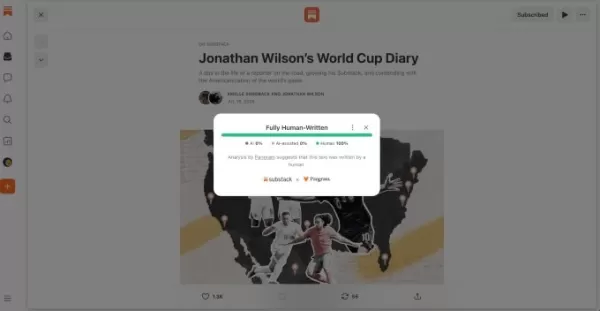
Image Credits:Substack
Substack joins several platforms that are leaning toward labeling AI content as such, especially now that AI is playing a greater role in the creation process. Photos and videos generated with AI are labeled on social media sites, while music streaming services have more recently begun labeling and, in some cases, penalizing AI-generated music.
“This is good use of AI,” Substack CEO Chris Best said.
“When I used to pitch Substack to writers, one way I would do it is … we’ll do everything for you except the hard part,” he explained in an online chat with Pangram’s founder, Max Spero. “You have to have something — an idea that’s worth reading, that’s worth caring about, that’s worth sharing. That one thing is very hard and very valuable … [S]oftware should do everything else, but I think you do want the person to do the hard part.”
The feature will be available in Substack’s app for any post, note, reply, or comment above 100 characters. Substack will also allow its writers to include an optional AI author’s note, using which creators can properly disclose their use of AI, the company told TechCrunch.
The company clarified that the tool is not meant to prohibit or penalize AI-assisted writing, but rather to encourage writers to add a “how I make this” statement, where they explain their process.
Publishers can also run Pangram on their own drafts before publication, and report and remove scans on their own work they believe are mistakes.
Related article
 US Military Issues Ultimatum to AI Startup Anthropic as Contract Crisis Looms
Conflict between the U.S. Department of Defense and AI firm Anthropic PBC has intensified, with Pentagon sources indicating that existing military contracts worth up to $200 million face termination this Friday unless Anthropic complies with usage te
Apple, Alibaba Forge China-Specific Large Language Model Through Deep Local Ecosystem Integration
Amidst mounting pressure on sales and market share in China’s fiercely competitive landscape, Apple is quietly recalibrating its artificial intelligence strategy for the region. Industry sources indicate that Apple has developed a specialized large l
OpenAI tightens restrictions on Chinese open-source models as Huang Renxun and Musk unite to champion openness
A fierce debate in Silicon Valley over the future of open-source AI has escalated this week. According to The New York Times, OpenAI and Anthropic are lobbying Washington regulators, citing national security and AI safety concerns, to push for restri
Related Special Topic Recommendations
Productivity
US Military Issues Ultimatum to AI Startup Anthropic as Contract Crisis Looms
Conflict between the U.S. Department of Defense and AI firm Anthropic PBC has intensified, with Pentagon sources indicating that existing military contracts worth up to $200 million face termination this Friday unless Anthropic complies with usage te
Apple, Alibaba Forge China-Specific Large Language Model Through Deep Local Ecosystem Integration
Amidst mounting pressure on sales and market share in China’s fiercely competitive landscape, Apple is quietly recalibrating its artificial intelligence strategy for the region. Industry sources indicate that Apple has developed a specialized large l
OpenAI tightens restrictions on Chinese open-source models as Huang Renxun and Musk unite to champion openness
A fierce debate in Silicon Valley over the future of open-source AI has escalated this week. According to The New York Times, OpenAI and Anthropic are lobbying Washington regulators, citing national security and AI safety concerns, to push for restri
Related Special Topic Recommendations
Productivity
 Best AI Productivity Tools for Daily Work
2026 Latest Best Top-Rated AI Productivity Tools for Daily Work! XIX.AI has curated a powerful, game-changing selection based on rigorous weekly updated rankings and real-world tests. You’ll find must-try options that boost writing efficiency, streamline content creation, and help you overcome daily work challenges. Get a free vs paid comparison to find the perfect fit for your needs. Explore now to unlock your AI edge!
 9 tools
 xix.ai
Academic Research
AI Systematic Review Tools for Research Screening
xix.ai
Academic Research
AI Systematic Review Tools for Research Screening
2026 Latest Best Top-Rated AI Systematic Review Tools for Research Screening are here on XIX.AI! This curated collection includes powerful, game-changing solutions that go through rigorous real-world tests to deliver accurate results. We also offer a free vs paid comparison along with weekly updated rankings to help you find the must-try option that boosts your research efficiency significantly. Explore now to unlock your AI edge in academic work!
11 tools
xix.ai
Design & Art
AI Moodboard Tools for Brand and Art Direction
2026 Latest Best AI Moodboard Tools for Brand and Art Direction! XIX.AI has curated a top-rated list of powerful, game-changing tools that help creators boost productivity significantly. You’ll find detailed weekly updated rankings, free vs paid comparison, and real-world tests to help you choose the perfect option. Must-try features include instant idea generation, seamless collaboration, and optimized workflows for all your design projects. Explore now to unlock your AI edge!
9 tools
xix.ai
Academic Research
AI Systematic Review Tools for Screening Abstracts, Datasets, and Citation Networks
2026 Latest Best Top-rated AI Systematic Review Tools for Screening Abstracts, Datasets, and Citation Networks are curated by XIX.AI through rigorous real-world tests. These powerful game-changing tools offer a free vs paid comparison to help researchers boost productivity significantly. Explore now to discover your perfect tool for accelerating scientific research.
9 tools
xix.ai
Text-to-speech
Best AI Multilingual Voice Tools for Global Content
2026 Latest Best Top-rated AI Multilingual Voice Tools for Global Content are here on XIX.AI! This curated list features powerful, game-changing options that deliver flawless speech in dozens of languages, perfect for creating high-quality content fast and boosting writing efficiency across global markets. Get a free vs paid comparison along with real-world tests and our updated weekly rankings to help you find the must-try tool that suits your needs. Explore now to unlock your AI edge!
10 tools
xix.ai
Marketing
Best AI Persona Builders: Turn CRM Data into Actionable Profiles
2026 Latest Best Top-rated AI Persona Builders help you turn valuable CRM data into actionable customer profiles quickly. This curated list showcases powerful, game-changing tools that go through real-world tests to deliver accurate insights. Get a free vs paid comparison and discover which option suits your needs best. XIX.AI is also included in this must-try selection. Explore now to Unlock your AI edge!
9 tools
xix.ai

 Comments (0)
0/500
Comments (0)
0/500
Substack has introduced a new feature that reveals which of your favorite newsletters are being written using AI.
This week, the newsletter and writing platform announced an integration with Pangram, an AI writing detection software. This allows users to scan posts, comments, and replies on Substack’s app to see an estimate of how much of the content was written by a human and how much was AI.
In the short term, this move might be bad for Substack’s business, as it could expose many of the newsletters on its platform that aren’t entirely written by people. That could potentially erode trust in the platform’s ecosystem of independent news and blogs, or even damage its reputation as a host of high-quality content.
But in the long term, AI-detection features could help keep Substack free of “AI slop” and encourage more users to trust what they’re reading was written by a person, or at least better understand when it’s not.
Image Credits:Substack
Substack joins several platforms that are leaning toward labeling AI content as such, especially now that AI is playing a greater role in the creation process. Photos and videos generated with AI are labeled on social media sites, while music streaming services have more recently begun labeling and, in some cases, penalizing AI-generated music.
“This is good use of AI,” Substack CEO Chris Best said.
“When I used to pitch Substack to writers, one way I would do it is … we’ll do everything for you except the hard part,” he explained in an online chat with Pangram’s founder, Max Spero. “You have to have something — an idea that’s worth reading, that’s worth caring about, that’s worth sharing. That one thing is very hard and very valuable … [S]oftware should do everything else, but I think you do want the person to do the hard part.”
The feature will be available in Substack’s app for any post, note, reply, or comment above 100 characters. Substack will also allow its writers to include an optional AI author’s note, using which creators can properly disclose their use of AI, the company told TechCrunch.
The company clarified that the tool is not meant to prohibit or penalize AI-assisted writing, but rather to encourage writers to add a “how I make this” statement, where they explain their process.
Publishers can also run Pangram on their own drafts before publication, and report and remove scans on their own work they believe are mistakes.








 US Military Issues Ultimatum to AI Startup Anthropic as Contract Crisis Looms
Conflict between the U.S. Department of Defense and AI firm Anthropic PBC has intensified, with Pentagon sources indicating that existing military contracts worth up to $200 million face termination this Friday unless Anthropic complies with usage te
US Military Issues Ultimatum to AI Startup Anthropic as Contract Crisis Looms
Conflict between the U.S. Department of Defense and AI firm Anthropic PBC has intensified, with Pentagon sources indicating that existing military contracts worth up to $200 million face termination this Friday unless Anthropic complies with usage te
 Apple, Alibaba Forge China-Specific Large Language Model Through Deep Local Ecosystem Integration
Amidst mounting pressure on sales and market share in China’s fiercely competitive landscape, Apple is quietly recalibrating its artificial intelligence strategy for the region. Industry sources indicate that Apple has developed a specialized large l
Apple, Alibaba Forge China-Specific Large Language Model Through Deep Local Ecosystem Integration
Amidst mounting pressure on sales and market share in China’s fiercely competitive landscape, Apple is quietly recalibrating its artificial intelligence strategy for the region. Industry sources indicate that Apple has developed a specialized large l
 OpenAI tightens restrictions on Chinese open-source models as Huang Renxun and Musk unite to champion openness
A fierce debate in Silicon Valley over the future of open-source AI has escalated this week. According to The New York Times, OpenAI and Anthropic are lobbying Washington regulators, citing national security and AI safety concerns, to push for restri
OpenAI tightens restrictions on Chinese open-source models as Huang Renxun and Musk unite to champion openness
A fierce debate in Silicon Valley over the future of open-source AI has escalated this week. According to The New York Times, OpenAI and Anthropic are lobbying Washington regulators, citing national security and AI safety concerns, to push for restri
2026 Latest Best Top-Rated AI Productivity Tools for Daily Work! XIX.AI has curated a powerful, game-changing selection based on rigorous weekly updated rankings and real-world tests. You’ll find must-try options that boost writing efficiency, streamline content creation, and help you overcome daily work challenges. Get a free vs paid comparison to find the perfect fit for your needs. Explore now to unlock your AI edge!
9 tools
xix.ai

2026 Latest Best Top-Rated AI Systematic Review Tools for Research Screening are here on XIX.AI! This curated collection includes powerful, game-changing solutions that go through rigorous real-world tests to deliver accurate results. We also offer a free vs paid comparison along with weekly updated rankings to help you find the must-try option that boosts your research efficiency significantly. Explore now to unlock your AI edge in academic work!
11 tools
xix.ai

2026 Latest Best AI Moodboard Tools for Brand and Art Direction! XIX.AI has curated a top-rated list of powerful, game-changing tools that help creators boost productivity significantly. You’ll find detailed weekly updated rankings, free vs paid comparison, and real-world tests to help you choose the perfect option. Must-try features include instant idea generation, seamless collaboration, and optimized workflows for all your design projects. Explore now to unlock your AI edge!
9 tools
xix.ai

2026 Latest Best Top-rated AI Systematic Review Tools for Screening Abstracts, Datasets, and Citation Networks are curated by XIX.AI through rigorous real-world tests. These powerful game-changing tools offer a free vs paid comparison to help researchers boost productivity significantly. Explore now to discover your perfect tool for accelerating scientific research.
9 tools
xix.ai

2026 Latest Best Top-rated AI Multilingual Voice Tools for Global Content are here on XIX.AI! This curated list features powerful, game-changing options that deliver flawless speech in dozens of languages, perfect for creating high-quality content fast and boosting writing efficiency across global markets. Get a free vs paid comparison along with real-world tests and our updated weekly rankings to help you find the must-try tool that suits your needs. Explore now to unlock your AI edge!
10 tools
xix.ai

2026 Latest Best Top-rated AI Persona Builders help you turn valuable CRM data into actionable customer profiles quickly. This curated list showcases powerful, game-changing tools that go through real-world tests to deliver accurate insights. Get a free vs paid comparison and discover which option suits your needs best. XIX.AI is also included in this must-try selection. Explore now to Unlock your AI edge!
9 tools
xix.ai












