


 Home
Home
Spotify Introduces AI Persona Tag; Algorithmic Playlists Default to Exclude AI Virtual Artists
On August 11, Spotify announced the rollout of its "AI Persona" profile tagging system in mid-September. This initiative clearly identifies virtual artists generated by artificial intelligence and excludes such music from editorial and algorithmic recommendation lists by default. Building on Spotify's AI music governance policy introduced in September 2025, this move represents a significant step for streaming platforms in managing the surge of generative AI content and safeguarding original creative ecosystems.
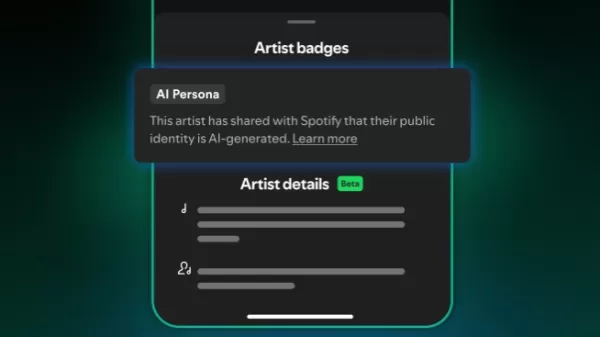
Under the new regulations, effective August 11, 2026, artists can voluntarily disclose their AI-generated status via the Spotify for Artists platform. Simultaneously, Spotify will employ algorithms to review high-profile artists and tracks with significant listening volumes, automatically flagging suspected AI-generated identities. The "AI Persona" badge will be displayed on artist homepage banners, search results, and playlist track rows. Unless users explicitly follow an AI artist, the platform will not default to recommending their music in personalized suggestions, curated playlists, or algorithmic feeds. Furthermore, Spotify has introduced an appeal process and a violation reporting tool to ensure the accuracy of these tags.
Spotify clarified that this tag targets the "public identity" of artists rather than "creative tools," leaving technologies like AI Credits and SongDNA unaffected. This decision not only defines compliance boundaries for upcoming AI remix and cover features but also establishes a clearer governance framework amidst the rapid evolution of generative music. By curbing the uncontrolled expansion of low-quality AI content, Spotify aims to re-anchor the core value of human voices and original art within the streaming ecosystem.
Related article
 OpenAI Files for IPO, Targets 2027 Listing
OpenAI’s Chief Financial Officer, Sara Ferial, announced during a Wednesday all-hands meeting that the company targets a 2027 public listing, with the possibility of an earlier debut if business momentum remains strong.Ferial emphasized that the IPO
Zhipu MaaS Revenue Surges Past Full-Year Total, Token Usage Jumps 40x
On August 31, Zhipu released its mid-2026 financial results, highlighting a marked acceleration in its commercialization strategy. The company generated 954 million yuan in revenue during the first half of 2026, representing a year-over-year growth o
Doubao Qianwen Shuts Down Intelligent Agent as China’s First AI Human-like Service Rules Take Effect
ByteDance’s Dou Bao and Alibaba’s Tongyi Qianwen have both announced the official discontinuation of their intelligent agent features today, effectively preventing users from creating or invoking existing agents. This shutdown coincides with the enfo
Related Special Topic Recommendations
Prompt
OpenAI Files for IPO, Targets 2027 Listing
OpenAI’s Chief Financial Officer, Sara Ferial, announced during a Wednesday all-hands meeting that the company targets a 2027 public listing, with the possibility of an earlier debut if business momentum remains strong.Ferial emphasized that the IPO
Zhipu MaaS Revenue Surges Past Full-Year Total, Token Usage Jumps 40x
On August 31, Zhipu released its mid-2026 financial results, highlighting a marked acceleration in its commercialization strategy. The company generated 954 million yuan in revenue during the first half of 2026, representing a year-over-year growth o
Doubao Qianwen Shuts Down Intelligent Agent as China’s First AI Human-like Service Rules Take Effect
ByteDance’s Dou Bao and Alibaba’s Tongyi Qianwen have both announced the official discontinuation of their intelligent agent features today, effectively preventing users from creating or invoking existing agents. This shutdown coincides with the enfo
Related Special Topic Recommendations
Prompt
 Best Prompt Management Tools for Multi Model Teams
2026 Latest Best Top-Rated Prompt Management Tools for Multi Model Teams! XIX.AI has curated a powerful, game-changing collection of must-try tools that offer free vs paid comparison, real-world tests, and detailed rankings. These top-rated solutions help boost productivity significantly by streamlining workflows, eliminating repetition, and unlocking creativity across all team projects. Explore now to Discover your perfect tool and Start creating today!
 9 tools
 xix.ai
Meeting Assistant
AI Meeting Summary Tools for Remote Teams
xix.ai
Meeting Assistant
AI Meeting Summary Tools for Remote Teams
2026 Latest Best Top-Rated AI Meeting Summary Tools for Remote Teams! XIX.AI has curated a powerful, game-changing collection of must-try tools that go through real-world tests to deliver accurate transcripts and actionable insights. You’ll find free vs paid comparison data and detailed rankings to help you pick the perfect option that boosts productivity and streamlines team communication. Explore now to Unlock your AI edge!
13 tools
xix.ai
Software Development
Best AI DevOps Helpers: Monitor Deployments, Logs, and Incidents
2026 Latest Best Top-Rated AI DevOps Helpers Curated for Monitoring Deployments, Logs, and Incidents. XIX.AI delivers powerful game-changing tools that boost productivity significantly through real-world tests and rigorous rankings. Get a free vs paid comparison to find the must-try solution perfect for your workflow. Explore now to unlock your AI edge.
7 tools
xix.ai
Image editing
AI Background Removal Tools for Product Photos
2026 Latest Best Top-Rated AI Background Removal Tools for Product Photos are here on XIX.AI! Our curated list includes powerful, game-changing solutions that deliver professional results through real-world tests. You’ll find a free vs paid comparison, weekly updated rankings, and must-try options to help you boost productivity and create flawless product shots without any hassle. Explore now to unlock your AI edge!
11 tools
xix.ai
code
AI Pull Request Review Tools for GitHub Repositories
2026 Latest Best Top-Rated AI Pull Request Review Tools for GitHub Repositories are here on XIX.AI! Our curated list features powerful, game-changing solutions that help teams streamline code reviews, catch errors faster, and boost productivity with real-world tests. Get a free vs paid comparison to find the perfect tool for your workflow. Explore now to unlock your AI edge!
10 tools
xix.ai
Academic Research
Best AI Reference Extraction Tools for Journal Papers
2026 Latest Best Top-rated AI Reference Extraction Tools for Journal Papers are curated by XIX.AI with weekly updated rankings. These powerful tools help users quickly pull relevant citations and data from massive academic sources, saving tons of time and effort. Get a free vs paid comparison along with real-world tests to find the perfect option that boosts your productivity. Explore now to unlock your AI edge!
10 tools
xix.ai

 Comments (0)
0/500
Comments (0)
0/500
On August 11, Spotify announced the rollout of its "AI Persona" profile tagging system in mid-September. This initiative clearly identifies virtual artists generated by artificial intelligence and excludes such music from editorial and algorithmic recommendation lists by default. Building on Spotify's AI music governance policy introduced in September 2025, this move represents a significant step for streaming platforms in managing the surge of generative AI content and safeguarding original creative ecosystems.
Under the new regulations, effective August 11, 2026, artists can voluntarily disclose their AI-generated status via the Spotify for Artists platform. Simultaneously, Spotify will employ algorithms to review high-profile artists and tracks with significant listening volumes, automatically flagging suspected AI-generated identities. The "AI Persona" badge will be displayed on artist homepage banners, search results, and playlist track rows. Unless users explicitly follow an AI artist, the platform will not default to recommending their music in personalized suggestions, curated playlists, or algorithmic feeds. Furthermore, Spotify has introduced an appeal process and a violation reporting tool to ensure the accuracy of these tags.
Spotify clarified that this tag targets the "public identity" of artists rather than "creative tools," leaving technologies like AI Credits and SongDNA unaffected. This decision not only defines compliance boundaries for upcoming AI remix and cover features but also establishes a clearer governance framework amidst the rapid evolution of generative music. By curbing the uncontrolled expansion of low-quality AI content, Spotify aims to re-anchor the core value of human voices and original art within the streaming ecosystem.








 OpenAI Files for IPO, Targets 2027 Listing
OpenAI’s Chief Financial Officer, Sara Ferial, announced during a Wednesday all-hands meeting that the company targets a 2027 public listing, with the possibility of an earlier debut if business momentum remains strong.Ferial emphasized that the IPO
OpenAI Files for IPO, Targets 2027 Listing
OpenAI’s Chief Financial Officer, Sara Ferial, announced during a Wednesday all-hands meeting that the company targets a 2027 public listing, with the possibility of an earlier debut if business momentum remains strong.Ferial emphasized that the IPO
 Zhipu MaaS Revenue Surges Past Full-Year Total, Token Usage Jumps 40x
On August 31, Zhipu released its mid-2026 financial results, highlighting a marked acceleration in its commercialization strategy. The company generated 954 million yuan in revenue during the first half of 2026, representing a year-over-year growth o
Zhipu MaaS Revenue Surges Past Full-Year Total, Token Usage Jumps 40x
On August 31, Zhipu released its mid-2026 financial results, highlighting a marked acceleration in its commercialization strategy. The company generated 954 million yuan in revenue during the first half of 2026, representing a year-over-year growth o
 Doubao Qianwen Shuts Down Intelligent Agent as China’s First AI Human-like Service Rules Take Effect
ByteDance’s Dou Bao and Alibaba’s Tongyi Qianwen have both announced the official discontinuation of their intelligent agent features today, effectively preventing users from creating or invoking existing agents. This shutdown coincides with the enfo
Doubao Qianwen Shuts Down Intelligent Agent as China’s First AI Human-like Service Rules Take Effect
ByteDance’s Dou Bao and Alibaba’s Tongyi Qianwen have both announced the official discontinuation of their intelligent agent features today, effectively preventing users from creating or invoking existing agents. This shutdown coincides with the enfo

2026 Latest Best Top-Rated Prompt Management Tools for Multi Model Teams! XIX.AI has curated a powerful, game-changing collection of must-try tools that offer free vs paid comparison, real-world tests, and detailed rankings. These top-rated solutions help boost productivity significantly by streamlining workflows, eliminating repetition, and unlocking creativity across all team projects. Explore now to Discover your perfect tool and Start creating today!
9 tools
xix.ai

2026 Latest Best Top-Rated AI Meeting Summary Tools for Remote Teams! XIX.AI has curated a powerful, game-changing collection of must-try tools that go through real-world tests to deliver accurate transcripts and actionable insights. You’ll find free vs paid comparison data and detailed rankings to help you pick the perfect option that boosts productivity and streamlines team communication. Explore now to Unlock your AI edge!
13 tools
xix.ai

2026 Latest Best Top-Rated AI DevOps Helpers Curated for Monitoring Deployments, Logs, and Incidents. XIX.AI delivers powerful game-changing tools that boost productivity significantly through real-world tests and rigorous rankings. Get a free vs paid comparison to find the must-try solution perfect for your workflow. Explore now to unlock your AI edge.
7 tools
xix.ai

2026 Latest Best Top-Rated AI Background Removal Tools for Product Photos are here on XIX.AI! Our curated list includes powerful, game-changing solutions that deliver professional results through real-world tests. You’ll find a free vs paid comparison, weekly updated rankings, and must-try options to help you boost productivity and create flawless product shots without any hassle. Explore now to unlock your AI edge!
11 tools
xix.ai

2026 Latest Best Top-Rated AI Pull Request Review Tools for GitHub Repositories are here on XIX.AI! Our curated list features powerful, game-changing solutions that help teams streamline code reviews, catch errors faster, and boost productivity with real-world tests. Get a free vs paid comparison to find the perfect tool for your workflow. Explore now to unlock your AI edge!
10 tools
xix.ai

2026 Latest Best Top-rated AI Reference Extraction Tools for Journal Papers are curated by XIX.AI with weekly updated rankings. These powerful tools help users quickly pull relevant citations and data from massive academic sources, saving tons of time and effort. Get a free vs paid comparison along with real-world tests to find the perfect option that boosts your productivity. Explore now to unlock your AI edge!
10 tools
xix.ai












