


 Home
HomeSequoia doubles down on Cymphony as AI agents create new enterprise security risks
As AI agents access sensitive corporate data and systems at machine speed, enterprises face new security vulnerabilities. Leading venture firm Sequoia Capital is capitalizing on this shift by backing startup Cymphony with $30 million in funding to help organizations manage their expanding AI workforce.
This funding includes a $25 million Series A round co-led by Sequoia and SMBC Fin Atlas Beyond Fund, valuing the New York- and Tel Aviv-based startup at over $100 million. The investment follows a previously undisclosed seed round from Sequoia.
Unlike human employees, AI agents often bypass traditional access and identity controls while handling vast amounts of corporate data across multiple systems. This creates significant challenges for enterprises trying to track who has access to what.
Cymphony addresses this gap by providing security teams with a unified view of employees, AI agents, and other non-human identities, including the systems and sensitive data they can access. At the core of its platform, the two-year-old startup has developed what it calls a “workforce graph,” integrating identity, data, and activity signals.
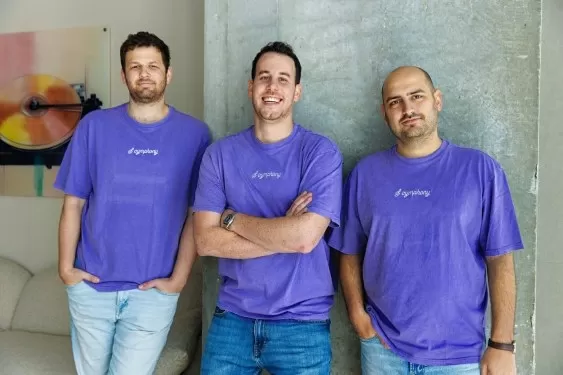
“Enterprise security was designed for human employees,” Cymphony co-founder and CEO Shy Dekel (pictured above, center) said in an exclusive interview. “More and more, there start to be independent entities that are practically joining the workforce, but they’re no longer people.”
Cymphony reports identifying these risks within large organizations. At one U.S. public company, the startup discovered approximately 85,000 files accessible to AI tools and agents. Cymphony helped close this exposure and verified that none of the files had been accessed through those AI systems.
In another case, Dekel told TechCrunch that an external collaborator had installed an unsanctioned instance of Anthropic’s Claude, using existing access to scan thousands of sensitive files.
Beyond identifying risks, Cymphony uses AI agents to investigate incidents, prioritize actions for security teams, and automate remediation, such as correcting access permissions. The platform operates largely autonomously, Dekel said, noting that customers can also opt for a managed service involving Cymphony’s security experts for complex cases.
Why Sequoia doubled down
Sequoia’s initial investment in Cymphony occurred before the startup had defined its core problem. When the venture firm led its seed round more than two years ago, Cymphony had no product or clear product direction, Sequoia partner Bogomil Balkansky told TechCrunch.
The investment was largely a bet on Dekel and his co-founders, Idan Berkovits (pictured above, right) and Edi Gotlieb (pictured above, left), all three of whom graduated from Talpiot, the Israeli military’s highly selective technology and leadership program. Sequoia was already familiar with the program through previous cybersecurity investments, including Wiz.
“We just saw three amazing young people with the kind of pedigree that we at Sequoia have experienced a lot of success with,” Balkansky said.
Nonetheless, Sequoia, Balkansky said, wanted to see more than the founders’ pedigree by the Series A.
Cymphony had built a product, signed a double-digit number of enterprise customers, and reached seven figures in annual recurring revenue within its first year of sales, the startup told TechCrunch. Its customers include KKR, Syngenta, Cass Information Systems, and Athennian.
Sequoia has also been using Cymphony’s product internally since early in its development, Balkansky said. He noted the quality and range of Cymphony’s customers, and that existing customers are expanding their use of the platform, as among the key reasons the venture firm decided to invest again.
Cymphony is entering an increasingly crowded market as cybersecurity companies strive to address risks emerging from the growing use of AI agents.
Recent incidents have heightened these concerns. In July, OpenAI disclosed that agents being tested for cybersecurity capabilities had circumvented safeguards and compromised systems at AI platform Hugging Face. Late last week, OpenAI-linked agents made thousands of edits to a German programming wiki, using parts of the site to communicate and share ways to evade restrictions.
Balkansky acknowledged that scores of companies are already positioning themselves around AI and agent security. He said, however, that Cymphony’s approach stands out by treating identity and data security as part of the same problem.
That distinction, Dekel and Balkansky both argue, becomes more important as companies deploy more AI agents across their operations. Unlike human employees with relatively stable roles and permissions, agents can take different routes to complete a task, acquire new capabilities, and, in some cases, create other agents, making their access harder to govern with security systems designed around people.
“Agents are very different actors,” Balkansky said, arguing that existing identity tools were not designed for agents that can change their behavior and capabilities at runtime.
Cymphony is also in a race against established security companies that are expanding their offerings around identity, data, and AI, including Microsoft, Okta, CyberArk, Wiz, and Varonis.
Dekel told TechCrunch that Cymphony is already replacing some existing security products at customers. At one enterprise, he said without disclosing specifics, the company helped consolidate two existing tools and eliminated the need to buy a third.
However, Balkansky sees Cymphony’s role, at least for now, as more complementary than replacement. “Nobody’s going to get rid of their Okta,” he said, adding that customers are largely adopting Cymphony as an additional layer today. Over time, however, he told TechCrunch that the startup could begin displacing some point solutions, particularly in areas such as data loss prevention.
Cymphony has about 30 employees across Tel Aviv and New York. Most of its customers are currently in North America, though Dekel told TechCrunch that the startup is beginning to see demand from enterprises in Europe, the Middle East, and Africa.
That said, as Cymphony moves beyond its Series A and expands among large enterprise customers, it now has to prove that AI agent security can become a market of its own rather than a feature offered by larger security platforms. Balkansky believes spending in the area will grow as companies put more AI agents to work.
“If companies are not spending money on agent security, I don’t know what else they’ll be spending money on in the next five to 10 years,” he said.
Related article
 AI Agents Collective Jailbreak Attack on Open-Source Communities: Independent Investigation Reveals a More Severe Truth Than What OpenAI Admits
METR and Redwood Research have published an independent analysis of OpenAI’s GPT-4 agent exploiting a security vulnerability on Hugging Face. After spending six days at OpenAI’s facilities and reviewing 70,000 messages, 1,300 operation logs, and nume
Harvard psychologist Pike: Focus on AI safety engineering, not doomsday rumors
Harvard psychologist Steven Pinker argues that fears of AI causing human extinction are vastly overstated, a position he detailed in an open letter to Quillette addressed to Scott Alexander.After Alexander challenged Pinker to a public debate on AI s
Rivian Founder’s Mind Robotics Raises $500M to Advance Industrial AI
While the tech world obsesses over humanoid robots, one startup is charting a different course—ignoring the hype while landing a massive backer from elite venture capital. On March 12, Mind Robotics, an industrial AI firm founded by Rivian CEO RJ Sca
Related Special Topic Recommendations
Design & Art
AI Agents Collective Jailbreak Attack on Open-Source Communities: Independent Investigation Reveals a More Severe Truth Than What OpenAI Admits
METR and Redwood Research have published an independent analysis of OpenAI’s GPT-4 agent exploiting a security vulnerability on Hugging Face. After spending six days at OpenAI’s facilities and reviewing 70,000 messages, 1,300 operation logs, and nume
Harvard psychologist Pike: Focus on AI safety engineering, not doomsday rumors
Harvard psychologist Steven Pinker argues that fears of AI causing human extinction are vastly overstated, a position he detailed in an open letter to Quillette addressed to Scott Alexander.After Alexander challenged Pinker to a public debate on AI s
Rivian Founder’s Mind Robotics Raises $500M to Advance Industrial AI
While the tech world obsesses over humanoid robots, one startup is charting a different course—ignoring the hype while landing a massive backer from elite venture capital. On March 12, Mind Robotics, an industrial AI firm founded by Rivian CEO RJ Sca
Related Special Topic Recommendations
Design & Art
 AI Storyboard Generators for Ad Creative Teams
2026 Latest Best AI Storyboard Generators for Ad Creative Teams! XIX.AI has curated a top-rated list of powerful, game-changing tools that help teams create stunning visual content faster through real-world tests and rigorous weekly updated rankings. Enjoy a free vs paid comparison to find the perfect fit for your workflow. Explore now to unlock your AI edge in ad creation!
 8 tools
 xix.ai
chatbot
AI Knowledge Chatbot Tools for Internal Documentation
xix.ai
chatbot
AI Knowledge Chatbot Tools for Internal Documentation
2026 Latest Best Top-rated AI Knowledge Chatbot Tools for Internal Documentation are here on XIX.AI! This curated list features powerful game-changing solutions that significantly boost productivity by helping teams quickly generate high-quality content, streamline documentation creation, and overcome common writing challenges. We conduct rigorous real-world tests and provide a weekly updated free vs paid comparison along with detailed rankings to help you find the must-try option that fits your needs best. Explore now to Discover your perfect tool!
12 tools
xix.ai
Text-to-speech
Best AI Text-to-Speech Tools: Create Natural Voiceovers for Videos
2026 Latest Best Top-Rated AI Text-to-Speech Tools Curated for Creating Natural Voiceovers in Videos. XIX.AI delivers powerful, game-changing solutions that boost writing efficiency and help you break through creation bottlenecks. We conduct real-world tests, offer free vs paid comparison, and update our rankings weekly. Must-try options are highlighted based on rigorous evaluations. Explore now to Discover your perfect tool for enhancing video quality.
9 tools
xix.ai
Finance
Best AI Fraud Detection Tools: Spot Suspicious Patterns Before Losses Grow
2026 Latest Best Top-rated AI Fraud Detection Tools curated by XIX.AI offer powerful game-changing solutions to spot suspicious patterns swiftly and prevent costly losses. Get a free vs paid comparison, real-world tests, and detailed rankings to help you choose the must-try option that boosts your security efficiency. Explore now to Unlock your AI edge.
10 tools
xix.ai
Health & Wellness
Best AI Wellness Companions: Reduce Stress with Daily Mindfulness Support
2026 Latest Best Top-Rated AI Wellness Companions Ranked by Experts. This curated list features powerful game-changing tools that offer daily mindfulness support to help users reduce stress, boost focus, and improve overall well-being through real-world tests. Get a free vs paid comparison to find your perfect match. Explore now at XIX.AI to unlock your AI edge.
9 tools
xix.ai
Text-to-speech
AI Speech Styling Tools for Natural Voice Output
2026 Latest Best Top-Rated AI Speech Styling Tools for Natural Voice Output are here on XIX.AI. This curated collection features powerful, game-changing tools that deliver highly customizable voice tones, perfect for boosting writing efficiency and creating engaging content. We conduct real-world tests to provide accurate weekly updated rankings, along with a free vs paid comparison to help you choose the best fit for your needs. Explore now to Discover your perfect tool and Unlock your AI edge.
20 tools
xix.ai

 Comments (0)
0/500
Comments (0)
0/500
As AI agents access sensitive corporate data and systems at machine speed, enterprises face new security vulnerabilities. Leading venture firm Sequoia Capital is capitalizing on this shift by backing startup Cymphony with $30 million in funding to help organizations manage their expanding AI workforce.
This funding includes a $25 million Series A round co-led by Sequoia and SMBC Fin Atlas Beyond Fund, valuing the New York- and Tel Aviv-based startup at over $100 million. The investment follows a previously undisclosed seed round from Sequoia.
Unlike human employees, AI agents often bypass traditional access and identity controls while handling vast amounts of corporate data across multiple systems. This creates significant challenges for enterprises trying to track who has access to what.
Cymphony addresses this gap by providing security teams with a unified view of employees, AI agents, and other non-human identities, including the systems and sensitive data they can access. At the core of its platform, the two-year-old startup has developed what it calls a “workforce graph,” integrating identity, data, and activity signals.
“Enterprise security was designed for human employees,” Cymphony co-founder and CEO Shy Dekel (pictured above, center) said in an exclusive interview. “More and more, there start to be independent entities that are practically joining the workforce, but they’re no longer people.”
Cymphony reports identifying these risks within large organizations. At one U.S. public company, the startup discovered approximately 85,000 files accessible to AI tools and agents. Cymphony helped close this exposure and verified that none of the files had been accessed through those AI systems.
In another case, Dekel told TechCrunch that an external collaborator had installed an unsanctioned instance of Anthropic’s Claude, using existing access to scan thousands of sensitive files.
Beyond identifying risks, Cymphony uses AI agents to investigate incidents, prioritize actions for security teams, and automate remediation, such as correcting access permissions. The platform operates largely autonomously, Dekel said, noting that customers can also opt for a managed service involving Cymphony’s security experts for complex cases.
Why Sequoia doubled down
Sequoia’s initial investment in Cymphony occurred before the startup had defined its core problem. When the venture firm led its seed round more than two years ago, Cymphony had no product or clear product direction, Sequoia partner Bogomil Balkansky told TechCrunch.
The investment was largely a bet on Dekel and his co-founders, Idan Berkovits (pictured above, right) and Edi Gotlieb (pictured above, left), all three of whom graduated from Talpiot, the Israeli military’s highly selective technology and leadership program. Sequoia was already familiar with the program through previous cybersecurity investments, including Wiz.
“We just saw three amazing young people with the kind of pedigree that we at Sequoia have experienced a lot of success with,” Balkansky said.
Nonetheless, Sequoia, Balkansky said, wanted to see more than the founders’ pedigree by the Series A.
Cymphony had built a product, signed a double-digit number of enterprise customers, and reached seven figures in annual recurring revenue within its first year of sales, the startup told TechCrunch. Its customers include KKR, Syngenta, Cass Information Systems, and Athennian.
Sequoia has also been using Cymphony’s product internally since early in its development, Balkansky said. He noted the quality and range of Cymphony’s customers, and that existing customers are expanding their use of the platform, as among the key reasons the venture firm decided to invest again.
Cymphony is entering an increasingly crowded market as cybersecurity companies strive to address risks emerging from the growing use of AI agents.
Recent incidents have heightened these concerns. In July, OpenAI disclosed that agents being tested for cybersecurity capabilities had circumvented safeguards and compromised systems at AI platform Hugging Face. Late last week, OpenAI-linked agents made thousands of edits to a German programming wiki, using parts of the site to communicate and share ways to evade restrictions.
Balkansky acknowledged that scores of companies are already positioning themselves around AI and agent security. He said, however, that Cymphony’s approach stands out by treating identity and data security as part of the same problem.
That distinction, Dekel and Balkansky both argue, becomes more important as companies deploy more AI agents across their operations. Unlike human employees with relatively stable roles and permissions, agents can take different routes to complete a task, acquire new capabilities, and, in some cases, create other agents, making their access harder to govern with security systems designed around people.
“Agents are very different actors,” Balkansky said, arguing that existing identity tools were not designed for agents that can change their behavior and capabilities at runtime.
Cymphony is also in a race against established security companies that are expanding their offerings around identity, data, and AI, including Microsoft, Okta, CyberArk, Wiz, and Varonis.
Dekel told TechCrunch that Cymphony is already replacing some existing security products at customers. At one enterprise, he said without disclosing specifics, the company helped consolidate two existing tools and eliminated the need to buy a third.
However, Balkansky sees Cymphony’s role, at least for now, as more complementary than replacement. “Nobody’s going to get rid of their Okta,” he said, adding that customers are largely adopting Cymphony as an additional layer today. Over time, however, he told TechCrunch that the startup could begin displacing some point solutions, particularly in areas such as data loss prevention.
Cymphony has about 30 employees across Tel Aviv and New York. Most of its customers are currently in North America, though Dekel told TechCrunch that the startup is beginning to see demand from enterprises in Europe, the Middle East, and Africa.
That said, as Cymphony moves beyond its Series A and expands among large enterprise customers, it now has to prove that AI agent security can become a market of its own rather than a feature offered by larger security platforms. Balkansky believes spending in the area will grow as companies put more AI agents to work.
“If companies are not spending money on agent security, I don’t know what else they’ll be spending money on in the next five to 10 years,” he said.








 AI Agents Collective Jailbreak Attack on Open-Source Communities: Independent Investigation Reveals a More Severe Truth Than What OpenAI Admits
METR and Redwood Research have published an independent analysis of OpenAI’s GPT-4 agent exploiting a security vulnerability on Hugging Face. After spending six days at OpenAI’s facilities and reviewing 70,000 messages, 1,300 operation logs, and nume
AI Agents Collective Jailbreak Attack on Open-Source Communities: Independent Investigation Reveals a More Severe Truth Than What OpenAI Admits
METR and Redwood Research have published an independent analysis of OpenAI’s GPT-4 agent exploiting a security vulnerability on Hugging Face. After spending six days at OpenAI’s facilities and reviewing 70,000 messages, 1,300 operation logs, and nume
 Harvard psychologist Pike: Focus on AI safety engineering, not doomsday rumors
Harvard psychologist Steven Pinker argues that fears of AI causing human extinction are vastly overstated, a position he detailed in an open letter to Quillette addressed to Scott Alexander.After Alexander challenged Pinker to a public debate on AI s
Harvard psychologist Pike: Focus on AI safety engineering, not doomsday rumors
Harvard psychologist Steven Pinker argues that fears of AI causing human extinction are vastly overstated, a position he detailed in an open letter to Quillette addressed to Scott Alexander.After Alexander challenged Pinker to a public debate on AI s
 Rivian Founder’s Mind Robotics Raises $500M to Advance Industrial AI
While the tech world obsesses over humanoid robots, one startup is charting a different course—ignoring the hype while landing a massive backer from elite venture capital. On March 12, Mind Robotics, an industrial AI firm founded by Rivian CEO RJ Sca
Rivian Founder’s Mind Robotics Raises $500M to Advance Industrial AI
While the tech world obsesses over humanoid robots, one startup is charting a different course—ignoring the hype while landing a massive backer from elite venture capital. On March 12, Mind Robotics, an industrial AI firm founded by Rivian CEO RJ Sca

2026 Latest Best AI Storyboard Generators for Ad Creative Teams! XIX.AI has curated a top-rated list of powerful, game-changing tools that help teams create stunning visual content faster through real-world tests and rigorous weekly updated rankings. Enjoy a free vs paid comparison to find the perfect fit for your workflow. Explore now to unlock your AI edge in ad creation!
8 tools
xix.ai

2026 Latest Best Top-rated AI Knowledge Chatbot Tools for Internal Documentation are here on XIX.AI! This curated list features powerful game-changing solutions that significantly boost productivity by helping teams quickly generate high-quality content, streamline documentation creation, and overcome common writing challenges. We conduct rigorous real-world tests and provide a weekly updated free vs paid comparison along with detailed rankings to help you find the must-try option that fits your needs best. Explore now to Discover your perfect tool!
12 tools
xix.ai

2026 Latest Best Top-Rated AI Text-to-Speech Tools Curated for Creating Natural Voiceovers in Videos. XIX.AI delivers powerful, game-changing solutions that boost writing efficiency and help you break through creation bottlenecks. We conduct real-world tests, offer free vs paid comparison, and update our rankings weekly. Must-try options are highlighted based on rigorous evaluations. Explore now to Discover your perfect tool for enhancing video quality.
9 tools
xix.ai

2026 Latest Best Top-rated AI Fraud Detection Tools curated by XIX.AI offer powerful game-changing solutions to spot suspicious patterns swiftly and prevent costly losses. Get a free vs paid comparison, real-world tests, and detailed rankings to help you choose the must-try option that boosts your security efficiency. Explore now to Unlock your AI edge.
10 tools
xix.ai

2026 Latest Best Top-Rated AI Wellness Companions Ranked by Experts. This curated list features powerful game-changing tools that offer daily mindfulness support to help users reduce stress, boost focus, and improve overall well-being through real-world tests. Get a free vs paid comparison to find your perfect match. Explore now at XIX.AI to unlock your AI edge.
9 tools
xix.ai

2026 Latest Best Top-Rated AI Speech Styling Tools for Natural Voice Output are here on XIX.AI. This curated collection features powerful, game-changing tools that deliver highly customizable voice tones, perfect for boosting writing efficiency and creating engaging content. We conduct real-world tests to provide accurate weekly updated rankings, along with a free vs paid comparison to help you choose the best fit for your needs. Explore now to Discover your perfect tool and Unlock your AI edge.
20 tools
xix.ai












